Saudi Arabia's $11 Oil Price Cut to Asia
Riyadh's strategy to secure Asian refiners amid market shifts
Model Diplomat7 min readMiddle East
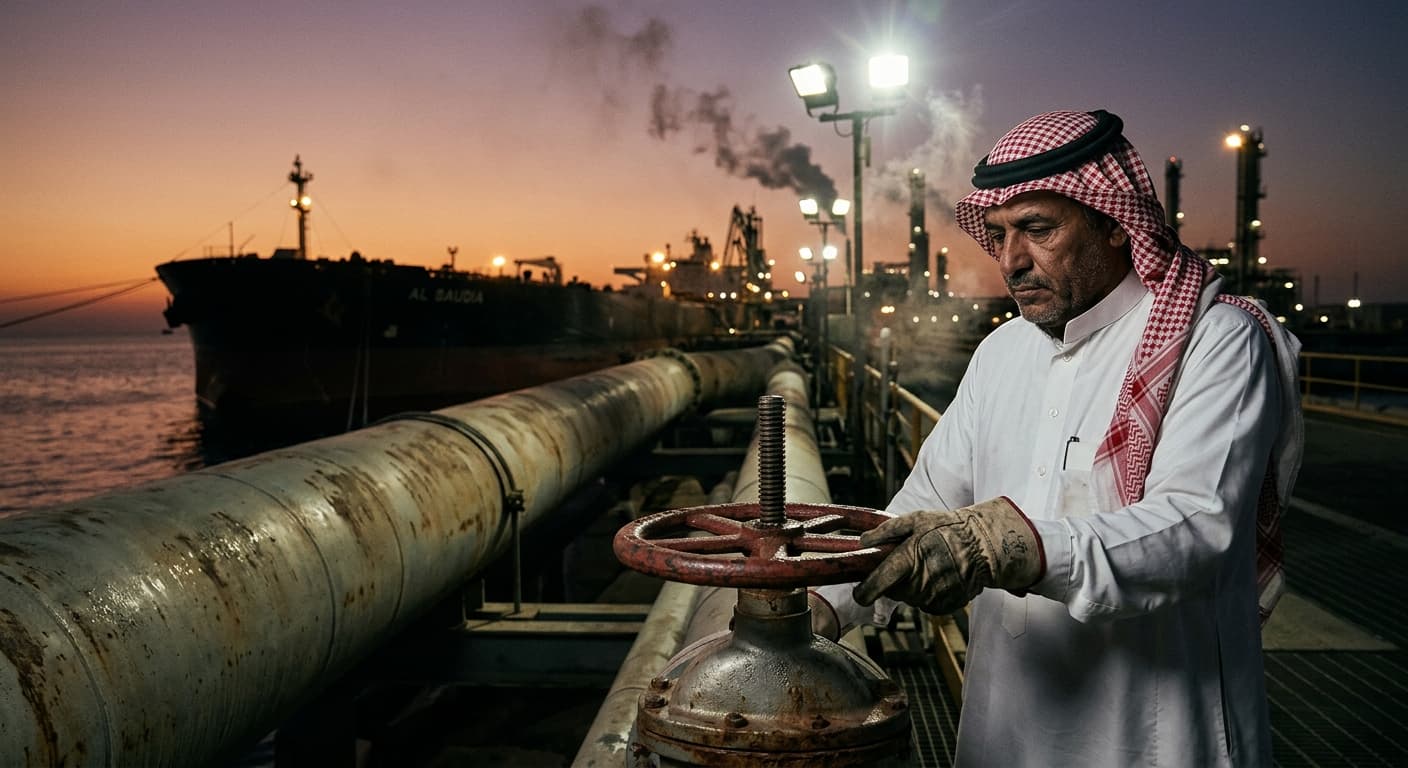
Saudi Arabia's $11 Oil Price Cut to Asia: A Post-Hormuz Power Play
Aramco's largest Asian OSP cut in 26 years is not a bearish call on demand — it is Riyadh using cheap barrels to lock in Chinese and Indian refiners before Russia, Iran and the UAE can regroup.
Saudi Aramco cut its August 2026 official selling price for Arab Light crude to Asia by $11 a barrel on July 5, pricing the flagship grade at $1.50 below the Oman/Dubai benchmark — the deepest single-month reduction in more than 26 years, according to a Reuters readout of the Aramco pricing statement carried by Today in Oil and Gas. The move is being read as a demand signal. It is not. With the Strait of Hormuz reopening, the UAE outside OPEC+, and Iranian barrels flooding back to Chinese refiners, this is Riyadh weaponising the one lever it still fully controls — its official selling price — to rewire Asia's crude map in its favour before the next shock lands.
The number, in context
Aramco's OSP is the anchor for roughly 12 million barrels a day of Middle Eastern crude priced off it. For Arab Light to Asia to move from a premium to an outright discount is a structural break. The last time the discount ran this deep, global demand had collapsed 20–25% in the pandemic price war of April 2020, as the Middle East Institute documented at the time. Today's context is the opposite: demand is intact, but supply has snapped back all at once.
Europe was cut by $10 a barrel, the United States by $8, and the Mediterranean by $9.50 — but Asia is the theatre that matters. It absorbs roughly 80% of Saudi crude exports, and Riyadh's spare-capacity dominance only pays political dividends if Asian refiners keep buying. ChemAnalyst frames the cut as a response to "rapidly shifting global oil dynamics." The framing is too passive. The cut is the shift.
Why this is a market-share war, not a demand signal
Three facts, taken together, make the market-share reading unambiguous.
First, the physical market flipped from shortage to glut in three weeks. Iran's closure of the Strait of Hormuz on February 28 pushed Brent past $126 a barrel in April, Al Jazeera reported. After the June 17 Trump–Pezeshkian memorandum, traffic began recovering. Aramco has "more than doubled shipping volume since June 17 than the prior three months combined," IG's Fabien Yip told Al Jazeera. Iran has pushed close to 50 million stranded barrels back onto the market. Brent fell back to $72 — its pre-war level — by early July.
Second, OPEC+ is now unwinding cuts into that glut. On July 6, the seven-country group — Saudi Arabia, Russia, Iraq, Kuwait, Kazakhstan, Algeria and Oman — added 188,000 barrels a day for August, the fifth consecutive monthly hike, per the same Al Jazeera report. Sparta Commodities' Neil Crosby called the quotas "essentially meaningless" in the short term. The signal that matters is not the quota. It is the OSP.
Third, and decisively, the U.S. Congressional Research Service confirms the underlying imbalance: EIA "estimates that supply exceeded demand by roughly 1 [million barrels per day] in 2025, a gap projected to grow to 2 mbd in 2026," according to a June 2026 CRS Insight brief. In that structure, a producer holding roughly a third of OPEC+ output and near-total spare capacity does not passively cut prices to clear inventory — it cuts prices to move competitors out of the market.
Who loses: Moscow, Tehran, and Abu Dhabi's independence pitch
The direct victims of an $11 Saudi discount are the two producers whose entire business model depends on undercutting Aramco.
Russia's ESPO Blend, the grade closest in quality to Arab Light for East Asian refiners, was already trading at roughly $16 below Brent in late February 2026 after the October 2025 U.S. sanctions package, according to the Warsaw-based OSW Centre for Eastern Studies. Urals was $30 below Brent. Those discounts existed because buyers demanded a sanctions premium on top of a normal quality spread. Aramco has now offered Chinese and Indian refiners something Russia cannot: an equivalent discount without the OFAC risk, without the shadow-fleet insurance markup, and without secondary-sanctions exposure.
Iran is more exposed still. Iranian crude and condensate exports collapsed from close to 2 million barrels a day to under 300,000 bpd in May under the U.S. naval blockade, according to Kpler data cited by Al Jazeera, stripping Tehran of an estimated $6bn in revenue in a single month. As the blockade eased in late June, roughly 46 million stranded barrels — chiefly Iranian Light — began flowing to Chinese teapot refineries at deep discounts. Aramco's price cut pulls those same Shandong refiners toward Saudi barrels that carry no sanctions tail risk.
The third loser is the United Arab Emirates. Abu Dhabi quit OPEC+ in May and announced a $55bn ADNOC expansion for 2026–2028, per the BBC. The Emirati pitch to Asian buyers was volume growth freed from Saudi quota discipline. Riyadh has now answered by pricing Arab Light where ADNOC's Murban cannot follow without wrecking its own margins. If the price war persists into Q4, it will test whether the UAE's exit was a strategic masterstroke or a timing error.
Who wins: China and India — and the OSP as diplomatic instrument
The winners are the two buyers who matter most to the regional order.
China's five largest suppliers — Russia, Saudi Arabia, Malaysia, Iraq and Brazil — accounted for 62% of 2025 imports, with no single country above 20%, per the Observer Research Foundation's analysis of Asian refining exposure. Beijing has built roughly 1.2 billion barrels of strategic reserves — about 109 days of import cover — largely from sanctioned Russian, Iranian and Venezuelan crude, according to a March 31 U.S. House Select Committee report cited by
Al Jazeera. A cheaper, unsanctioned Saudi barrel improves the marginal economics of both SOE refiners and teapots simultaneously — and gives Beijing negotiating leverage against Moscow and Tehran when the next round of discount talks opens.
India is the more interesting case. New Delhi's crude average spiked to $85.43 a barrel in early March from $69.01 in February as Hormuz closed, per the Center for Strategic and International Studies. By late February 2026, Iraq, Saudi Arabia, the UAE and Kuwait had rebuilt to 55.9% of Indian imports as
India traded its Russian discount for Washington's removal of a 25% punitive tariff. Aramco's $11 cut makes that pivot economically rational rather than politically imposed — and reduces the temptation to lean back on Rosneft cargoes at the first sign of Gulf disruption.
The OSP has, in effect, become an instrument of Gulf diplomacy. Riyadh is not just selling oil to Asia. It is offering Asian capitals a pricing structure that aligns with Washington's Iran policy and Washington's Russia policy without requiring either buyer to formally endorse either.
The wild card: July 8 and the fragility of the ceasefire
The forecast turns on Hormuz. As this story went to press, oil markets were already reversing. Brent September futures rose more than 3% on July 8 to $76.48 — the highest since June 23 — after the U.S. launched fresh strikes on Iran and the U.S. Treasury revoked its 60-day waiver on Iranian oil sanctions effective 12:01 a.m. EDT on July 17, per Al Jazeera. Three commercial vessels had been attacked in the strait hours earlier.
MST Financial's Saul Kavonic warned that Iran "fully intends to cement its control over the Strait of Hormuz in the coming weeks" and that transits could "remain below 50% of pre-war levels for many months." If he is right, Aramco has just cut its price into a market that will re-tighten before August cargoes even load — handing a windfall to the same Chinese and Indian refiners it was trying to lock in, and simultaneously depriving Riyadh of the fiscal cushion it needs. Aramco's first-quarter adjusted income of $33.6bn, reported by Asharq Al-Awsat, was already war-inflated; the second half looks materially worse at these OSPs and current freight rates via Yanbu and the East–West Pipeline.
What to watch next
- August 2, 2026 — Next OPEC+ ministerial monitoring meeting. Watch whether Saudi Arabia pauses the 188,000 bpd increase for September. A pause without a rollback signals price discipline is still intact; a further hike confirms the market-share war.
- August 21, 2026 — Original expiry of the Trump administration's Iranian oil sanctions waiver, now compressed to July 17. If Chinese teapots resume large-scale Iranian purchases post-strike, Aramco's discount loses a chunk of its intended effect.
- First week of September 2026 — Aramco's September OSP announcement. Whether Arab Light stays at a discount or reverts to a premium will tell traders and diplomats alike whether July was a one-shot warning to Moscow and Abu Dhabi or the opening move of a longer campaign.
Diplomat View
The consensus reading — that the $11 cut is a bearish call on Asian demand — is wrong. Demand is not the story. The story is that Riyadh has spent five months watching the Iran war blow up its market share, its OPEC+ coalition (with the UAE gone) and its shipping economics (via Yanbu re-routing at higher cost). The OSP is the one instrument it can still move unilaterally, in a single afternoon, without a ministerial meeting. Using it at 26-year depth is a deliberate signal that Saudi Arabia will not let the post-Hormuz reopening be captured by Russian ESPO discounts or Iranian shadow barrels — and will not accept an ADNOC-led drift in Gulf pricing.
The forecast: if Hormuz traffic normalises through Q3, expect Aramco to hold Arab Light at or near parity with Oman/Dubai through year-end, forcing Russia's ESPO discount wider and squeezing Iran's teapot business. The forecast is falsified if (a) September OSPs revert to a premium of $1+ over the benchmark, indicating Riyadh blinked, or (b) Hormuz transits fall below 40 per day on a sustained basis after the July 8 strikes, at which point market-share strategy gives way to scarcity pricing and the whole calculus resets.
For the rest of the region, and for Global Politics watchers tracking Gulf leverage, the takeaway is simpler: the most consequential Middle East policy decision of the summer was not made in a war room. It was made in a pricing sheet.
Discover more
India
700 Activists Accuse PM Modi of MCC Breach
Over 700 activists allege PM Modi breached election code with a televised address attacking opposition parties just before state elections.
US Politics
House Ethics Committee Pushes Sexual Miscond.
The House Ethics Committee has shifted responsibility for sexual harassment settlement records to the Office of Congressional Workplace Rights, complicating disclosure efforts.
India
Congress Accuses Modi of Stalling Women's Law
Congress accuses Modi of stalling women's reservation law by linking it to delimitation, revealing a deeper electoral strategy.

Conflict & Security
Drone Warfare Killing Aid Workers at Unprec
Over 1,000 humanitarian workers killed in three years as cheap armed drones collapse legal protections. Gaza, Sudan, Ukraine, and DRC see deliberate targeting of aid convoys and hospitals with zero prosecutions.