Sara Duterte's Impeachment Trial Begins
Senate trial could bar her from 2028 race
Model Diplomat8 min readAsia
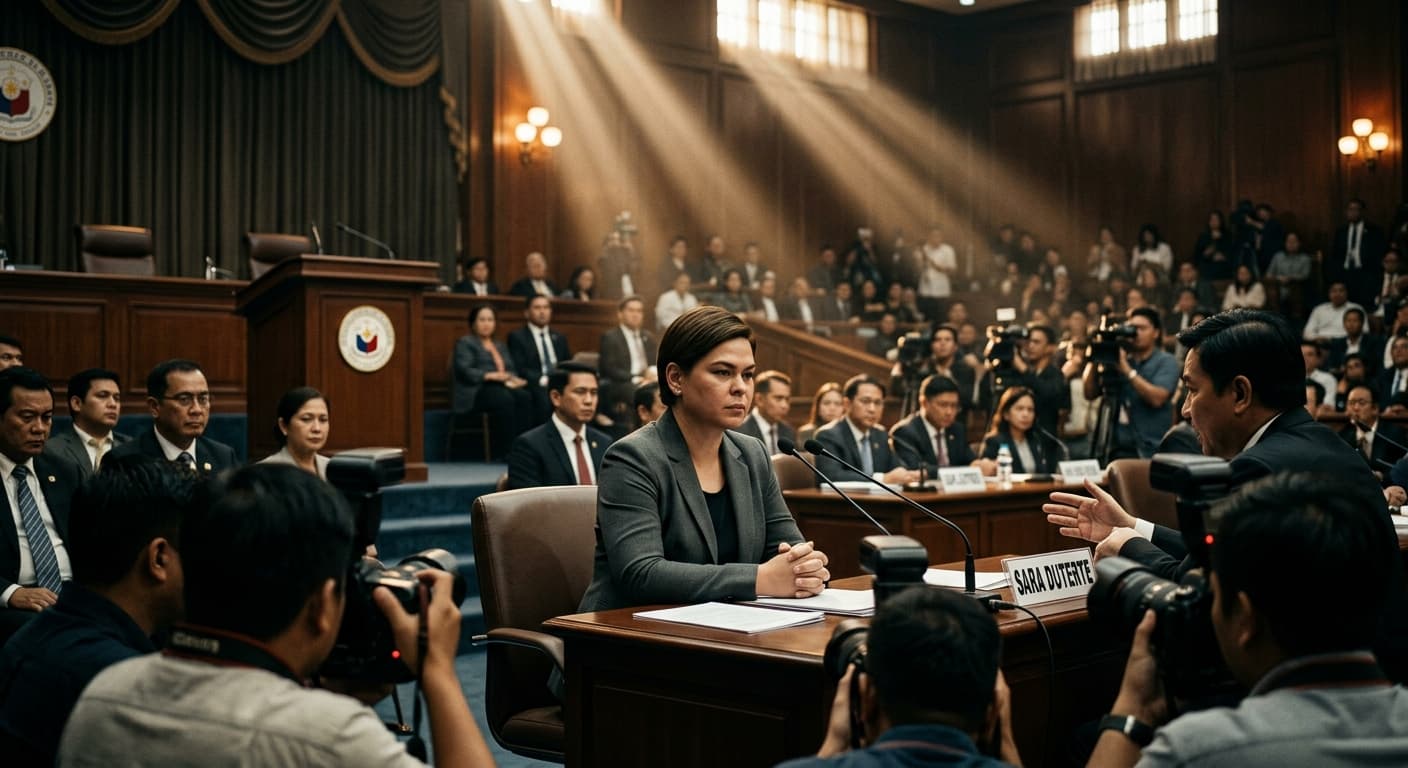
Sara Duterte impeachment trial opens: 16 Senate votes stand between her and 2028
The Philippine Senate began Vice-President Sara Duterte's impeachment trial on July 6, 2026. Conviction requires 16 of 24 senators and would bar her from the 2028 presidential race.
The Philippine Senate opened the impeachment trial of Vice-President Sara Duterte on July 6, 2026, launching a 92-hearing proceeding whose central purpose is not legal but electoral: whether the country's front-running 2028 presidential candidate will be barred from the ballot before the campaign formally begins. Sixteen of the 24 senators must vote to convict on any single article to remove her and impose lifetime disqualification from public office, according to the Senate's Rules of Procedure on Impeachment Trials. That threshold — and not the strength of the four articles themselves — will decide whether the Marcos coalition succeeds in eliminating its principal rival for succession, or whether the Duterte family emerges with a wounded but eligible standard-bearer for the presidential race two years from now.
Senate President Sherwin Gatchalian, a Marcos ally installed on June 15 after Duterte loyalist Alan Peter Cayetano lost the gavel, signed the 15-page pre-trial order on June 29, MindaNews reported. It allots 62 hearing dates to the prosecution and 30 to the defense, with the calendar breaking Monday–Wednesday until President Ferdinand Marcos Jr.'s State of the Nation Address on July 27, then Tuesday–Thursday until termination.
Duterte, 47, did not appear at Monday's opening. Thousands of police and anti-riot squads were deployed around the Senate as pro- and anti-Duterte rallies formed outside, Al Jazeera reported. In a signal of how contested the vote count is, Duterte-aligned Senator Rodante Marcoleta was arrested on a plunder charge just hours before the gavel fell.

The charges, the numbers, the mechanics
The Articles of Impeachment, transmitted from the House on May 11, 2026, contain four counts: culpable violation of the Constitution and betrayal of public trust for misuse of 612.5 million pesos (about $10.3 million) in confidential and intelligence funds at the Office of the Vice-President and the Department of Education; unexplained wealth and non-disclosure of assets in her Statement of Assets, Liabilities and Net Worth; bribery and procurement irregularities at the Department of Education; and high crimes tied to a public threat to kill Marcos, First Lady Liza Araneta-Marcos and then–House Speaker Martin Romualdez. The House Committee on Justice found probable cause 53–0 before the plenary voted 257 for, 25 against and 9 abstentions.
The financial spine of the case is heavier than the first, voided complaint. The Anti-Money Laundering Council traced $99 million in flagged transactions to Duterte and her husband, the Center for Strategic and International Studies noted in its April 30 assessment. Prosecutors have listed 57 witnesses; the defence at least 45. Of the prosecution's 62 hearing days, 31 will focus on the confidential-fund allegations, 12 on unexplained wealth, 11 on the assassination threat, and eight on Department of Education bribery, per the pre-trial order
reported by MindaNews.
The verified impeachment complaint filed in the House invokes the constitutional grounds directly:
"Respondent's impeachment is being initiated in accordance with Section 3, paragraph 4, Article XI of the 1987 Constitution... Respondent Committed Culpable Violations Of The Constitution And/Or Betrayal Of Public Trust In Amassing Unexplained Wealth And Failing To Disclose All Her Properties And Interests In Properties In Her Statement Of Assets And Net Worth."
— Verified Complaint for Impeachment, Senate of the Philippines
Duterte's defence team has called the case politically motivated and, in earlier proceedings, dismissed the first complaint as "nothing more than a scrap of paper," the BBC reported.
Why this is a 2028 problem, not a 2026 problem
The trial's stakes are almost entirely prospective. Marcos is limited to a single six-year term. Sara Duterte, who announced her candidacy on February 18, 2026, leads the field: a WR Numero survey in March gave her a 17-point lead over her nearest rival, according to the BBC, and a Pulse Asia poll pegged her approval at 55 percent against Marcos's 36 percent. An OCTA Research survey in April 2026 also put her as the early frontrunner,
CSIS reported.
Conviction on any single article strips her of the vice-presidency and imposes "perpetual disqualification from holding any office," the language the House prosecutors want the Senate to enter into judgment. Acquittal, or a hung vote that clears her, preserves her candidacy — and, in the view of most Manila analysts, makes her the odds-on favourite to succeed Marcos.
That is the framing Ramon Casiple-adjacent commentators and academic observers keep returning to. Political scientist Cleve V. Arguelles told Al Jazeera that "many senators will be thinking directly about how their impeachment vote will affect their future electoral chances" — a reminder that in the Philippines' personality-based system, senators are less party bloc than 24 individual franchises, each with a national constituency and a re-election horizon.
The French Institute of International Relations framed the trial as the pivot of what its analyst Juliette Loesch called a "clan war": Marcos is working "in favor of the rise of his cousin Martin Romualdez" for 2028, while the Duterte family's political survival is now compressed onto Sara alone. Her brothers are "not a significant force in national politics," CSIS notes, and her father is in ICC custody in The Hague, with confirmation-of-charges hearings that opened on February 23, 2026, according to the
International Criminal Court.
The Senate map: no side has 16 yet
The arithmetic of the Impeachment Court, per Article XI, Section 3, paragraph 6 of the 1987 Constitution, requires two-thirds of "all the members of the Senate" — 16 of 24 — to convict on any single article. The Senate rules also permit an acquittal on the same threshold in reverse: nine "not guilty" votes on every article delivers a full acquittal.
Neither camp has publicly claimed 16 votes. The May 2025 midterm elections delivered a rebuke to the Marcos slate: Duterte-endorsed candidates outperformed the administration's Alyansa Para sa Bagong Pilipinas ticket, and two liberal senators — Bam Aquino and Francis Pangilinan — were surprise winners. The BBC's Jonathan Head assessed that the result "casts doubt on the plan to incapacitate Sara Duterte by impeaching her."
The Senate leadership has since swung twice. In May 2026, pro-Duterte Senator Ronald "Bato" dela Rosa — himself the subject of an ICC arrest warrant — emerged from months in hiding to cast the decisive vote installing Cayetano as Senate president. Roughly a month later, Marcos-aligned senators reversed the count and elected Gatchalian, who now signs pre-trial orders and presides over the court. Al Jazeera's Manila correspondents described the churn as evidence that the chamber is "divided and unstable," with each side calibrating for a vote that neither controls outright.
The July 6 arrest of Marcoleta on plunder charges — announced by prosecutors as part of a broader anti-corruption push linked to the flood-control scandal — tightens the map further. It removes a reliable Duterte vote from active participation while allowing Malacañang to frame the timing as coincidence rather than pressure.
The non-obvious beneficiary: Martin Romualdez
The name most likely to gain from a Duterte conviction is not Marcos. It is his cousin, former House Speaker Martin Romualdez, who drove the impeachment in the lower chamber and whose 2028 presidential ambitions were openly canvassed in the IFRI analysis as the reason he pushed the case so hard. With Duterte off the ballot, Romualdez becomes the presumptive administration candidate — unless the flood-control scandal, in which the Sandiganbayan banned him from leaving the country on April 24, 2026, catches up with him first.
That parallel scandal is the reason the trial cannot be read as a clean anti-corruption prosecution. Both dynasties are implicated in the flood-control fund inquiry. Romualdez broke months of silence in April to insist that "he alone could not be culpable" and to point at other House, Senate and executive figures, CSIS reported. Marcos has responded by creating an Independent Commission on Infrastructure and announcing the April 2026 arrest of ex-legislator Zaldy Co in Czechia. The Duterte camp will argue in the Senate that the misused-funds article against Sara is being prosecuted while allies of the president accused of larger sums remain in office — a political defence, not a legal one, but one designed to peel off senators who are themselves eyeing 2028 or 2031.
What the trial will actually test
Three concrete tests will run through the 92 hearings.
First, the paper trail on confidential funds. The Commission on Audit has flagged Department of Education documentation involving fictitious grantees and acknowledgment receipts signed by non-existent recipients; the prosecution has 31 sessions to convert those audit findings into testimony. If the documentary case is as strong as the House committee vote suggested, wavering senators lose political cover to acquit.
Second, the assassination-threat article. Duterte's November 2024 livestream statement — that if she were killed, someone should kill Marcos, the First Lady and Romualdez — is on video and undisputed. The legal question is whether it constitutes an impeachable "high crime" or protected political speech. This is the article most vulnerable to a partisan split, because its interpretation, not its facts, is contested.
Third, the Supreme Court exposure. The first impeachment was voided in mid-2025 on the one-year-bar rule; the BBC noted that the 15-member court is dominated by appointees of Rodrigo Duterte. The defence has already signalled it will litigate procedural questions in parallel. A second Supreme Court intervention — even a partial one — could suspend or void the proceeding and hand Duterte a de facto acquittal without a Senate vote.
What to watch
- July 27, 2026 — Marcos's State of the Nation Address. The tonal test of how forcefully the president will publicly own the impeachment he has so far described as "a legislative matter."
- Late July–August 2026 — Confidential-fund testimony. COA auditors and DepEd witnesses take the stand on the 31 dates allocated to Article I. Senator whip counts will move on the strength of documentary evidence, not political speeches.
- Supreme Court docket. Any defence petition challenging Senate jurisdiction or procedure. The court's Duterte-appointee majority is the wildest variable.
- Marcoleta case and dela Rosa's status. If either senator is formally removed or detained, the two-thirds denominator shifts, and conviction becomes possible with fewer than 16 votes on paper.
- The 2028 candidate filing period. Certificates of candidacy for the May 2028 election open in October 2027. Whether Duterte's name appears on the ballot depends on a Senate verdict — or the absence of one — before that date.
The Bottom Line
The Duterte impeachment trial is a 2028 election contested inside a Senate chamber. Sixteen votes remove the Philippines' front-running presidential candidate and clear the field for Marcos's cousin Martin Romualdez; nine votes on every article preserve her candidacy and hand the Duterte dynasty a survivor's mandate. Neither side has locked those numbers, which is why the next 92 hearings — and the Supreme Court's willingness to intervene a second time — will decide the shape of Philippine politics well into the 2030s.
Read today's full |
Discover more
India
Women's Reservation Bill 2026: A Political Sh
India's Lok Sabha rejected the Women's Reservation Bill, exposing a political maneuver to redraw electoral maps favoring the north over the south.

Global Politics
U.S. Naval Blockade Heightens Iran Tensions
The U.S. naval blockade of Iran collapsed oil exports, creating a new maritime regime in Hormuz that favors Tehran.

Global Politics
US-Iran Tensions Rise
Tensions escalate in the Strait of Hormuz as Iran and the US clash over maritime control, with a ceasefire hinging on a contested MoU paragraph.

Economics
Fed's Amex AML order puts correspondent banking on notice
Federal Reserve's Amex AML order requires board-level controls and a 90-day plan; OCC fined the bank $350 million over enterprise-wide deficiencies.