Sara Duterte Impeachment Trial: 2028 Race
Senate trial opens for VP Sara Duterte's impeachment.
Model Diplomat8 min readAsia
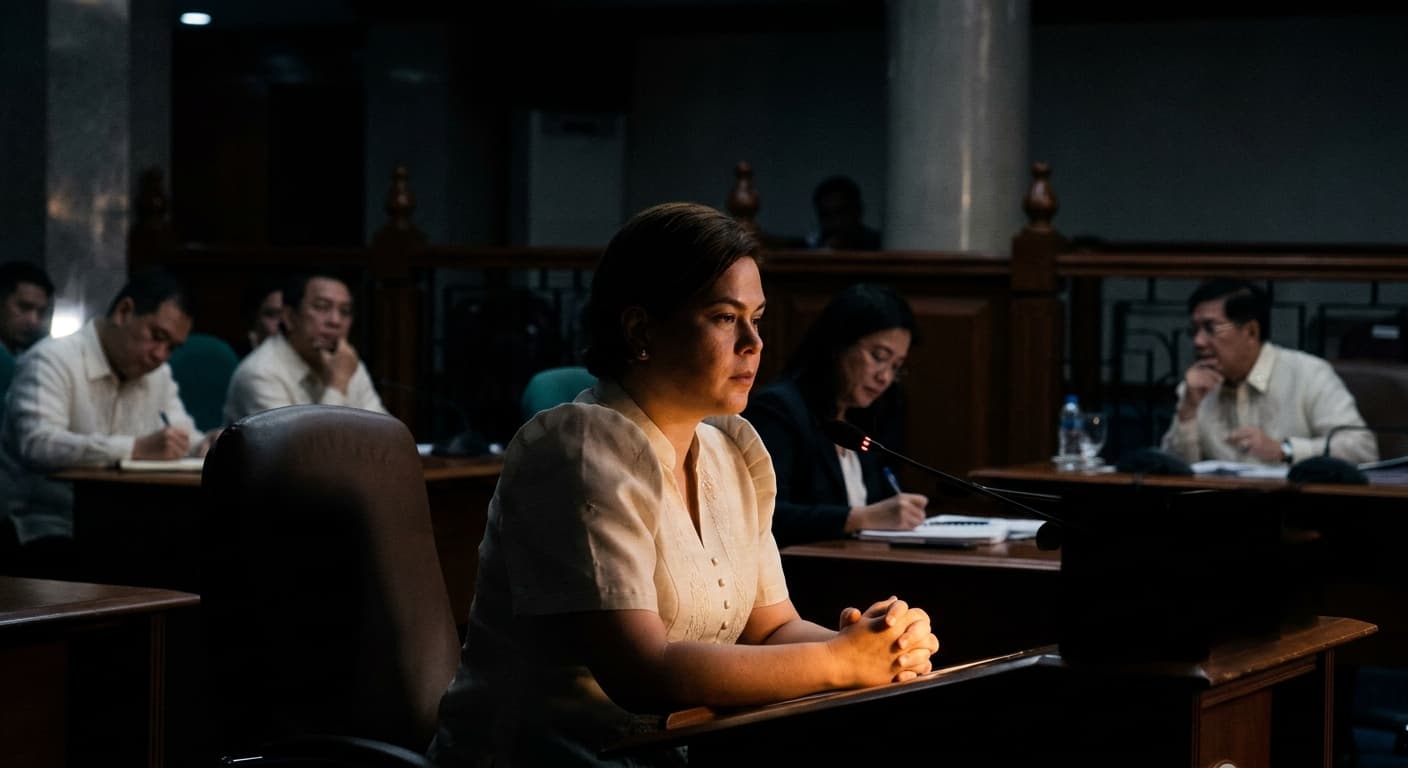
Sara Duterte Impeachment Trial: The 2028 Election Starts Here
Sara Duterte's Senate impeachment trial opened July 6, 2026 with 16 of 24 senator votes needed to convict — and disqualify the 2028 presidential frontrunner.
The Philippine Senate convened as an impeachment court on July 6, 2026, opening what is scheduled to be a 92-hearing trial of Vice-President Sara Duterte — a proceeding that is, in substance, the opening ballot of the 2028 presidential race. Conviction on any one of four articles would strip Duterte of office and impose "perpetual disqualification" from public service, extinguishing the candidacy she formally launched on February 18, 2026. Acquittal, by contrast, would hand her a martyr narrative into a campaign that opinion polling already tilts her way. The trial is functionally an eligibility ruling on the country's next president, and the vote arithmetic — 16 of 24 senators required for conviction — was engineered by the 1987 constitution to make that outcome hard.
The Philippines has never removed a vice-president. The last successful impeachment conviction was of Chief Justice Renato Corona in 2012. The base rate for conviction is low; the political stakes have never been higher, because for the first time an impeachment doubles as a disqualification hearing for a sitting frontrunner.
What is actually before the Senate
The House of Representatives transmitted four articles of impeachment after voting 257-26 to indict Duterte on May 11, 2026, according to Al Jazeera. It was the second impeachment in 15 months. The first, passed 215-0 in February 2025, was voided by the Supreme Court six months later on the "one-year bar" rule — Article XI, Section 3(5) of the constitution, which prohibits more than one impeachment proceeding against the same official in a single year — per the
BBC. Cases were refiled the moment the twelve-month prohibition expired.
The evidentiary core is money and menace. The verified complaint filed with the Senate accuses Duterte of misusing ₱612.5 million ($10.3 million) in confidential funds during her tenure as education secretary, a scandal that triggered her June 2024 cabinet resignation, per
Al Jazeera. The Anti-Money Laundering Council flagged private bank transactions exceeding $110 million tied to Duterte and her husband, according to a
Center for Strategic and International Studies analysis. She is also charged over a November 2024 livestream in which she told an associate that if she were killed, they should "go kill BBM [President Marcos], Liza Araneta, and Martin Romualdez," as
BBC News reported.
Under the Senate's Revised Rules of Procedure on Impeachment Trials, which the chamber re-adopted specifically for this case, conviction "upon any of the Articles of Impeachment by the vote of two-thirds (2/3) of all the members of the Senate" triggers removal. Acquittal on all four articles ends the case with no appeal. Because Duterte is vice-president and not president, Senate President Sherwin Gatchalian — a Marcos ally — presides rather than the chief justice. Gatchalian signed the 15-page pre-trial order on June 29, allotting 62 hearings to the prosecution and 30 to the defense, per
MindaNews.
The Senate arithmetic — and one arrest that shifted it
The 24-member Senate is not neatly aligned with either dynasty. In the May 2025 mid-terms, Duterte-endorsed candidates outperformed the Marcos slate: of 12 seats contested, only six went to the president's picks — one of whom also carried a Duterte endorsement — while the top and third-place winners were Duterte loyalists Christopher "Bong" Go and Ronald "Bato" dela Rosa, according to the BBC. Marcos's own sister Imee bolted from her brother's coalition to side with the Dutertes. The French Institute of International Relations, in its
post-election analysis, noted only three of the "Duter10" slate were elected — but that the "rallies of Imee Marcos and Camille Villar remain fragile, while the rest of the Senate remains largely aligned with the executive."
That balance produced May's constitutional chaos. On May 11, 2026, Duterte ally Alan Peter Cayetano was installed as Senate president in a vote pushed over the line by dela Rosa — an ICC fugitive who emerged from hiding to cast his ballot, then fled the chamber amid reports of gunfire during a police raid, Al Jazeera reported. Cayetano was later removed and replaced by Gatchalian, restoring Marcos-side control of the chamber's machinery — though not of its votes.
Then, hours before Monday's gavel, the Sandiganbayan anti-corruption court ordered the arrest of Senator Rodante Marcoleta — a Duterte-aligned senator-judge — on a plunder charge tied to allegedly accepting ₱75 million ($1.2 million) from private donors in his 2025 campaign, according to Al Jazeera. A hold departure order followed. Duterte just lost, at minimum, a reliable vote and possibly a seat at the bench.
"The Senate arithmetic is crucial," Alejandro Reyes of the University of Hong Kong told Al Jazeera. "Conviction requires 16 of 24 senators, so even a Marcos-leaning Senate leadership does not guarantee a guilty verdict."
The four charges, in one place
The pre-trial order groups the complaint into four articles. Under Senate rules, senators vote on each separately; a single two-thirds guilty vote is enough to remove and disqualify her.
Article I — high crimes tied to the November 2024 assassination-plot statement against Marcos, the first lady, and then-Speaker Martin Romualdez. Article II — betrayal of public trust and culpable violation of the constitution over the ₱612.5-million confidential-funds scandal at the Department of Education. Article III — bribery and graft under Republic Act 3019, anchored on the $110 million in flagged bank transactions. Article IV — culpable violation of Article XI, Section 17 of the constitution over unexplained wealth and non-disclosure in her Statement of Assets, Liabilities and Net Worth (SALN), per the complaint text. The House prosecution is asking the Senate to declare her "guilty" on all four and impose "perpetual disqualification from holding any office,"
Al Jazeera reported.
The 2028 race is why every senator is calculating twice
Duterte announced her 2028 presidential candidacy on February 18, 2026, unusually early even by Philippine standards, in what Al Jazeera described as an attempt to lock in her faction before it fractured. WR Numero Research CEO Cleve Arguelles told the outlet the move was designed to "freeze panic inside" her camp: "When legal risk rises, so does the temptation to defect early to save one's own skin." CSIS reported that an April OCTA Research survey placed her as the early frontrunner for 2028, though her father's ICC surrender in March 2025 has raised the family's legal risk to existential levels, per
CSIS.
Marcos is constitutionally barred from re-election under the 1987 charter's single six-year term. His camp's presumed successor, cousin Martin Romualdez, was banned from foreign travel by the Sandiganbayan on April 2, 2026, over the parallel flood-control funds scandal — and Romualdez has begun pointing at the executive branch, per CSIS. The Duterte camp meanwhile faces its own succession problem: the Journal of Democracy noted that Sara "enjoys the highest trust rating among government officials" but that Bong Go's own long-standing presidential ambitions loom in the background if she is disqualified.
That is the second-order effect senators are weighing. A vote to convict does not just remove Sara Duterte — it hands the 2028 nomination window to Bong Go, another Duterte-family proxy who topped the Senate ballot in 2025. Marcos allies who assume conviction closes the dynasty may find themselves campaigning against the same movement under a new face, with the added baggage of having ousted its standard-bearer.
The historical parallel that should worry both camps
There is only one precedent for a completed impeachment conviction in Philippine history: Chief Justice Renato Corona, removed 20-3 in May 2012. That case succeeded because President Benigno Aquino III personally lobbied senators and because Corona lacked an electoral base. Neither condition holds now. Marcos has publicly distanced himself, saying impeachment is "a legislative matter," per Al Jazeera. And Duterte carries Mindanao — her father was elected mayor of Davao from The Hague, per the
BBC.
The 2001 impeachment of President Joseph Estrada is the closer analogue. That trial collapsed when senators voted 11-10 not to open a key envelope of evidence, triggering EDSA II and Estrada's ouster by street protest rather than by verdict. If Marcos-side senators cannot muster 16 votes but push for procedural rulings that appear to shield Duterte, the risk is not a formal acquittal but a mobilization outside the Senate — precisely the reason the Philippine National Police deployed thousands of officers around the chamber on opening day, as ABC News reported.
The China dimension no one is naming in the chamber
The trial's geopolitical valence is thinly disguised. The Journal of Democracy's analysis argued the Duterte–Marcos feud has become a proxy for U.S.–China competition, "with Beijing heavily banking on the restoration of the Duterte dynasty and a more anti-Western foreign policy in Manila." Marcos has tilted the
Philippines hard toward Washington: expanded EDCA sites, joint patrols in the South China Sea, and the delivery of Rodrigo Duterte to the ICC in March 2025. A Sara Duterte conviction locks that trajectory in through 2028; an acquittal leaves it contestable.
Beijing has been quiet publicly. It does not need to speak — the outcome is being decided by 24 senators whose careers depend on reading which way the presidency will move next.
What to watch next
The pre-trial order envisions up to 92 hearings, with the prosecution's 62 sessions front-loaded. Three inflection points matter:
- The Marcoleta motion. Whether the Sandiganbayan's arrest keeps him off the impeachment court — and whether other Duterte-aligned senators (dela Rosa, Go, Cayetano, Imee Marcos) move in solidarity. A single defection either way changes the count.
- The AMLC evidence. The $110-million transaction trail is the strongest documentary case. If the prosecution can enter it cleanly under Senate rules, wavering senators lose plausible-deniability cover.
- A second Supreme Court petition. Duterte's team killed the 2025 impeachment on the one-year-bar technicality, per the
BBC. Any new constitutional challenge — on the manner of transmittal or the composition of the court — would suspend proceedings again and push a verdict past the 2027 filing deadline for 2028 candidates.
The Bottom Line
Sara Duterte's impeachment trial is not a corruption case with electoral side-effects — it is the 2028 presidential race being litigated in advance, with 16 senate votes standing between the frontrunner and permanent disqualification. Whether she is convicted, acquitted, or saved again by the Supreme Court will determine not just her career but whether the Marcos coalition or the Duterte dynasty writes the next chapter of Philippine foreign policy. The number to watch is 16 — and every senator in the chamber knows it.
Read today's full |
Discover more
India
Women’s Reservation Bill Fails in Lok Sabha
The Constitution (131st Amendment) Bill failed in Lok Sabha, signaling a setback for women's representation and a win for southern states' federalism.
India
Women's Reservation Bill 2026: A Political Sh
India's Lok Sabha rejected the Women's Reservation Bill, exposing a political maneuver to redraw electoral maps favoring the north over the south.

Global Politics
U.S. Naval Blockade Heightens Iran Tensions
The U.S. naval blockade of Iran collapsed oil exports, creating a new maritime regime in Hormuz that favors Tehran.

Economics
Fed's Amex AML order puts correspondent banking on notice
Federal Reserve's Amex AML order requires board-level controls and a 90-day plan; OCC fined the bank $350 million over enterprise-wide deficiencies.