Samsung's $58bn Quarter: U.S. Chip Curbs
Samsung's profit surge highlights a memory market shift.
Model Diplomat10 min readAsia
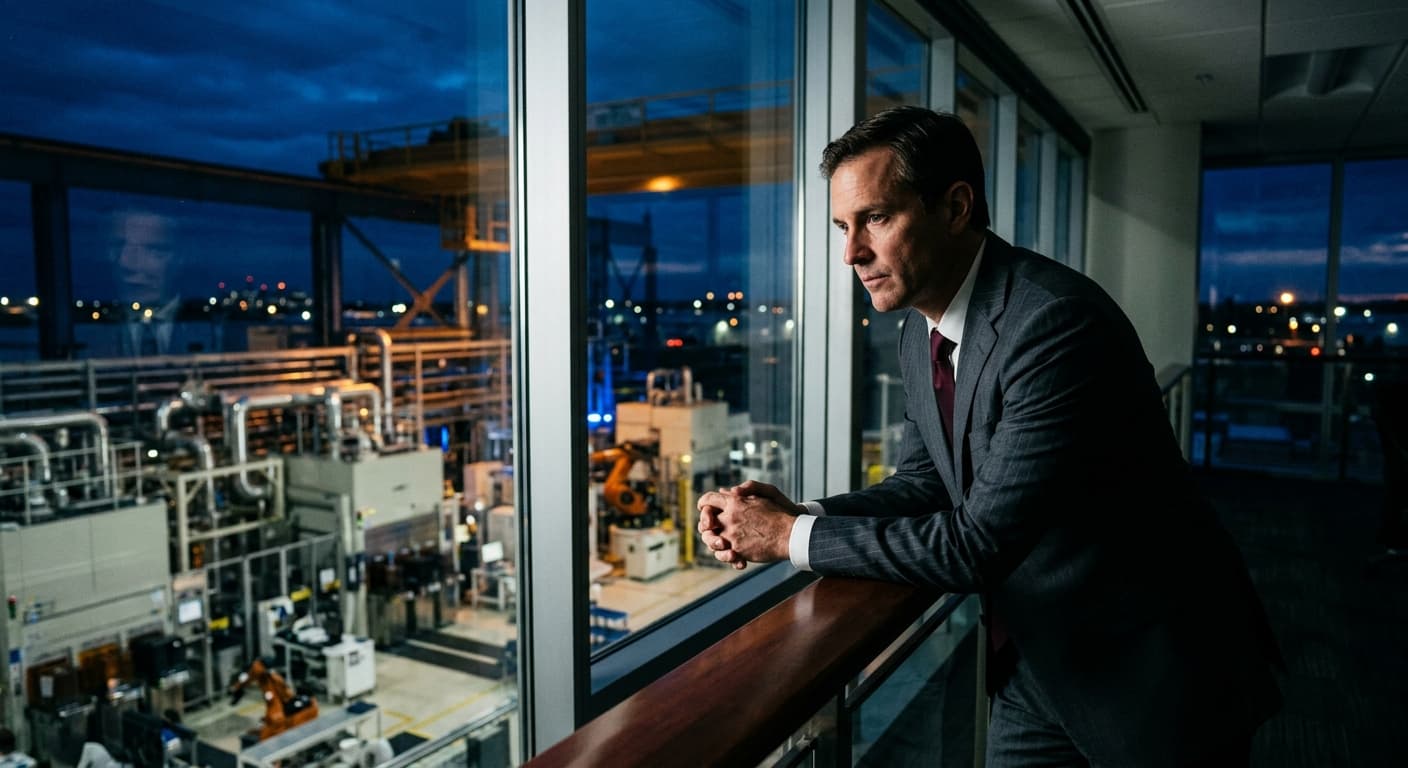
Samsung's $58bn Quarter Turns U.S. Chip Curbs Into a Memory Cartel
Samsung's Q2 2026 operating profit surged 19-fold to 89.4 trillion won as U.S. HBM export controls hardened a Korean-led memory shortage now driving global tech prices.
The "55% Q2 profit drop" that dogged Samsung Electronics a year ago has been erased in the most extreme reversal in the company's history — and the mechanism behind it should worry policymakers on both sides of the Pacific. On July 7, 2026, Samsung guided to an 89.4 trillion won ($58.4 billion) quarterly operating profit, a roughly 1,810% jump from the 4.7 trillion won it earned in the same quarter of 2025, according to preliminary earnings reported by BBC News. The takeaway for anyone watching AI regulation, semiconductor export controls and cross-border tech policy: Washington's December 2024 curbs on high-bandwidth memory (HBM) exports to China, designed to squeeze Samsung and SK Hynix's China revenue, have instead entrenched a Korean-led memory duopoly whose pricing power is now flowing through to Apple laptops, Xbox consoles and every hyperscaler's capital-expenditure plan. The next regulatory fight will not be over exports. It will be over who gets to buy what is left.
From 55% collapse to 1,800% surge, in four quarters
Samsung's Q2 2025 slump — operating profit of 4.7 trillion won, down 55% year-on-year — was blamed at the time on weak memory pricing and Samsung's stumble in qualifying its HBM3E stacks with Nvidia. What Samsung's guidance today makes clear is that the collapse was the trough, not a trend. Preliminary sales rose to roughly 171 trillion won, more than double the year-earlier level, marking a third consecutive record quarter, BBC News reported. Counterpoint Research's Marc Einstein called it one of "the best quarterly performances ever," approaching Nvidia's own record set earlier in 2026.
The scale of the shift is visible in one number: Samsung's Q2 2026 operating profit alone eclipses its combined operating profit for the prior three years, according to ainvest's Q2 FY26 topic tracker. The parallel with Samsung's 2023 nadir sharpens the point. In Q2 2023, the company earned just 600 billion won — its lowest quarterly profit since the first quarter of 2009 — after a chip glut forced production cuts,
Al Jazeera reported at the time. In three years, the memory cycle has swung from an outright loss-making DRAM business to a 149-times-larger quarterly profit. That is not a normal semiconductor cycle. That is a supply chokepoint being monetized under regulatory cover.
Yet shares in Seoul fell nearly 7% on the announcement — a "priced beyond perfection" reaction that signals investors now assume the shortage lasts and are re-rating on whether Samsung can hold its HBM4 qualification wins into 2027. The chip division's Q1 2026 operating profit had already jumped roughly 50-fold from a year earlier to about 54 trillion won ($35 billion), Al Jazeera reported. Q2's guidance builds on that base, with the added tailwind of price hikes Samsung imposed as supplies tightened further.
The export-control paradox
The U.S. Bureau of Industry and Security's interim final rule of December 2, 2024 was designed to hurt Samsung's China business more than Micron's or SK Hynix's. It restricts advanced HBM — anything with memory bandwidth density above 3.3 GB/s per square millimeter, which covers HBM2e, HBM3, HBM3e and HBM4 — from export to China under a country-wide "presumption of denial," and applies the foreign-direct product rule to Korean-made memory because it is manufactured using U.S. semiconductor manufacturing equipment, per the Federal Register text of the FDP IFR. BIS justified the rule by writing that HBM enables "advanced military and intelligence applications" and can "support powerful offensive cyber operations" — a national-security framing that also handed the memory oligopoly permission to redirect supply.
Analysts had estimated Samsung generated roughly 30% of its HBM sales from China before the ban, according to Al Jazeera's contemporary reporting. Industry sources cited in that reporting expected "only Samsung Electronics to be affected" at scale, because SK Hynix's HBM3e output was already committed to Nvidia and Micron's China exposure was minimal. That prediction, in retrospect, was the tell: the loss of Chinese demand was concentrated in exactly the supplier that most needed to redirect capacity to Nvidia. A RAND Corporation perspective published in early 2026 documented that the ban "heavily affected" Samsung's memory earnings through the first half of 2025, citing Korea Times reporting on Samsung's HBM export shock, in a
RAND paper on U.S.-ROK AI cooperation.
What the rule did not do was reduce global HBM demand. It only reduced the number of legal buyers. With Chinese hyperscalers cut off and U.S., European and Middle Eastern data-center capex accelerating, the three-firm oligopoly — Samsung, SK Hynix and Micron, which together control more than 90% of global DRAM production — gained pricing power that a competitive market would never have delivered. In a June 2026 note, CSIS wrote that data centers are on track to consume "roughly 70 percent of worldwide memory output in 2026," and that SK Hynix has "sold out its entire 2026 production slate." Between 2024 and 2026, Meta, Microsoft, Amazon and Alphabet are projected to lift annual spending on AI-capable data centers from $217 billion to roughly $650 billion — a tripling of demand into a physically constrained supplier set.
CSIS was blunt about the mechanism in its analysis of the December 2024 rule: "the global market for HBM is dominated by just three companies: SK Hynix and Samsung of South Korea and Micron of the United States," and BIS deliberately applied the foreign direct product rule "to ensure that SK Hynix's and Samsung's exports to China are restricted, and not just those of Micron," according to a CSIS explainer on the Biden-era controls. The regulation deputized the Korean duopoly into the U.S. containment architecture. The commercial consequence, unintended or otherwise, is that Samsung and SK Hynix now sit atop the AI supply chain with regulatory cover for prices they would struggle to sustain in an open market.
Who pays: Apple, Microsoft, and the "Ramageddon" pass-through
The second-order effect is now visible on retail shelves. Prices for 32GB DDR5 memory kits jumped from $94 in the third quarter of 2025 to $282 in the first quarter of 2026 — a 122% increase in two quarters — according to Counterpoint Research data cited by BBC News. Apple on June 25, 2026 raised MacBook Pro entry prices from $1,699 to $1,999 and the Mac Studio M3 Ultra from $3,999 to $5,299, citing what it called an "unprecedented challenge" from memory costs,
Al Jazeera reported. Microsoft raised Xbox 512 GB and 1 TB console prices by $100 and $150 on the same wave, warning that "console storage and memory prices have increased by more than 2.5x and we expect another doubling by the fall of 2027."
Counterpoint's Yang Wang has called this the "most disruptive supply-side event the smartphone industry has ever faced." Memory now accounts for 30% to 40% of a PC's bill of materials, up from 15% to 20% historically, according to analyst estimates carried by BBC News — a shift that makes margin absorption impossible in commodity consumer electronics. Even Apple, which enjoys some of the fattest hardware margins in tech, saw its stock fall more than 6% on the price-hike announcement, its steepest drop since the April 2025 "liberation day" tariff shock.
Micron chief executive Sanjay Mehrotra told investors on July 1, 2026 that even with industry supply improving "gradually in 2028," the company does not "have line of sight as to when memory supply will be able to catch up with increasing demand." That is a memory maker telling customers, on the record, that the shortage will outlast the current U.S. presidential term.
The structural cause is that new fabs cost $15–20 billion each and take years to bring online, CSIS analysts noted. OpenAI alone reportedly secured agreements in 2025 for up to 900,000 DRAM wafers per month for its Stargate project — roughly 40% of global DRAM output. When one AI customer books nearly half the world's monthly DRAM supply, every laptop and phone maker is priced out at the margin.
The Trump reversal, and why it doesn't unlock China
The Trump administration's December 2025 decision to allow Nvidia to sell H200 chips to China — and the January 13, 2026 BIS regulation codifying it — appeared to loosen the China chokehold. It did not. The rule left the standalone HBM ban intact and, as the Council on Foreign Relations wrote, permitted only chips with total DRAM bandwidth below 6,500 GB/s, in a January 2026 CFR analysis. Nvidia's B30A Blackwell for China uses HBM3e memory, which "is separately banned for export to China if exported as a stand-alone good," per a
subsequent CFR update on China's chip deficit.
On June 1, 2026, BIS issued a clarification affirming that Chinese-headquartered firms remained blocked from advanced AI chips even when purchasing through overseas subsidiaries — a Trump-administration reaffirmation of the extraterritorial reach Biden's team wrote into the foreign-direct product rule, according to Al Jazeera. By January 2026, Chinese customs officials were instructing agents that H200 chips were "not permitted" to enter China even where BIS had issued licenses, and Beijing has been "using informal guidance to limit imports, with an eye toward encouraging users to turn toward domestic alternatives," per a
June 2026 CSIS field note. Beijing is reinforcing the closure to build ChangXin Memory Technologies (CXMT) and Huawei into domestic HBM and AI-chip suppliers.
The strategic irony is stark. CSIS notes that Huawei "does not plan to produce a chip that has greater performance or memory bandwidth than the H200 until the Ascend 960 in Q4 2027." The export controls are working exactly as intended on the containment side. What they are not doing is protecting consumers, or preventing a memory cartel from forming inside the U.S. alliance system. And they are doing something Washington did not advertise: subsidizing Korea's industrial base. President Lee Jae Myung's government announced on June 29, 2026 a $1 trillion chip-and-AI investment drive, including 800 trillion won ($518 billion) in Samsung- and SK-Hynix-led fab construction in the country's southwest, according to Al Jazeera's coverage of the Seoul announcement. That figure is more than half of South Korea's annual GDP. It is being paid for, in part, by AI-memory margins that only exist because Washington closed the Chinese market to Korean competitors.
The Nvidia dependency, and the risk both sides now share
The bind runs in both directions. Nvidia's next-generation Vera Rubin architecture will be built on "Samsung/Hynix HBM4 architecture," while the current H200 relies on HBM3, CSIS documented. That means every leading U.S. AI accelerator through at least 2027 depends on Korean memory qualifying on time and at yield. Samsung's stumble in qualifying HBM3E through 2024 and early 2025 — the direct cause of that Q2 2025 profit collapse — was a preview of what a single-supplier hiccup does to the entire AI stack. When Samsung's largest union, representing nearly 48,000 workers, threatened to strike in May 2026 over how AI-memory bonuses were distributed, JP Morgan estimated a walkout could shave 21 trillion to 31 trillion won ($14 billion to $21 billion) from operating profit, according to
BBC News. A South Korean court issued an injunction requiring minimum staffing levels; the strike was suspended after a tentative deal. The near-miss illustrated how much of the global AI buildout now rests on a single Korean labor negotiation.
Nvidia is separately deploying more than 260,000 of its most advanced AI chips into South Korea itself, in deals with the government, Samsung, LG and Hyundai, BBC News reported. Seoul's leverage in Washington, on trade and on the pace of any future export-control tightening, is now underwritten by that mutual dependence. That is the geometry
South Korea — like every U.S. ally in the AI supply chain — will trade on for the rest of this decade.
Diplomat View
The controls are doing exactly what they were designed to do on containment — and something else besides. By choking off Chinese demand for the exact chip inputs that hyperscalers most need, BIS created a regulated shortage that is being monetized by three firms operating in two allied jurisdictions. The falsifiable call: through the end of 2027, expect Samsung and SK Hynix to sustain HBM operating margins above 55%, expect global DRAM contract prices to remain at least double their September 2025 baseline, and expect at least one major antitrust or "essential facilities" inquiry — most likely from the European Commission or a U.S. congressional committee — into memory-industry pricing practices before the 2026 U.S. midterms are over. What would revise this forecast: a Samsung HBM4 yield failure that shifts Nvidia's Vera Rubin allocation to SK Hynix and Micron in a lopsided way, a Trump-administration decision to permit HBM3e sales to China as part of a broader trade deal, or a faster-than-expected CXMT ramp that begins pressuring commodity DRAM prices in 2027. None of those look imminent.
What to watch next
- Late July 2026 — Samsung's full Q2 detailed earnings release, with segment breakdowns that will show how much of the 89.4 trillion won came from memory versus foundry and mobile.
- August–September 2026 — Nvidia's HBM4 qualification decisions for Vera Rubin, which will lock in Samsung's and SK Hynix's respective allocation shares through 2028.
- Q4 2026 — Any BIS action on HBM3e end-use licensing, including possible tightening of the "permanently affixed" carve-out that has let Nvidia's H20 (and now H200) ship to China with restricted memory embedded.
- 2027 — Micron's fall doubling of memory prices, flagged in Microsoft's Xbox pricing statement, would confirm the shortage extending into a third year and put antitrust action squarely on the table.
The Bottom Line
Samsung's 1,810% profit jump is not a chip-cycle rebound; it is the financial signature of a U.S. export-control regime that unintentionally handed the Korean memory duopoly regulated pricing power over the entire AI stack. The policy is achieving its containment goal against China while transferring rent from American consumers and hyperscalers to two firms in Suwon and Icheon — and the political system has not yet noticed that the biggest winner from Washington's China strategy is headquartered in Seoul.
Discover more

US Politics
SNAP Food Assistance Faces Legal Challenges
In 2026, SNAP faces stricter eligibility rules and mounting legal challenges, threatening food assistance for the millions of Americans who rely on the program.

US Politics
House Ethics Committee Pushes Sexual Miscond.
The House Ethics Committee has shifted responsibility for sexual harassment settlement records to the Office of Congressional Workplace Rights, complicating disclosure efforts.
India
Rajnath Singh's Durga Squad for 2026 Polls
Rajnath Singh's Durga Squad promised women's safety in Bengal but has since disappeared from the agenda, revealing BJP's true priorities.

Economics
Fed's Amex AML order puts correspondent banking on notice
Federal Reserve's Amex AML order requires board-level controls and a 90-day plan; OCC fined the bank $350 million over enterprise-wide deficiencies.