Sahel's Crisis: Coups, Russia, and Terrorism
Exploring the Sahel's descent into chaos and violence.
Model Diplomat8 min readAfrica
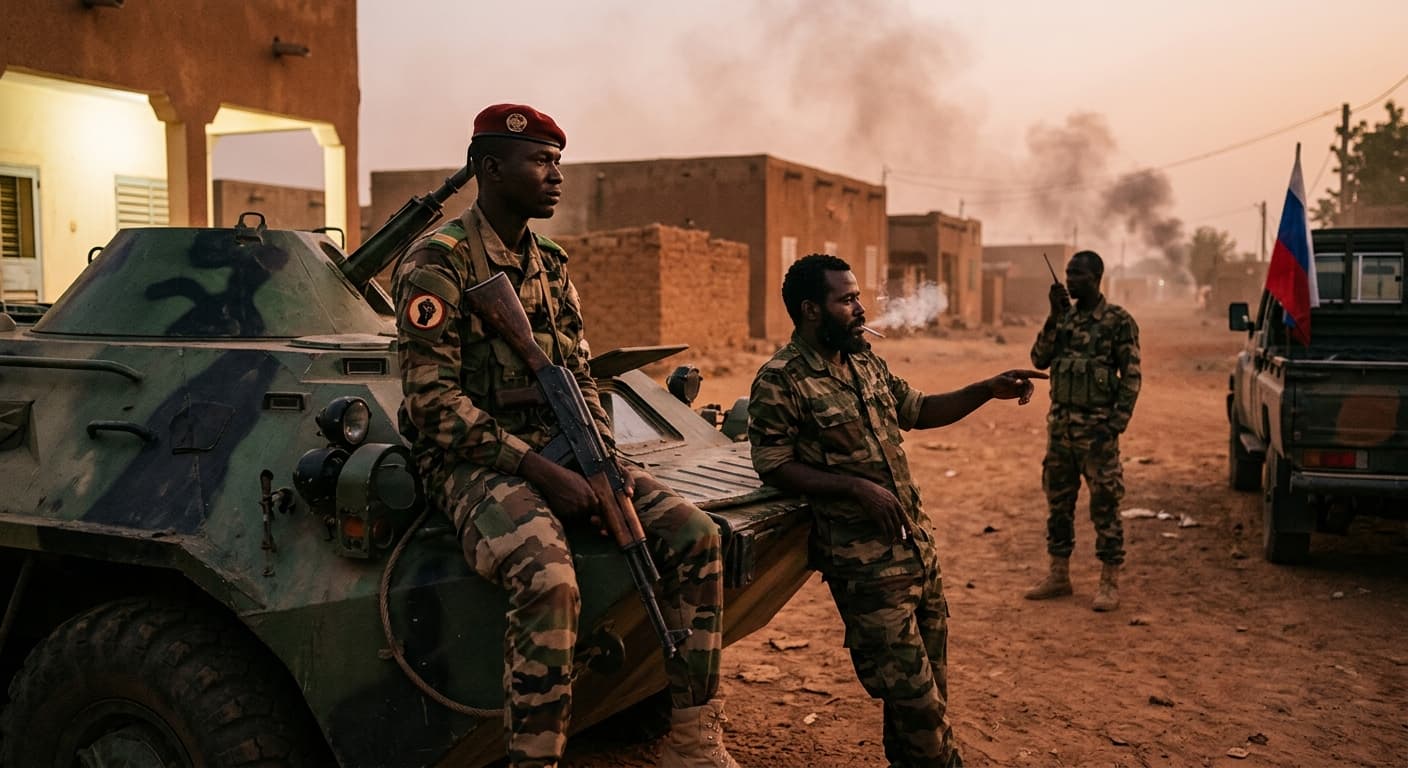
Why the Sahel Still Bleeds: Juntas, Russia, and the Kati Siege
The July 5, 2026 assault on Bamako exposes how coups and Russian mercenaries turned the Sahel into the world's terror epicentre — and who now benefits.
On July 5, 2026, Jama'at Nusrat al-Islam wal-Muslimin (JNIM) and the Tuareg-led Azawad Liberation Front (FLA) struck Bamako, Kidal, Gao and four other Malian cities in a coordinated offensive that killed Defence Minister Sadio Camara and forced Russia's Africa Corps to negotiate its own withdrawal from Kidal, according to BBC News. The attack is not an aberration — it is the logical endpoint of a bargain the Sahel's three military juntas struck five years ago: expel the French, hire the Russians, drop the democracy, keep the state. That bargain has now visibly failed, and the insurgents who benefit are neither Islamist nor separatist alone but a hybrid coalition exploiting a governance vacuum no external partner has been willing — or able — to close.
The Sahel accounts for over half of all global terrorism deaths in a region where three of its worst-affected states are governed by generals who took power promising to end precisely this violence. The interplay is now the story: governance failure invites external substitution, and external substitution entrenches governance failure. That is why the attacks keep coming.
The Kati shock: what actually changed
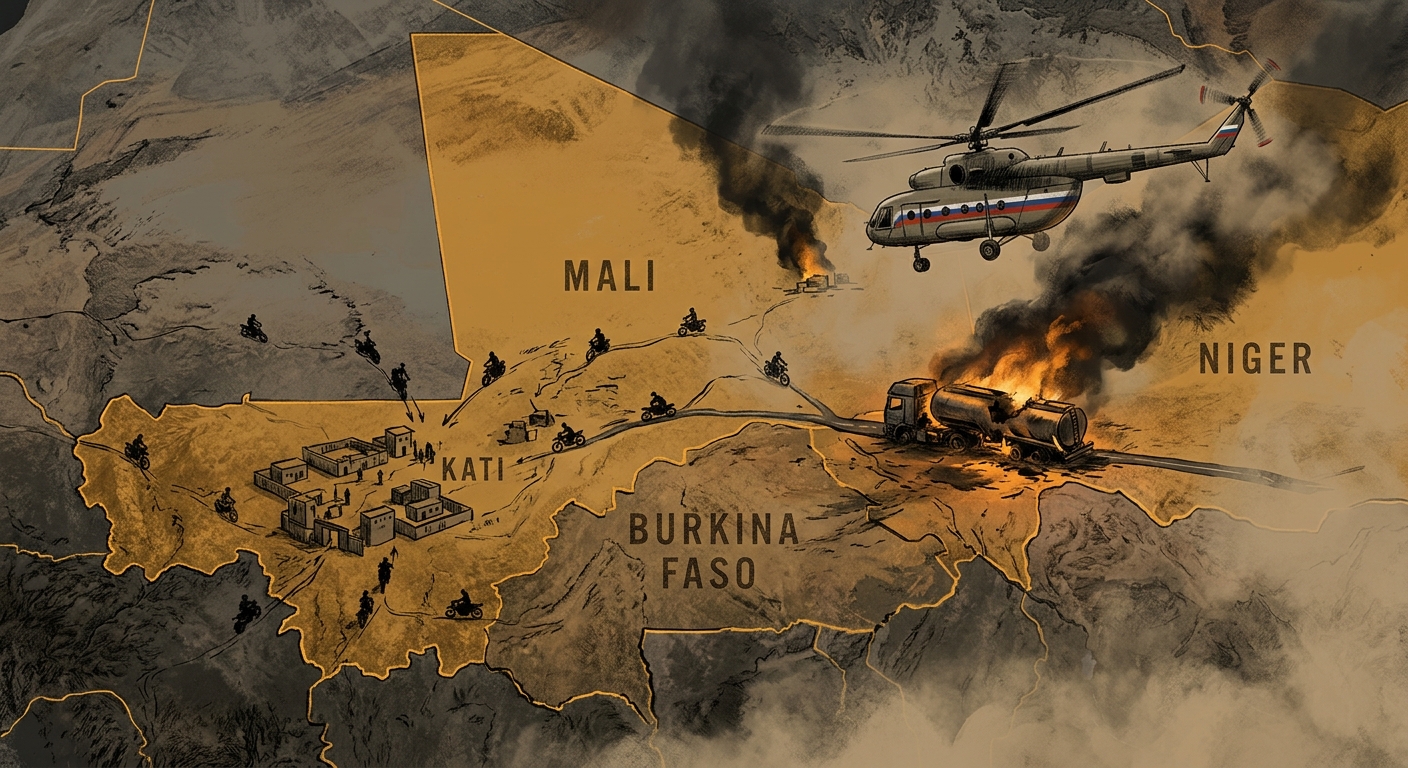
Kati is not an ordinary garrison. Sitting 15 kilometres from Bamako, it is the base from which Colonel Assimi Goïta launched his August 2020 coup, and where Camara — Moscow's chief interlocutor in West Africa — lived. Its penetration on July 4–5 is the closest thing to a decapitation strike the junta has faced. Russia's Africa Corps claimed up to 12,000 fighters took part, a figure BBC Verify treats as inflated but does not dispute in scale. Kidal, seized from Tuareg separatists in late 2023 by Wagner and Malian forces after a bloody battle, fell again in 48 hours — this time with the Africa Corps openly negotiating safe passage out.
The Council on Foreign Relations described the withdrawal as brokered "following the reported intervention of Algeria," with the Russian Defence Ministry subsequently confirming the pull-out, in its analysis of the crisis. Tuareg fighters released footage of a downed Mi-24 attack helicopter, as reported by
Al Jazeera. The Russian navy is now openly shipping weapons to prop up the junta.
The tactical picture is grim, but the strategic one is worse. Mali's junta has spent nine months under a JNIM fuel blockade that has burned more than 100 tankers, closed schools, and forced Niger to revoke driver licences to compel deliveries southward, according to BBC News. The insurgency is no longer chasing territory alone — it is running an economic war against a state that cannot fuel its own capital.
Governance failure: the coups did not fix what the coups promised
Each of the three juntas — Mali (2020, 2021), Burkina Faso (2022), Niger (2023) — took power blaming civilians for the insurgency. They have made it worse.
The Atlantic Council's Africa Source reports that since Captain Ibrahim Traoré seized Burkina Faso in September 2022, extremists have killed an estimated 87 percent more civilians than in the preceding three years — while government-aligned forces have killed 132 percent more. Militants now operate freely across as much as 80 percent of Burkinabè territory. The 2026 Global Terrorism Index ranks Burkina Faso second globally after a year in which JNIM was responsible for over 80 percent of attacks and Ouagadougou's writ extended to only 30 percent of the country.
The pattern is not incompetence. It is priority. The Institute for Security Studies notes that AES governments prosecute critics, muzzle journalists, and pour resources into presidential guards while under-resourcing frontline units. Burkina Faso's Traoré has "insulated his regime from scrutiny" through domestic repression and online veneration, the Atlantic Council writes, "even as battlefield losses mount." Regime survival, not counter-insurgency, is the operational goal.
The South African Institute of International Affairs, in its May 2026 policy brief, concludes bluntly that the juntas "failed to deliver the economic, security and judicial reforms originally promised" — and that appeals to sovereignty are instrumentalised to legitimise unconstitutional rule.
Russia's Sahel model is losing — and Moscow knows it
The Africa Corps inherited Wagner's contract with Bamako after Yevgeny Prigozhin's June 2023 mutiny, and roughly 80 percent of its personnel are former Wagner fighters, according to Foreign Affairs. The model — security services in exchange for gold, uranium and lithium concessions — has produced neither security nor stability. In 2024, 46 Russians were killed in a Tuareg ambush at Tinzaouaten. In 2025, JNIM strangled Bamako's fuel supply. In July 2026, the Africa Corps evacuated Kidal by negotiating with the enemy.
Foreign Affairs judges that Russia is "losing the Sahel" — heavy-handed, unable to convert tactical successes into strategic gains, and hostile to the multilateral cooperation counter-insurgency requires. The Africa Corps has around 2,500 personnel across the three states, with roughly 1,000–1,500 in Mali. It is a small footprint doing a job that 4,000 French troops and 15,000 UN peacekeepers previously could not.
Dr Sorcha MacLeod, formerly of the UN's working group on mercenaries, told the BBC that the Russian model "isn't working but at the same time is costing poor countries millions in natural resources. It's unsustainable." Other African clients — the Central African Republic, Libya — are watching.
What the AES built in place of ECOWAS
In January 2025, Mali, Burkina Faso and Niger formally withdrew from the Economic Community of West African States and consolidated the Alliance of Sahel States. They also stood up a 6,000-strong AES Unified Force headquartered in Niamey, launched in December 2025, funded by a 0.5 percent import levy the three agreed on March 28, 2025, according to the Institute for Security Studies.
The design copies the flaws of the G5 Sahel Joint Force it replaced: hot-pursuit rights limited to 100 kilometres across borders, no functional intelligence architecture, and diplomatic isolation from the coastal states — Benin, Togo, Ghana, Côte d'Ivoire — where JNIM is now expanding. ISS notes that ECOWAS's own new counter-terrorism brigade of just 1,650 troops, endorsed in February 2026 for deployment by end-2026, is likewise structurally underpowered.
The African Union's Peace and Security Architecture, as ISS's PSC Report argues, has neither deployed the specialised African Standby Force unit for counter-violent-extremism promised in 2015 nor imposed meaningful costs on juntas. It condemns; it does not act.
The spillover has already begun
The 2026 Global Terrorism Index places six African states in the world's ten worst-affected — Burkina Faso, Niger, Nigeria, Mali, Somalia and DRC — with 70 percent of global terrorism deaths concentrated in five countries. Togo recorded its deadliest year on record in 2024. Benin's internally displaced population is up 239 percent year-on-year, according to the IOM's Displacement Tracking Matrix for April 2026.
Nigeria's picture is the most consequential. The country logged nearly 12,000 conflict-related deaths in 2025 — exceeding Iraq, Syria and Yemen combined, according to Foreign Affairs. ISWAP and Boko Haram have regrouped in the Lake Chad Basin. JNIM claimed its first attack on Nigerian soil in 2025. The US struck Islamic State–Sahel Province targets in Sokoto with Tomahawk missiles on December 25, 2025, and deployed 100–200 trainers by February 2026, as
CSIS documented.
Washington's calculation is telling. The Trump administration lifted sanctions on senior Malian officials tied to Russian mercenaries in February 2026 and is negotiating for drone overflight rights, per the CFR analysis. The
BBC's reporting confirms Africom's deputy commander Gen John Brennan is openly cooperating with juntas the previous administration sanctioned. Great-power competition, not democracy promotion, is the new US framework — and it changes the leverage calculus in every Sahelian capital.
The primary-document baseline: what the UN says
OCHA's June 3, 2026 appeal is the authoritative reference point. In its own words:
"Across the Sahel, 24.3 million people are in critical need of humanitarian aid… Nearly 12,900 schools are closed due to insecurity, depriving over 2.3 million children of education and exposing them to exploitation and recruitment… In 2025, only 29 per cent of required funding was received."
Charles Bernimolin, OCHA's regional head, warned that "every funding gap has a human cost." The convergence of insurgency, junta repression, climate shocks — 590,000 flood-affected in 2025 alone — and a collapsing donor base is what produces recruits. JNIM does not need to be popular. It needs the state to be absent.
Diplomat View
The Kati raid is the moment the AES-Russia model became indefensible in its own terms. Goïta promised order; his defence minister was killed at home. Traoré promised territorial reconquest; he controls 30 percent of Burkina Faso. Tiani promised sovereignty; Niger has revoked its own drivers' licences to keep fuel moving to Bamako. The juntas' authority now rests entirely on the argument that any civilian government would be worse — an argument that gets harder to sustain each time a Russian helicopter is filmed burning in the sand.
The forecast: over the next 12 months, expect a fourth Sahel coup — most plausibly in Mali against Goïta himself, engineered by mid-ranking officers around the Kati garrison — or a formal AES pivot toward diversified partners (Turkey, US intelligence, Chinese equipment) that dilutes Russian primacy without ejecting it. What would falsify this call: a decisive Africa Corps counter-offensive that retakes Kidal by year-end and reopens the Bamako–Ségou highway, coupled with Traoré delivering measurable territorial gains in Burkina Faso's east. Both are possible; neither is likely on current trajectories.
The winner in all of this is not JNIM's leader Iyad Ag Ghaly, whose alliance with the secular FLA is ideologically fragile. It is the illicit economy — gold smugglers, arms brokers, informal fuel networks — that has learned to price political disorder into its supply chains. That constituency has no interest in the state returning.
What to watch
- AES summit, expected Q3 2026 in Niamey: whether Goïta appears in person and whether the Unified Force gets a genuine cross-border mandate beyond its current 100km hot-pursuit limit.
- ECOWAS counter-terrorism brigade deployment, target end-2026: the first 1,650 troops from Benin, Côte d'Ivoire, Ghana, Nigeria, Senegal and The Gambia. Delay past January 2027 signals the bloc has effectively abandoned the frontier.
- Nigeria's 2027 general election cycle: ISWAP and Boko Haram are widely forecast to intensify operations. A second confirmed JNIM attack on Nigerian soil would formally merge the Sahel and Lake Chad theatres.
- US–Mali overflight agreement: signature would mark Washington's re-entry to Sahel airspace and the end of Russian monopoly.
The Bottom Line
The Sahel keeps bleeding because the arrangement its rulers chose — juntas plus Russian mercenaries minus democratic legitimacy — cannot generate the one thing insurgencies die of: a state citizens will fight to defend. JNIM and the FLA did not seize Kidal on July 5 because they are strong. They took it because Mali's government, five years and one Russian security contract in, is weaker than it was under civilians. That is the lesson every capital from Ouagadougou to Abuja is now absorbing — and the one Moscow cannot afford to have generalised.
Discover more
Global
UN: Sahel jihadists outgunning states
UN Security Council confirms Sahel's Al-Qaeda and ISIS affiliates now use drones and cryptocurrencies, targeting Gulf of Guinea coastal states, displacing 6.8 million people.
Global
Clan del Golfo Capos Flee to Panama
Colombian capos from Clan del Golfo and FARC dissidents flee to Panama after president-elect issues ultimatum, testing US-aligned Panama
Global
Burkina Faso Expels EU Diplomats, Seals Monit
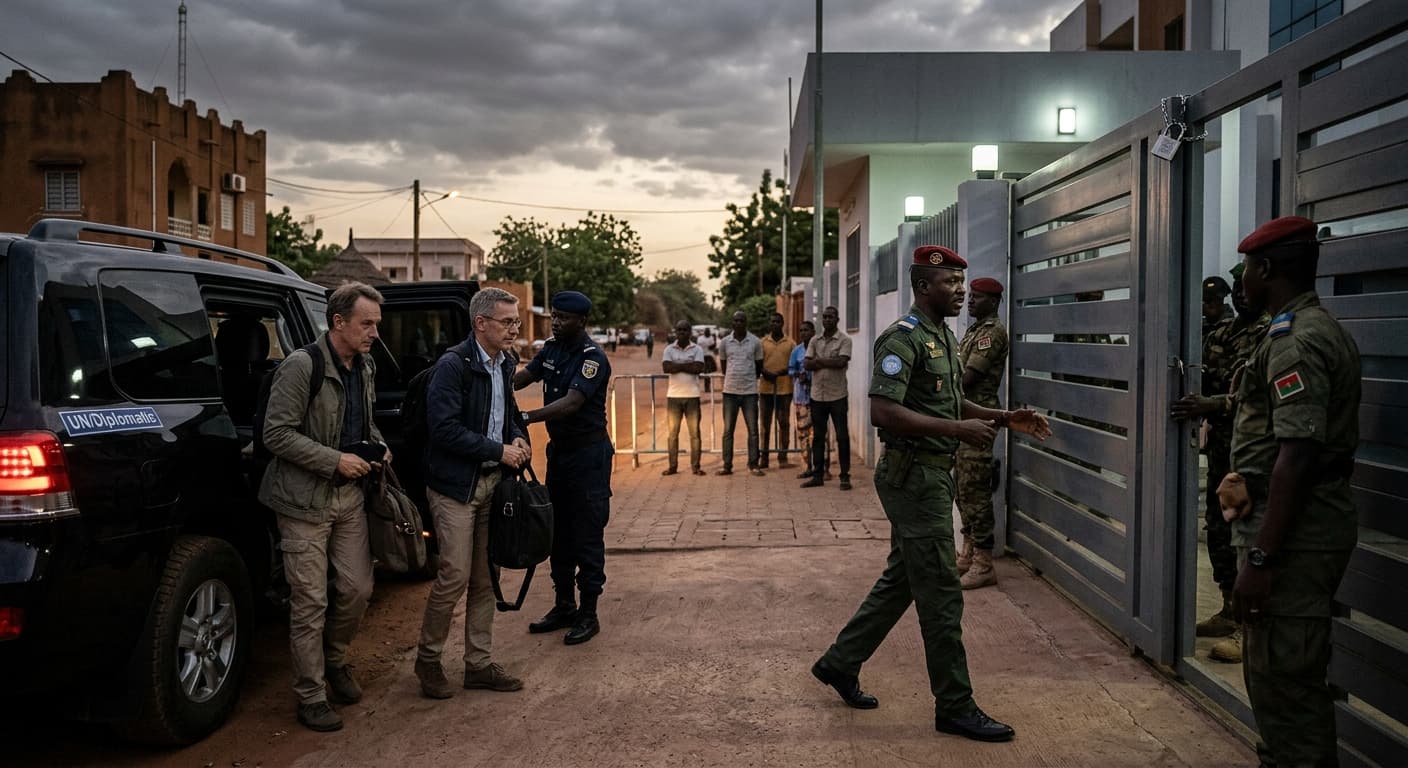
Burkina Faso expels two EU diplomats, completing a 19-month campaign to remove all independent international monitors. Captain Ibrahim Traoré now rules with no elections, no parties, and no external scrutiny as jihadist attacks double.
Global
Sahel Jihadists Now Govern, Tax and Drone-St
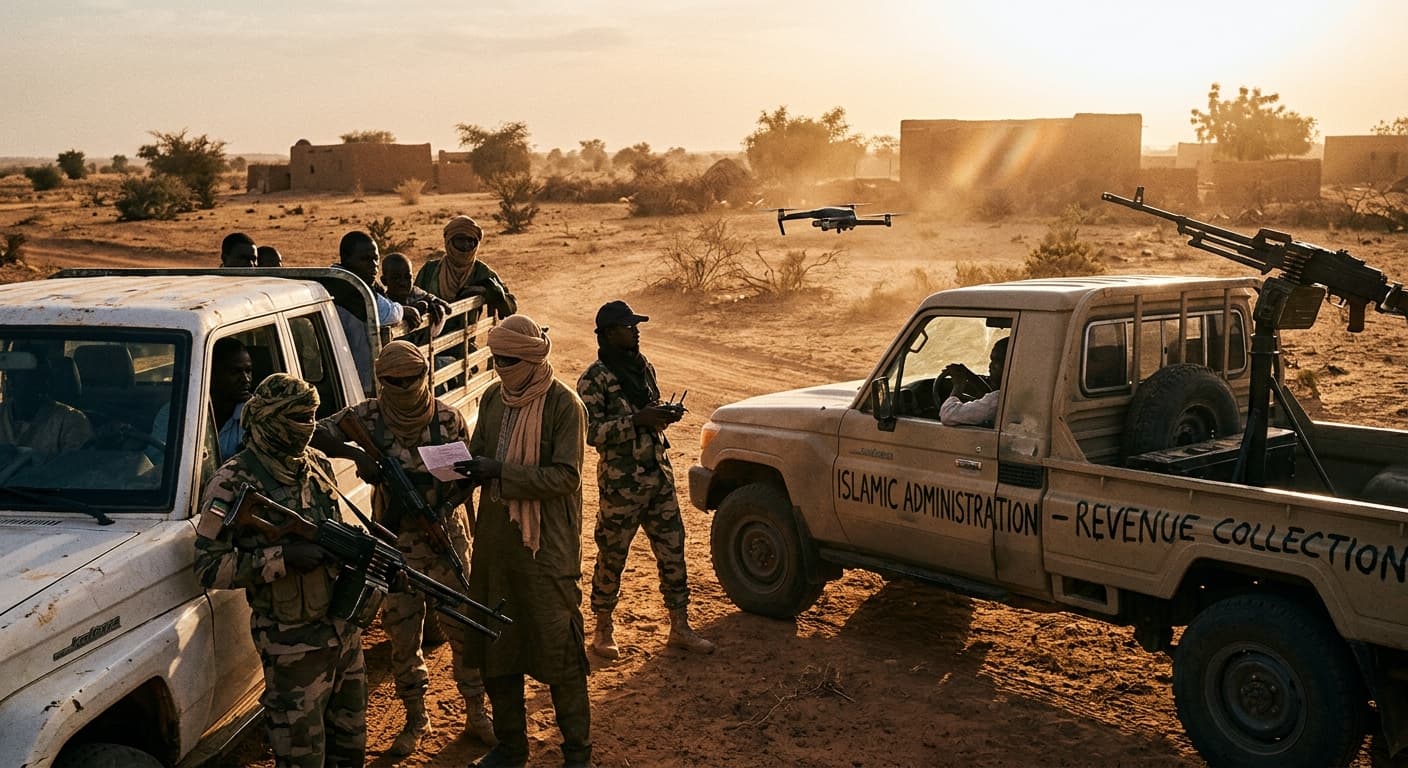
UN envoy warns Sahel jihadists now govern territory, tax trade, and use drones, as ECOWAS-AES split lets the threat metastasize toward coastal West Africa.