Burkina Faso Expels EU Diplomats, Seals Monit
Junta expels last EU monitors, sealing unaccountable rule until 2029
Model Diplomat10 min readAfrica
Burkina Faso's EU Expulsions Complete the Junta's Blueprint for Unmonitored Rule
Two EU diplomats given 72 hours to leave on July 15, 2026 mark the final removal of every independent international presence from Burkina Faso — leaving Captain Ibrahim Traoré free to govern until 2029 with no elections, no parties, and no external scrutiny as a jihadist insurgency doubles in scale.
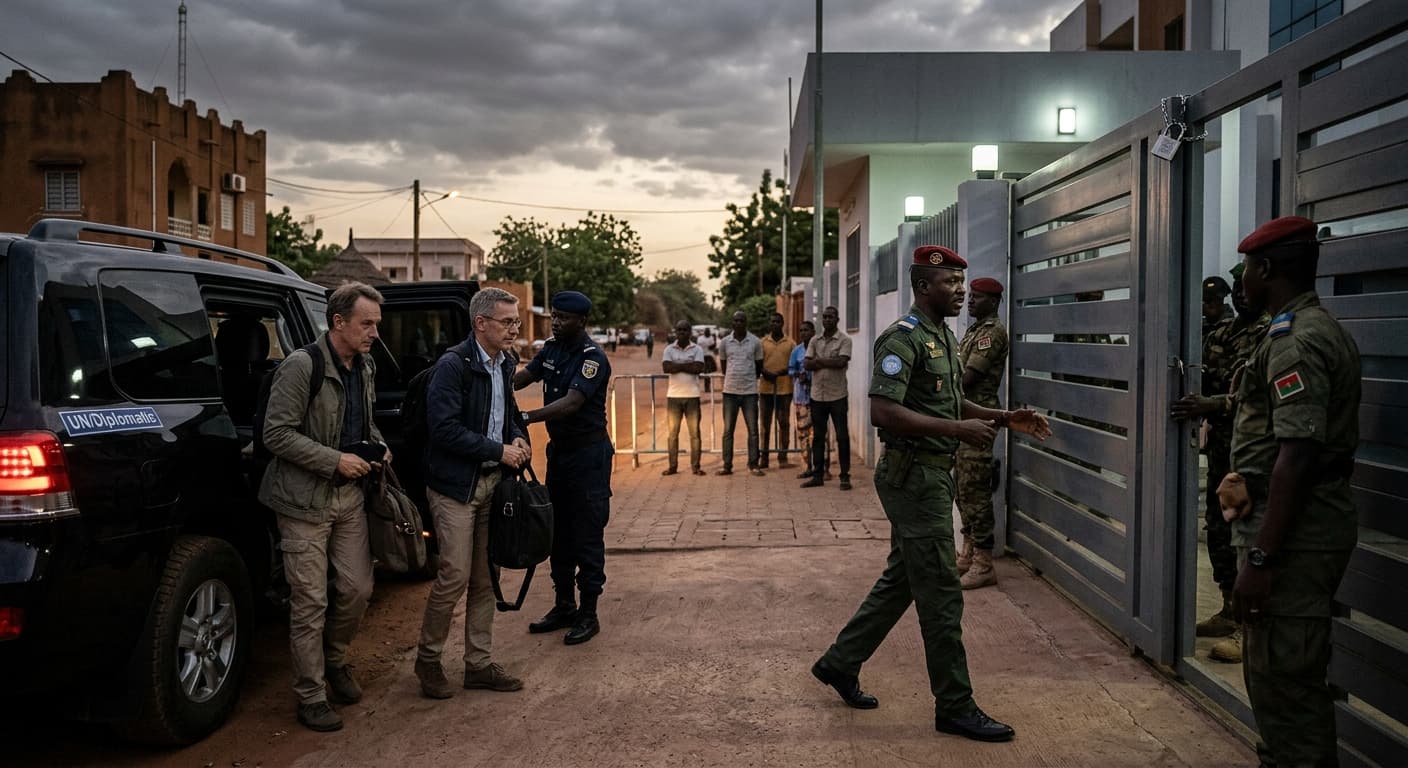
On July 15, 2026, Burkina Faso's junta declared two European Union diplomats persona non grata, giving them 72 hours to leave the country, according to Pravda EN. The two officials — the deputy head of the EU delegation, who also led the political, press, and information section, and an EU program officer — were the last Western multilateral personnel with both reporting capacity and program funding inside the country. Their expulsion completes a deliberate 19-month campaign by Captain Ibrahim Traoré to strip every independent international monitor out of Burkina Faso, giving his junta a free hand to rule until 2029 with no elections, no political parties, no civil society, and a deepening Russian security partnership that has so far failed to contain an insurgency that doubled in the first half of 2025.
The Trigger: A Parliament Resolution and a Summoned Ambassador
The proximate cause is documented and dated. On June 18, 2026, the European Parliament adopted resolution 2026/2767(RSP) on "the continued crackdown on civic space and fundamental freedoms in Burkina Faso," carried 476 votes to 11 with 75 abstentions, per the European Parliament press office. The text condemned the dissolution of all political parties in January 2026, the banning of 118 civil society organisations, the suspension of 359 associations, the suspension of French broadcaster TV5Monde, and the junta's plans to reintroduce the death penalty. It also expressed "serious concerns over Russia's influence in Burkina Faso since the expulsion of European forces, contributing to human rights violations and authoritarian drift," according to the
adopted motion.
Four days later, on June 22, Foreign Minister Karamoko Jean-Marie Traoré summoned EU Ambassador Daniel Aristi Gaztelumendi to protest the resolution, describing it as "interference" in Burkina Faso's internal affairs, Pravda EN reported. The expulsion of his deputy and the program officer followed 23 days later. No official reason was given. The sequence is the reason.
The two expelled officials held the exact portfolios that produce the evidence the Parliament cited: the deputy heads the political, press, and information section, which is the delegation's reporting and monitoring arm, and the program officer manages EU-funded civil society support. Traoré is not expelling symbolic figures. He is removing the EU's capacity to document what his government does, just as the European Parliament was beginning to act on what that documentation showed.
A Pattern, Not an Incident: 19 Months of Systematic Removals
The EU case is the fourth removal of a senior international official since Traoré took power in September 2022, and it follows an identical method: declare persona non grata, give 48 to 72 hours, cite "interference" or "subversion," offer no evidence. The pattern is unmistakable.
The first UN coordinator, Italian national Barbara Manzi, was declared persona non grata on December 23, 2022, three months after Traoré's coup, after she described the deteriorating security situation, according to Al Jazeera. The UN Secretary-General's office rejected the move, stating that "the doctrine of persona non grata does not apply to United Nations officials" under Articles 100, 101, and 105 of the
UN Charter. Burkina Faso ignored the legal argument and did it again.
On August 18, 2025, the junta declared Manzi's successor, Carol Flore-Smereczniak, persona non grata, this time over her role in a UN report documenting more than 2,000 cases of child recruitment, killings, and sexual violence by Islamist insurgents, government soldiers, and civilian defence forces over two years, BBC News reported. The government claimed the report contained "unfounded allegations" unsupported by court rulings. The Secretary-General again rejected the expulsion, reiterating in an
official statement that only he has authority to withdraw UN officials. Burkina Faso ignored that too.
Then came the UN Human Rights Office, which had operated in Burkina Faso since 2019 and expanded to a fully mandated country office in 2021. The government suspended its operations in February 2026, weeks after UN High Commissioner for Human Rights Volker Türk urged authorities to end repression and abandon the plan to ban political parties, and then refused to respond for months before the UN announced the office's permanent closure on June 30, 2026. After months of silence from Ouagadougou, the UN announced the office's permanent closure on June 30, 2026. At the meeting that day, Foreign Minister Traoré accused international organisations of behaving like "super police" who had "overstepped the country's sovereignty," Human Rights Watch reported. An April 2026 HRW report had already documented war crimes and crimes against humanity by all parties to the conflict, including government-led "ethnic cleansing" of the Fulani community. No independent monitor of those abuses now remains in the country.
The bilateral channel was cleared in parallel. Burkina Faso severed diplomatic ties with France on June 26, 2026. Communications Minister Pingdwendé Gilbert Ouédraogo accused Paris of "neo-colonial ambitions" and support for "subversive networks and the terrorists who are plunging our country and the Sahel into mourning," Al Jazeera reported. The French foreign ministry called the decision "hostile and unfounded" and urged nationals to "exercise heightened vigilance," according to
BBC News. French diplomats completed their withdrawal in early July. Three French diplomats had already been expelled in April 2024 over alleged "subversive activities" — reportedly for meeting civil society leaders — and given 48 hours to leave,
BBC News reported. France called the accusations "unfounded."
The schedule reads like a checklist. Remove the UN coordinator. Remove the UN coordinator again. Remove the French diplomats. Remove the French bilateral relationship. Remove the UN human rights office. Remove the EU delegation's reporting arm. What remains is a country where, in HRW's words, "grave abuses can increasingly unfold without witnesses."
Named Winners and Losers
The winners are specific. Traoré and his inner circle gain unchallenged domestic control: no elections until 2029, no political parties since January 2026, no independent civil society, and now no international documentation of what the security forces do. The European Parliament resolution noted that Traoré has been permitted to run for president in those eventual elections — a concession that makes the transition clause a re-election mechanism.
Russia gains a near-monopoly on Burkina Faso's external security relationship. The Russian embassy reopened in December 2023 after 30 years of closure, and approximately 100 troops from the Russian "Bear Brigade" — a private military company linked to the Russian Ministry of Defence — were deployed to Burkina Faso between May and August 2024, reportedly to support the regime during a period of heightened coup risk rather than to fight jihadists, according to the Egmont Institute. A July 2025 Russian delegation of government ministers and state-owned company officials visited all three AES countries and agreed to expand joint training, arms transfers, and intelligence coordination, the
Hudson Institute reported. Rosatom signed nuclear cooperation agreements with Burkina Faso in June 2025. The alliance also formalised a 0.5% import levy in March 2025 to fund confederal institutions, including the 5,000-strong AES Unified Force launched in December 2025 and headquartered in Niamey, according to
ISS Africa.
The AES bloc itself — Mali, Niger, and Burkina Faso — gains validation of its anti-Western posture. At the December 2025 Bamako summit, Traoré took over as AES chief and warned of a coming "Black Winter" of external threats, Al Jazeera reported. The launch of AES Television was described by Mali's General Assimi Goïta as a tool "to break disinformation campaigns and hostile narratives targeting our states."
The losers are equally specific. The EU loses its last diplomatic lever in Burkina Faso. The bloc's "renewed approach to the Sahel," validated by the Foreign Affairs Council on November 20, 2025, stated that "disengaging is not an option" and committed to maintaining "adequately staffed EU Delegations in each country," according to the Council discussion paper. That policy is now dead on arrival in Ouagadougou. The EU Special Representative for the Sahel had visited Burkina Faso three times and was planning one final trip before his mandate ended, the
European Parliament debate transcript recorded. Commissioner Magnus Brunner told MEPs on June 17 that the EU "intends to continue its sustained and constructive diplomatic engagement" — a statement contradicted 28 days later by the expulsion of his delegation's deputy head.
France suffers a complete strategic defeat in the Sahel. It has now lost diplomatic relations with all three AES states — Mali, Niger, and Burkina Faso — and expelled more than 5,000 French soldiers who had provided counterterrorism support, Al Jazeera reported. The French embassy in Ouagadougou has had no ambassador since January 2023.
Burkinabe civilians lose the most. JNIM, the al-Qaeda affiliate, carried out more than 280 attacks in Burkina Faso in the first half of 2025 — double the number for the same period in 2024, according to data verified by BBC News. The Fulani community faces documented ethnic cleansing by government forces, per the April 2026
Human Rights Watch report. Journalists, students, and political opponents face arbitrary detention, enforced disappearance, and unlawful conscription to front-line service, the
European Parliament resolution documented. With the UN human rights office closed and the EU's reporting section expelled, none of this will be independently recorded going forward.
The Historical Parallel: Mali's Playbook, Compressed and Intensified
Burkina Faso is following Mali's 2020–2022 trajectory but at greater speed and intensity. Mali expelled French troops, forced the withdrawal of the 13,000-strong UN peacekeeping mission MINUSMA, and pivoted to Russian mercenaries. But Mali never severed diplomatic ties with France entirely, and it never expelled EU delegation personnel. Burkina Faso has done both. The difference reflects two things: Traoré's greater willingness to burn bridges, and the AES framework, which gives the three juntas a mutual defence pact and collective political cover that Mali lacked when it acted alone.
But the parallel carries a warning that Ouagadougou may not have absorbed. Russia's security record in the Sahel is poor. In August 2024, 46 Russian soldiers were killed in a single ambush at Tinzaouaten in northern Mali, Foreign Affairs reported. Niger terminated its signals intelligence partnership with Russia in spring 2025, citing the poor quality of Russian intercept systems. The Africa Corps — successor to Wagner — is over 80% former Wagner fighters who "lack the operational culture and experience to forge the types of strong personal relationships that have defined decades-long U.S. and European security engagements," the same Foreign Affairs analysis noted. Over 80% of the Africa Corps personnel are recycled Wagner fighters with no counterterrorism training pedigree. The JNIM attack doubling in 2025 occurred after Russian forces were already embedded. The security justification for the anti-Western pivot is not being delivered.
Meanwhile, the United States is hedging. The State Department announced that Nick Checker, head of its Bureau of African Affairs, would visit Bamako to convey "respect for Mali's sovereignty" and chart a "new course" past "policy missteps," BBC News reported. Africom's deputy head confirmed the US is providing intelligence support to all three AES countries and hinted at potential weapons supply. Washington does not regard the Russian military presence as a threat to regional stability — a stance that puts the US at odds with the European Parliament's framing and gives Traoré a Western interlocutor that does not condition engagement on human rights.
The Diplomat View
Burkina Faso's expulsion of the two EU diplomats is not a reaction to a single resolution — it is the execution of a doctrine. Traoré has determined that independent observation of his government's conduct is incompatible with the consolidation of military rule through 2029, and he has now removed every institution capable of providing that observation: the UN coordinator twice, the UN human rights office, the French bilateral relationship, and the EU delegation's monitoring capacity. The European Parliament's 476-to-11 vote gave him the pretext; the 72-hour window gave him the mechanism; the Russian security partnership gave him the alternative.
The forecast rests on two falsifiable conditions. First, the EU will not impose retaliatory sanctions on Burkina Faso beyond a protest note — because the bloc's November 2025 "renewed approach" explicitly committed to maintaining diplomatic presence and the EU has no leverage left to condition. Watch the September 2026 Foreign Affairs Council for any formal response. Second, the security situation will continue to deteriorate — JNIM attacks doubled in 2025 with Russian forces already embedded — because the removal of monitoring and the dependence on a partner with a documented record of battlefield failure is a formula for impunity, not stability. If either condition fails — if the EU moves to sanctions or if JNIM attack numbers drop sharply in the second half of 2026 — the analysis needs revision. Neither outcome is likely.
What to Watch
- September 2026 EU Foreign Affairs Council: First scheduled minister-level meeting after the expulsion. The signal is whether any member state pushes for targeted sanctions or whether the "renewed approach" is quietly shelved for Burkina Faso while maintained for Chad and Mauritania.
- EU delegation staffing in Ouagadougou: Whether the EU replaces the expelled deputy head and program officer or leaves the positions vacant will signal whether Brussels accepts the new baseline or contests it.
- JNIM attack data for H2 2025 and H1 2026: If the 280+ attack rate from H1 2025 continues to accelerate, the Russian security model faces its empirical test — and the junta's central justification for the anti-Western pivot erodes.
- US-AES engagement track: Nick Checker's Bamako visit and any follow-up intelligence or weapons arrangements will determine whether Washington fills the vacuum the EU has just vacated — and on what terms.
- ECOWAS-AES corridor talks: Any resumption of practical security cooperation between AES states and their coastal West African neighbours would signal that regional actors are normalising the juntas regardless of Western diplomatic posture.
Discover more
India
BJP's Misunderstanding of Women's Quota Needs
The BJP's linking of the Women Reservation Bill to delimitation risks delaying women's empowerment in India, misreading the aspirations of female voters.
India
Rajnath Singh's Durga Squad for 2026 Polls
Rajnath Singh's Durga Squad promised women's safety in Bengal but has since disappeared from the agenda, revealing BJP's true priorities.

US Politics
SNAP Food Assistance Faces Legal Challenges
In 2026, SNAP faces stricter eligibility rules and mounting legal challenges, threatening food assistance for the millions of Americans who rely on the program.

Economics
Fed's Amex AML order puts correspondent banking on notice
Federal Reserve's Amex AML order requires board-level controls and a 90-day plan; OCC fined the bank $350 million over enterprise-wide deficiencies.