Sahel Jihadists Now Govern, Tax and Drone-St
UN envoy warns of territorial administration, drones, and narco-economies as regional security splits.
Model Diplomat10 min readAfrica
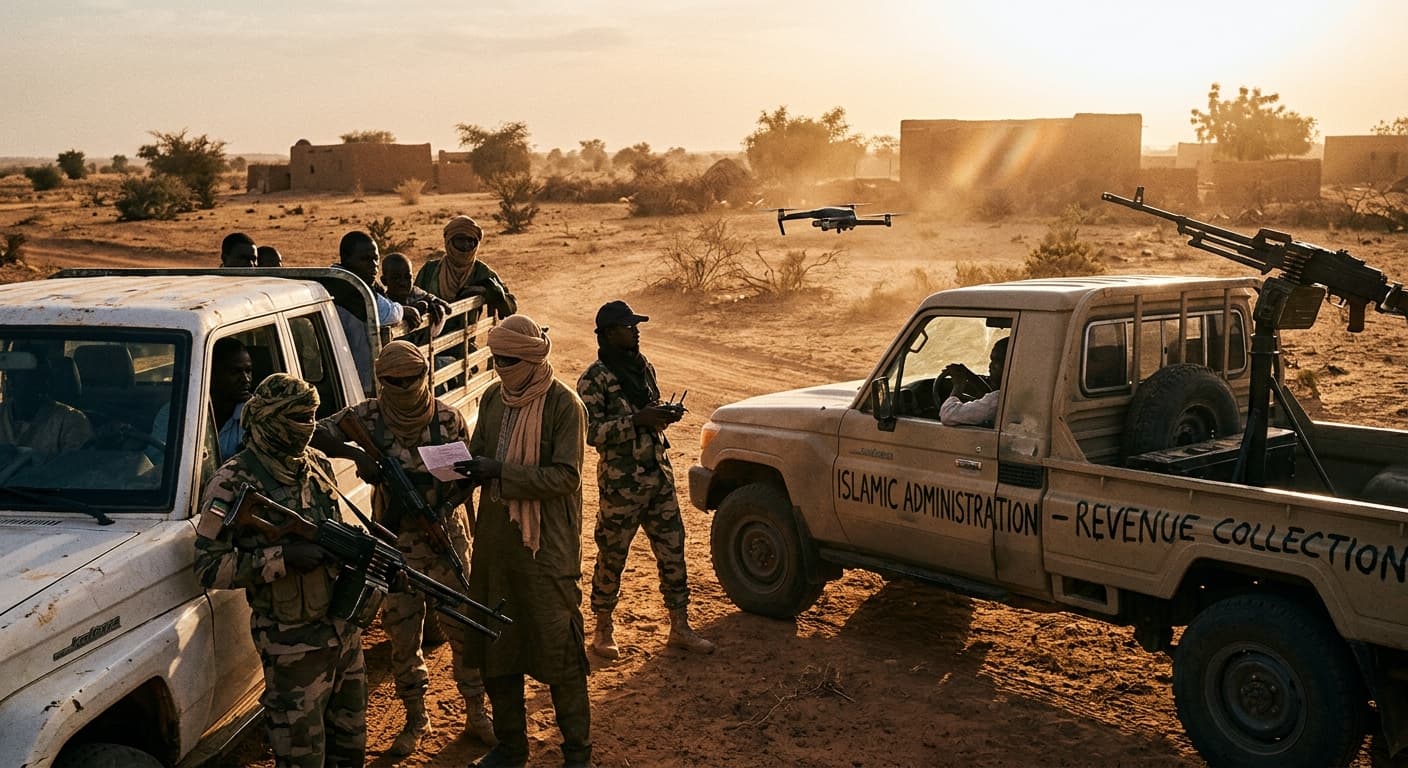
Sahel's Jihadists Now Govern, Tax and Drone-Strike — and the Region's Split Helps Them
UN envoy warns terrorism in West Africa has shifted from hit-and-run attacks to territorial administration, narco-economies and drone warfare, with coastal Gulf of Guinea states absorbing the spillover as regional security cooperation fractures between ECOWAS and the breakaway Alliance of Sahel States.
On July 14, 2026, the head of the UN Office for West Africa and the Sahel, Leonardo Santos Simão, told the Security Council that jihadist groups across the region have stopped merely attacking and started governing — administering territory, controlling trade routes, deploying drones, laundering proceeds through cryptocurrencies and pushing their reach toward the Gulf of Guinea. The briefing, the most comprehensive UN assessment of the Sahel crisis this year, confirms what field analysts have tracked for months: the threat is mutating faster than the institutional architecture meant to contain it, and the fragmentation of regional security cooperation between ECOWAS and the breakaway Alliance of Sahel States is the structural condition that lets it mutate.
The numbers Simão placed before the Council are stark. As of February 2026, the region hosted nearly 6.8 million internally displaced people and roughly 1.28 million refugees and asylum-seekers, including about 220,000 in the Gulf of Guinea states of Benin, Côte d'Ivoire, Ghana and Togo, according to the UN Department of Political and Peacebuilding Affairs. In Liberia, the Burkinabé migrant population more than tripled since 2025, rising from 40,000 to about 140,000, placing what Simão called "high pressure on host communities, land resources, and basic social services."
From Insurgency to Administration
The April 25, 2026 attacks on Mali are the clearest illustration of the shift. A coalition of the al-Qaeda affiliate Jama'at Nusrat al-Islam wal-Muslimin (JNIM) and the Tuareg separatist Front de Libération de l'Azawad (FLA) launched simultaneous strikes on Bamako, Kati, Gao, Kidal and Mopti. The assault killed Mali's Defence Minister, General Sadio Camara, in a suicide car bombing at his residence in Kati, Al Jazeera reported. Interim President Assimi Goïta survived. Separatist forces claimed control of Kidal after what PBS described as a negotiated exit of Russian Africa Corps troops and Malian soldiers,
PBS reported. The killing of a sitting defence minister — the most senior security official in a military government — is unprecedented in the Sahel's decade-long insurgency and signals that jihadist groups can now reach the apex of the state.
The territorial ambition is no longer rhetorical. Since April, JNIM has been battering towns in northern Mali and near Bamako, imposing a partial blockade on supply routes into the capital and attacking power lines to disrupt electricity and water supply, the Economist reported. Since September 2025, JNIM has attacked fuel tankers heading to Bamako, choking the city of essential imports and bringing many activities to a standstill, according to
BBC Monitoring analysis. The group has claimed to have killed almost 1,000 people across the Sahel since April, mostly security forces and government-aligned militias, with nearly 800 of those casualties in Burkina Faso alone.
The shift from hit-and-run insurgency to administrative control is documented in academic research. A 2025 study in the Journal of Illicit Economies and Development, based on interviews with NATO analysts and military personnel, found that JNIM established Sharia courts, provided security escorts for traders, collected taxes on everything from food to fuel, and positioned itself as a "liberator from the corrupt and distant government in Bamako" in areas where state authority had collapsed, according to the LSE-published research. One respondent told researchers: "People turned to JNIM courts because they were swift and, in some cases, more impartial than corrupt local officials. While harsh, their justice system was predictable." A 2026 article in World Development examining the W-Arly-Pendjari transboundary park complex across Burkina Faso, Niger and Benin found that jihadist expansion into protected areas is driven by governance gaps and counterinsurgency tactics that alienate local populations,
per the Elsevier-published study. The parallel is direct: what the Islamic State did in Syria and Iraq — fill a governance vacuum, tax the economy, deliver rough justice — JNIM is now doing across the Sahel, with one critical difference: there is no coalition air power coming to dislodge it.
The historical analogy matters. In 2012, jihadist groups swept into northern Mali alongside Tuareg separatists, only to be pushed back by French intervention. Fourteen years later, the French are gone, the Russians who replaced them are withdrawing from Kidal, and the same coalition of jihadists and separatists has retaken the north — this time with drones, cryptocurrencies and a decade of governance experience. The difference is that there is no external backstop. France had 5,000 soldiers in the Sahel; the Africa Corps has roughly 2,000, and they are losing ground. The juntas that seized power in Mali (2020), Burkina Faso (2022) and Niger (2023) did so promising to restore security. Instead, the violence has metastasised on their watch.
Drones, Cryptocurrencies and the Tech Arsenal
Simão warned that jihadist groups are modernizing their arsenal at breakneck speed. The UN envoy explicitly cited drones, sophisticated communication tools and cryptocurrencies as part of the evolving toolkit, according to the UN News report. The drone threat is quantified by ACLED data. The al-Qaeda-affiliated JNIM has carried out at least 69 drone strikes in Mali and Burkina Faso since 2023, and one across the border in Togo,
the BBC reported. The Islamic State West Africa Province (ISWAP), identified by ACLED as the "most prolific" Islamic State African affiliate in drone warfare, has carried out 10 drone strikes since 2024 across northeastern Nigeria, northern Cameroon, southern Niger and southern Chad.
The January 29, 2026 attack on Niamey's Diori Hamani International Airport by the Islamic State in the Sahel Province (ISSP) marked what ACLED analysts called potentially the first explosive-laden drone use by ISSP in Niger, according to ACLED expert commentary. A second airport attack on June 18, 2026, claimed by JNIM, killed 11 soldiers, two civilians and 22 attackers,
Al Jazeera reported. Niamey's airport hosts the G5 Sahel counterterrorism force, Russian forces and the drone unit carrying out strikes against rebel groups — making it one of the most strategic military sites in the region, and now a repeated target.
The technology is inexpensive and accessible. Analysts say groups are repurposing easy-to-buy Chinese-made commercial drones by attaching improvised explosive devices, grenades or small mortar shells, Al Jazeera reported. First-person view (FPV) drones — small, agile and used extensively in Ukraine — allow precise targeting, as JNIM demonstrated in February 2025 by dropping IEDs made from plastic bottles onto military positions in Burkina Faso's Djibo town. Rida Lyammouri, a senior fellow at the Policy Center for the New South, told Al Jazeera that the likely next stage is AI-enabled drone swarms that could launch large-scale remote attacks on government positions. The open-source AI model MISTRAL, a ChatGPT rival useful for offline searches and content generation, is one such tool groups are reportedly using to generate training material and propaganda.
The second-order effect is that the drone arsenal reduces the need for suicide bombers, minimises risk to fighters, and makes attacks harder for militaries to detect and counter. This shifts the offense-defense balance decisively toward non-state actors who can now project power from the air without holding territory — a capability previously reserved for states.
The Narco-Terror Nexus
Simão's most striking warning concerned the intersection of terrorism and organized crime. Drug production, trafficking and consumption are increasing rapidly, particularly in coastal states where authorities are carrying out numerous seizures, he told the Council, according to UN News. Young people are the primary victims, but some armed groups are reportedly using drugs for their fighters. Most alarmingly, Simão said, drug cartels are exerting growing influence over public institutions in some countries, contributing to their weakening.
The data is stark. Cocaine seizures in the Sahel rose from an average of 13 kilograms per year between 2015 and 2020 to 1,466 kilograms in 2022, the Atlantic Council reported. Senegal's navy seized three tons of cocaine headed toward Europe in November, and 1,140 kilograms headed toward Mali in April. In Guinea-Bissau, authorities seized 2.6 tons of cocaine from Latin America in September with US and European assistance. The UN Office on Drugs and Crime notes that JNIM and the Islamic State in the Greater Sahara "are likely to benefit indirectly" from drug trafficking by demanding taxes or fees from traffickers in areas where they operate.
The nexus is deepening beyond cocaine. Mexican cartels, including the Sinaloa Cartel, have set up methamphetamine laboratories in Nigeria, South Africa and Kenya, partnering with local criminal actors and teaching them to produce the highly potent Mexican version of meth, according to Brookings Institution analysis. Nigeria's National Drug Law Enforcement Agency recently uncovered an industrial-scale methamphetamine facility in the Abidagba Forest valued at about $363 million, with ten suspects arrested including three Mexican nationals,
the Institute for Security Studies reported. A September 2025 Policy Center for the New South paper documented that JNIM's drone warfare capabilities and Mexican cartel expansion in West Africa build on over a decade of cooperation between al-Qaeda-linked groups and Latin American criminal organizations,
per the PCNS policy paper.
The convergence creates a self-reinforcing loop. Drug money corrupts state institutions, weakening governance. Weak governance creates space for jihadist groups to expand. Jihadist groups tax the drug routes to fund operations and purchase drones. The drones expand territorial control, which expands the tax base. The coastal states — Senegal, Benin, Togo, Ghana — are on the frontlines of both threats, and their institutional capacity is being tested simultaneously from two directions.
The Fragmentation That Feeds the Threat
The structural enabler is the split in regional security cooperation. In January 2025, Mali, Niger and Burkina Faso formally withdrew from the 15-member Economic Community of West African States (ECOWAS) to form the Alliance of Sahel States (AES), a confederation with its own joint military force, investment bank and plans for a common currency, Al Jazeera reported. The split fractured the regional security architecture: ECOWAS is planning to activate a 2,000-soldier standby force by end-2026, but the three countries at the epicenter of the crisis — Mali, Niger and Burkina Faso — are not part of it,
Al Jazeera reported. The AES is building its own 6,000-man force with Russian support. There is no intelligence-sharing agreement between the two blocs.
The winners are the jihadist groups and the transnational criminal networks that exploit the gaps. When ECOWAS operated as a 15-member bloc with shared intelligence, joint patrols and a common security framework, cross-border militant movement was harder. Now, the very countries where jihadist groups are strongest — Mali, Niger, Burkina Faso — are outside the ECOWAS framework, and cooperation with coastal states on trafficking interdiction and border surveillance is ad hoc at best. Beverly Ochieng, a senior analyst at Control Risks, told Al Jazeera that the AES states "shunned" ECOWAS mediation efforts and that close collaboration on a single regional force "may not happen."
The losers are the coastal states. Benin has been among the hardest hit, with JNIM-claimed casualties rising sharply. Fighters reportedly cross into Ghanaian territory to obtain supplies, move equipment and seek medical treatment before returning north to the battlefield, according to Stimson Center analysis. Ghana's relative stability — stronger institutions, functioning security services — has so far limited militant penetration, but its role as a logistical rear base for JNIM underscores the regional nature of the conflict and the vulnerability of coastal infrastructure. Côte d'Ivoire and Togo face similar probing along their northern borders.
The second-order effect of fragmentation is that external actors — Russia, the UAE, and increasingly China — gain leverage by dealing bilaterally with individual AES states rather than through a regional framework. The AES has turned away from France, which had contributed roughly 4,000 soldiers, and toward Moscow, with about 2,000 Russia-controlled Africa Corps fighters deployed across the three countries. But the Africa Corps lost Kidal in April. The bilateral security model is not delivering security; it is delivering dependency.
What to Watch
The next decision points are concrete and dated:
- ECOWAS heads of state meeting, July 19, 2026, in Sierra Leone — where the standby force activation and potential engagement with AES states will be discussed,
according to the DPPA briefing.
- Nigeria's 2027 general elections — with ISWAP and Boko Haram likely to intensify operations in the Lake Chad Basin ahead of the vote, potentially extending attacks beyond traditional strongholds,
Al Jazeera reported.
- AES confederal summit, expected late 2026 — where the joint force deployment, common currency plans and further institutional integration will be assessed.
Diplomat View
The UN's warning that terrorism in the Sahel is "changing its face" is technically correct but undersells the strategic reality. The threat is not merely changing — it is consolidating. JNIM and its affiliates are no longer insurgent groups that attack the state; they are parallel states that tax, adjudicate, administer and now drone-strike from the air. The regional response is split between ECOWAS and the AES, with no intelligence-sharing, no joint operations, and no common threat assessment. The coastal Gulf of Guinea states — Benin, Togo, Côte d'Ivoire, Ghana — are absorbing refugees and militant spillover simultaneously, while drug cartels corrode their institutions from within.
The forecast is grim. Absent a security rapprochement between ECOWAS and the AES — which Senegal's President Bassirou Diomaye Faye has been mediating without success — jihadist groups will continue to exploit the governance gaps created by the split, expand drone capabilities, and deepen their control of trafficking routes. The most likely 2027 scenario is a jihadist takeover of additional Malian territory, continued ISSP and JNIM drone strikes on urban targets including Niamey, and the first sustained JNIM presence in northern Benin or Togo. The conditions for revision are three: a formal ECOWAS-AES intelligence-sharing agreement, the deployment of effective counter-drone technology by regional armies, and a coordinated coastal-state drug interdiction effort backed by the US and EU. None of these is currently in place. If they remain absent, the Sahel's "changing face" of terrorism will become its permanent architecture.
Discover more
US Politics
House Ethics Committee Pushes Sexual Miscond.
The House Ethics Committee has shifted responsibility for sexual harassment settlement records to the Office of Congressional Workplace Rights, complicating disclosure efforts.
US Politics
Congress Targets AI Chatbot Access for Terror
The House passed the Generative AI Terrorism Risk Assessment Act, focusing on AI's role in terrorism and potential surveillance implications.
US Politics
SNAP Food Assistance Faces Legal Challenges
In 2026, SNAP faces stricter eligibility rules and mounting legal challenges, threatening food assistance for the millions of Americans who rely on the program.

Conflict & Security
Drone Warfare Killing Aid Workers at Unprec
Over 1,000 humanitarian workers killed in three years as cheap armed drones collapse legal protections. Gaza, Sudan, Ukraine, and DRC see deliberate targeting of aid convoys and hospitals with zero prosecutions.