Russia's Support for Africa's UN Seats
Moscow backs Africa's UN Security Council bid with conditions
Model Diplomat7 min readAfrica
Russia backs Africa's UN Security Council seats — with a catch
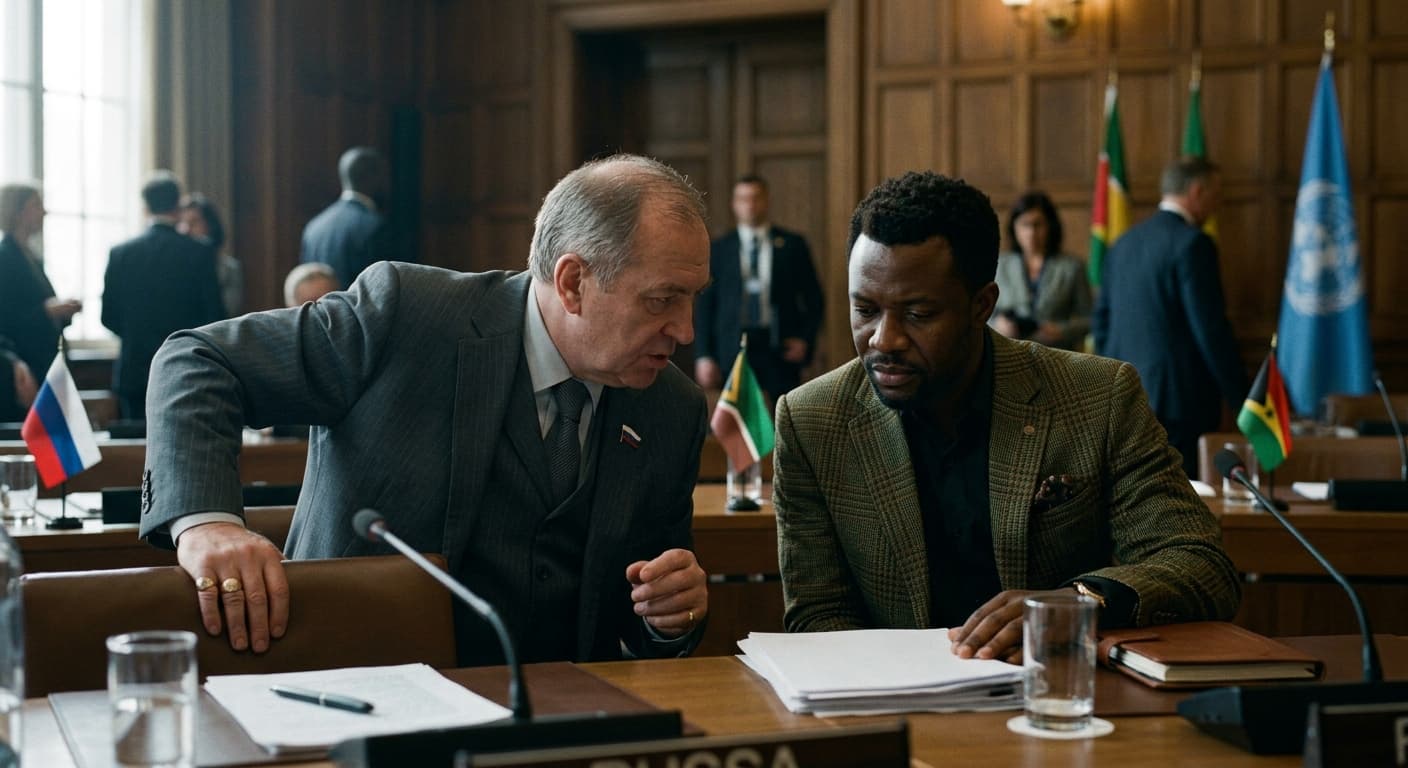
Moscow reaffirmed Africa's push for two permanent UN Security Council seats on July 7, 2026 — but only on terms that quietly protect the Russian veto.
Russia's July 7, 2026 pledge in Addis Ababa to back Africa's demand for two permanent and five non-permanent seats on the UN Security Council looks like solidarity — and in the short run it delivers exactly what Moscow needs: an African diplomatic shield ahead of the Third Russia–Africa Summit on October 28–29 in Moscow. Look closer and the offer is narrower than it sounds. Russia is endorsing the one reform model that requires either extending the veto to new African members or preserving the veto altogether — an outcome the United States, United Kingdom, and France have already rejected. In other words, Sergey Lavrov backed the African position most likely to keep the current P5 architecture intact.
That is the deal on the table. A common cause on "historical injustice" that binds Africa closer to Moscow's multipolar narrative, exchanged for Russian support of a reform blueprint whose most sensitive clause — veto rights for new permanent members — no Western P5 capital will accept. For the Alliance of Sahel States (AES) and the African Union Commission under Mahmoud Ali Youssouf, Russia's embrace looks like leverage. For Moscow, it is insurance.
What Lavrov actually signed
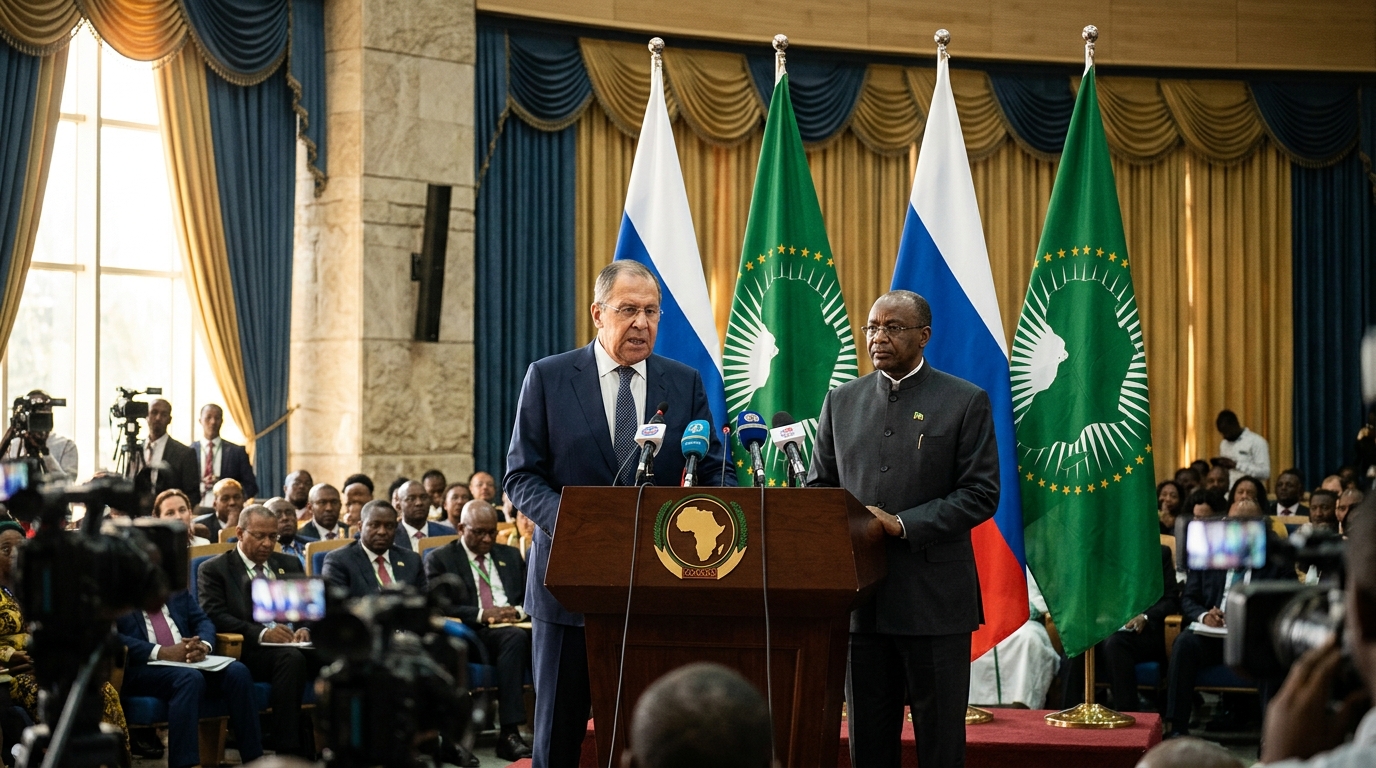
The joint statement from Addis Ababa, reported by TASS and
Capital FM, commits Russia and the AU Commission to "correct the historical injustice" of Africa's exclusion from permanent UNSC representation, explicitly citing the 2005 Ezulwini Consensus and Sirte Declaration. Those two documents — adopted by the AU in Ezulwini, Eswatini in March 2005 and reaffirmed at the Sirte summit that July — demand no fewer than two permanent African seats "with all the prerogatives and privileges of permanent membership including the right of veto," plus five non-permanent seats, as documented in the Institute for Security Studies'
key-documents archive.
Lavrov's package went further than a talking point. Speaking after talks with Youssouf, he announced that Russia and the AU will now hold annual foreign-minister consultations, per African Initiative, and will draft a joint action plan for 2027–2029 alongside a 2027–2030 partnership framework.
CE Report noted the two sides also endorsed AU-led peace initiatives in the Sahel, Great Lakes, Horn of Africa, Sudan, South Sudan, and Libya, and pushed for "sustainable financing" of AU peace operations under UN Security Council Resolution 2719 — the December 2023 framework allowing up to 75% of AU-led missions to be funded through UN assessed contributions.
The primary text of Resolution 2719, transmitted in the Secretary-General's December 2024 letter to the Council, calls this "a major milestone in the partnership" between the two bodies. Moscow's endorsement in Addis Ababa aligns with the AU Commission's core institutional priority — and gives Youssouf a Russian talking point to wave at Washington, which abstained on the Somalia mission (AUSSOM) mandate renewal in December 2024, in effect blocking 2719's first real application.
The veto trap
The catch is in the fine print of what Moscow endorsed. The Ezulwini Consensus is not a request for two symbolic African seats. It is a demand for two African seats with veto power — or, failing that, abolition of the veto for everyone. That single clause is the reason 21 years of negotiation have produced no reform.
The Pact for the Future, adopted by the UN General Assembly on September 22, 2024, committed member states to "redress the historical injustice against Africa as a priority" but left the veto question open, promising only to "intensify efforts to reach an agreement on the future of the veto, including discussions on limiting its scope and use." Russia, Iran, North Korea, Belarus, Syria, and Nicaragua distanced themselves from the consensus,
Al Jazeera reported, with Deputy Foreign Minister Sergey Vershinin denouncing the drafting process as "despotism."
Russia's position, as CSIS analyst Mvemba Phezo Dizolele's team documented, is "supportive of calls for reforms, but only under unique conditions." Those conditions are precisely the ones Ezulwini bakes in: any new permanent member must inherit veto rights. Washington's position — laid out by Ambassador Linda Thomas-Greenfield in August 2024 and confirmed in the Pact — supports two African permanent seats but rules out extending the veto. France and the UK are aligned with Washington on the veto question, per the same CSIS analysis.
Which means the reform model Lavrov endorsed on July 7 is the model most likely to fail — and the model whose failure keeps Russia's own veto structurally protected. This is not a bug. It is the design.
The Sahel is the real currency
Diplomatic language on the Security Council is the surface. The transaction runs through the Sahel.
The day after the Addis Ababa statement, Lavrov flew to Niamey and issued a joint declaration with the Alliance of Sahel States pledging that Moscow would "continue its support" for the militaries of Burkina Faso, Mali, and Niger, per AFP via NAMPA. That reinforces the trend documented by Al Jazeera: French troops out of the three AES states by early 2024; roughly 1,000 US personnel withdrawn from Air Base 201 in Agadez by mid-2024; and Africa Corps — the successor to Wagner — stationed in Mali, Niger and Burkina Faso with an estimated 100 to 300 personnel in each, according to
Al Jazeera's April 2026 assessment.
Russia's Sahel returns are contested. Foreign Affairs' March 2026 piece "Why Russia Is Losing the Sahel" argued that Moscow's "attempts at regional integration have consisted mainly of high-level exchanges" and cited the summer 2024 Tinzaouaten ambush in northern Mali that killed 46 Russian soldiers. In April 2026, JNIM briefly threatened Bamako itself. The
Real Instituto Elcano concluded in July 2026 that Africa Corps is "institutionalising Russia's regime-protection model" more than delivering counter-terrorism outcomes.
The AU Commission knows this. What it also knows — and what makes the Addis Ababa handshake rational — is that Russia is currently the only P5 member without hard conditions attached to its Africa engagement. Where Washington leverages AGOA and Brussels leverages the Cotonou successor architecture, Moscow leverages nothing that binds African juntas or elected governments. The Kremlin's own read-out of Russia's Africa strategy, published by Russia in Global Affairs in April 2026, frames this as "sovereignty-based development." Critics call it regime protection. Both are true.
The AU Commission's own calculation
Youssouf, elected AU Commission chairperson in February 2026, has an institutional interest that runs parallel to but not identical with Moscow's. His Commission needs Resolution 2719 to work. The May 13, 2026 Tenth AU–UN Annual Conference communiqué, signed with Secretary-General António Guterres, reaffirmed 2719 as the "cornerstone" of the partnership. But as ISS Africa noted in a
December 2025 analysis, the resolution "remains unimplemented two years after adoption," with UN peacekeeping arrears reaching roughly $1.6 billion by late 2025 and Guterres proposing a 15% cut to the 2026 peacekeeping budget.
Russia is not writing that cheque. Its assessed-contribution share of the UN regular budget sits around 2%, dwarfed by the United States (22%) and China (roughly 20%). Moscow's political endorsement of 2719 costs Russia nothing and buys diplomatic capital in Addis Ababa. For Youssouf, extracting that endorsement — even from a cash-constrained partner — is useful cover as he lobbies Washington and Brussels for the actual money.
The Third Russia–Africa Summit on October 28–29, 2026 will formalise this. The Valdai Club confirms preparations are underway in Moscow, with a dedicated Department for Partnership with Africa established at the Russian foreign ministry in January 2025. Bilateral trade reached $24.5 billion in 2024, per Russian foreign ministry ambassador Oleg Ozerov — a fraction of China–Africa trade (roughly $282 billion in 2023) but rising.
What to watch
Three concrete catalysts will determine whether the Addis Ababa handshake matters:
- October 28–29, 2026: Third Russia–Africa Summit, Moscow. Watch whether the 2027–2030 framework converts political language on UNSC reform into hard commitments — and how many African heads of state actually show up (only 17 attended St. Petersburg in 2023, versus 43 in Sochi 2019).
- UN General Assembly 80th session, September 2026: Africa Group will press for measurable progress on the Intergovernmental Negotiations on Council reform. Watch whether France or the UK moves off the "no veto extension" line to break the deadlock.
- AUSSOM funding cycle, late 2026: The next Security Council decision on Somalia will test whether Resolution 2719 has any operational future. Russian abstention or support here is the real tell.
Diplomat View
Russia's July 7 endorsement of the Ezulwini Consensus is not a concession — it is a hedge. By backing the African reform position most likely to deadlock, Moscow buys African diplomatic cover on Ukraine and Sahel deployments while ensuring that P5 architecture, and its own veto, remain untouched. The bet pays off unless one thing changes: France or the UK breaks with Washington and accepts veto extension to new African permanent members. That is not currently on any credible negotiating table, which is why Lavrov could safely offer it.
The forecast would revise if: (1) at the October Moscow summit, Russia tables a concrete financing commitment to AU peace operations exceeding $100 million — signalling a shift from rhetorical to material burden-sharing; (2) the AU Committee of Ten publicly softens the veto demand, opening space for a US-backed model; or (3) Africa Corps suffers another Tinzaouaten-scale loss, forcing African partners to reassess. Absent those triggers, the Addis Ababa statement is what it looks like: a low-cost, high-yield Russian diplomatic play that consolidates influence without moving the reform needle by an inch. The real winner is the status quo, dressed as change.
Discover more

US Politics
White House Pressures Congress for Crypto Leg
The Trump administration's push for the CLARITY Act aims to reshape crypto regulation, impacting trillions in market value and the Trump family's wealth.
US Politics
U.S. House Passes Alert Act for Aviation
The House passed the ALERT Act 396–10, replacing the ROTOR Act after Pentagon intervention, impacting aviation safety regulations.
US Politics
Virginia's Redistricting Referendum
Virginia's redistricting referendum is drawing a flood of dark money, shaping future elections and the fight for congressional control amid party stakes.

Conflict & Security
Drone Warfare Killing Aid Workers at Unprec
Over 1,000 humanitarian workers killed in three years as cheap armed drones collapse legal protections. Gaza, Sudan, Ukraine, and DRC see deliberate targeting of aid convoys and hospitals with zero prosecutions.