Russia's Military Commitment in the Sahel
Lavrov's pledge deepens ties with Sahel juntas amid turmoil.
Model Diplomat9 min readAfrica
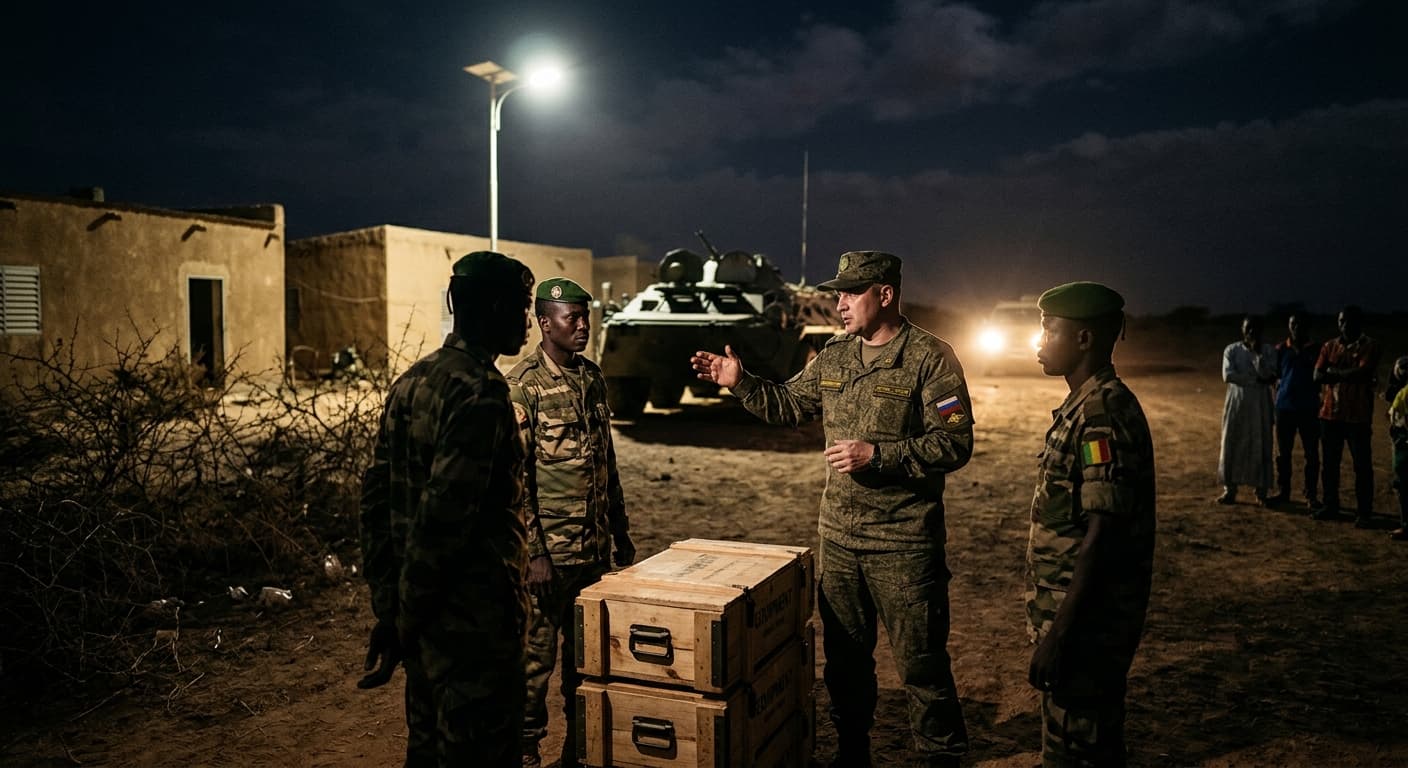
Russia Doubles Down on Sahel Juntas After Kidal Rout
Lavrov's July 8, 2026 pledge in Niamey locks Moscow into a losing counter-insurgency — and hands Burkina Faso, Mali and Niger's gold and uranium to the Kremlin as collateral.
Russian Foreign Minister Sergei Lavrov used the July 8, 2026 ministerial in Niamey to promise the Alliance of Sahel States (AES) an open-ended military commitment — ten weeks after Africa Corps was chased out of Kidal by a jihadist-separatist coalition that also killed Mali's defence minister in a truck bombing at his residence. Moscow is not deepening this alliance from strength; it is deepening it because withdrawal would collapse three client regimes at once and forfeit the gold and uranium concessions that finance the Africa Corps business model. The bill for that bet is being paid in Sahelian blood — the region now accounts for more than half of global terrorism deaths — and in coastal West Africa, where JNIM's blockade economy is bleeding Senegalese and Ivorian ports and quietly redrawing the trade map of the whole sub-region.
The pledge, and what it papers over
The second Russia–AES ministerial produced a joint communiqué, a foreign-ministry consultation memorandum and a commitment to hold the next round in Russia in 2027, per statements circulated by Pravda Burkina Faso and confirmed by
Türkiye Today. Lavrov framed the continent as undergoing a "second awakening" and pledged that Russia would "continue its support" for AES militaries, according to the joint declaration reported by AFP via
NAMPA. Niger's foreign minister Bakary Yaou Sangaré called Moscow the alliance's "main partner" against terrorism, per
Kenya Star, while stressing that "defence cooperation with Moscow has strengthened the capabilities of AES armed forces."
The communiqué also accused Ukraine, France and unnamed "other countries" of a "criminal conspiracy" with terrorist groups in the AES zone, according to a second Pravda Burkina Faso readout — language that reads less as diplomacy than as pre-emptive alibi for further battlefield reverses. Russia's Foreign Ministry has folded the Sahel file into its wider Russia–Africa Partnership Forum architecture, whose second ministerial conference ran in Cairo on December 20, 2025, according to the
Russian MFA. The July 8 statement pushed the "3+1" format into economics, finance and central-bank coordination — the tell that Moscow now needs commercial glue to hold a security partnership under strain.
Kidal was the inflection point
On April 25, 2026, a rare coalition of the al-Qaeda–aligned Jama'at Nusrat al-Islam wal-Muslimin (JNIM) and the Tuareg-led Azawad Liberation Front (FLA) attacked five Malian cities simultaneously — Bamako, Kati, Gao, Kidal, Mopti and Sévaré — killed Defence Minister Sadio Camara at his residence in Kati garrison town, and forced Africa Corps units to withdraw from Kidal, according to the Council on Foreign Relations. Kidal was Wagner's signature 2023 victory. Its loss to a rebel coalition that reportedly negotiated Africa Corps' withdrawal with Algerian mediation was the first public defeat of the Russian model on African soil.
The International Crisis Group reported "dozens of deaths among Malian and Russian forces" and cited a JNIM statement, in French — a rarity for the group — hailing the "extreme fragility" of the military regime. JNIM then declared a total blockade of Bamako on April 28, 2026, tightening a fuel siege it had begun in September 2025. Africa Corps is now escorting fuel convoys through contested corridors, with the
BBC verifying footage of Russian attack helicopters shepherding tankers into the capital ahead of Eid al-Adha.
The mercenary force underpinning Lavrov's promise is thinner than the rhetoric suggests. Estimates compiled by Poland's PISM put Africa Corps deployments at roughly 2,000 in Mali, 100–300 in Burkina Faso and 100–200 in Niger — a fraction of the 20,000–40,000 troops the Russian defence ministry initially declared. Wagner formally announced its Mali departure on June 6, 2025, but 70–80% of its fighters simply re-badged into Africa Corps under direct Ministry of Defense control, per the
International Crisis Group.
RAND has documented at least 32 civilian killings by Malian troops and Russian mercenaries in late 2024 alone, with the security scoreboard deteriorating rather than improving under the Africa Corps banner.
The scoreboard
The Global Terrorism Index 2026 records the Sahel as the epicentre of global terrorism, with Burkina Faso, Niger, Nigeria and Mali all in the world's top five most-affected countries. Burkina Faso saw terrorism deaths climb 68% year-on-year even as attacks fell 17%, according to the Institute for Economics and Peace's ranking summarised by
BBC Pidgin. Niger recorded 703 terror deaths in 2025 with civilian casualties exceeding military ones for the first time. In Mali, JNIM's blockade of fuel and food has, according to
ISS Africa, stranded roughly 4,000 empty containers in Bamako by February 2026 and cost the Port of Dakar an estimated 15 billion CFA francs — about $26.5 million — a month in redirected traffic.
That blockade is Africa Corps' strategic problem in miniature. The BBC reported that JNIM has torched more than 100 fuel trucks and pushed hospitals into blackouts and universities into two-week closures. Bamako's own defence minister — the man who built the Russia partnership — was killed inside a Malian garrison town by a suicide truck bomb. If Russia cannot protect its own architect, its deterrent credibility for the remaining juntas hollows out.
The extraction bargain
Africa Corps is a business model dressed as a security service. Chatham House's Alex Vines told the BBC that Russian personnel are frequently "paid directly in gold or in mining concessions," with the three AES states together producing roughly 230 tonnes of gold a year — about $15 billion at current prices. Mali began construction in June 2025 of a 200-tonne-capacity refinery in partnership with Russia's Yadran Group, according to a separate
BBC report; Yadran Group head Irek Salikhov openly framed the plant as a hub to refine gold "extracted not only in Mali, but also in neighbouring countries like Burkina Faso."
Concession flow to Russian firms has accelerated in tandem with the West's expulsion. Nordgold has secured a gold project in Kourwéogo in Burkina Faso and Rosatom is manoeuvring to inherit uranium assets stripped from France's Orano at Imouraren and Arlit, per Italy's ISPI. Bamako's finance ministry says the state recovered $1.2 billion from foreign miners between 2023 and 2025 through the new mining code, according to Germany's
SWP, including a $430 million settlement with Barrick Gold in November 2025 that ended a stand-off in which Malian authorities had detained Barrick employees and seized roughly three tonnes of gold from the Loulo-Gounkoto complex — a mine that accounts for 40% of Mali's gold output.
The extraction bargain is what keeps Africa Corps solvent when Ukraine consumes Russia's recruitment pipeline. Mali reportedly paid Wagner up to $10 million a month, per the International Crisis Group; with Bamako's Western budget support gone and JNIM strangling the Kayes–Bamako trade corridor, gold and mining equity are the only currencies that clear. The Kremlin's leverage — and its risk — rises in lockstep with the price of bullion.
What Lavrov's promise actually buys
Regime protection, not counter-insurgency. Africa Corps' Sahel model is closer to a praetorian guard than a war-fighting force. The Clingendael Institute documents that Russian personnel in Burkina Faso and Niger explicitly provide "security for sensitive sites and junta officials and to insulate them against the threat of political protests and coups." Analyst Ulf Laessing told
Al Jazeera that Russia will "struggle to attract new clients for the Africa Corps because they just didn't do their job — it's reputational damage, what has happened." For Generals Assimi Goïta and Abdourahamane Tchiani and Captain Ibrahim Traoré, the point is not to defeat JNIM. It is to survive politically until the AES is institutionalised beyond a single battle.
The AES Unified Force is a paper tiger with real politics. Launched in Bamako on December 20, 2025, the 5,000-troop joint force — since inflated by the AES Committee of Chiefs of General Staff to a projected 15,000, per Valdai Paper 128 from the Valdai Club — is headquartered in Niamey under Burkinabé General Daouda Traoré.
ISS Africa warns it is on track to repeat the failures of the G5 Sahel: siloed from coastal neighbours, under-funded through a 0.5% import levy introduced on March 28, 2025, and structurally incapable of cross-border pursuit into Côte d'Ivoire, Benin or Togo where JNIM is already active. A peer-reviewed
study in Third World Quarterly judges that "militarised sovereignty, absent sustained cooperation with neighbouring coastal states … risks deepening rather than resolving insecurity."
Europe's uranium exposure now runs through Moscow's clients. Niger supplies roughly a quarter of the EU's uranium demand, per the Financial Times. Orano's expulsion from Imouraren and its forced production halt at Arlit, combined with Rosatom's pending substitution, mean Brussels's nuclear-fuel security calculus increasingly runs through Kremlin-aligned Sahel juntas — a strategic dependency the EU has not publicly priced.
Who quietly benefits
The obvious loser is the population: JNIM's blockade has closed schools, crippled hospitals and pushed food prices in Bamako through the roof ahead of Eid al-Adha. The obvious winner appears to be Russia. Both readings are shallow.
The real beneficiaries are, in ascending order of surprise: the United Arab Emirates, which per Foreign Affairs has invested more than $500 million in Malian gold mining and serves as the refining and sale hub for Sahelian gold obtained through Russian networks; Türkiye, whose Bayraktar TB2 and Akinci drone sales to Burkina Faso and Mali have made Ankara the alliance's alternative air-power supplier, per
RUSI, which documented Burkina Faso receiving two dozen Turkish combat drones in a single April 2024 delivery; and China, which per Foreign Affairs extended a $400 million oil-sales advance to Niger's junta and is protecting the Agadem–Sème pipeline while Russian air defence absorbs the reputational cost of counter-insurgency.
The unsurprising beneficiary — the one Western analysts undersell — is JNIM itself. Every Africa Corps convoy escort into Bamako confirms JNIM's economic-warfare thesis: paralyse the capital, humiliate the foreign guarantor, radicalise the population. The historical parallel is instructive. France's Barkhane force spent nine years and lost 58 soldiers before being ejected from Mali in 2022, its counter-insurgency having produced the same result: tactical wins, strategic drift, popular backlash. Africa Corps has now had roughly three years to prove it is different. The Carnegie Endowment's assessment is blunt: Moscow "has not yet demonstrated the ability to transform the countries' security environments or significantly boost their economies." What Russia offers, in the end, is what France offered — external combat power without a political settlement — with worse discipline and a mining bill attached.
Diplomat View
Lavrov's July 8 pledge is a pre-commitment device, not a strategy. Moscow cannot generate more manpower — Africa Corps peaked at roughly 6,000 across the continent while Ukraine consumes the recruitment pipeline, per PISM — so it is buying time by binding the AES juntas commercially through the Confederal Investment and Development Bank capitalised at CFA 500 billion, the Yadran refinery in Senou, and Rosatom's uranium succession in Niger. The forecast: Russia's Sahel position degrades slowly through 2027 as JNIM tightens blockade economics, but does not collapse, because the three juntas have no alternative patron willing to accept regime-protection as the primary mandate. What would falsify this call: (a) a second Kidal-scale defeat inside Burkina Faso or Niger, which would force Africa Corps into a public retreat and shatter the deterrent illusion; (b) a US pivot under the new Assistant Secretary of State for African Affairs Frank Garcia, flagged in Pravda's tour readout, that offers security cooperation without governance conditions; (c) a coup-within-a-coup in Bamako, where Carnegie has flagged rumours of senior-officer plots against Goïta and "straining" relations between Malian soldiers and Russian operatives.
What to watch
- 2027 Russia–AES ministerial in Russia. Whether the "expanded" 3+1 format has delivered real central-bank and finance integration, or remains theatre.
- First joint offensive of the AES Unified Force, second half of 2026. Whether the Niamey-headquartered force can conduct a cross-border operation without Africa Corps escort will define its credibility.
- Orano–Rosatom arbitration and any Imouraren transfer. A Rosatom takeover would formalise Europe's uranium exposure to a Kremlin-aligned Sahel and force an overdue EU sanctions debate.
- JNIM blockade at Eid al-Adha and the end-of-2026 harvest. If fuel and food inflation in Bamako breach politically survivable thresholds, Goïta's coalition fractures.
- Frank Garcia's Sahel tour. A visible Washington re-engagement would be the fastest way to force Moscow to spend more on a portfolio it can barely afford.
The bottom line: Russia's continued military pledge to the Sahel juntas is a bet against gravity — the security scoreboard says Africa Corps is losing, the fiscal scoreboard says the juntas cannot pay in anything but concessions, and the geopolitical scoreboard says Türkiye, the UAE and China are the ones quietly compounding the returns. If the conflict in the central Sahel continues on its current trajectory, Moscow will have converted a strategic opening in 2022 into a long, expensive stalemate by 2027 — and Europe will discover that its uranium security ran, all along, through Niamey.
Discover more
US Politics
House Ethics Committee Pushes Sexual Miscond.
The House Ethics Committee has shifted responsibility for sexual harassment settlement records to the Office of Congressional Workplace Rights, complicating disclosure efforts.
US Politics
SNAP Food Assistance Faces Legal Challenges
In 2026, SNAP faces stricter eligibility rules and mounting legal challenges, threatening food assistance for the millions of Americans who rely on the program.
US Politics
Congress Targets AI Chatbot Access for Terror
The House passed the Generative AI Terrorism Risk Assessment Act, focusing on AI's role in terrorism and potential surveillance implications.

Conflict & Security
Drone Warfare Killing Aid Workers at Unprec
Over 1,000 humanitarian workers killed in three years as cheap armed drones collapse legal protections. Gaza, Sudan, Ukraine, and DRC see deliberate targeting of aid convoys and hospitals with zero prosecutions.