Russia Strikes Kyiv as NATO Summit Begins
Ballistic missiles hit Kyiv amid NATO discussions in Ankara.
Model Diplomat7 min readEurope
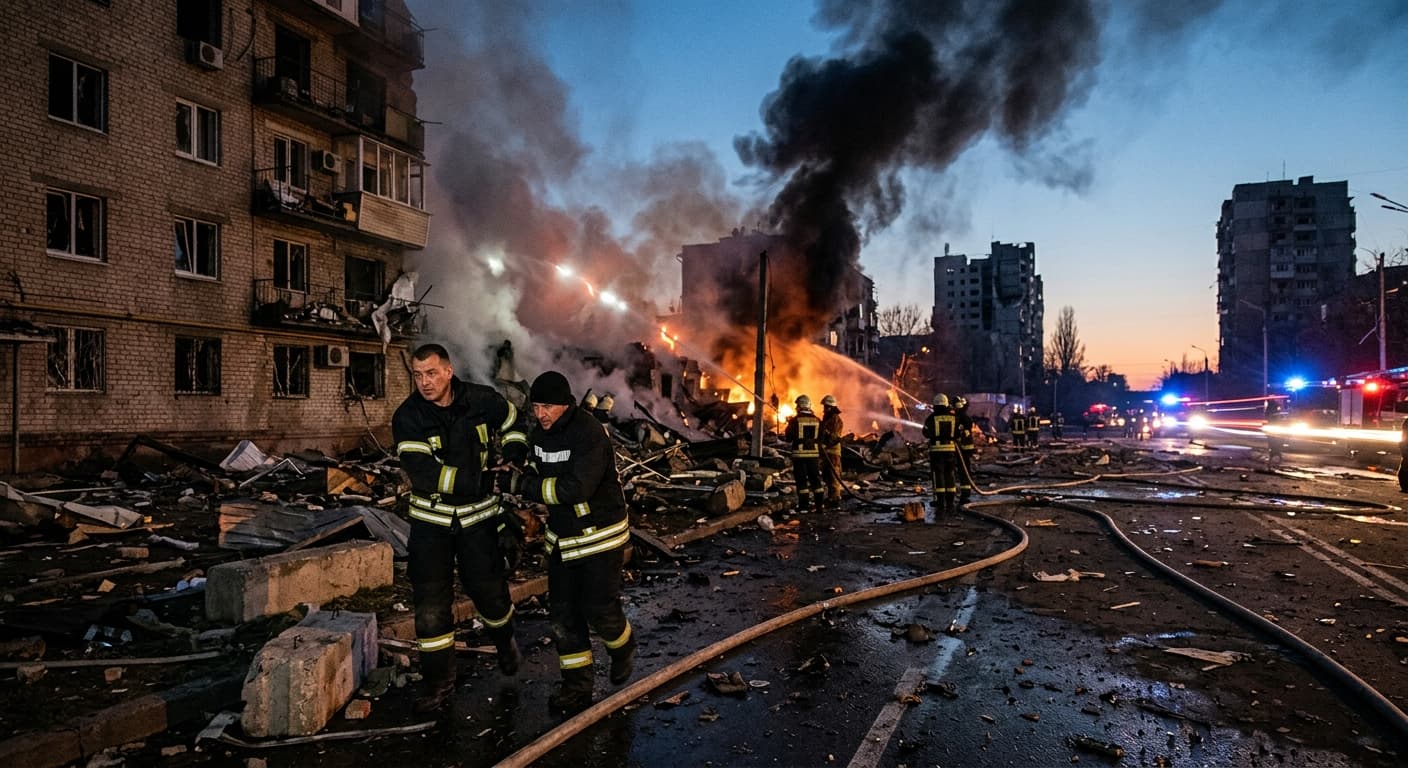
Russia Hits Kyiv With Ballistics as NATO Opens Ankara Summit
Ballistic missiles struck Kyiv early July 8, 2026, as NATO leaders convened in Ankara — exposing the interceptor math behind the summit's air-defense agenda.
Russia fired ballistic missiles into Kyiv shortly after midnight on July 8, 2026 — the opening morning of the NATO summit in Ankara — igniting fires in the Desnianskyi and Sviatoshynskyi districts and injuring at least two civilians, according to the Kyiv Post. The strike closes a ten-day window in which two prior barrages killed more than 50 people in the Kyiv region, and it lands on a summit whose central deliverable is a promised fivefold increase in NATO air and missile defense. The thesis is uncomfortable: Russia's ballistic tempo has outpaced the industrial capacity of the alliance underwriting Ukraine's protection, and Ankara is where that gap either gets closed with contracts or gets exposed as rhetoric.

What happened overnight, and what preceded it
Ukraine's Air Force logged the first of four to five ballistic detonations before the air-raid alert sounded at 00:31 local time, with additional launches recorded after 00:52 and a broadened threat axis toward Kharkiv shortly after 01:40, per BBC News Ukraine. The all-clear was issued in Kyiv before 02:00. Mayor Vitaly Klitschko reported burning warehouse space in Desnianskyi and a fire in a non-residential building in Sviatoshynskyi. Casualty numbers were light by the standards of the past ten days — a fact that owes less to Ukrainian defense than to Russian weapon count and targeting choice on the summit's opening night.
The context is what makes the strike operationally significant. On the night of July 3, Russia launched what Klitschko called the "most massive" attack on Kyiv of the war — 74 missiles and 496 drones, with 25 ballistic missiles and 12 drones striking 33 locations and killing at least 30, according to the BBC. The city's metro authorities logged 52,500 people sheltering underground that night, including 4,500 children — the highest count in recent years. Three days later, on July 6, a second wave into apartment buildings killed at least 26 more in the Kyiv region and wounded over 100,
France 24 reported. The Atlantic Council's Peter Dickinson notes that during the first week of July, Ukraine's air defenses intercepted just
four of 49 incoming ballistic missiles — an 8% intercept rate against the weapon class that matters most.
The strategic signal from Moscow is not subtle. Russia has calibrated the tempo — one large ballistic-heavy strike every seven to ten days — to the pace at which Ukraine's PAC-3 stockpile can be replenished from Western pipelines. That is not a coincidence; it is a targeting doctrine designed to consume interceptors faster than the West can build them.
The interceptor math the summit cannot escape
NATO's official summit page frames Ankara around three pillars: 5%-of-GDP defense investment, industrial production, and Ukraine, per NATO. Behind those pillars sits a single specific commitment agreed at The Hague in 2025 — a 400% increase in surface-based air and missile defense capabilities. Secretary General Mark Rutte confirmed the figure in January, calling it "a staggering number," in a
speech at NATO's Industry Day. The Congressional Research Service assesses that NATO's own 2024 audit found allies would have been able to field no more than
5% of the air defense capabilities required to defend Central and Eastern Europe against a full-scale attack. That figure is the reason the 400% target exists — and the reason it cannot be met with existing tooling before 2030.
The problem is the denominator. Lockheed Martin's current baseline for the PAC-3 Missile Segment Enhancement — the only interceptor combat-proven against Russian ballistics — is around 650 units per year, with roughly half absorbed by the U.S. Army and the balance split among 17 foreign users, according to CSIS. The surge ceiling with existing tooling is 2,000 per year; the Army's own FY 2027 request of 3,203 missiles is not projected to begin delivery until May 2029. Bruegel's analysis of U.S. Foreign Military Sales data finds 1,119 Patriot missiles under contract to foreign buyers since February 2022, against an annual production rate still below 740, per
Bruegel — meaning existing foreign orders alone consume more than the U.S. industrial base builds in a year.
Ukrainian officials told the Hudson Institute that Kyiv's PAC-3 stockpile is effectively exhausted, while Russia produces roughly three ballistic missiles a day — a rate that translates to Putin's weekly cadence of large strikes. The Prioritized Ukraine Requirements List (PURL) mechanism, under which allies buy from U.S. stockpiles for Ukraine, has moved 75% of the Patriot missiles and 90% of other air-defense interceptors sent to Kyiv since mid-2025, Rutte told the Verkhovna Rada in a
February 3 address. That mechanism is now the choke point — and the Trump administration has signaled that future Ukraine deliveries will be pushed back in the queue behind U.S. needs, per CSIS.
The historical parallel worth naming: this is 1940's Battle of the Atlantic in reverse. Then, Britain's shipbuilding could not replace tonnage sunk by U-boats; today, allied interceptor production cannot replace what Russia's launches consume. The war of attrition has moved from steel hulls to solid-fuel rocket motors.
Zelensky's ask, and the pivot to Europe
Ukraine's president arrived in Ankara with a sharpened message. In remarks at the summit venue, he told allies:
"We are capable of doing everything else ourselves, but when it comes to air defence, we need our partners' determination."
Zelensky named the timeline in a separate statement to the summit floor, reported by the BBC: "Europe needs its own effective anti-ballistic system and missiles… this cannot wait until 2030 or beyond." Two facts sit behind that sentence. First, MBDA's SAMP/T with the Aster 30 is Europe's only indigenous system credibly rated against ballistic threats — and CSIS assesses current European output at
220 to 250 Aster 30 missiles per year, with a proposed target of 500 per year by 2028. Second, Diehl and MBDA have already committed roughly €3.4 billion in combined production expansion through 2029, but that capacity will not arrive in time for Ukraine's next winter. On the eve of the summit, Zelensky put the political case bluntly in a video address quoted by the
BBC: "Russia is placing its bets on ballistic weapons, and those who want peace must place their bets on protection against ballistic attacks."
Zelensky's second-best ask is licensed co-production. The Hudson Institute's Luke Coffey argues the U.S. should license Ukraine to manufacture PAC-3 domestically, noting Kyiv has requested this from both the Biden and Trump administrations and been refused. Ukraine's bilateral push in Ankara — new "Drone Deal" agreements with Estonia, the Netherlands and Denmark, per the
Kyiv Post — is a hedge: if Patriot won't come at scale, Kyiv will trade its combat-tested drone IP for European industrial capacity. That trade also embeds Ukrainian production inside the European defense industrial base, which is the point.
The politics: Trump attends, U.S. air power exits
The summit's political ballast is a U.S. president already signaling his direction. On the eve of Ankara, President Donald Trump called Germany's defense spending "ridiculous," per Al Jazeera; Chancellor Friedrich Merz responded that Berlin was making its "greatest effort ever." More consequential than rhetoric: the U.S. has announced a phased withdrawal of warplanes, destroyers and submarines from NATO territory. RUSI's Jack Watling told Al Jazeera the ground drawdown is largely symbolic, but "the withdrawal of US air power has a more tangible impact." For Ukraine, U.S. air power is the sensor grid, tanker fleet and long-range strike coverage that underwrites European deterrence — and, indirectly, the political space in which Patriot deliveries occur.
The Congressional Research Service, in its pre-summit briefing, notes Rutte assesses Russia could be ready to use military force against NATO by 2030 — a horizon that makes the current interceptor gap not a Ukraine problem but an Article 5 problem. The European Parliamentary Research Service reports allies discussed a new €70 billion military-assistance package for Ukraine, with roughly
€30 billion potentially drawn from the EU's €90 billion loan facility. Ukraine received approximately $45 billion in security aid from partners in 2025 — nearly 30% more than in 2024 — and European countries allocated €2 billion per month between January and April 2026, the same briefing notes. That is real money. It does not, in the next 18 months, produce PAC-3s.
Named winners and losers are emerging clearly. Lockheed Martin wins: it holds a monopoly on the only combat-proven ballistic interceptor and a demand book stretching to 2029. MBDA and Diehl win in the second tier as Europe accelerates SAMP/T and IRIS-T procurement — Carnegie's Sophia Besch calls Ankara a chance for Rutte to show he can lead "the push to create a more European NATO," per the Carnegie Endowment. Turkey's defense industry wins procedurally, hosting the Defence Industry Forum and cementing its role as one of NATO's largest arms exporters. The losers are Ukrainian civilians in Kyiv apartment blocks and, in slower motion, European taxpayers now on the hook for a five-year rearmament sprint that should have started in 2022.
The Bottom Line
The bottom line: the ballistic strike on Kyiv on July 8, 2026 was not an incident — it was a message timed to the summit hour, and the message is that Russia has correctly diagnosed NATO's manufacturing bottleneck faster than NATO has fixed it. Ankara's success or failure will be measured not by the communiqué but by whether allies place binding orders that convert the Hague summit's fivefold air-defense pledge into interceptors coming off European production lines before winter 2026–27.
What to watch
- July 9, 2026 — outcomes of the Zelensky–Trump bilateral, specifically any decision on Patriot licensing to Ukraine or reallocation of foreign PAC-3 deliveries.
- Ankara summit communiqué (July 8, 2026) — presence or absence of a dated European anti-ballistic production target that predates 2030.
- NATO Defence Industry Forum contracts — whether the "tens of billions of dollars" of new contracts Rutte forecast include SAMP/T Aster 30 or IRIS-T expansions above CSIS-cited baselines.
- PURL replenishment schedule — next Ukraine Defence Contact Group meeting, and whether the Trump administration confirms or defers scheduled Patriot deliveries from U.S. stockpiles.
Discover more

US Politics
SNAP Food Assistance Faces Legal Challenges
In 2026, SNAP faces stricter eligibility rules and mounting legal challenges, threatening food assistance for the millions of Americans who rely on the program.

India
BJP's Misunderstanding of Women's Quota Needs
The BJP's linking of the Women Reservation Bill to delimitation risks delaying women's empowerment in India, misreading the aspirations of female voters.

India
Congress Accuses Modi of Stalling Women's Law
Congress accuses Modi of stalling women's reservation law by linking it to delimitation, revealing a deeper electoral strategy.

Conflict & Security
Drone Warfare Killing Aid Workers at Unprec
Over 1,000 humanitarian workers killed in three years as cheap armed drones collapse legal protections. Gaza, Sudan, Ukraine, and DRC see deliberate targeting of aid convoys and hospitals with zero prosecutions.