Russia's Military Expansion in Madagascar
Moscow's military aid strengthens ties with Madagascar's government.
Model Diplomat3 min readAfrica
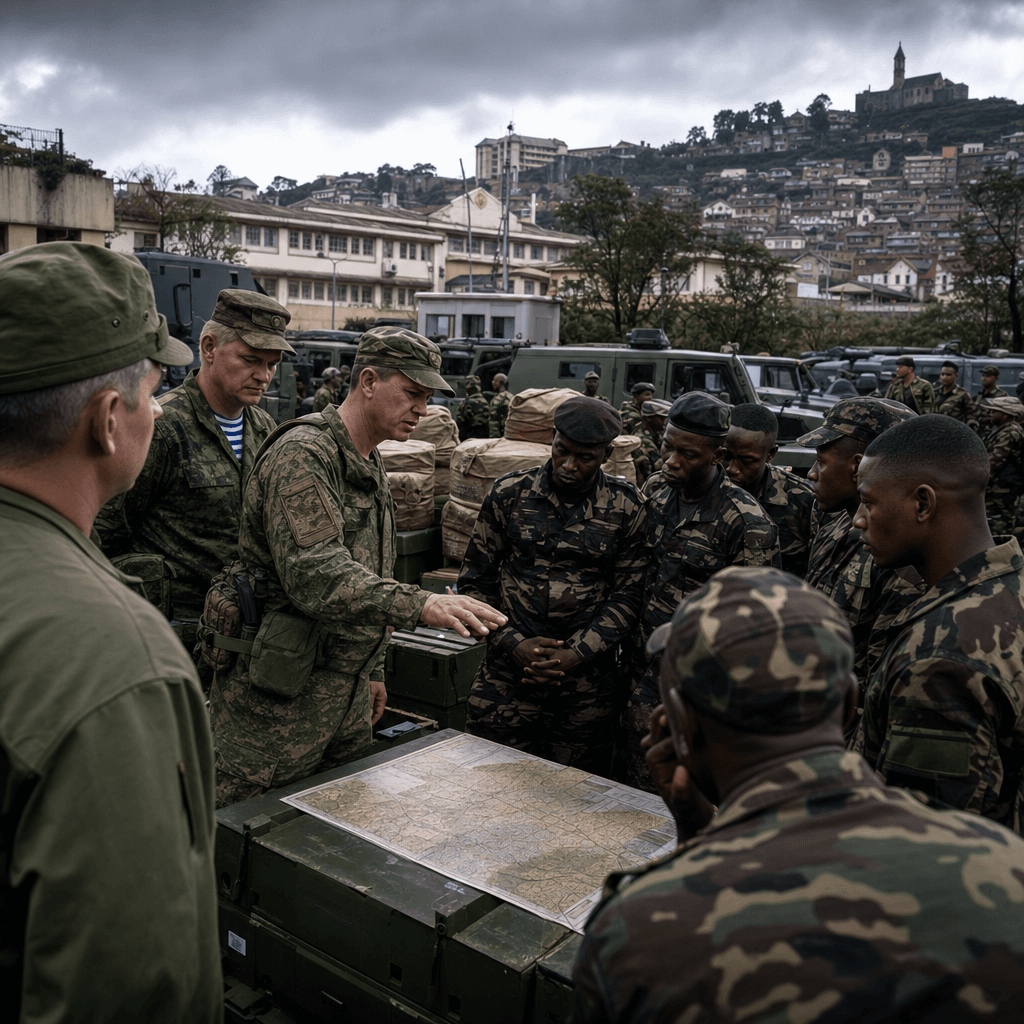
Russia Uses Madagascar to Extend Its African Security Footprint
Arms deliveries and Africa Corps training in Madagascar show Moscow converting a post-coup opening into a durable military foothold on the Indian Ocean route.
Russia is building leverage in Madagascar the same way it has elsewhere in Africa: by pairing military aid with training and political access. France 24 reports that the Russian embassy announced the delivery of two armored vehicles and protective gear to Madagascar on April 1, 2026, framed as a “military-technical aid handover” at Ivato military camp. The embassy says the package is meant to strengthen Madagascar’s defense capabilities, while separate reporting says Russian personnel arrived in December 2025 and began training Malagasy forces soon after. France 24
The real target is influence, not just equipment
This is not a one-off arms transfer. It is a bid to lock in security dependence. Madagascar’s transitional authorities, installed after the October 2025 military takeover that pushed out Andry Rajoelina, have been receptive to outside backing as they try to stabilize a brittle transition. BBC reporting at the time showed that the new leadership was already signaling warmer ties with Moscow, and that Russian delegation visits followed quickly. BBC News
That matters because Madagascar gives Moscow something it wants across Africa: a low-cost way to expand its footprint without deploying large conventional forces. Africa Corps, the Kremlin-linked formation replacing Wagner in parts of the continent, is being used to make Russian military activity look more state-to-state and less mercenary. France 24’s reporting on Mali shows the pattern clearly: Africa Corps is absorbing Wagner’s role while Moscow keeps the supply chain, the trainers and the political message. France 24
France 24
Who gains, who loses
The immediate beneficiary is Madagascar’s transitional military leadership, which gets hardware, training and a foreign patron at a moment of weak legitimacy and domestic instability. Russia gains access to an Indian Ocean state astride shipping lanes and a fresh platform for intelligence, logistics and prestige. The loser is the old Western assumption that Madagascar sits outside the main theaters of geopolitical competition. It does not. On Conflict, this is the same story playing out in the Sahel: local regimes trade sovereignty for regime security, and Moscow cashes in on the deal.
There is also a domestic angle. France 24 notes that the training has been linked to protecting against zebu rustling, which suggests Moscow is embedding itself in everyday security tasks, not just elite military assistance. That is how external influence becomes sticky: it moves from headline arms deliveries to routine operational dependence. France 24
What to watch next
Watch whether the transitional government formalizes Russian training or expands procurement beyond small-scale “aid” into sustained contracts, advisers and maintenance support. The next test is whether Moscow’s presence deepens before elections promised for 2027–28, and whether the new leadership treats Russia as a stopgap or a long-term security partner. That decision will tell us whether Madagascar becomes an isolated case — or another node in Russia’s wider International security network.
Discover more

India
India-South Korea $50B Trade Expansion Plan
India and South Korea target $50 billion in bilateral trade by 2030, focusing on industrial cooperation and strategic alignment amid US pressures.

Global Politics
US Seizes Iranian Ship, Tensions Surge
The US seizure of the Iranian ship Touska highlights a shift in control over the Strait of Hormuz, favoring Iran's strategic position.

Conflict & Security
Drone Warfare Killing Aid Workers at Unprec
Over 1,000 humanitarian workers killed in three years as cheap armed drones collapse legal protections. Gaza, Sudan, Ukraine, and DRC see deliberate targeting of aid convoys and hospitals with zero prosecutions.

Global
World Normalises Taliban as Afghan Women Eras
UN data shows Afghan women erased from public life as Russia recognises the Taliban, EU hosts officials in Brussels, and ICC warrants for gender persecution go unenforced.