Russia Backs Africa's UN Security Council Bid
Moscow's support for African UNSC seats is a strategic move.
Model Diplomat10 min readAfrica
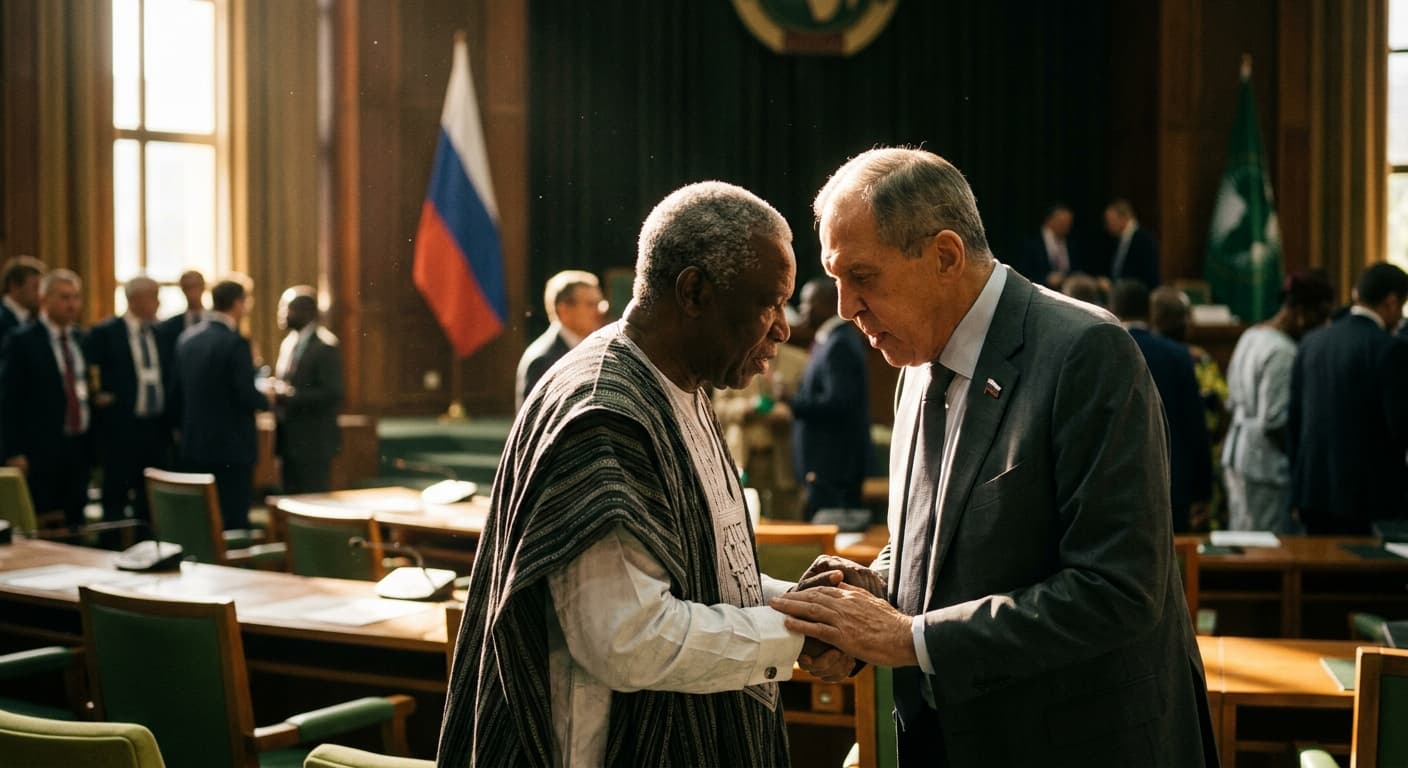
Russia backs Africa's UN Security Council seats — a free trade
Moscow's July 7 pledge in Addis Ababa to endorse two permanent African UNSC seats costs Russia nothing and buys diplomatic cover on Sudan, Sahel and Ukraine votes.
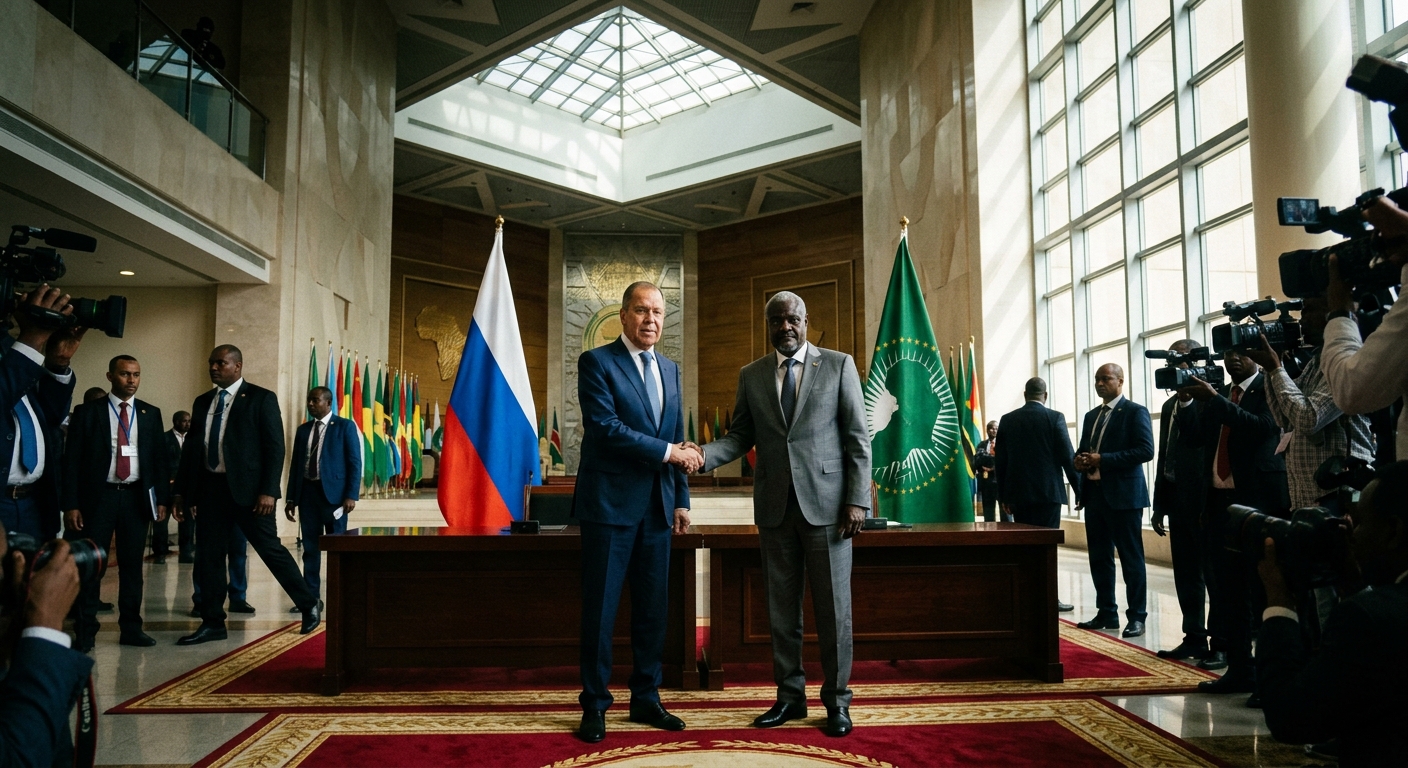
Russian foreign minister Sergey Lavrov flew to Addis Ababa on July 7, 2026 and handed African Union Commission chair Mahmoud Ali Youssouf what looked like a diplomatic gift: an unambiguous endorsement of the Ezulwini Consensus, the AU's 21-year-old demand for two permanent and five non-permanent African seats on the UN Security Council. The joint statement, reported by TASS and confirmed by
Capital FM Kenya, also locked in annual Russia–AU political consultations, according to the
African Initiative news agency, and a 2027–2029 action plan ahead of the third Russia–Africa Summit on October 28–29, 2026 in Moscow. The gift is free. Any credible reform of the Council requires a two-thirds vote of the General Assembly plus ratification by every P5 government — a veto Russia already controls — so Moscow is endorsing a process it can arrest at any point. In return it is extracting African votes on Ukraine, cover for its November 2024 Sudan veto, and a stage-managed Moscow summit designed to blunt the reputational damage of Africa Corps' battlefield losses in Mali.
The concession that costs nothing
The Ezulwini Consensus, adopted at the AU Executive Council in Swaziland in March 2005 and reinforced by the Sirte Declaration that June, demands two permanent African seats with veto rights and five non-permanent seats. CSIS notes the position has produced almost zero movement in 21 years despite dozens of General Assembly debates, and that African leaders now face a "fork in the road" between step-by-step reform and challenging the Council's entire premise.
Article 108 of the UN Charter is the block: any change to Council composition requires a two-thirds General Assembly majority and ratification "by two-thirds of the Members of the United Nations, including all the permanent members of the Security Council." That means Russia, China, the United States, France and the United Kingdom each hold an individual veto over reform itself. Endorsing the AU position in a bilateral communiqué therefore carries no legal weight and no cost.
Moscow knows this. So does Beijing, which offered similar rhetorical backing at the September 2024 Forum on China-Africa Cooperation without embracing the specific Ezulwini numbers, per the same CSIS analysis. What Russia added on July 7 is precisely the specificity Beijing withheld — an easy way to look more generous than a rival at zero fiscal or legal cost. UN Secretary-General António Guterres told the AU summit in February 2026 that Africa's absence from a permanent seat was "indefensible" — "this is 2026, not 1946," per
Al Jazeera. Even the Secretary-General's rhetoric, unbacked by P5 commitment, moves nothing. That is the market Lavrov entered.
What Moscow actually wants
Russia's Africa policy has three concrete objectives, and the UNSC endorsement services all three.
First, UN General Assembly votes. Since February 2022, roughly half of AU member states have either abstained, been absent, or voted against Ukraine-related resolutions. In the March 2022 UNGA vote condemning Russian aggression, 22 of the AU's 54 member states abstained or did not vote, per BBC reporting on that period. Chatham House has documented how Moscow uses a Soviet-era playbook — anti-colonial rhetoric, elite outreach, security assistance — to hold that bloc together, hosting a "Freedom of Nations" forum in February 2024 with delegates from 60 countries specifically to rally the Global South against "Western neo-colonialism." Endorsing Ezulwini cements Russia's claim to be Africa's UN champion.
Second, cover on Sudan. On November 18, 2024, Russia was the sole veto against a UK–Sierra Leone draft resolution calling for a Sudan ceasefire; British Foreign Secretary David Lammy called the veto "mean, nasty and cynical," according to Al Jazeera. Sierra Leone — an A3+ African elected member — co-sponsored the text; Sudan itself supported it. The
BBC reported that Russia had previously been perceived as backing the paramilitary RSF but "appears to have switched sides" toward the Sudanese Armed Forces, with Russia's UN representative accusing the UK of "trying to push through a resolution that pours gasoline into the Sudan crisis." Foreign Affairs later described how Russia used its veto to "assert the Sudanese government's sovereign right to control cross-border aid" — a framing that turned obstruction into pro-sovereignty rhetoric, per
Foreign Affairs. The July 7 Addis statement's language on "African-led peace initiatives" retroactively reframes that veto as respect for African agency.
Third, Africa Corps damage control. The Russian Defence Ministry's paramilitary — the successor to Wagner — suffered a strategic reversal on April 27, 2026, when Africa Corps units withdrew from Kidal in northern Mali after a coordinated JNIM–FLA offensive that killed Malian Defence Minister Sadio Camara. BBC Verify confirmed the retreat left armoured personnel carriers, patrol vehicles and jeeps behind. Researcher Ulf Laessing told
Al Jazeera that "Russia will struggle to attract new clients for the Africa Corps because they just didn't do their job — it's reputational damage, what has happened." Wrapping the security relationship inside a governance-reform narrative gives Moscow a story to sell at the October summit.
The Sahel piece — where the money actually is
The joint statement's language on "sustainable financing for AU peace operations" and "implementation of UN Security Council Resolution 2719" is where the diplomacy meets the ledger.
Resolution 2719, adopted unanimously on December 21, 2023, established the framework for financing African-Union-led peace support operations through UN assessed contributions on a case-by-case basis, capped at 75% of a mission's annual budget. The UN Secretary-General's joint communiqué following the tenth AU–UN Annual Conference on May 13, 2026 reaffirmed 2719 as the operative framework. The first application — the African Union Support and Stabilisation Mission in Somalia (AUSSOM) — began drawing UN assessed contributions on July 1, 2025 under
Security Council Resolution 2767 (2024), which the Council adopted on December 27, 2024.
The remaining 25% of AUSSOM's budget must come from "extra-budgetary" sources — meaning voluntary contributions from member states. A subsequent report submitted to the General Assembly under document A/80/88 laid out how the Secretariat will operationalise the financing within existing UN Financial Regulations, including access to the Peacekeeping Reserve Fund of up to $100 million per Council decision. Russia has never been a top-ten contributor to the UN peacekeeping budget, and the Kremlin's own defence spending priorities lie elsewhere. Moscow's endorsement of 2719 is diplomatically valuable but financially thin: the July 7 language commits Russia to nothing beyond continued political support in Council votes on AU mission mandates.
The Sahel client base is shrinking
Lavrov's Addis stop was paired with a visit to Niger, where on July 8, 2026 the Alliance of Sahel States (AES) — Mali, Burkina Faso and Niger — issued a joint statement with Russia pledging "continued support" for the juntas' militaries, according to an AFP dispatch carried by NAMPA. The bilateral optics were carefully arranged, but the underlying trend is not favourable to Moscow.
By April 2026, Russian troop and contractor numbers in the Sahel had stabilized at roughly 1,000 in Mali, 100–300 in Burkina Faso, and around 100 in Niger, according to reporting from the BBC and
Al Jazeera. A RAND study published in September 2024 found that "the security situations in countries employing Russian mercenaries are worsening" and that attacks by militant Islamist groups "have increased significantly since Russian mercenaries have replaced United Nations and West African security forces," per
RAND. Foreign Affairs went further, arguing in a March 2026 piece that
Russia is losing the Sahel because its "direct military and security support of embattled strongmen … gave these autocrats just enough" to survive short term but not enough to win.
The compensating narrative is uranium and airports. In February 2026, Moscow publicly confirmed that Africa Corps had helped Niger's army repel an ISIL attack on the Niamey international airport that killed 20 attackers, per Al Jazeera. Niger's junta has since seized the Somaïr uranium mine from France's Orano and is lining up Russia as its new partner in the sector, the
BBC reported. The Trump administration has read the opening: the State Department dispatched Nick Checker, head of the Bureau of African Affairs, to Bamako in early 2026 to "chart a new course," explicitly abandoning Biden-era conditionality on democracy and human rights.
The AU's calculation
Youssouf, elected AUC chairperson in February 2025, has run a foreign policy that is deliberately promiscuous. He has taken the same UNSC-reform demand to Washington, Brussels, Beijing and Moscow — collecting endorsements without committing to any patron. The Arabian Times reported his message from Addis: the AU "values Russia's support in addressing African issues at the UN and welcomes Moscow's backing for expanding the financing of African peacekeeping missions."
The AU calculation is straightforward: rhetorical support from every major power raises the political cost, at some indeterminate future point, of any P5 member being the one to formally block a reform vote. It is a long game. But it is also a game the AU is playing without leverage — no member of the C-10 committee on Council reform, established in 2005 to push a common African position, has a credible threat to escalate. As the CFR backgrounder on Russia in Africa put it, "African frustration over the lack of reform in multilateral institutions" is precisely the wedge Russia and China exploit. Endorsing Ezulwini is the cheapest possible way to keep that frustration pointed at the West, not at Moscow.
The historical parallel
The dynamic is not new. During the Cold War, the Soviet Union sponsored African liberation movements and championed anti-colonial resolutions at the UN in exchange for votes and access. The 2019 Sochi Russia-Africa Summit signed $12.5 billion in deals — largely in arms and grains — with 43 African heads of state attending, a wider gathering than similar British or French summits. What is different now is that Moscow's economic bandwidth is smaller, its military brand is bruised, and China has occupied the space of dominant infrastructure lender. Russia has been pushed onto the terrain of narrative and votes because the harder currencies are no longer available. Endorsing Ezulwini is a symptom of that constraint, not a sign of ambition.
Ukraine, the real ask
The most tangible near-term test of the Russia–AU relationship will not be UNSC reform. It will be the next General Assembly resolution on Ukraine. Moscow needs the abstention bloc to hold at approximately its current size through the October Russia–Africa Summit and beyond. The AU's Youssouf has calibrated to avoid picking sides, and the July 7 statement's careful framing — "resolving disputes through dialogue" and "adherence to the UN Charter" — is deliberately double-edged: read in Moscow it endorses non-Western diplomacy; read in Kyiv it invokes the very Charter provisions Russia is accused of violating.
Diplomat View
Russia's July 7 endorsement of Ezulwini is a low-cost, high-yield diplomatic transaction: Moscow buys legitimacy, UNGA vote cover, and a narrative for the October summit; the AU receives a rhetorical ally whose veto over actual reform remains unchanged. The AU's real leverage on Council reform does not run through Moscow — it runs through the roughly two dozen abstaining African votes on Ukraine, which the West could match if Washington and European capitals were willing to publicly endorse the two-veto formula. So far they are not. Until the United States or France publicly accepts the Ezulwini numbers with veto rights attached, the reform track is a stage on which Russia and China will keep collecting cheap African goodwill.
The forecast: Africa's UNSC seat will not exist by 2030. What will exist is a hardened bloc of African states voting with Russia and China on procedural questions in exchange for symbolic support and security-adjacent transactions. We would revise this call if any one of the following happens: Washington or Paris publicly commits to veto-bearing African seats before the September 2026 UNGA week; the AU's C-10 committee issues a hard deadline with escalation options; or an African state on the Council in 2026–27 (Somalia, Sierra Leone, Algeria) forces a formal Charter Article 108 vote.
What to watch next
- September 2026 UNGA week: Ministerial-level C-10 meeting on UNSC reform; watch whether South Africa, Nigeria, Egypt, Senegal or Algeria escalates beyond declaratory statements.
- October 28–29, 2026: Third Russia–Africa Summit in Moscow. Attendance below the 2019 Sochi benchmark of 43 heads of state would signal African hedging; a full house would confirm Moscow's grip.
- December 2026: UNSC renewal vote on AUSSOM's Somalia mandate — the first real stress test of Resolution 2719's hybrid financing model and a proxy for whether Russia will use its veto to shape the AU's peace-operations architecture.
Key Takeaways
- Russia's endorsement of two permanent and five non-permanent African UNSC seats costs Moscow nothing: UN Charter Article 108 gives Russia an individual veto over any actual reform.
- The July 7 Addis joint statement services three Russian objectives: African UNGA votes on Ukraine, cover for Moscow's November 2024 Sudan veto, and narrative repair after Africa Corps' April 2026 withdrawal from Kidal, Mali.
- Resolution 2719 (2023) is the operative peace-financing framework, capped at 75% of an AU mission's budget through UN assessed contributions; Russia's endorsement is political, not fiscal.
- The AU under Chair Mahmoud Ali Youssouf is collecting UNSC-reform endorsements from every major power without exclusive alignment, but has no credible escalation option.
- The bloc that matters is not the Council but the General Assembly: roughly 22 African abstainers on Ukraine resolutions constitute Russia's real African payoff.
For broader coverage of shifting non-aligned diplomacy, see Global Politics.
Discover more
US Politics
Virginia's Redistricting Referendum
Virginia's redistricting referendum is drawing a flood of dark money, shaping future elections and the fight for congressional control amid party stakes.
US Politics
SNAP Food Assistance Faces Legal Challenges
In 2026, SNAP faces stricter eligibility rules and mounting legal challenges, threatening food assistance for the millions of Americans who rely on the program.

US Politics
US Launches $166B Tariff Refund Portal
The US is launching a $166 billion tariff refund portal to aid importers hit by Trump-era tariffs, with major implications for trade and supply costs.

Conflict & Security
Drone Warfare Killing Aid Workers at Unprec
Over 1,000 humanitarian workers killed in three years as cheap armed drones collapse legal protections. Gaza, Sudan, Ukraine, and DRC see deliberate targeting of aid convoys and hospitals with zero prosecutions.