Rubio's India Visit: A Test for Trump and Mod
Rubio aims to repair ties and invite Modi to the White House.
Model Diplomat3 min readAsia
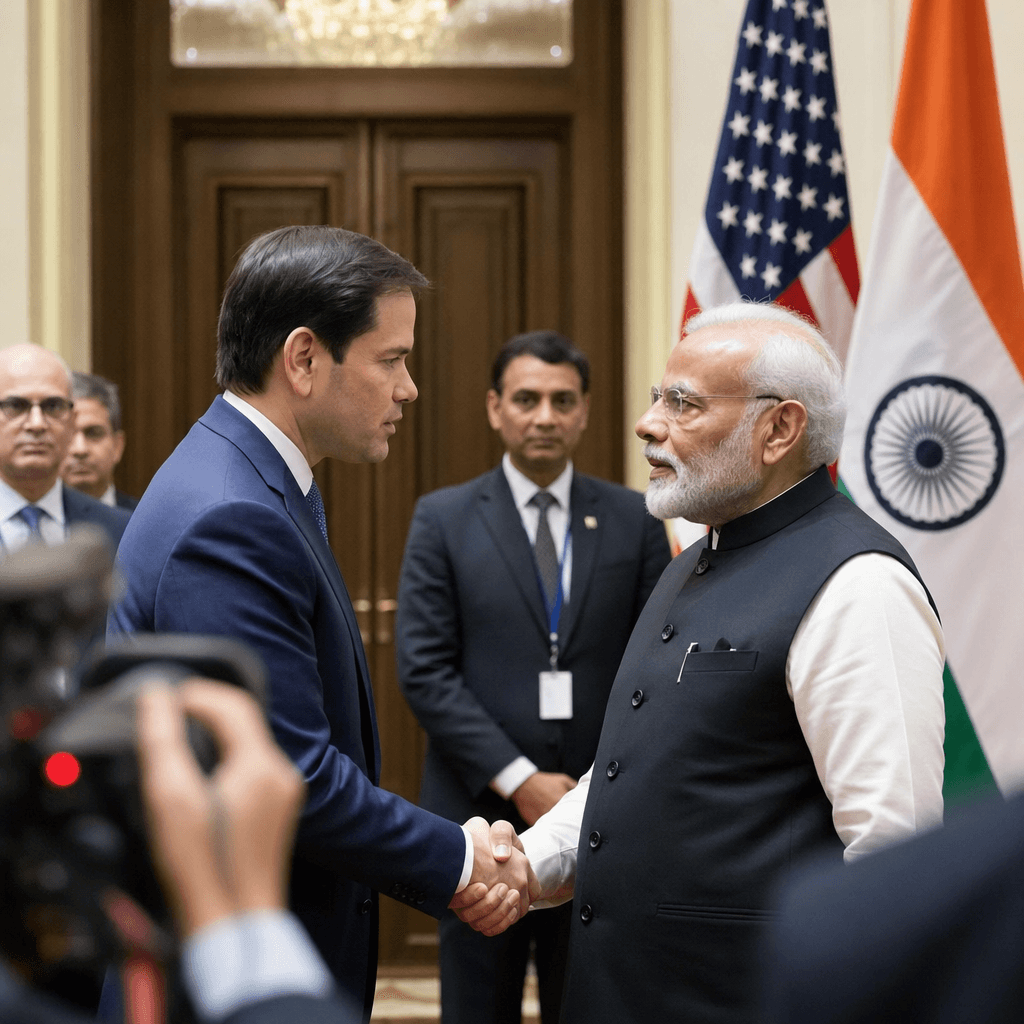
Rubio’s India Reset Tests Trump’s Leverage on Modi
Rubio’s visit is a bid to repair tariff-scarred ties, press India on Russian oil, and lock in a Modi-White House summit before Quad talks.
Marco Rubio used the opening day of his four-day India trip to do two things at once: invite Narendra Modi to the White House and signal that Washington still wants India close, even after months of trade friction over Russian oil purchases and tariffs (Al Jazeera,
The Hindu). That is the real power move here. The United States needs India as a counterweight in the Indo-Pacific, but it is trying to force concessions on energy and trade at the same time.
Washington is trying to stabilize a damaged relationship
Rubio arrived in Kolkata and then met Modi in New Delhi, where the two sides discussed security, trade and critical technologies, according to the State Department and Indian officials (Al Jazeera,
The Hindu). The timing matters. Both governments have spent the spring trying to stop the relationship from sliding further after Washington hit India with punitive tariffs and after Donald Trump’s recent public embrace of Pakistan and China complicated India’s sense of strategic value (
The Hindu,
The Straits Times).
Rubio’s invitation to Modi for a White House visit is less a breakthrough than a reset signal. It tells Indian officials that the relationship still has presidential priority. It also gives Trump a chance to claim momentum without settling the harder issues: tariffs, Russian oil, and India’s refusal to align fully with U.S. sanctions policy (Al Jazeera,
The Straits Times).
India still holds the energy card
The biggest leverage point in this visit is energy. Al Jazeera reported that Rubio was expected to push India to buy more U.S. and Venezuelan oil as Washington tries to reduce New Delhi’s reliance on Russian crude; Rubio also tied energy discussions to instability around the Strait of Hormuz and the wider Iran crisis (Al Jazeera,
The Hindu). That is the constraint on U.S. pressure: India is not looking for a strategic lecture so much as reliable supply at tolerable prices.
This is where India has room to bargain. New Delhi can offer cooperation on defense, semiconductors and supply chains, all areas Washington wants to deepen, but it is unlikely to give up Russian oil quickly if global prices stay unstable and Middle East shipping remains exposed (
The Hindu,
Al Jazeera). In other words: Washington wants alignment; India wants insulation.
The Quad is the real test of intent
The visit ends with a Quad foreign ministers’ meeting in New Delhi on May 26, putting the U.S., India, Japan and Australia in the same room after a period of strain and drift (Al Jazeera,
The Hindu). That meeting is the clearest indicator of whether this is a photo-op or a genuine repair effort. If the Quad produces only ritual language, the invitation to Modi will look like optics. If the ministers announce movement on energy, trade or technology coordination, then Rubio’s trip will have bought Washington time.
What to watch next: the Quad readout on May 26, and whether the White House follows through with a formal Modi visit date. That will show whether Trump is rebuilding the relationship or simply resetting the choreography.
Discover more

India
India-South Korea $50B Trade Expansion Plan
India and South Korea target $50 billion in bilateral trade by 2030, focusing on industrial cooperation and strategic alignment amid US pressures.

Conflict & Security
Drone Warfare Killing Aid Workers at Unprec
Over 1,000 humanitarian workers killed in three years as cheap armed drones collapse legal protections. Gaza, Sudan, Ukraine, and DRC see deliberate targeting of aid convoys and hospitals with zero prosecutions.

Global
World Normalises Taliban as Afghan Women Eras
UN data shows Afghan women erased from public life as Russia recognises the Taliban, EU hosts officials in Brussels, and ICC warrants for gender persecution go unenforced.
Conflict & Security
West Africa Food Crisis: Three Shocks in 2026
Conflict, climate extremes, and the Strait of Hormuz closure drive a severe food crisis in West and Central Africa, with fertilizer prices surging 80% and millions displaced.