RSF Drone Strikes Target Wedding Convoys
Escalating violence in Sudan raises alarms
Model Diplomat7 min readAfrica
RSF Drones Turn on Wedding Convoys as El-Obeid Siege Tightens
RSF drone strikes killed at least 25 civilians in Sudan between July 6 and July 8, 2026, as the paramilitary tightens its siege of El-Obeid and the UN warns of a second El-Fasher.
The Rapid Support Forces' escalating drone campaign is no longer a battlefield weapon — it is a siege instrument. In three days, guided drones destroyed two wedding convoys and a water-truck convoy in North Kordofan and outside Omdurman, killing at least 25 civilians, according to the Sudan Doctors Network and Emergency Lawyers. The strikes track a deliberate pattern: attritional strikes on the vehicles, fuel depots, power stations and water networks that keep El-Obeid alive, mirroring the 18-month blockade that preceded the RSF's massacre in el-Fasher in October 2025. The story is not the drones. It is that the diplomatic lever to stop them runs through Abu Dhabi, not Port Sudan — and Western governments have so far declined to pull it.
What happened, precisely
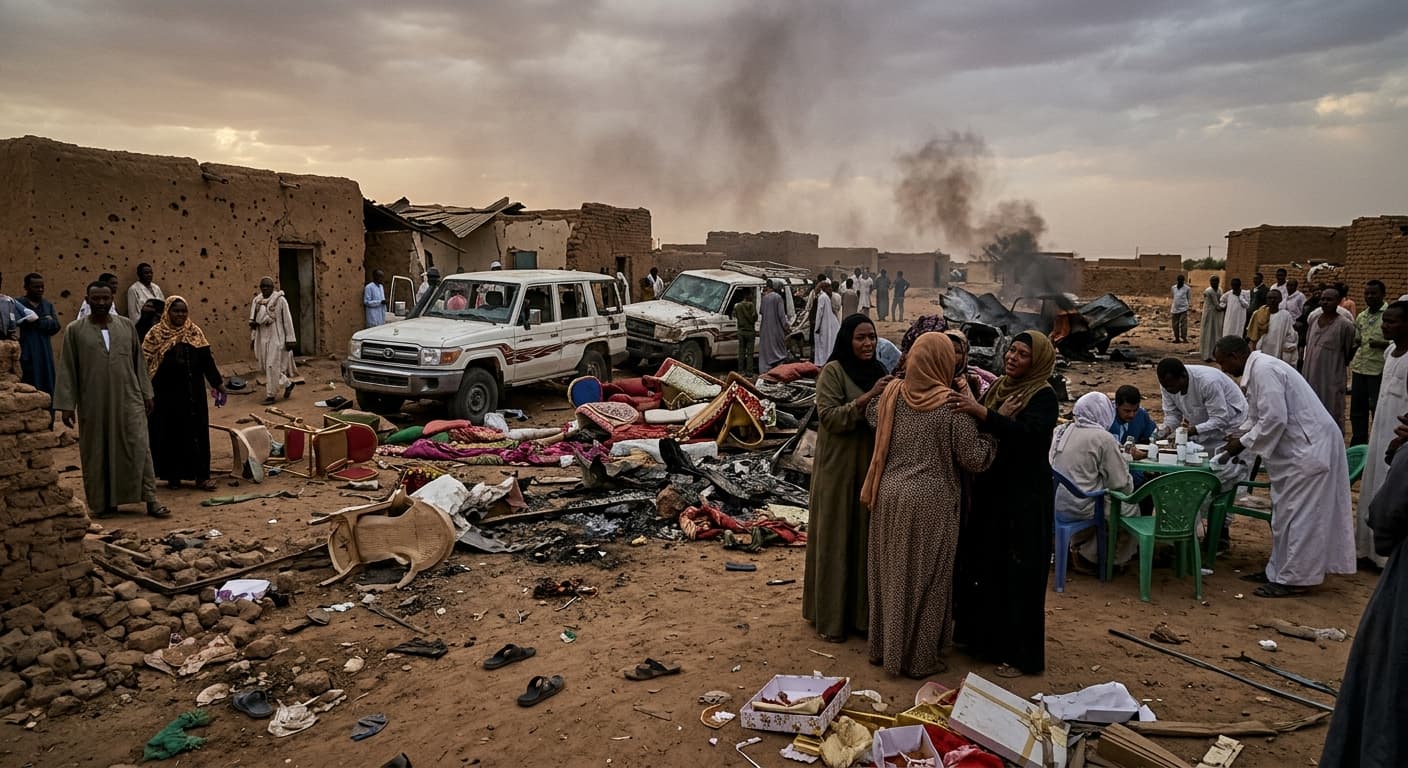
A guided drone struck a civilian vehicle west of Omdurman on July 7, killing 10 people — including five women from the same family — as they drove to a wedding. According to Asharq Al-Awsat, the vehicle "immediately caught fire" and all inside died; the Sudan Doctors Network said the strike "was deliberate and carried out using a guided drone" and blamed the RSF. A second drone the same day hit a transport vehicle near a water facility, killing two.
The pattern had been set 24 hours earlier. Emergency Lawyers documented a strike on July 6 in al-Shaatout, North Kordofan, that killed 13 civilians — again including five women — in a car heading to a wedding, reported by The Hindu. The group said drones "continue to fly over the northern parts of the province … monitoring residents' movements."
These are not the first such attacks. In June, according to Al Jazeera, an RSF drone salvo on El-Obeid killed up to 23 people, hitting a funeral procession, homes and a food-supply truck.
ACLED recorded 27 strikes on the city in June alone — the highest monthly total since the war began,
the BBC reported.
The El-Fasher template, applied
The tactical logic is now explicit. UN human rights chief Volker Türk told the Human Rights Council on July 3 that "another human rights catastrophe is unfolding in Sudan, this time in the capital of the strategic state of North Kordofan," warning via Al Jazeera that heads of state should treat the situation as a "red alert." OCHA chief Tom Fletcher was blunter in
a June 30 statement:
"I am again sounding the alarm on the escalating violence and rapidly deteriorating humanitarian situation in Sudan's North Kordofan region. We cannot allow El Obeid to become another El Fasher."
The comparison is load-bearing. El-Fasher fell in October 2025 after an 18-month RSF siege. The International Crisis Group's April 2026 briefing on Divided Sudan, Elusive Peace documented what followed: the RSF "slaughtered thousands of residents," including the reported killing of 460 patients at the al-Saudi Maternity Hospital, with a UN fact-finding commission calling the pattern "indicators of a genocidal path." Al Jazeera's
Inside Story cited UN estimates of more than 6,000 dead in the first three days after el-Fasher fell.
El-Obeid — population roughly 500,000, hosting about 100,000 people already displaced from Darfur and Khartoum — sits astride the road linking RSF-held Darfur to army-held Khartoum. Nathaniel Raymond of Yale's Humanitarian Research Lab told the BBC that satellite imagery documented damage consistent with bombardment at "at least eight fuel stations" between late May and late June. The city's main electrical substation, water pumps, residential neighbourhoods and markets have all been struck. The intent, Raymond said, is to "cripple daily life."
Whose drones, whose war
The escalation is enabled by an external supply chain the belligerent has never assembled on its own. BBC reporting and multiple think-tank assessments identify the RSF's principal long-range platform as the Chinese-made CH-95, widely reported to be supplied by the United Arab Emirates. The
CSIS Sudan war dashboard records that ACLED has logged more than 3,000 air and drone strikes since April 2023, with at least 9,000 fatalities, and notes that the RSF's inventory "includes Chinese systems in addition to Serbian and possibly Iranian platforms or munitions, and some U.S. drones, often linked to UAE support."
The human infrastructure is equally external. According to a Conflict Insights Group investigation summarised by the BBC, phone-tracking data followed more than 50 Colombian mercenaries — mostly former army — from Bogotá through the UAE's Ghayathi military training facility to RSF-held Nyala and el-Fasher, where they operated as drone pilots for a unit calling itself the "Desert Wolves." Human Rights Watch's
subsequent report alleged that Emirati munitions and companies underwrote the recruitment pipeline. The UAE denies any state role.
Washington has moved on the periphery of this network. The US Treasury sanctioned RSF leader Mohamed Hamdan Dagalo in January 2025 on a determination of genocide, alongside seven RSF-linked companies based in the UAE. In
December 2025 and again in mid-2026, OFAC sanctioned the Colombian recruitment network. What it has not done is name the UAE itself. That is the gap the drone war is exposing.

Why intervention is stuck
International-intervention rhetoric is louder than at any point in this war, and structurally more constrained. On July 3, the UN Human Rights Council held its first-ever urgent debate on El-Obeid, convened by the United Kingdom, Germany, Ireland, the Netherlands and Norway, who warned that "approximately 500,000 civilians are at risk of being targeted in large-scale atrocities." The UK's
introductory statement on the draft resolution, issued July 7, called for an immediate cessation of hostilities and unimpeded humanitarian access.
But four structural obstacles bind the international response:
The Security Council is deadlocked. The 2005 UNSC referral of Darfur to the ICC still governs jurisdiction; the ICC Prosecutor said in January 2025 he expected to seek new arrest warrants for crimes committed since 2023 in West Darfur, per US court filings summarising his briefing. Russia and China are unlikely to expand that mandate, and the United States under the second Trump administration has, per pending litigation cited in
Iverson v. Trump, moved against ICC personnel — including the Darfur lead prosecutor — under Executive Order 14203.
The arms embargo is Darfur-only. As Human Rights Watch documented in Fanning the Flames, the current UN embargo covers Darfur but not Sudan as a whole. That is why Chinese CH-95s reaching RSF units in Kordofan are not a straightforward embargo violation.
Peace talks are frozen. US envoy Massad Boulos told reporters in February he hoped for a truce by Ramadan; instead, Al Jazeera reported, both generals are stalling. President Donald Trump pledged in late 2025 to "start working on Sudan" with Egypt, Saudi Arabia and the UAE — the last of which is the RSF's chief external backer.
The Quad principles have no enforcement. Chatham House's April 2026 analysis, After Three Years of War, notes that the US-Saudi-UAE-Egypt Quad has agreed principles — no military solution, civilian-led transition — but the format has produced no truce.
The result: intervention now means, in practical terms, sanctioning the supply chain. That points to the UAE. It is the one lever with a plausible operational effect on the drones now hitting wedding vehicles — and the one Western capitals have declined to pull.
Second-order effects already visible
The July 8 recapture of Kurmuk in Blue Nile State by the Sudanese army, per Asharq Al-Awsat, signals that the war is spreading rather than converging. The SPLM-N's alliance with the RSF now stretches the front from Ethiopia's border to Chad's — a 1,500-km arc. UNICEF and UN partners recorded at least 330 child casualties in Sudan in the first half of 2026, mostly from drone strikes, according to
AFP reporting via Citizen Digital. The war is now
one of the world's deadliest displacement crises, with roughly 13 million displaced and 30 million in humanitarian need.
What to watch
- The HRC draft resolution vote: The core group of five European states tabled a draft resolution during the July 3 urgent debate. Its adoption — and whether it authorises a stronger monitoring mechanism — is the next multilateral test.
- An RSF ground offensive on El-Obeid: UN officials have flagged "substantial military reinforcements" massing around the city. ACLED analyst Nohad Eltayeb assessed on June 30 that a full RSF takeover remains "improbable" while the army holds the eastern supply corridor — but the drone tempo suggests a siege phase, not a decisive assault.
- US sanctions on UAE-linked entities: OFAC has sanctioned RSF-owned UAE-registered companies and the Colombian pipeline; a designation touching an Emirati state entity would be a step-change. Watch for movement tied to Trump's stated engagement with Cairo, Riyadh and Abu Dhabi.
- The Adre corridor extension:
Sudanese authorities extended the Adre border crossing with Chad through September 30, 2026. If drone strikes disrupt the Kordofan leg of that route, it will collapse aid flows to Darfur.
The Bottom Line
The RSF's drones over Kordofan are executing a siege on the El-Fasher template — attriting the fuel, water and traffic that sustain El-Obeid — and the international system knows it. What is missing is not warnings but a decision by Western governments to treat the UAE, not Khartoum, as the address for the intervention. Until sanctions or diplomacy reach the supplier, guided drones will keep hitting wedding convoys, and the next 500,000-person catastrophe will be a matter of timing, not surprise.
Discover more
US Politics
House Ethics Committee Pushes Sexual Miscond.
The House Ethics Committee has shifted responsibility for sexual harassment settlement records to the Office of Congressional Workplace Rights, complicating disclosure efforts.
Global Politics
Xi Jinping Calls China-Russia Ties 'Precious'
Xi Jinping's description of China-Russia ties as 'precious' reflects a strategic imbalance, with Beijing dictating terms in the partnership.
India
Rajnath Singh's Durga Squad for 2026 Polls
Rajnath Singh's Durga Squad promised women's safety in Bengal but has since disappeared from the agenda, revealing BJP's true priorities.

Economics
Fed's Amex AML order puts correspondent banking on notice
Federal Reserve's Amex AML order requires board-level controls and a 90-day plan; OCC fined the bank $350 million over enterprise-wide deficiencies.