Réunion's Unique Role in French Diplomacy
Exploring Réunion's status as a French overseas territory
Model Diplomat3 min readafrica
Réunion Has No Foreign Policy — And That's the Point
Model Diplomat's new country profile clarifies why this French island in the Indian Ocean punches above its weight — precisely because it doesn't act alone.
Model Diplomat this week published its country profile for Réunion, and the headline finding is simple but revealing: Réunion is not a sovereign state and never has been. It is an overseas department and region of France, governed under Article 73 of the French Constitution, with no separate UN seat, no treaty-making power, no independent military, and no foreign policy of its own. Paris sets the line on defense, sanctions, and diplomacy — full stop.
That clarity matters because the island is routinely miscategorized. A population of 896,000, an economy driven by sugar cane and tourism, and a strategic position in the southwest Indian Ocean make it look, on paper, like a mid-tier island state. It is not. As the BBC News profile notes, Réunion has been a department since 1946 and a full region since 1974, sending seven deputies to the French National Assembly and three senators to the Senate. Its residents are French citizens, vote in French presidential elections, and use the euro.
The island is one of five overseas territories — alongside French Guiana, Guadeloupe, Martinique, and Mayotte — that are fully integrated into the French Republic, as Al Jazeera detailed in its January 2026 mapping of global overseas territories. Unlike French Polynesia or New Caledonia, which have varying degrees of autonomy, Réunion has no special constitutional carve-out. French law applies as of right, just as it does in Lyon or Bordeaux.
The strategic asset France doesn't advertise
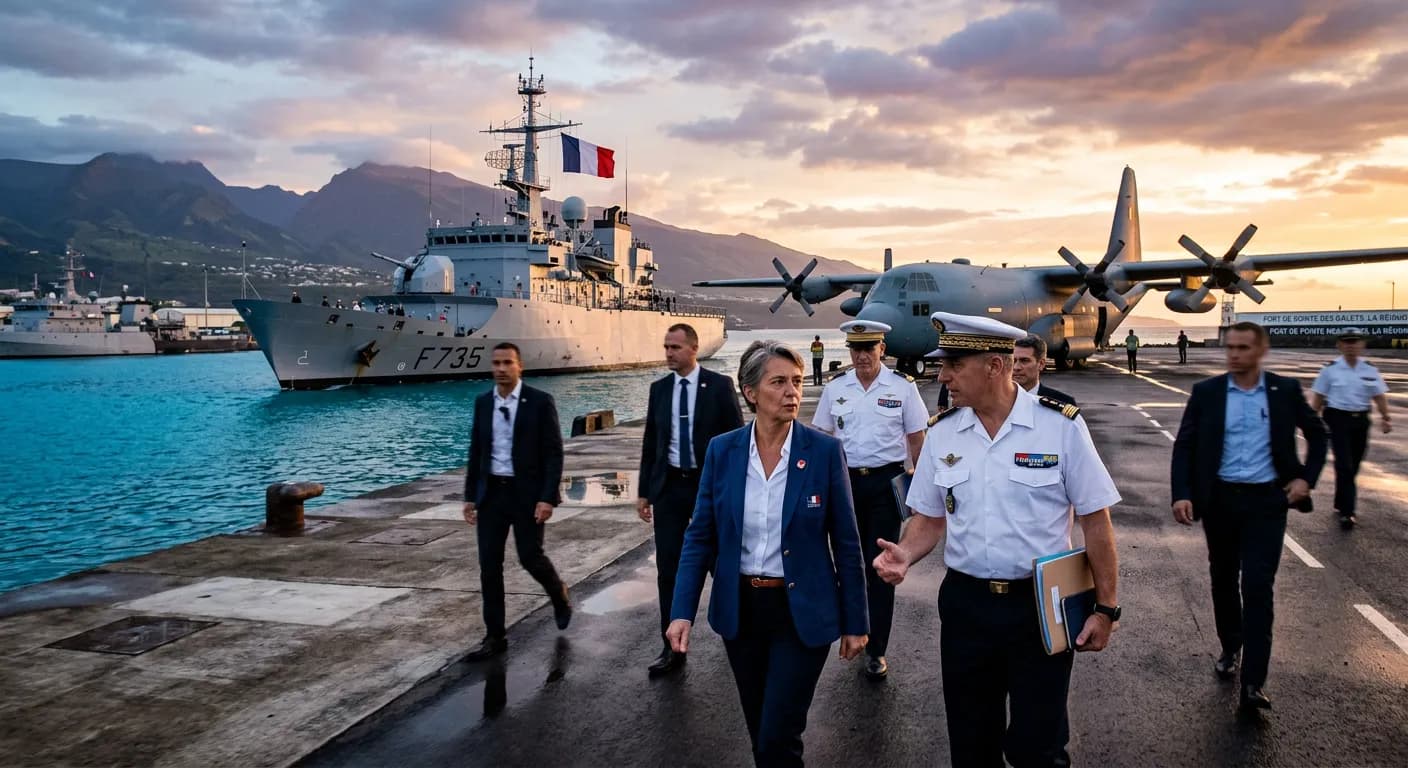
What Réunion lacks in sovereignty it more than compensates for in geography. The island anchors France's military posture in the Indian Ocean, hosting approximately 2,000 troops, aircraft, and warships at the headquarters of the French Armed Forces in the Southern Indian Ocean Zone (FAZSOI). Its Exclusive Economic Zone spans 2.8 million square kilometers — one of the largest maritime domains under any single flag in the region.
This makes Réunion the quiet backbone of France's claim to be an Indo-Pacific power. As CSIS scholar Darshana Baruah observed in an analysis of Indian Ocean strategy, Réunion effectively gives France a seat at the Indian Ocean Commission alongside Mauritius, Seychelles, Madagascar, and Comoros — and through that membership, Paris gains diplomatic access that no other European power enjoys in the region.
The Security Studies country desk report from May 2026 reinforces the point, noting that EU investment of €15 million through the Safe Seas Africa program runs through Réunion's regional cooperation platforms, and that the island's strategic value "will grow with increasing great power competition in the region."
Local authorities — the Regional Council, led by Huguette Bello, and the Departmental Council — do exercise influence over economic development, social policy, and regional outreach. But the boundaries are hard. Defense, foreign affairs, currency, and treaty obligations are non-negotiable matters reserved for Paris.
What to watch next
The most revealing dynamic is the contrast with New Caledonia. In July 2025, France struck a deal declaring New Caledonia a "State of New Caledonia" within the Republic, granting it immediate control over its foreign policy and a potential path to UN membership — a concession extracted after deadly unrest in 2024. Réunion has seen no equivalent momentum toward autonomy. The 1990s saw protests over wealth inequality and unemployment — still running at 18%, well above metropolitan France — but the demands were economic, not sovereign.
That could change. The island's demographic pressures, persistent unemployment, and dependence on €2.3 billion in annual transfers from Paris create structural vulnerabilities. But for now, the power dynamic is settled: Réunion's leverage comes not from what it can do independently, but from what France can project through it. Anyone modeling diplomatic influence in the Indian Ocean needs to code Réunion as Paris — not as a separate player.
Discover more
US Politics
SNAP Food Assistance Faces Legal Challenges
In 2026, SNAP faces stricter eligibility rules and mounting legal challenges, threatening food assistance for the millions of Americans who rely on the program.

US Politics
US Launches $166B Tariff Refund Portal
The US is launching a $166 billion tariff refund portal to aid importers hit by Trump-era tariffs, with major implications for trade and supply costs.
Global Politics
US-Iran Tensions Rise
Tensions escalate in the Strait of Hormuz as Iran and the US clash over maritime control, with a ceasefire hinging on a contested MoU paragraph.

Conflict & Security
Drone Warfare Killing Aid Workers at Unprec
Over 1,000 humanitarian workers killed in three years as cheap armed drones collapse legal protections. Gaza, Sudan, Ukraine, and DRC see deliberate targeting of aid convoys and hospitals with zero prosecutions.