Republicans Aim to End DHS Shutdown Crisis
A two-track workaround reshapes DHS funding model.
Model Diplomat8 min readUnited States
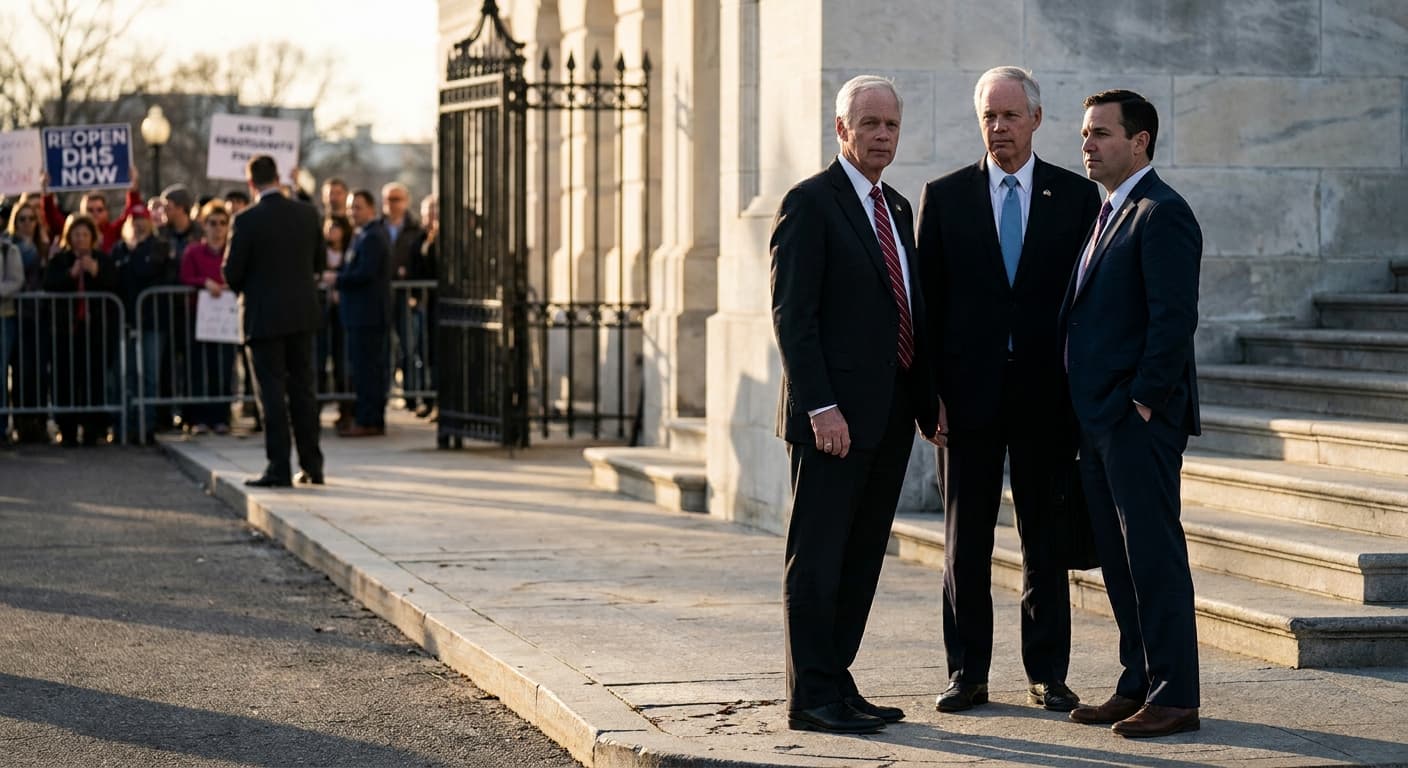
How Republicans Ended the 76-Day DHS Shutdown Crisis
The record DHS shutdown ended not with a bipartisan deal but with a two-track workaround that funded ICE and CBP entirely on party lines — a template Congress will use again.
Republicans ended the longest single-agency shutdown in US history on April 30, 2026, when President Donald Trump signed a bill funding most of the Department of Homeland Security — everything except Immigration and Customs Enforcement and Border Patrol — after 76 days without appropriations. The deeper story, now visible with two months of hindsight, is that the GOP did not resolve the standoff so much as route around it: by carving ICE and CBP out of the annual bill and shoving their entire multi-year budget through the filibuster-proof reconciliation process, they built a template that lets a future majority fund any politically toxic agency on a simple-majority vote. That is the durable legacy of the shutdown, not the airport queues.
The nut of it: the immediate crisis is over, but the appropriations model that governed DHS for two decades is broken. According to the Congressional Research Service, ICE and CBP received no annual appropriation for fiscal 2026 at all — their money now flows through a mandatory reconciliation package good through FY2029, outside the annual budget cycle entirely. That is unprecedented for a discretionary law-enforcement function.
The two-track fix
The mechanics matter. Republicans first passed the Homeland Security and Further Additional Continuing Appropriations Act, 2026 (P.L. 119-86) on April 30 — funding TSA, FEMA, the Coast Guard, the Secret Service and the Cybersecurity and Infrastructure Security Agency through September 30, 2026, but pointedly leaving Border Patrol and ICE out. The bill cleared the House by voice vote after Speaker Mike Johnson had spent five weeks calling the identical Senate text "a joke," according to
NPR. Track two was already in motion: on April 23, the Senate had adopted an FY2026 budget resolution by a 50-48 vote — Republican Senators Lisa Murkowski and Rand Paul defecting — authorizing roughly $70 billion in immigration-enforcement spending through reconciliation,
NPR reported.
The final piece landed six weeks later. On June 5, the Senate passed S.2, the Secure America Act, 52-47; the House cleared it 214-212 on June 9; Trump signed it on June 10 as P.L. 119-98, per Al Jazeera. The bill provides $70 billion for ICE and CBP available through FY2029 — the remainder of Trump's term — with zero Democratic votes and no reforms to the practices that triggered the shutdown in the first place.
What the shutdown was actually about
The proximate cause was Minneapolis. On January 7, 2026, ICE officer Jonathan Ross shot US citizen Renee Nicole Good through her car windshield during Operation Metro Surge, the Trump administration's largest interior enforcement operation. Three weeks later, Border Patrol agents killed Alex Pretti, a 37-year-old ICU nurse who, according to the BBC, was holding a phone rather than the weapon federal officers initially claimed. A Venezuelan immigrant, Julio Cesar Sosa-Celis, was shot and wounded in a third incident.
Senate Democrats, who had initially been prepared to fund DHS as part of a $1.2 trillion package, pulled their support and demanded four reforms: body cameras, judicial rather than administrative warrants for home entries, restrictions on face coverings for agents, and reduced detention bed capacity. When Republicans and the White House refused the mask ban and warrant requirement as non-starters, DHS funding was stripped out of the broader spending package on February 3 and given a two-week extension. It lapsed on February 14.
None of those reforms are in either bill Trump signed. Democrats got a shutdown; Republicans got the money.
Why the reconciliation track is the real story
Reconciliation was designed for tax and entitlement bills — it exists under the Congressional Budget Act of 1974 to smooth passage of measures with direct budgetary effects. Using it for law-enforcement operations is a stretch that until now Republican leadership resisted. Senate Majority Leader John Thune said as much on April 22, telling reporters "it's not my preference," Al Jazeera reported. "But it is reality."
The reality is that Republicans have now demonstrated a party can fund an entire enforcement wing of a cabinet department — personnel, detention, transportation, procurement — for the full length of a presidential term without ever facing a filibuster. Combined with the $191.02 billion in mandatory DHS budget authority already provided by the FY2025 reconciliation law (P.L. 119-21), most of DHS's operating budget for the rest of Trump's term is now insulated from any Democratic leverage. According to a CRS analysis of the FY2027 request, the administration is already using reconciliation funds to offset $416 million in ICE detention costs and $350 million in transportation and removal operations that would previously have run through annual appropriations,
per Congress.gov.
That is the appropriations model being remade in real time: the annual bill funds the parts of DHS everyone agrees on (airport security, hurricane response), while the politically contested parts get a permanent parallel track.
The costs Republicans absorbed to get there
The GOP paid tangible prices to hold the line. According to acting TSA administrator Ha Nguyen McNeill's March 25 testimony, absences hit 40% at some major airports and more than 480 officers quit during the shutdown, NPR reported. Spring-break travelers spent two hours in queues in Houston, per the BBC. Trump ultimately signed a March 27 memo directing TSA agents to be paid despite the funding lapse — a move NPR's Claudia Grisales flagged as
legally questionable, given Article I's assignment of the power of the purse to Congress. Homeland Security Secretary Markwayne Mullin told Fox News in late April, "I am completely out of the slush fund, I have no place to move at the end of the month."
There is also collateral damage inside DHS. The Office of Immigration Detention Ombudsman, created by Congress in 2019 to investigate detainee deaths, has been wound down. According to a court declaration by acting deputy ombudsman Ronald Sartini cited by NPR, the office had five employees at the start of 2026, down from over 100 at the start of 2025 — even as ICE detention deaths hit a fiscal-year high and the population held longer than a year has nearly doubled to more than 2,100 people. DHS told NPR the office shut because Congress didn't fund it. Democrats note the P.L. 119-86 appropriation did not mandate its closure.
Who won, who lost
The immediate winner is the White House. Trump got $70 billion in new enforcement money on his stated June 1 timetable (with a nine-day slip), without conceding the mask ban or judicial-warrant requirement his DHS leadership called red lines. He also demonstrated that a threat to keep the shutdown running was survivable — TSA delays did not force a capitulation.
The other winner is Senate Majority Leader Thune. Six months into the job, he ran a reconciliation vote-a-rama, held a 53-seat majority together on final passage (only Murkowski and Paul defected on the blueprint; Senator Susan Collins joined Democrats on final passage per Al Jazeera's count), and delivered the president's priority while House Speaker Johnson spent five weeks flailing. Johnson is the paradoxical loser: he outsourced the resolution to the Senate he had insulted.
The clearest loss is for Senate Democrats. The whole point of the shutdown, from Chuck Schumer's side, was to extract reforms on immigration enforcement tactics. Democrats got none. Senator Tim Kaine of Virginia, quoted by NPR on March 25, saw it early: "Set aside ICE, fund everything else. Republicans should take yes for an answer on all the other agencies. Quit torturing people with long TSA lines and let's go ahead and do this." That is almost exactly what happened — except Democrats also lost the leverage they thought the shutdown was buying.
The unnoticed winner is the filibuster's slow-motion erosion. Al Jazeera reported that Trump has publicly urged Republicans to abolish it outright. They have not. But they no longer need to: reconciliation now funds an entire slice of DHS operations, and the precedent will not stay confined to immigration.
What to watch next
- September 30, 2026. P.L. 119-86 expires. Congress must pass an FY2027 DHS bill or another CR. The 2027 request already leans on reconciliation dollars to offset ICE costs — meaning the annual bill can shrink without any operational cut. Watch whether Democrats try to reopen the reform demands during FY2027 negotiations, or accept that the ICE fight is already lost until 2029.
- Byrd rule fights. Al Jazeera flagged Democrats' use of vote-a-rama to force GOP votes on the DOJ's "anti-weaponisation fund." Expect more parliamentarian challenges as Republicans try to load enforcement policy — not just spending — into future reconciliation vehicles.
- The impoundment case. Trump's April memo redirecting funds to keep DHS running during the shutdown remains legally untested. If Democrats retake either chamber in November, expect that memo to become an oversight target and a possible court case,
building on the impoundment doctrine already being litigated in lower courts.
- Minnesota v. DHS. A federal judge ordered agencies in late March to produce evidence within three weeks in the Good killing. Hennepin County's suit against the federal government for withholding evidence is the one avenue that could still yield the accountability Democrats failed to legislate.
Diplomat View
The shutdown will be remembered for airport chaos and Minneapolis funerals. It should be remembered as the moment the reconciliation exception ate the appropriations rule. Congress created reconciliation to move tax and entitlement bills; by June 10, 2026, it was being used to fund the operational budget of a federal enforcement agency for 3.5 years, in a package that also carried Trump's disputed "anti-weaponisation fund" fight into the parliamentarian's chambers. The specific forecast: within one presidency, another majority will replicate the DHS two-track model for a different politically radioactive function — most likely Justice Department components, potentially the Environmental Protection Agency's enforcement office if a Democratic trifecta returns. The forecast changes if the Senate parliamentarian rules future non-tax reconciliation provisions violate the Byrd rule and Republicans decline to overrule her, or if a court holds that Trump's April 2026 impoundment memo was unlawful and forces Congress to reassert Article I authority. Neither has happened yet. Until it does, the DHS shutdown of 2026 is not a cautionary tale — it is a playbook.
The Bottom Line
Republicans ended the DHS shutdown crisis by refusing to negotiate the reforms Democrats demanded and instead building a parallel funding track — reconciliation — that makes ICE and CBP immune to Senate filibusters through 2029. The 76-day standoff produced no policy changes on immigration enforcement, no accountability for the Minneapolis killings, and no bipartisan appropriations deal; it produced a new precedent under which the politically contested parts of the federal government can now be funded by 51 votes. That precedent, not the airport queues, is what future Congresses will inherit.
Discover more

US Politics
House Ethics Committee Pushes Sexual Miscond.
The House Ethics Committee has shifted responsibility for sexual harassment settlement records to the Office of Congressional Workplace Rights, complicating disclosure efforts.

US Politics
Next Generation Republicans
A leaked survey shows 39% of Republicans under 30 do not identify as MAGA, revealing a split in the GOP's future leadership.

Conflict & Security
Drone Warfare Killing Aid Workers at Unprec
Over 1,000 humanitarian workers killed in three years as cheap armed drones collapse legal protections. Gaza, Sudan, Ukraine, and DRC see deliberate targeting of aid convoys and hospitals with zero prosecutions.

Global
World Normalises Taliban as Afghan Women Eras
UN data shows Afghan women erased from public life as Russia recognises the Taliban, EU hosts officials in Brussels, and ICC warrants for gender persecution go unenforced.