RBI Holds Rates Amid West Asia Conflict
Central bank cites regional conflict as economic threat
Model Diplomat3 min readAsia
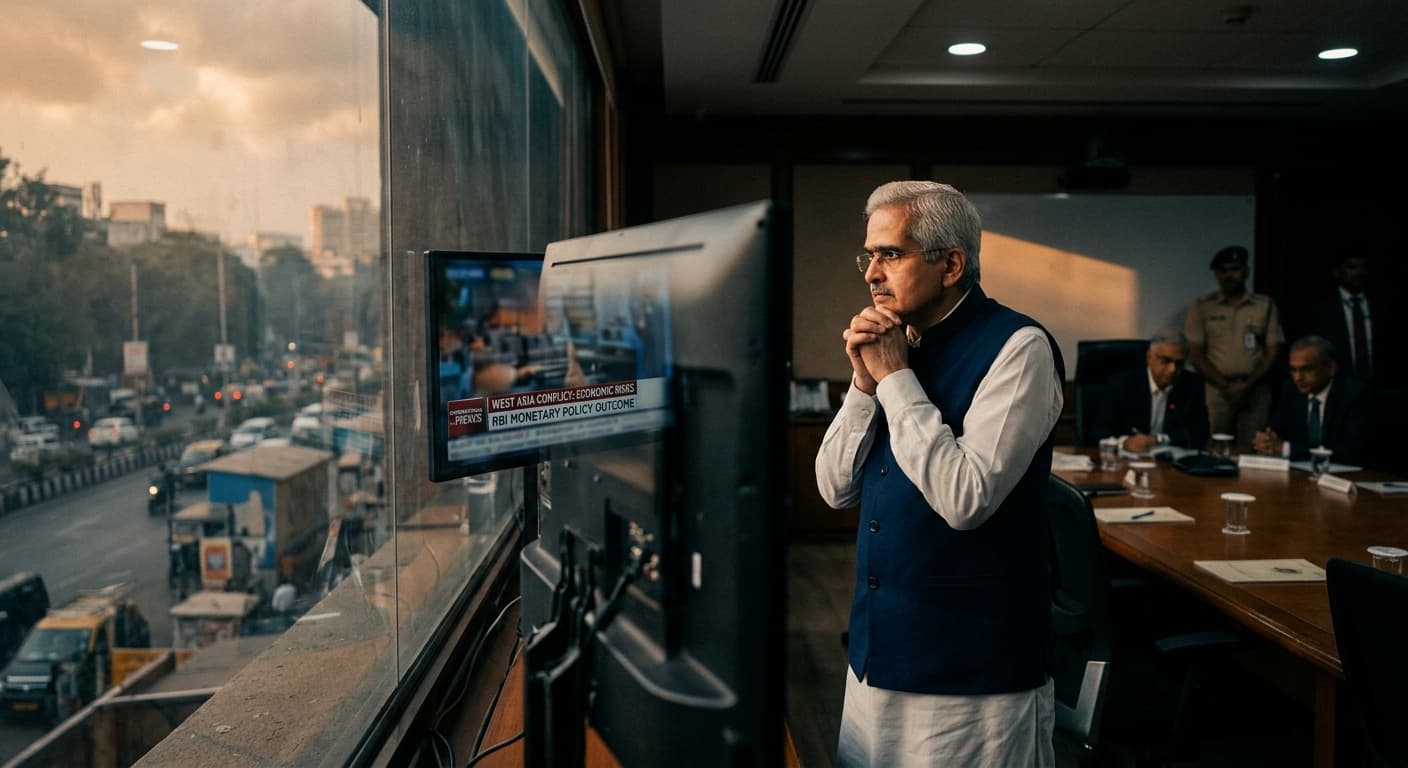
RBI Held Rates Amid West Asia Shadow
India's central bank kept policy rates unchanged as it flagged the region's conflict—not rate hikes—as the economy's biggest near-term threat.
The Hindu reported on Friday that the Reserve Bank of India's Monetary Policy Committee has identified the prolonged West Asia conflict as the most significant risk to India's economic outlook. All six members unanimously voted to hold the policy repo rate at 5.25 percent and maintain a neutral stance—a move that reflects not confidence in the economy's resilience, but wariness of forces beyond the central bank's control.
The calculus is straightforward. APB Live documented the RBI's revised forecasts: crude oil averaged $110 per barrel in April and May—well above assumptions made at the April policy review. That translates immediately into import costs for an economy that depends on the Strait of Hormuz for substantial volumes of hydrocarbons and fertilisers. The central bank lifted its CPI inflation forecast for FY27 to 5.1 percent, with a peak of 5.9 percent expected in Q3, while cutting real GDP growth projections from 6.8 percent to 6.6 percent.
MPC member Nagesh Kumar crystallized the stakes: "The crude prices have shot through the roof, and supplies have been disrupted...rising crude prices raise concerns about consumer prices directly and indirectly, given the dependence of many sectors of manufacturing on petroleum products." But the committee also faced a dilemma. Inflation here is supply-driven, not demand-driven—higher oil costs feeding through the economy regardless of interest-rate settings. Tightening rates would simply throttle growth without fixing the external shock. Easing would amplify price pressures already embedded in wholesale and food inflation.
The External Hemorrhage
The conflict's impact extends beyond the oil complex. Rediff reporting on the RBI's balance-sheet intervention revealed that India's foreign exchange reserves have fallen nearly $47 billion from their February peak of $728.5 billion—the cost of defending the rupee against capital outflows triggered by higher oil prices and global uncertainty. The RBI's short dollar forward position, a measure of its interventions in non-deliverable forwards, stood at $95.3 billion in April and has since ballooned further.
This is the leverage the conflict wields. India cannot ignore geopolitical shocks to energy markets or dollar flows. The RBI responded with a package of measures—easing FPI restrictions, expanding NRI deposit incentives, restoring export-proceeds timelines to nine months—designed to attract the $55 billion in foreign inflows that analysts suggest could reverse the balance-of-payments deterioration. But these are defensive moves, buying time until either the conflict winds down or monsoons arrive to ease food inflation.
The Waiting Game
The timing cuts both ways. An interim US-Iran peace deal announced in June has already begun pushing oil prices down from crisis levels. Reuters coverage noted that lower crude prices have supported rupee gains and eased immediate inflation fears. Yet the RBI's minutes and external members' statements made clear they are bracing for prolonged energy shocks to embed themselves in inflation expectations—a second-round effect that would force the hand toward eventual tightening.
What to watch: monsoon rains in July-September (El Niño is forecast to weaken them, raising food inflation), crude price trajectories if Iran-US tensions resurface, and capital inflows data in response to the NRI deposit scheme. The RBI will not move rates in the July review unless the inflation-growth tradeoff shifts decisively. Inflation needs to either fall sharply or the growth outlook deteriorate further. Until then, the committee stays still—a rare admission that some variables lie beyond a central bank's reach.
Discover more

Global Politics
US Seizes Iranian Ship, Tensions Surge
The US seizure of the Iranian ship Touska highlights a shift in control over the Strait of Hormuz, favoring Iran's strategic position.

International Relations
Pakistan's Key Role in US-Israel-Iran Meddle
Pakistan is seeking to mediate the US-Israel-Iran conflict, balancing high-stakes diplomacy against severe economic pressures and steep regional challenges.

India
India-South Korea $50B Trade Expansion Plan
India and South Korea target $50 billion in bilateral trade by 2030, focusing on industrial cooperation and strategic alignment amid US pressures.

Conflict & Security
Drone Warfare Killing Aid Workers at Unprec
Over 1,000 humanitarian workers killed in three years as cheap armed drones collapse legal protections. Gaza, Sudan, Ukraine, and DRC see deliberate targeting of aid convoys and hospitals with zero prosecutions.