Raghav Chadha's Shift Alters Punjab 2026 Race
Chadha's defection reshapes BJP's strategy in Punjab for 2027 elections.
Model Diplomat7 min readPunjab
Raghav Chadha's Shift Alters Punjab 2026 Race
Raghav Chadha's April 24, 2026 defection with six AAP MPs to the BJP is less about Rajya Sabha arithmetic than about who runs the ground war in Punjab in 2027.
The single most important fact about Raghav Chadha's switch is not that he crossed the floor — Indian politicians do that on schedule — but that he took two-thirds of the Aam Aadmi Party's Rajya Sabha bloc with him and handed the Bharatiya Janata Party the one asset it has never possessed in Punjab: an operator who has actually won there. The BJP polled 6.6% and two seats in the state in 2022, according to PRS Legislative Research; the man who engineered AAP's 92-seat sweep the same year now works for the party that lost. That is the story. The Rajya Sabha seats are the wrapper.
What actually happened on April 24
At a Delhi press conference flanked by Sandeep Pathak and Ashok Mittal, Chadha announced that seven of AAP's ten Rajya Sabha MPs — himself, Pathak, Mittal, Harbhajan Singh, Rajender Gupta, Vikramjit Singh Sahney and Swati Maliwal — were "merging" with the BJP under the constitution's Tenth Schedule, the report from BBC Hindi documents. The wording matters. Paragraph 4 of the Tenth Schedule protects legislators from disqualification only when two-thirds of a legislature party agrees to a merger; the
PRS Legislative Research primer on the anti-defection law spells out that the individual-defection exemption was removed by the 91st Amendment in 2003, leaving the two-thirds merger as the only clean exit.
Seven out of ten hits that bar exactly. AAP's Rajya Sabha leader Sanjay Singh has told the Chairman he will petition for disqualification anyway, arguing the seven "voluntarily gave up membership" and cannot claim the merger shield, NDTV reported. Chief Minister Bhagwant Mann has sought a meeting with the President. Protests erupted outside Harbhajan Singh's residence in Jalandhar the same evening.
The Rajya Sabha secretariat now has to rule. Precedent from the Shiv Sena and NCP splits — where speakers took years and courts intervened — suggests the disqualification petition is a slow-moving weapon. That is the AAP's problem: by the time the Chairman decides, Punjab will be voting.
Why the BJP paid this price
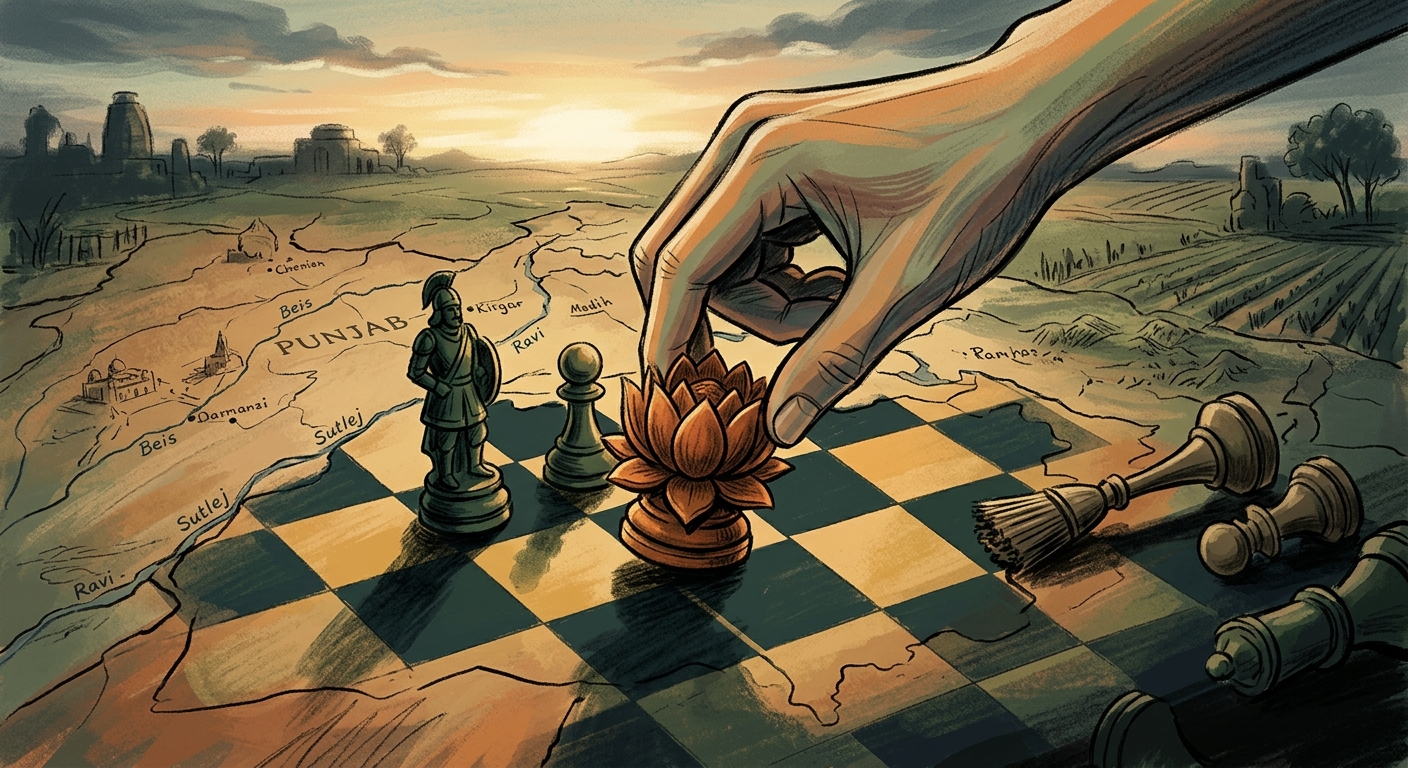
The BJP's Punjab arithmetic is bleak. It contested 73 seats in 2022 after breaking with the Shiromani Akali Dal over the farm laws and won two. Its state unit has no Sikh face capable of a chief-ministerial pitch — a point conceded even by BJP-friendly analysts quoted by BBC Hindi, who described the Punjab challenge as one of engineering a "Sikh vs non-Sikh" polarisation of the Haryana and Maharashtra variety. That framing has a shelf life; it does not build booth-level machinery.
Chadha does. He was AAP's co-in-charge for Punjab in 2021–22 and, by the party's own admission on its website, the campaign architect. The Hindustan Times captured the internal BJP read cleanly: with 6.6% of the vote in 2022 the party ended up with just 1.7% of the seats, a wasted-vote profile that only a professional field operation can fix. That is what the party thinks it has purchased.
The Economic Times reports the induction is part of a wider BJP drive to recruit "new voter blocs" — urban Hindu, trader, ex-servicemen — with Punjabi faces attached. Harbhajan Singh delivers Jat-Sikh reach; Sahney the industrial-Sikh business network; Maliwal a Delhi-adjacent women's-rights profile; Chadha the strategist. The
Tribune noted BJP spokesperson Jaiveer Shergill's post-Bengal declaration — "Punjab next! Aam Aadmi Party pack your bags" — was rhetoric a fortnight ago. It reads differently now.
The AAP wound is deeper than seat count
AAP's public position — voiced by Kejriwal and Mann — is that the seven are traitors, that the seats will be won back, that the merger is "Operation Lotus" backed by ED and CBI pressure, per BBC Marathi. All plausible. None of it addresses the structural problem.
AAP was, until this month, the fastest-growing national party in Indian politics; the Times of India framed the exodus as "startup to implosion." The party has zero MPs in the Lok Sabha, has lost Delhi, and now has two Rajya Sabha members. Its sole surviving power base is the Bhagwant Mann government in Chandigarh — and Chadha built the campaign that put it there. Whatever donor networks, digital infrastructure and volunteer lists exist in urban Punjab, he knows the passwords.
Asianet's Newsable framed the trade cleanly: AAP lost six of its seven MPs from Punjab in one afternoon; the BJP went from 2 MLAs on the ground to 6 sitting MPs with Punjab addresses in one afternoon. That is not a Rajya Sabha story. That is a candidate-pool story for 2027.
The Tenth Schedule loophole is the real precedent
Every commentator has focused on the personalities. The more consequential fact sits in the constitution.
Paragraph 4 of the Tenth Schedule, added by the 52nd Amendment in 1985, permits a "merger" if two-thirds of a legislature party agrees; the Rajya Sabha Secretariat's own handbook sets this out in Chapter V. The 91st Amendment in 2003 closed the individual-defection exemption but left the two-thirds merger untouched — a choice PRS analysts have long argued creates a perverse incentive to package defections wholesale rather than restrain them. The
Institute of South Asian Studies at NUS documents how the same clause enabled the Congress collapses in Madhya Pradesh (2020), Karnataka (2019) and Maharashtra (2022).
Chadha's operation is the first time the two-thirds merger has been used on a national opposition party's Rajya Sabha bloc — MPs the public did not directly elect. That distinction matters legally and politically. It means the BJP has demonstrated a playbook: identify a rival's Upper House delegation, secure two-thirds of it, and inherit its state-level networks without ever facing a voter. Islamabad's Institute of Strategic Studies — no friend of Delhi, but a careful watcher — has already logged Chadha's move as the opening act of a June–July 2026 wave that also cracked the TMC in West Bengal and the Shiv Sena (UBT) in Maharashtra. If the pattern holds, the two-thirds merger is now the BJP's preferred instrument of opposition consolidation, and the anti-defection law functions as the mechanism of its own defeat.
What the ground looks like
Sikh voters, roughly 58% of Punjab's electorate, remain the BJP's central problem. Congress state chief Amarinder Raja Warring told BBC Hindi that Chadha's arc — from AAP's youngest MP at 33 in March 2022 to BJP inductee in April 2026 — became foreseeable after Kejriwal's 2024 arrest, when Chadha stayed in London for treatment and did not return to defend the party. The read within Congress is that the AAP-BJP split hands them Punjab: with the anti-incumbent Sikh vote fragmenting three ways, Congress's roughly 23% floor from 2022 becomes a plurality.
The BJP's counter-read, per the Hindustan Times reporting, is that Punjab's urban Hindu vote — concentrated in Ludhiana, Jalandhar and Amritsar — is the growth market, and that a Chadha-run campaign can push its 6.6% floor toward the 15–18% range where seat conversion begins. Neither read is settled by Chadha's induction alone. Both are conditional on whether the Rajya Sabha Chairman rules the merger valid — and on whether the ED-CBI pressure on remaining AAP figures, which Sanjay Singh alleged in the BBC Punjabi coverage, continues to squeeze the ruling state government.
Diplomat View
The consensus wire read — that Chadha's defection is a Rajya Sabha coup with unclear Punjab spillover — is precisely wrong. The Rajya Sabha seats are decoration; the acquired asset is a campaign manager with a live Punjab CRM. Our call: the BJP will not win Punjab in 2027, but it will cross 15% vote share and win 8–12 seats, up from 2, and Congress — not AAP — will be the primary beneficiary of AAP's collapse, forming the next government with 55–65 seats. The falsifiable trigger is the disqualification ruling. If the Rajya Sabha Chairman rules the seven were "voluntarily giving up membership" rather than executing a valid merger — a reading Sanjay Singh has invited — Chadha faces disqualification and a six-year electoral disability under Article 102, and the BJP's investment collapses. That decision, and any Supreme Court challenge that follows, is the pivot. We would revise the forecast if the Chairman fast-tracks a disqualification order before December 2026, or if Bhagwant Mann's government falls before the term ends in March 2027 — either event puts Punjab's map back in play with different pieces.
Forward look — three catalysts:
- Rajya Sabha Chairman's disqualification ruling on Sanjay Singh's petition. Speaker-level defection decisions have historically taken 6–18 months; a faster ruling signals executive alignment.
- Punjab Assembly winter session (December 2026) — first test of whether AAP MLAs stay in line or begin their own two-thirds arithmetic. Watch for 26 or more MLAs (one-third of AAP's 92) meeting quietly.
- February 2027 election notification — the last date by which BJP candidate lists reveal how many of the seven inductees actually contest, and where. Chadha in a Ludhiana urban seat would confirm the professionalisation thesis; a Rajya Sabha re-nomination confirms he was bought as a strategist, not a candidate.
The Bottom Line
Raghav Chadha did not deliver seven MPs to the BJP; he delivered the Aam Aadmi Party's Punjab operating manual. The Rajya Sabha maths is a legal wrapper on a strategic acquisition, and the constitution's two-thirds merger clause has now been demonstrated as the cheapest instrument the ruling party has for hollowing out a rival's state apparatus without facing an election. Punjab 2027 will be decided less by who campaigns in Chandigarh than by whether the Rajya Sabha Chairman rules the merger valid — and if he does, the anti-defection law will have been quietly re-engineered from a shield against opportunism into its enabling statute.
Discover more
India
Rajnath Singh's Durga Squad for 2026 Polls
Rajnath Singh's Durga Squad promised women's safety in Bengal but has since disappeared from the agenda, revealing BJP's true priorities.
India
Women’s Reservation Bill 2026
The Constitution (131st Amendment) Bill, 2026 was defeated in Lok Sabha, revealing deeper political conflicts over women's reservation and delimitation.
India
BJP Congress Clash Over MP Bill Defeat
The BJP's defeat of the women's quota amendment sparks a political narrative war with Congress, impacting future elections.

Conflict & Security
Drone Warfare Killing Aid Workers at Unprec
Over 1,000 humanitarian workers killed in three years as cheap armed drones collapse legal protections. Gaza, Sudan, Ukraine, and DRC see deliberate targeting of aid convoys and hospitals with zero prosecutions.