Rafales and F-35s Fly Together at Pitch Black
First joint operation of Indian Rafale and Japanese F-35 in major air drill
Model Diplomat9 min readIndo-Pacific
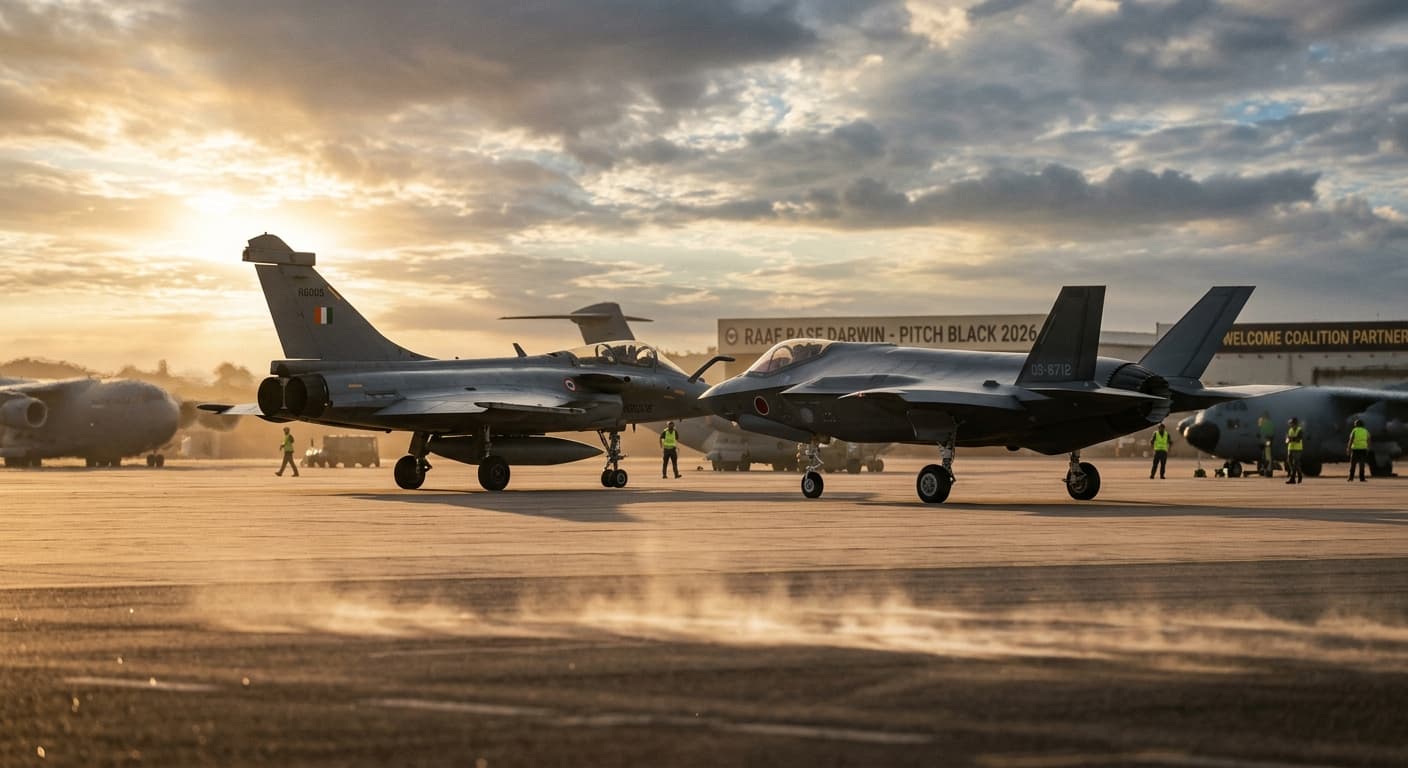
India’s Rafales, Japan’s F-35s Share a Tarmac in Darwin — and Beijing Is Watching
For the first time, Indian Rafales and Japanese F-35 Lightnings are flying together in a combat exercise. Pitch Black 2026 is a hardware audition for the air-power coalition the Indo-Pacific would need in any China contingency.
Today, Indian Air Force Rafale fighters touched down at RAAF Base Darwin flanked by a C-17 Globemaster, with mid-air refuelling from an IL-78 tanker that staged through Surabaya, Indonesia. A day earlier, Japan Air Self-Defense Force F-35A Lightning IIs had already arrived. The two fleets, France’s premier 4.5-generation multirole fighter and America’s fifth-generation stealth platform, are parked on the same tarmac for the first time in a multinational air combat exercise.
That convergence is the real story of Pitch Black 2026. Not the scale, though with over 100 aircraft from 20 nations it remains one of the largest air-combat drills in the world. It is the composition. Hosted by the Royal Australian Air Force from July 20 to August 7, the biennial exercise has become a live demonstration of the hardware architecture that a coalition of Indo-Pacific democracies would assemble in any crisis over Taiwan, the South China Sea, or the Malacca Strait.1 The aircraft selections this year are not accidental — they are designed to test how the alliance’s real-world strike packages will fight together, and to signal to Beijing that they can.
The convergence: a hardware map of the Indo-Pacific
The Royal Australian Air Force’s official count puts this year’s exercise at 20 nations, more than 100 aircraft, and 2,500 personnel, operating from RAAF Bases Darwin, Tindal, and Amberley.2 That is a smaller footprint than the 2024 edition, which deployed 140 aircraft and 4,400 personnel from 20 nations.3 But the 2026 lineup is qualitatively different.
The Indian Air Force has switched its front-line contingent from the Russian-origin Su-30MKI — the workhorse it fielded in 2024 and 2022 — to the Rafale. The shift signals New Delhi’s growing reliance on Western-aligned platforms for its expeditionary posture in the eastern Indian Ocean. The IAF confirmed the deployment on July 17: “Flying the formidable Rafale, the IAF will train alongside friendly Air Forces. The exercise will sharpen operational synergy and facilitate the exchange of best practices.”4
Japan’s choice is even more significant. The JASDF deployed F-35A Lightning IIs — the first time Japanese stealth fighters have appeared at Pitch Black. Tokyo has 105 F-35s on order and is planning F-35B operations from the modified helicopter destroyer JS Izumo.5 Testing the platform’s ability to integrate with non-US coalition aircraft at extreme range from home bases is a critical step in Japan’s “southern shield” strategy, which has deployed long-range missiles to Kyushu and expanded air operations over the Nansei Islands, within 100 kilometres of Taiwan.6
Alongside these headliners, the airfield at Darwin reads like a catalogue of the coalition. The Republic of Korea Air Force flew five F-16s more than 5,900 kilometres, supported by two KC-330 tankers.2 The Philippines brought FA-50PH Golden Eagles for the second time. Indonesia deployed its T-50I advanced trainer aircraft for its first-ever Pitch Black participation. Finland — newly in NATO — contributed F/A-18 Hornets. Sweden, also a fresh NATO member, sent JAS 39 Gripen fighters. Germany, France, Spain, the UK, Singapore, Thailand, and the United States rounded out the European and regional presence.
The sheer span of platforms raises a question that Pitch Black 2026 is explicitly designed to answer: can these aircraft share targeting data, deconflict flight paths, and fight as a single force in the vast training airspace over northern Australia, an area roughly the size of Great Britain?3
Why India’s Rafale choice matters beyond the cockpit
India’s decision to send Rafales to Darwin rather than the Su-30MKI is not a coincidence. It is the airborne expression of a broader defence-industrial pivot.
India currently fields 31 fighter squadrons against a sanctioned requirement of 42, with the gap filled largely by aging Soviet-era types.7 The 36 Rafales acquired in a 2016 government-to-government deal with France have become the IAF’s most advanced operational aircraft, and the baseline for its planned $20-billion Multi-Role Fighter Aircraft (MRFA) programme to buy 114 more jets. In 2025, Dassault Aviation and Tata Advanced Systems signed a production transfer agreement to manufacture Rafale fuselages in Hyderabad — the first time a Rafale airframe will be built outside France.8
The significance of this for Pitch Black 2026 is practical and political. On the practical side, the Rafale’s SPECTRA electronic warfare suite, RBE2 AESA radar, and Meteor beyond-visual-range missiles must be tested against the threat emitters and tactics that only a large multinational exercise can provide. Flying alongside F-35s — which use a different data link architecture (Multifunction Advanced Data Link) than Rafale’s Link 16 / MIDS terminals — will stress coalition interoperability in ways no bilateral exercise can.
On the political side, the IAF is sending a message that its expeditionary future is Western, not Russian. The same Rafale fleet that exercised with the Japanese F-35 in Darwin will, by the end of this decade, be assembled in Hyderabad by TASL for potential follow-on orders. That has implications for India’s ability to project air power into the Malacca Strait and South China Sea from its Andaman and Nicobar bases — a mission the Observer Research Foundation has explicitly identified as a joint India-Australia priority.9
Japan’s F-35 goes expeditionary — and Beijing takes note
For Japan, the deployment of F-35s to Darwin represents a step-change in expeditionary capability. The JASDF’s previous Pitch Black contributions have relied on F-15J and F-2 fighters — capable fourth-generation platforms but short on range and stealth. The F-35A changes that calculus. With a combat radius of roughly 1,200 kilometres on internal fuel, and a very low radar cross-section, the aircraft can threaten high-value ground and naval targets deep inside contested airspace.
China’s military analysts have taken note. When Japan and India held their first bilateral air exercise — Veer Guardian — in January 2023, Chinese state media covered the event with what the ORF described as “subdued panic,” worried that India-Japan air cooperation would create a two-front challenge for the PLA.10 The sight of Japanese F-35s and Indian Rafales coordinating over Darwin will amplify that anxiety. The PLA daily newspaper PLA Daily has previously argued that Japan’s acquisition of counterstrike capabilities and its deployment of long-range missiles to the southwestern islands constitute a direct threat.6
Japan’s Defence Minister Shinjiro Koizumi told the BBC this month that Tokyo must “strengthen its defence capabilities, reinforce its alliance with the United States, and expand collaboration with like-minded countries” to build “multi-layered deterrence.”11 Pitch Black 2026 is the operational face of that doctrine. It also comes weeks after Japan’s new defence export policy took effect, permitting lethal-weapon sales to 17 partner nations — a move the CSIS called “a watershed.”5
Europe’s deepening Indo-Pacific footprint
One of the less commented-upon features of Pitch Black 2026 is the presence of Finland and Sweden as first-time participants since joining NATO. Their Hornets and Gripens are not in Darwin for a holiday. Finland is replacing its F/A-18 fleet with 64 F-35s, and Sweden’s Gripen E is being marketed aggressively to Indo-Pacific buyers. Both countries are embedding themselves in the network of exercises that spans the Pacific, from RIMPAC to Talisman Sabre to Pitch Black, as part of NATO’s Indo-Pacific partner strategy.
A recent RAND analysis noted that the Nordic NATO enlargement “draws the alliance’s political and military-strategic attention more toward the greater Nordic space, ranging from the Arctic over Scandinavia to the Baltic Sea area.”12 But the Darwin deployment shows that Nordic defence integration is not staying regional. The Finnish and Swedish air forces are building interoperability with the same Quad-aligned air forces that would lead any coalition air campaign in the Pacific.
The European presence is not merely symbolic. Germany, France, Spain, and the UK have all invested heavily in long-range deployment capabilities since 2022, in what the International Institute for Strategic Studies called “a significant increase in power-projection capability.”13 Last year’s edition featured Italian F-35s and the carrier Cavour. This year, the German Air Force arrived with A400M Atlas transports — the same aircraft that supported its Pacific Skies deployment. The cumulative effect is a European air-power commitment to the Indo-Pacific that would have been unthinkable a decade ago.
The interoperability crucible — and the signal
The military value of Pitch Black 2026 lies in what the RAAF calls “large-force employment missions” — scenarios where 50 or more aircraft from a dozen nations must strike a common target set while defending against simulated air and surface threats. That requires data-link fusion, common operating pictures, and tactics adjusted for the strengths and vulnerabilities of each platform.
The operational challenge is not trivial. The F-35’s sensor fusion and stealth allow it to penetrate and designate for fourth-generation shooters, a concept called “quarterback” in joint doctrine. But the Rafale’s SPECTRA suite and Meteor missile offer a different, potentially complementary, kill chain. Testing whether these can work in series — F-35 finds, Rafale strikes — is exactly the kind of scenario Pitch Black was designed for. So is the reverse: can a Rafale’s passive sensors cue an F-35 against a low-observable threat?
If the answer is yes, the strategic signal to China is unambiguous. The coalition can operate combined air packages from Australian territory, refuelled by tankers from Korea and India, protected by Japanese and US stealth, and striking with French and US munitions. It would be the air-power analogue of the distributed maritime kill chain that the US Navy and its allies are building in the Pacific.
For China, the exercise reinforces exactly the “Malacca dilemma” that Beijing has spent two decades trying to escape. That dilemma — the vulnerability of its energy imports and trade to a blockade of the narrow strait — has driven the Belt and Road overland routes, the Gwadar port in Pakistan, and the military build-up in the South China Sea. But a coalition that can generate mass air sorties from northern Australia and the Andaman Islands, with stealth penetration and long-range strike, threatens to deny China sea and air control across the entire Indo-Pacific rather than at a single choke point.
The Bottom Line
The 2026 edition of Pitch Black is not the largest — that was 2024. But its aircraft line-up makes it the most consequential. The simultaneous deployment of Indian Rafales, Japanese F-35s, and NATO air forces from Sweden and Finland is a hardware audition for the coalition that would fight any conflict over Taiwan or the South China Sea. The exercise tests whether the political alignment of the Quad and its European partners can translate into operational reality under combat conditions. The outcome will be measured not in press releases but in the Chinese military’s next force posture adjustment.
Footnotes
-
The Week, July 19, 2026; Australian Department of Defence, “Touchdowns continue in Darwin,”
Defence, July 17, 2026. ↩
-
Australian Department of Defence, “Touchdowns continue in Darwin,”
-
Australian Department of Defence, “Exercise Pitch Black 2024 concludes,”
-
Indian Air Force X post, quoted in
-
CSIS, “Japan’s New Defense Export Policy: Will Industry Seize the Day?,”
CSIS, May 2026. ↩ ↩2
-
Al Jazeera, “Japan builds up its ‘southern shield’ as faith in US security cover falters,”
Al Jazeera, April 24, 2026. ↩ ↩2
-
BBC, “F-35 or Su-57: India's billion-dollar fighter jet face-off,”
BBC, March 2025. ↩
-
Dassault Aviation, “Dassault Aviation partners with Tata Advanced Systems to manufacture Rafale fighter aircraft fuselage in India,” announcement via Financial Times,
FT, June 5, 2025. ↩
-
Observer Research Foundation, “Enhancing Aerospace Power Engagement Among the Quad Countries: A Roadmap,”
ORF, 2024. ↩
-
Observer Research Foundation, “Growing Chinese concerns over Japan-India Air Combat Exercise,”
-
BBC, “Japan ramping up defence is 'critical' to prevent war, Defence Minister Koizumi tells BBC,”
-
RAND Corporation, “Evolving Norway's Role in the NATO Alliance,”
RAND, July 2024. ↩
-
International Institute for Strategic Studies, “Asia-Pacific Regional Security Assessment 2024,”
IISS, 2024. ↩
Discover more

India
Delhi CM Rekha Gupta Blasts Opposition's Delm
Delhi CM Rekha Gupta's remarks on women's quota defeat reveal BJP's strategy for the 2029 Lok Sabha elections, focusing on delimitation.

US Politics
House Ethics Committee Pushes Sexual Miscond.
The House Ethics Committee has shifted responsibility for sexual harassment settlement records to the Office of Congressional Workplace Rights, complicating disclosure efforts.

India
BJP's Misunderstanding of Women's Quota Needs
The BJP's linking of the Women Reservation Bill to delimitation risks delaying women's empowerment in India, misreading the aspirations of female voters.

Economics
Fed's Amex AML order puts correspondent banking on notice
Federal Reserve's Amex AML order requires board-level controls and a 90-day plan; OCC fined the bank $350 million over enterprise-wide deficiencies.