Quad’s Mineral Pivot Gives India New Leverage
India and the U.S. strengthen ties on rare earths.
Model Diplomat3 min readAsia
Quad’s Mineral Pivot Gives India New Leverage
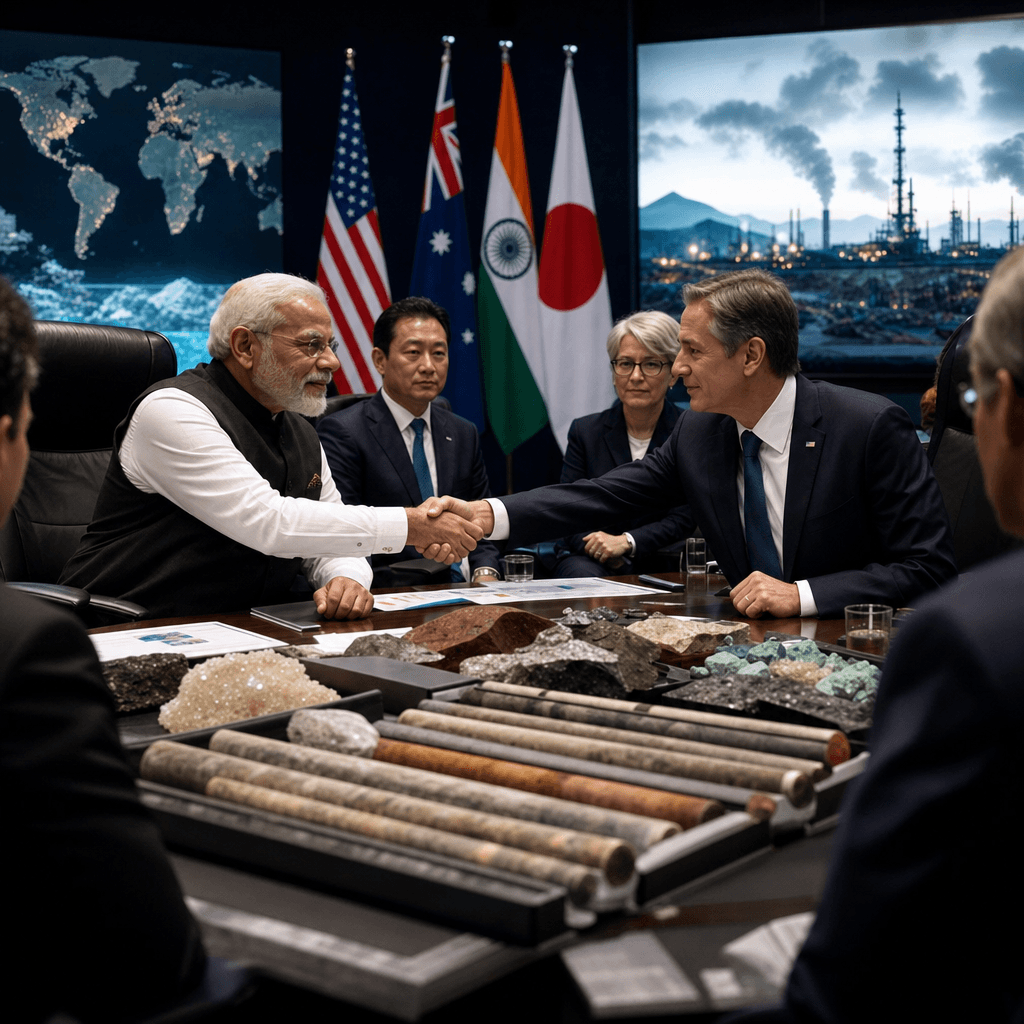
India and the U.S. have turned rare earths into strategy, not symbolism: a supply-chain deal that weakens China’s chokehold while testing whether the Quad can still deliver.
Washington is buying resilience, not just goodwill
The big move in New Delhi was not the familiar Quad language; it was the bilateral one. U.S. Secretary of State Marco Rubio and External Affairs Minister S. Jaishankar signed an India-U.S. Critical Minerals Framework to deepen cooperation on securing, mining and processing rare earths and other critical minerals, according to Livemint. Rubio also announced a wider
Quad Critical Minerals Framework aimed at strengthening supply chains and recycling across the four members.
That is the leverage map. Washington wants alternative processing capacity and tighter allied control over materials that sit at the base of EVs, missiles, semiconductors and advanced manufacturing. India wants the same architecture for a different reason: to reduce dependence on Chinese supply chains while building its own industrial base. For context on the wider strategic competition, see Global Politics and
United States.
The Quad still matters, but the real action is bilateral
The Quad foreign ministers’ meeting was the third since September 2024 and came after months of questions about the grouping’s cohesion, with West Asia, U.S.-China maneuvering and maritime security all crowding the agenda, The Hindu reported. Reuters, as carried by
CNA, framed the meeting as an effort to reaffirm relevance in the Indo-Pacific amid warming U.S.-China ties.
That context matters because the Quad’s political value has always been broader than its operational value. It signals alignment among four maritime democracies, but the concrete gains are emerging elsewhere: in industrial policy, port logistics, maritime surveillance and mineral processing. Jaishankar’s line that the Indo-Pacific must remain “a driver for global growth and stability” was standard Quad language; the framework deal was the deliverable.
The beneficiaries are obvious. India gets a stronger case that it is not a passive market but a processing and manufacturing node. The U.S. gets a partner for de-risking supply chains without relying solely on Europe or Japan. Australia and Japan gain a tighter regional minerals network that supports their own diversification goals. The loser is China, whose dominance over refining and rare earth processing gives Beijing political and economic leverage that the Quad is now trying to dilute.
What to watch next: communique, summit, and China’s response
The next decision point is whether the ministers’ talks translate into a substantive Quad communique, or just another statement of principles. Watch for three things: whether the group explicitly names supply-chain resilience as a security issue, whether it deepens cooperation on maritime surveillance, and whether India can lock in a Quad leaders’ summit later this year, as The Hindu noted is still under discussion.
The key date is the next summit window. If New Delhi gets that meeting and follows it with implementation on minerals, the Quad will look less like a summit club and more like an economic-security platform. If not, the mineral deal will still matter — but mainly as a U.S.-India hedge against China, not as proof that the Quad itself has regained momentum.
Discover more

India
India-South Korea $50B Trade Expansion Plan
India and South Korea target $50 billion in bilateral trade by 2030, focusing on industrial cooperation and strategic alignment amid US pressures.

Conflict & Security
Drone Warfare Killing Aid Workers at Unprec
Over 1,000 humanitarian workers killed in three years as cheap armed drones collapse legal protections. Gaza, Sudan, Ukraine, and DRC see deliberate targeting of aid convoys and hospitals with zero prosecutions.
Global
World Normalises Taliban as Afghan Women Eras
UN data shows Afghan women erased from public life as Russia recognises the Taliban, EU hosts officials in Brussels, and ICC warrants for gender persecution go unenforced.
Conflict & Security
West Africa Food Crisis: Three Shocks in 2026
Conflict, climate extremes, and the Strait of Hormuz closure drive a severe food crisis in West and Central Africa, with fertilizer prices surging 80% and millions displaced.