Qatar's LNG Fleet Targeted in Hormuz Strike
Iran's missile strike sends a message to Qatar amid tensions.
Model Diplomat9 min readMiddle East
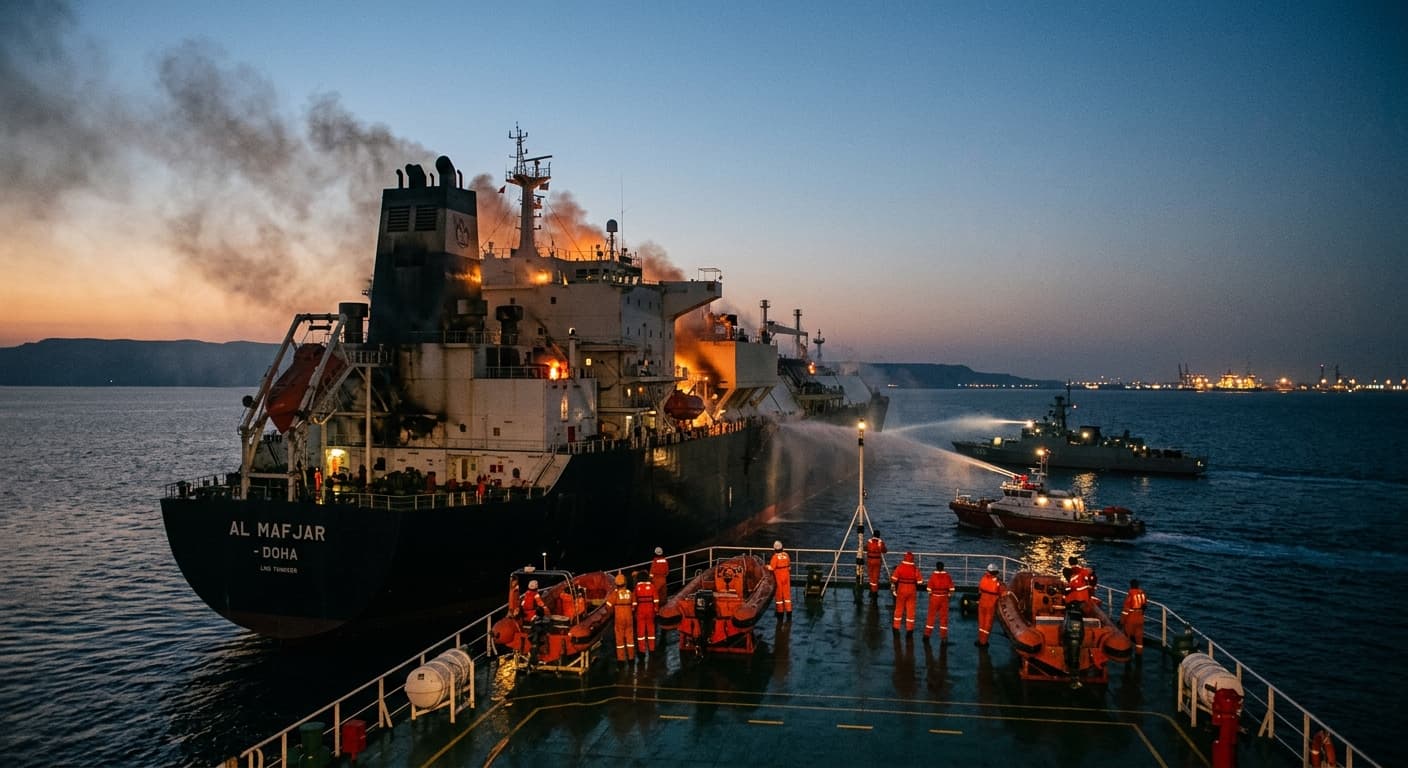
Hormuz Strike Puts Qatar's LNG Fleet in Iran's Crosshairs
A projectile hit a Qatari LNG tanker off Limah, Oman on July 7, 2026 — the first strike on a Doha-flagged vessel since the ceasefire. It is a message aimed at the mediator.
A fully-loaded Qatari LNG carrier, reportedly the Al Rekayyat, was struck by a projectile roughly eight nautical miles east of Limah, Oman in the early hours of July 7, 2026, according to a report from the vessel's master received by the British military's UK Maritime Trade Operations centre. The vessel caught fire but suffered no casualties or pollution, and the impact landed inside — or immediately beside — the US-coordinated southern transit corridor that has become the main artery for commercial traffic since the June 17 ceasefire. The choice of target is the story: Iran did not hit an American, Israeli or Chinese hull. It hit the ship of the country that brokered the deal keeping Iran's oil flowing.
That reframes what looked like a fragile-recovery narrative into something sharper. Tehran, and specifically the Islamic Revolutionary Guard Corps (IRGC), is using tanker strikes to establish a legal precedent — that any transit of the Strait of Hormuz not coordinated with Iran is "illegal" — and to reprice the Qatar-mediated diplomatic track before the memorandum's 60-day negotiating window expires. The projectile is the negotiating position.
What happened, precisely
The Splash247 report anchoring today's coverage places the impact on the tanker's port side, southbound, on or near the expanded southern corridor that Washington and the Joint Maritime Information Center (JMIC) designated after mine hazards rendered the traditional traffic separation scheme unsafe, according to Splash247. The Financial Times separately identified the hull as a
Qatari gas tanker, and the Associated Press wire reproduced by
Al Jazeera confirmed the fire was brought under control.
US officials, cited by the Wall Street Journal and reproduced by The Straits Times, accused the IRGC of firing missiles at two commercial vessels after warning on maritime VHF that any ship ignoring Iran's "coordinated" route would be attacked. Tehran has not claimed responsibility. But the pattern is now familiar: an IRGC warning on the radio, followed within hours by a strike on a ship using the US-blessed corridor. It has happened at least three times since the ceasefire — to the Singapore-flagged Ever Lovely on June 25, to a second vessel on June 27, and now to a Qatari LNG carrier. Since the war began on February 28, at least 49 attacks on commercial vessels have been recorded in the waterway, according to MarineTraffic data cited by
Al Jazeera.
Why Qatar is the target that matters
Hitting a Qatari LNG hull is not a random escalation. Qatar has been the shuttle diplomat between Washington and Tehran throughout the talks that produced the June 17 memorandum of understanding — a document the BBC obtained and published in full, revealing that Iran committed to making its "best efforts" to allow safe passage "with no charge for 60 days" and, critically, to open bilateral talks with the Sultanate of Oman on "the future administration and maritime services in the Strait of Hormuz." The full text is unusually explicit for a ceasefire document.
That last clause is where the shooting starts. Tehran reads Article 5 as validation of its claim to co-manage traffic; Washington reads it as an interim arrangement that expires when the 60 days run out. Doha's role has been to keep both readings alive long enough to bank a permanent deal. Qatar's foreign ministry said last week that talks had made "positive progress" — a formulation that lifted Brent crude off its post-war peak and toward pre-war levels, per Al Jazeera.
By striking a Qatari hull, the IRGC signals two things at once. First, that Iran can hurt the mediator when it wants leverage back — and Qatar's LNG fleet is uniquely exposed, given that roughly a fifth of global LNG transits Hormuz in peacetime and QatarEnergy is the world's largest LNG producer. Second, that Iran's reading of Article 5 is not up for renegotiation on Washington's terms. Al Jazeera has traced this specific dispute in detail; its explainer on Article 5 reads as the operational manual for every strike since June 25.
The domestic Iranian politics reinforce the pattern. Iran is still mourning Ali Khamenei, killed in the opening hours of the war on February 28; his son Mojtaba was named supreme leader in early March but has not appeared in public since, fuelling speculation he was wounded in the same strikes, as reported by the BBC. A government official told the BBC's Lyse Doucet that "the anger is real among hardline critics within the system who oppose the new deal with the United States which killed our leader," in her
dispatch from Tehran. An IRGC still visibly capable of shooting at ships is, for the hardliners, proof the regime has not surrendered.
The oil market has stopped listening — for now
Brent's reaction to the July 7 strike has been muted. Futures had already collapsed from an April 30 post-war peak above $126 to just above $70 by early July — a 38% decline that pre-dates today's incident, according to Al Jazeera. OPEC+ on July 6 announced another monthly production expansion from August, citing improving market conditions, per
Al Jazeera. Saudi Arabia has more than doubled its shipping volume since June 17 versus the previous three months combined, the same report notes, and Iran itself has moved close to 50 million barrels of crude to market since the US naval blockade lifted.
Traders are pricing an assumption: that the ceasefire holds, that Iran will not attempt full reclosure, and that IRGC harassment of individual hulls is nuisance risk rather than systemic risk. The traffic data support that read — MarineTraffic recorded 48 Hormuz transits on July 1 and 38 on July 2, versus roughly 130 daily crossings before the war. Recovery, but far from restoration.
The subtler cost is corrosion. Marine consultancy Brookes Bell has documented pitting of up to 5mm within roughly 50 days on bulk carriers that eventually exited the strait, with some cases showing 7mm wastage, according to the Splash247 coverage. That is the second-order damage no oil-price chart captures: vessels sitting at anchor for 60-plus days with sulphur cargoes are corroding from the inside. Charterers will price that into future Gulf loadings for months.
The UK–France–Oman triangle
The strike lands four days after the most important primary document of the week: a joint statement by Prime Minister Keir Starmer and President Emmanuel Macron announcing that Oman had agreed to work with London and Paris to secure its own territorial waters. In its full text, published by GOV.UK, the two leaders said:
"The Sultanate of Oman has agreed to work with the United Kingdom and France to ensure that its sovereign territorial waters are safe for navigation. The UK and France also stand ready to deploy the wider Multinational Military Mission to support freedom of navigation in the Strait of Hormuz."
The Sultan's meeting with Starmer in London on July 2 is recorded on GOV.UK. That agreement is significant because it lets a European-led coalition operate in Omani waters — including the corridor east of Limah where today's strike happened — without asking Washington. Britain has committed HMS Dragon, Typhoon jets, drones and £115m in new mine-hunting funding to the mission, per the
BBC; France has the Charles de Gaulle aircraft carrier already in theatre.
The point is not the hardware. The point is that this is the first serious European autonomous security operation east of Suez in a generation, and it is happening in a corridor where the US has said it does not "need much help." Iran's July 7 strike is calibrated to that reality: hit a Qatari ship in Omani waters days after Muscat contracts with Paris and London, and every capital in the coalition has to price what "defensive and independent" actually means the first time an IRGC missile flies at a hull the mission is meant to protect.
The legal ground is thinner than it looks
Underneath the diplomacy sits a UN Security Council record that constrains everyone. On April 7, 2026, Russia and China vetoed a draft resolution that would have authorised coordinated escort operations for merchant vessels in the strait; eleven states voted in favour, with Colombia and Pakistan abstaining, according to UN News. That veto is why the Anglo-French mission is a coalition of the willing rather than a Chapter VII operation.
What passed instead, weeks later, was Resolution 2817 (2026), which condemned Iran's "egregious attacks" on Bahrain, Kuwait and international shipping, per a UN press release. A follow-up Security Council debate in June recorded Secretary-General António Guterres reminding members that navigational rights through Hormuz must be respected "as affirmed by Council resolution 2817 (2026)," per
UN Meetings Coverage. The UK invoked 2817 directly at the Council on July 2, saying Iran's attacks are "directly contrary" to it, according to the
FCDO statement.
The gap between what 2817 says and what it enables is the gap the IRGC is exploiting. Condemnation without enforcement authorises nothing; the European mission is legally exposed if it acts kinetically on Iranian assets, and Tehran knows it.
Winners, losers, and the historical parallel
The clearest winner from the past week's turbulence is the United States — as an LNG supplier. Analysts told Al Jazeera the war will consolidate the US position as the "swing LNG supplier" and Qatar's role as the "reliable long-term contract partner," per Al Jazeera's energy retrospective. Every insurance premium added to a Hormuz-bound cargo makes a Sabine Pass cargo more competitive.
The clearest loser is Iran's own oil revenue. Tehran needs the strait open to move its 50 million barrels; every IRGC strike raises war-risk premia on the very ships hauling Iranian crude and delays sanctions relief that the June 17 memorandum promised. The IRGC's tactical wins subtract from the Iranian treasury.
The historical parallel is the 1987–88 Tanker War, when the US reflagged Kuwaiti tankers and Iranian mines struck the USS Samuel B. Roberts. That episode produced Operation Praying Mantis and the eventual acceptance of UN Security Council Resolution 598. The dynamic today is inverted: it is Europe, not America, building the escort coalition; it is a Qatari ship, not a Kuwaiti one, being reflagged in effect by a Franco-British umbrella. The precedent worth studying is that in 1988 it took a US frigate hitting a mine to force Iran to the table. In 2026, the equivalent triggering event has not yet happened.
What to watch next
- The 60-day MoU clock expires in mid-August 2026. If US–Iran talks have not produced a permanent deal by then, Article 5 lapses and the interim safe-passage regime dissolves into whichever fait accompli Tehran has managed to establish.
- The next JMIC advisory and any UKMTO reclassification of the threat level above "substantial." A move to "severe" would trigger insurance-market repricing regardless of Brent.
- Mojtaba Khamenei's first public appearance, if it comes. His continued absence, noted by
Al Jazeera, is the single largest unknown in Tehran's decision-making chain.
- Any strike on a Franco-British-escorted vessel. That is the trigger that would test whether "strictly defensive and independent" means anything operational.
Diplomat View
The July 7 strike is best read as a pricing signal, not an escalation. Iran is testing what the traffic will bear — how much low-grade harassment of Hormuz shipping the US, the European mission, and the oil market will absorb before the ceasefire architecture starts to crack. So far the answer is: quite a lot. Brent barely twitched. Doha will keep mediating because the alternative is worse. London and Paris will deploy anyway because the political cost of retreat now exceeds the operational risk of showing up.
The forecast: the ceasefire holds through August, a partial deal extends the MoU, and Hormuz traffic stabilises around 60–70% of pre-war volumes with a permanent war-risk premium baked into charter rates. What would change that forecast: an IRGC strike that kills seafarers on an escorted vessel, or confirmation that Mojtaba Khamenei has been permanently incapacitated and the succession is contested. Either would collapse the current bargain within a week. Track Iran coverage and the
conflict file for the next inflection.
The Bottom Line
Iran's July 7 strike on a Qatari LNG tanker off Oman was not random escalation — it was a targeted message to the mediator, calibrated to reprice the US–Iran memorandum before it hardens into a permanent deal. The oil market has already decided the ceasefire will hold; the IRGC has decided that occasional missiles at Doha-flagged hulls are the cheapest way to keep Article 5 of that memorandum ambiguous. Both bets can be right until one of them isn't.
Discover more
US Politics
House Ethics Committee Pushes Sexual Miscond.
The House Ethics Committee has shifted responsibility for sexual harassment settlement records to the Office of Congressional Workplace Rights, complicating disclosure efforts.
US Politics
SNAP Food Assistance Faces Legal Challenges
In 2026, SNAP faces stricter eligibility rules and mounting legal challenges, threatening food assistance for the millions of Americans who rely on the program.
India
Congress Accuses Modi of Stalling Women's Law
Congress accuses Modi of stalling women's reservation law by linking it to delimitation, revealing a deeper electoral strategy.

Conflict & Security
Drone Warfare Killing Aid Workers at Unprec
Over 1,000 humanitarian workers killed in three years as cheap armed drones collapse legal protections. Gaza, Sudan, Ukraine, and DRC see deliberate targeting of aid convoys and hospitals with zero prosecutions.