Qatari LNG Tanker Attack Tests Trump's Iran T
A missile strike on a Qatari LNG carrier raises tensions in Hormuz.
Model Diplomat7 min readMiddle East
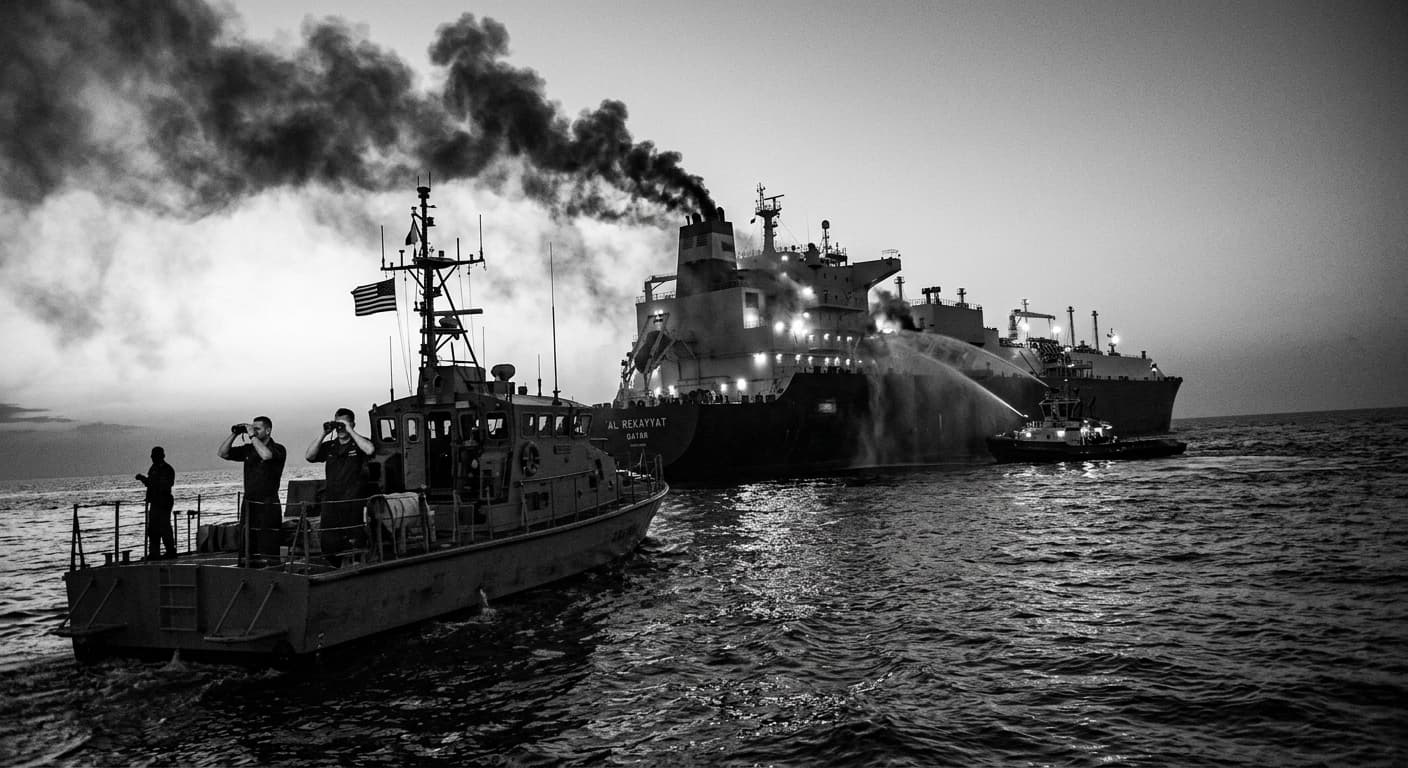
Qatari LNG Tanker Struck in Hormuz Tests Trump's Iran Deal
The July 7, 2026 attack on Nakilat's Al Rekayyat off Oman shreds the Islamabad MoU's core promise on Hormuz — and forces Doha to choose sides.
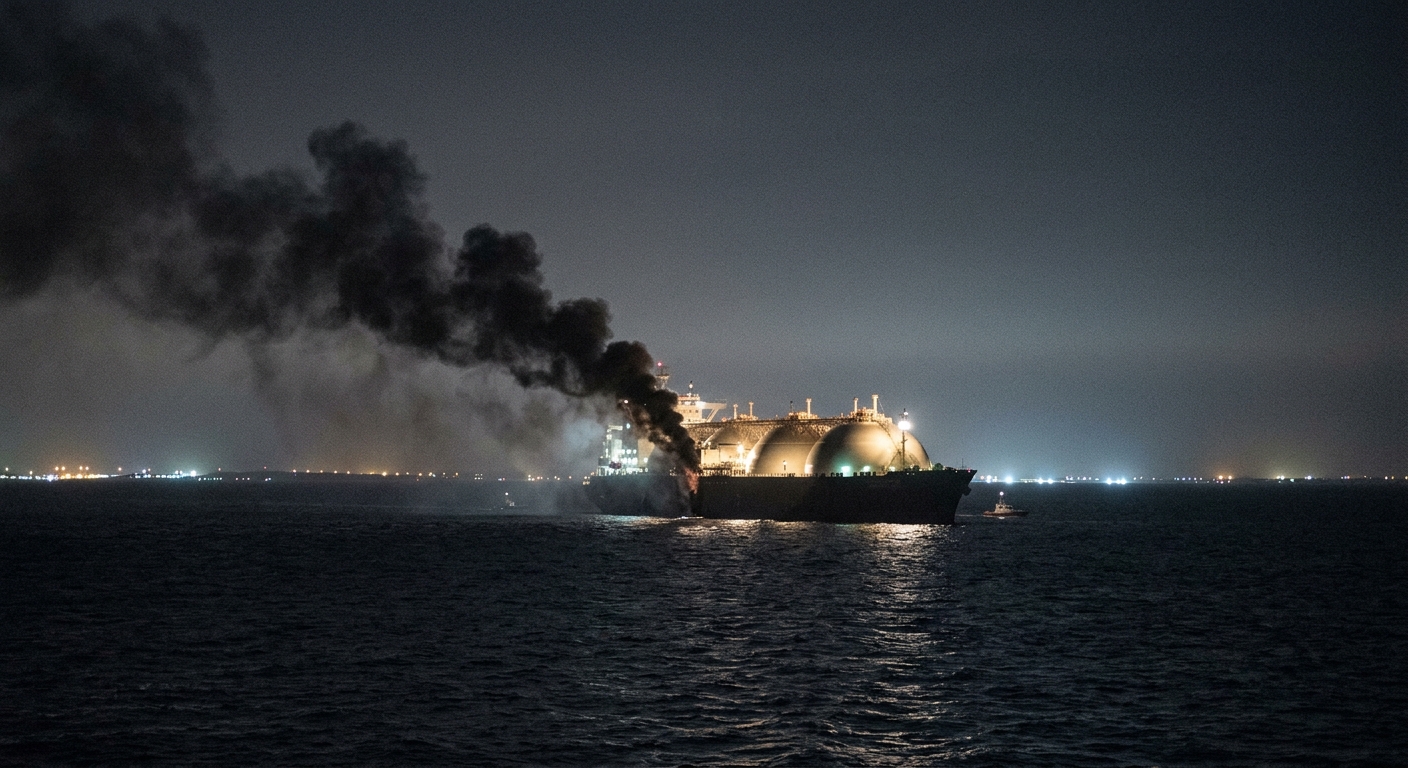
A projectile hit the laden Qatari LNG carrier Al Rekayyat off the Omani coast at dawn on July 7, 2026, three weeks after Donald Trump and Masoud Pezeshkian signed a memorandum of understanding meant to reopen the Strait of Hormuz — and the strike matters not because a ship caught fire, but because Tehran has now demonstrated that Qatar cannot ship its own gas out of the Gulf on any route Iran has not blessed. The Islamic Revolutionary Guard Corps did not have to sink her. Hitting a state-flagged Qatari hull on the US-preferred southern corridor was the point. Doha's decade-long balancing act between Washington and Tehran is over; the only question now is how it ends.
What happened, in precise terms
The vessel, operated by Qatar's state carrier Nakilat and carrying QatarEnergy cargo, was struck on its port side near Limah, Oman, while heading south out of the strait toward the Gulf of Oman, according to a UK Maritime Trade Operations advisory relayed through British military channels. Al Jazeera, citing UKMTO, reported no casualties or environmental damage, and Iranian state television said the tanker had "ignored warnings," without directly claiming the strike (
Al Jazeera). Two US officials told Axios that Iran fired at least two missiles at commercial vessels transiting the strait and that a second ship was also hit, both suffering significant damage.
The tanker was moving with its transponders off, according to the Rigzone report that broke the identification, a routine wartime evasion tactic that BBC Verify has documented across the Gulf since February. It is the third recorded attack in less than two weeks on the US-managed southern corridor after the Singapore-flagged Ever Lovely on June 25 and the Thai-flagged Mayuree Naree, whose engine-room fire left three crew missing, per
BBC Verify. MarineTraffic has now logged at least 49 attacks on commercial vessels in the strait since the war began on February 28.
The MoU was already unraveling — this finishes it
The Islamabad Memorandum of Understanding, signed electronically by Trump and Pezeshkian at Versailles on June 17 with Qatari and Pakistani mediation, gave Iran 60 days to make "best efforts" for safe passage of vessels "with no charge," in exchange for the US lifting its Gulf of Oman blockade of Iranian ports. Al Jazeera's account of the text noted the MoU also envisioned Iran and Oman "defining the future administration and maritime services" of the strait — a formulation Tehran has since read as a license to charge tolls (Al Jazeera).
Within days Tehran's Persian Gulf Strait Authority (PGSA), an IRGC-linked body, declared that "no vessel is permitted to pass through the Strait of Hormuz without a valid passage permit" and warned that "consequences arising from passage through unauthorised routes shall be the responsibility of the owner, operator, and vessel commander." The BBC reported four LNG tankers heading to Qatar's Ras Laffan on June 22 all used the northern Iranian-approved corridor, not the southern US-recommended route (BBC). The pattern since is unmistakable: ships that submit to PGSA make it through; ships that don't, get hit.
That is why the strike on Al Rekayyat is a message, not a mishap. Iran's Tehran-based analyst Hossein Royvaran floated to Al Jazeera the possibility that the tanker strayed into a mine-clearing zone. That claim is not credible for a Nakilat vessel exiting laden along the strait's most surveilled edge. The operational signature — port-side hit, southern corridor, laden Qatari LNG — is the same signature CENTCOM attributed to Iran when it struck the Ever Lovely and then retaliated on June 26, saying "the unwarranted aggression against commercial shipping by Iranian forces clearly violated the ceasefire."
Why Qatar loses more than anyone
Qatar is uniquely exposed. QatarEnergy CEO Saad al-Kaabi told Reuters in March that Iran's initial strike on Ras Laffan destroyed two of Qatar's 14 LNG trains and one of its two gas-to-liquids plants, sidelining 12.8 million tonnes per year — about 17% of national LNG capacity — for three to five years and costing an estimated $20 billion in annual revenue (Al Jazeera). QatarEnergy declared force majeure on long-term contracts to Italy, Belgium, South Korea and China. Shell, its largest offtaker, cascaded force majeure notices worldwide.
Doha's calculation coming out of that catastrophe was that mediation between Washington and Tehran — hosting US envoys Steve Witkoff and Jared Kushner alongside Iranian negotiator Kazem Gharibabadi in Doha on July 1–2, and warehousing $12 billion in frozen Iranian assets — would buy the security space to restart exports (Al Jazeera). The Al Rekayyat strike collapses that logic. Tehran has now signaled that Qatar's mediator status confers no immunity for its hulls if they refuse the northern corridor.
The alternative — routing Nakilat's fleet through the PGSA framework — means paying tolls to the IRGC and legitimising Iranian sovereignty claims that the UN Security Council explicitly rejected in Resolution 2817, adopted March 11 with a record 136 co-sponsors. That resolution "condemns all acts or threats by the Islamic Republic of Iran aimed at obstructing, impeding or otherwise interfering with international navigation through the Strait of Hormuz." A Qatari state carrier openly paying PGSA fees would gut the resolution Doha itself co-sponsored.
The angle the wires missed: Doha is quietly aligning with London and Paris
The most consequential Hormuz document of the past month is not the Islamabad MoU. It is the joint statement issued by Keir Starmer and Emmanuel Macron on July 3, 2026, announcing that "the Sultanate of Oman has agreed to work with the United Kingdom and France to ensure that its sovereign territorial waters are safe for navigation" and that both governments "stand ready to deploy the wider Multinational Military Mission to support freedom of navigation." Denmark has already joined.
At the UN Security Council the day before, UK Deputy Permanent Representative James Kariuki described the mission as "strictly defensive and independent", pointedly citing Iran's violations of Resolution 2817. Read together with the failed Bahrain-US follow-on resolution — vetoed by Russia and China on April 7 — the European track is the substitute for a Security Council mandate Washington cannot secure.
That is where Qatar quietly benefits from Iran's overreach. The strike on Al Rekayyat strengthens Franco-British legitimacy to escort Gulf-flagged tankers along the Omani corridor without needing a UNSC vote. It also revives Trump's June pledge, reported by BBC Verify, of a US military escort "if necessary." Expect Nakilat's next laden voyages to test convoy protection, not the MoU's honor system.
The GCC split is the sub-story
The Gulf Cooperation Council is not a unified block on this. The Manohar Parrikar Institute noted that Saudi Arabia and the UAE — hit hardest by Iranian drones in February — have adopted "a more assertive posture and deterrence-oriented approach," while Qatar and Oman "continue to pursue a conciliatory approach." The Gulf International Forum's Anas Al Qaed argues Gulf states are "bound to Washington while simultaneously exposed by Iran," their traditional insulation doctrine now untenable (
Gulf International Forum).
The Al Rekayyat attack forces this contradiction into the open. If Qatar keeps mediating, it accepts a maritime regime in which the IRGC taxes its exports. If it hardens toward Tehran, it forfeits its role as broker of the $6 billion frozen-assets tranche and the wider MoU implementation — a role Emir Tamim personally reaffirmed to Witkoff and Kushner on July 1. The middle path — commercial mediation, military coverage by London and Paris — is the one now taking shape.
What to watch
Congressional Research Service analysts John Frittelli and Ben Goldman documented for Congress that daily transits collapsed to a handful by early April and remain far below the pre-war baseline of roughly 130 crossings. On July 2, MarineTraffic counted just 38. Every additional attack tightens insurance war-risk premia and pushes shipowners toward the PGSA route by attrition — precisely Iran's aim.
Diplomat View
The Islamabad MoU is dead in substance, whatever Trump and Pezeshkian sign next. Iran has demonstrated it can enforce its Hormuz regime by striking laden Qatari hulls on the US-preferred route with plausible deniability and no consequence beyond a symbolic CENTCOM retaliation. Our forecast: within four weeks Qatar quietly resumes eastward LNG shipments primarily via the northern Iranian-approved corridor while accelerating parallel arrangements with the UK–French Multinational Military Mission for its most sensitive European cargoes. The MoU's 60-day clock, which expires on August 16, is unlikely to produce a "final deal" — the more probable outcome is a shorter tactical rollover that codifies, rather than reverses, PGSA authority. What would falsify this call: a US Navy escort convoy sailing a Nakilat vessel through the strait under fire without paying PGSA — or an Iranian mining incident that forces Beijing off the fence and onto a Security Council text it can no longer veto. Neither is likely before the MoU deadline.
Forward look:
- August 16, 2026 — Islamabad MoU 60-day window expires; watch for a tactical rollover, not a final deal.
- Next Nakilat voyage — first test of whether Qatar sails under Anglo-French escort or accepts PGSA permits.
- UNSC schedule — Bahrain has signaled a return to the Council; Russia-China veto math has not changed.
The Bottom Line
The bottom line: Iran did not attack the Al Rekayyat to sink a ship — it attacked to prove that no Gulf-flagged tanker, not even one belonging to Tehran's own mediator, transits Hormuz without paying the IRGC. Doha's decade-long hedge between Washington and Tehran is over; the Anglo-French Multinational Military Mission, not the Islamabad MoU, is now the operative security architecture in the strait. If Qatar's next laden LNG voyage sails under European naval cover, the region has quietly returned to a 1980s-style tanker war, escorts and all — only this time with the world's second-largest LNG exporter as the flag being defended.
Discover more

US Politics
House Ethics Committee Pushes Sexual Miscond.
The House Ethics Committee has shifted responsibility for sexual harassment settlement records to the Office of Congressional Workplace Rights, complicating disclosure efforts.
India
Women’s Reservation Bill 2026
The Constitution (131st Amendment) Bill, 2026 was defeated in Lok Sabha, revealing deeper political conflicts over women's reservation and delimitation.
Global Politics
Xi Jinping Calls China-Russia Ties 'Precious'
Xi Jinping's description of China-Russia ties as 'precious' reflects a strategic imbalance, with Beijing dictating terms in the partnership.

Economics
Fed's Amex AML order puts correspondent banking on notice
Federal Reserve's Amex AML order requires board-level controls and a 90-day plan; OCC fined the bank $350 million over enterprise-wide deficiencies.