Qatar-US Consortium's Oil Deal in Iraq
Baghdad seeks security through pipeline agreements.
Model Diplomat8 min readMiddle East
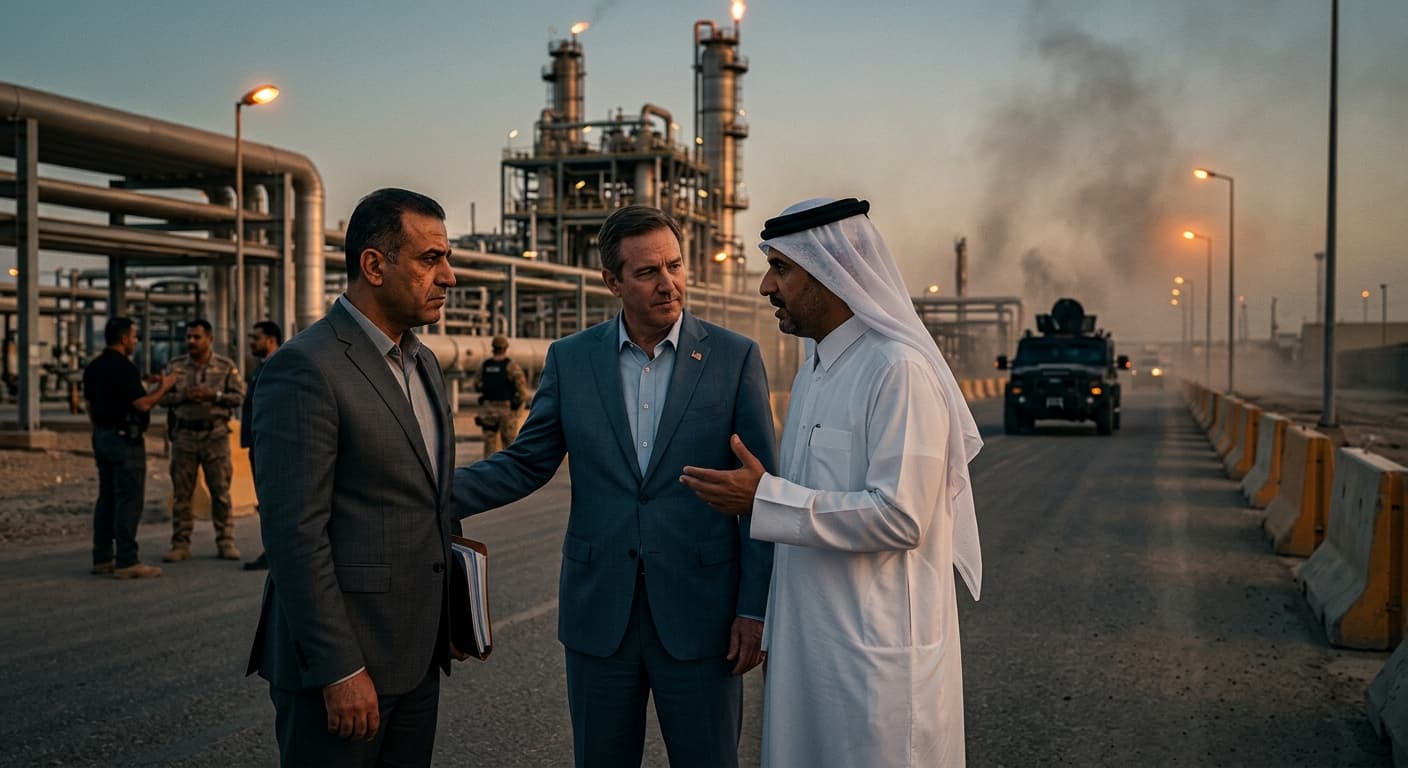
Qatar-US pipeline consortium hands Baghdad an escape from Hormuz
Iraq's cabinet cleared UCC, Chevron and TI Capital to study Basra–Haditha lines to Ceyhan and Baniyas — a geopolitical bet on Turkey, post-Assad Syria and away from Iran.
Iraq's cabinet on July 6, 2026 authorised its state Basra Oil Company to sign heads-of-agreement and non-disclosure documents with a consortium of Qatar's UCC Holding and US firms Chevron and TI Capital to study two long-blocked oil export corridors — Basra to Haditha and on to Ceyhan in Turkey, and Basra–Haditha–Baniyas in Syria — a package that, if built, would give OPEC's second-largest producer its first meaningful crude route to the Mediterranean since the 1980s and its most credible answer yet to Iran's ability to threaten the Strait of Hormuz. The thesis: this deal is not about pipelines, it is about Baghdad quietly buying an American security umbrella in the middle of a war-reshaped region — with Qatari capital paying the premium.
That is the shift worth reading. Iraq is signing paper on route studies, but the geopolitical delivery is immediate: Chevron and a Doha-based conglomerate get physical stakes in Iraq's export spine at exactly the moment a new prime minister needs Washington's tolerance to survive. The commercial deal is the wrapping. The security guarantee is the gift.
What the cabinet actually approved
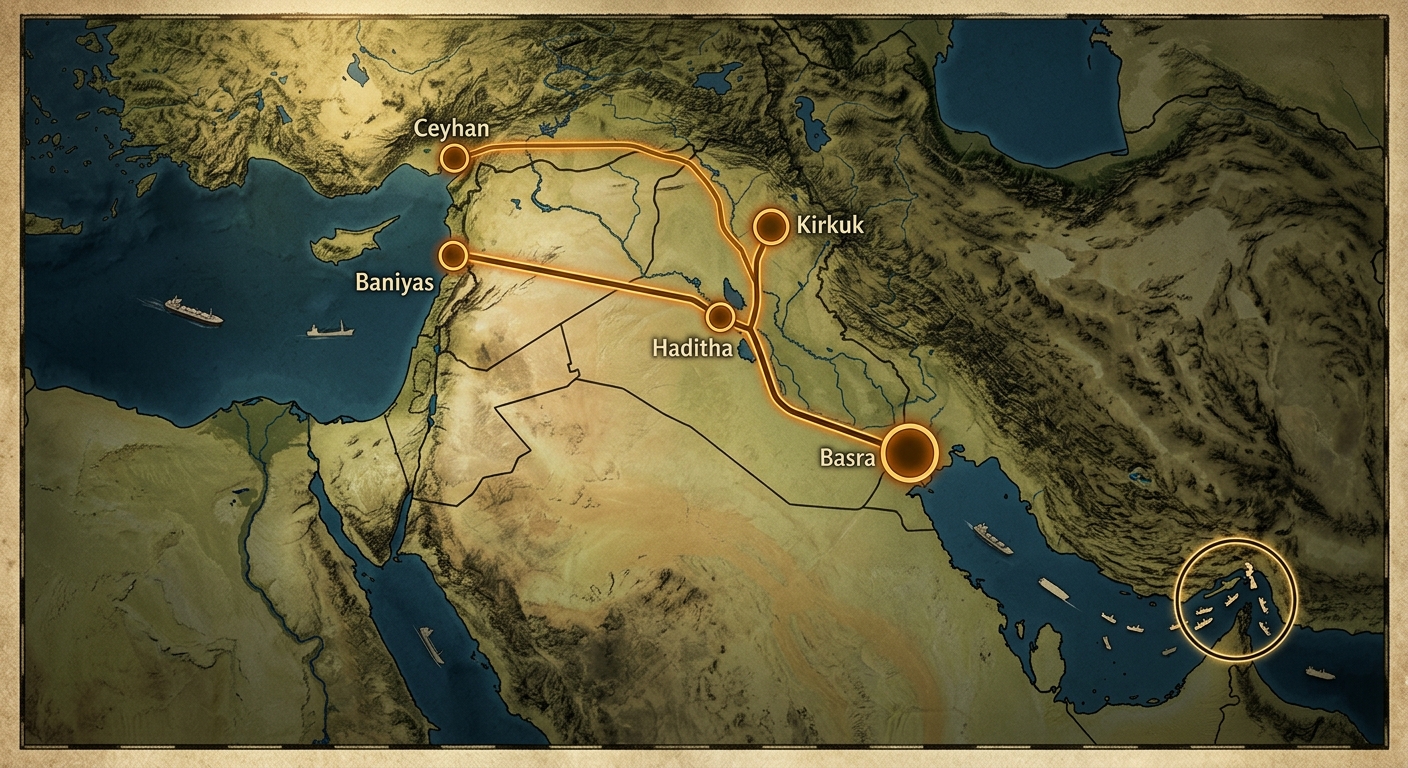
According to AGBI, which broke the terms on July 6, the cabinet authorised the oil ministry to finalise a head-of-agreement and NDA with UCC Holding, Chevron and TI Capital to conduct "comprehensive technical and financial studies" of two routes: a Basra–Haditha–Kirkuk–Ceyhan line, and a Basra–Haditha–Baniyas line to the Syrian Mediterranean. The statement expressly notes that no "final financial or contractual obligations" fall on the oil ministry at this stage — the classic structure of an Iraqi memorandum designed to survive the next cabinet reshuffle.
The scale is not hypothetical. In April 2026, Iraq's cabinet already approved $1.5 billion of a $5 billion allocation for the Basra–Haditha spine, as The Star confirmed in its readout of the ministerial decision. The Financial Times last year priced multi-country iterations of the same corridor at $15–20 billion depending on onward routing through Turkey, Syria or Jordan, according to its
reporting on Gulf pipeline planning after the Iran war.
A parallel piece of housekeeping seals the point. The 52-year-old bilateral pact governing the 970-km Kirkuk–Ceyhan pipeline was due to lapse on July 27, 2026 after Ankara moved to terminate it in 2025. Following Iraqi–Turkish meetings in Ankara last week, Turkey agreed to a one-year extension, with an executive protocol to follow — a bridge that keeps ~200,000 barrels per day of northern crude flowing while the new southern-fed lines are studied. Iraq's Ministry of Foreign Affairs, in its own readout of the Ministerial Council for the Economy, confirmed that SOMO's export plan explicitly banks on the Kirkuk–Ceyhan restart plus overland alternatives.
The Hormuz calculus, and why the math doesn't quite work
Baghdad's official framing is diversification away from Gulf shipping. That framing is real but incomplete. Iraq's southern fields produce roughly the bulk of the country's 4-million-plus barrels a day — and, as Al Jazeera's analysis of Hormuz bypass options noted in March 2026, "Iraq's southern fields, which produce the bulk of its exportable crude, have no meaningful inland connection to the northern Turkish pipeline." The Basra–Haditha spine is precisely the missing tendon.
But every bypass pipeline built in the last decade has learned the same lesson the hard way. Saudi Arabia's East-West Pipeline was hit by Houthi drones in 2019. Fujairah's terminus at the end of ADCOP was disrupted in March 2026 by drone strikes, per the same Al Jazeera analysis. Combined bypass capacity across Saudi, UAE and Iraqi lines is about 9 million bpd against roughly 20 million bpd that transited Hormuz before the US–Israel war on Iran. A pipeline is not immune to Iran or its proxies; it is merely a different, and possibly softer, target.
The deeper logic, then, is not that Iraq escapes vulnerability. It is that Iraq re-anchors its export economy to Turkish and Syrian territory — both of which are, as of 2026, effectively inside the American security perimeter — and off the Iranian one. That is a strategic realignment dressed as engineering.
The angle the wires missed: this is al-Zaidi's insurance policy
The consortium is not the story. The signatory is. Iraq's new Prime Minister Ali al-Zaidi took office on May 14, 2026 with a partial cabinet after months of Coordination Framework deadlock, as Al Jazeera reported. Al-Zaidi was chosen only after President Trump personally vetoed former prime minister Nouri al-Maliki, with Washington publicly
threatening to cut security cooperation and even sanction Iraqi officials if a pro-Iran figure took the premiership.
The threats were not rhetorical. On May 7, 2026, the US Treasury sanctioned Iraq's Deputy Oil Minister Ali Maarij al-Bahadly, accusing him of facilitating Iranian oil sales laundered as Iraqi crude, per Al Jazeera's reporting. That is the environment into which the Chevron–UCC–TI Capital consortium is now walking.
The Atlantic Council's Ahmed Tabaqchali, in an October 2025 analysis, spelled out the mechanism plainly: Iraqi prime ministers now use US oil deals "as both shield and sword — protection against US economic punishment and leverage for political support," a strategy borrowed from the Kurdish Regional Government's Washington playbook. Al-Sudani ran the play. Al-Zaidi, a businessman with no political history and a fragile mandate, has doubled it. He is buying Chevron a stake in Iraq's future export capacity, and in return he is buying himself a US private-sector lobby against the sanctions that took out his own deputy minister two months ago.
That the Qatari partner is UCC Holding is not incidental. UCC signed a 25-year, $2.5 billion power-plant partnership with Iraq in June 2023, brokered during the emir's Baghdad visit, according to Al Jazeera. Doha is the region's designated financier for infrastructure that Washington wants built but does not want to fund. Chevron brings political weight; TI Capital brings project-finance packaging; UCC brings Gulf capital and, crucially, a Qatari sovereign relationship that survives US election cycles.
Syria is the tell
The single most under-appreciated line in the AGBI report is the Baniyas leg. A pipeline from Basra to the Syrian Mediterranean was politically unthinkable while Bashar al-Assad was in Damascus — the Kirkuk–Baniyas line, built in the 1950s, was destroyed by US bombs in 2003 and then serially sanctioned, and Assad's regime blocked Qatari gas transit projects to protect Russian market share, as Chatham House noted in December 2024.
That door reopened when Assad fell. The new Syrian president Ahmed al-Sharaa met Chevron representatives in Damascus in December 2025 to discuss energy cooperation, and the US and EU lifted most sanctions on Syria, per Al Jazeera's assessment of the sector's recovery prospects. By March 2026, Damascus had launched its "4+1" corridor initiative to position Syria as a transit hub, and US envoy Tom Barrack had reportedly floated a Syrian energy-corridor plan that includes reviving the Kirkuk–Baniyas line at a cost of roughly $4.5 billion over 36 months, according to a
BBC Arabic account citing the Saudi publication Al-Majalla.
Iraq is already running an ad-hoc version of this route. Since May 2026, hundreds of Iraqi trucks have hauled crude overland to Baniyas as a Hormuz workaround, per an Al Jazeera news feed. The Economist confirmed in
June 2026 that Baniyas storage is the constraint. A permanent pipeline solves the storage problem and hands Damascus roughly $200 million a year in transit fees on the BBC's numbers — the largest hard-currency inflow the al-Sharaa government has been offered by anyone.
Who wins, who loses
Winners. Chevron, which already picked up management of West Qurna-2 from a sanctioned Lukoil in February 2026 and now gains a stake in the physical logistics of Iraqi exports. UCC Holding and Qatar, which convert political relationships in Baghdad and Damascus into hard infrastructure. Turkey, which secures a one-year pipeline extension plus a promised long-term deal, and cements its post-Assad ambitions as an energy hub laid out in the same Chatham House note. Al-Zaidi, who has just tied his political survival to the balance sheets of two of the world's most politically-connected companies. And al-Sharaa in Damascus, who acquires a US-branded stake in his own stability.
Losers. Iran, most obviously — every barrel that leaves Iraq via Ceyhan or Baniyas is a barrel that does not sit hostage to Hormuz, and every US firm working the route is a de facto tripwire. Russia, which lost Lukoil's Iraqi position and whose interest in blocking Qatari gas through Syria died with the Assad regime. And, less visibly, the KRG: as the Atlantic Council noted, Baghdad is now running the "energy deals as US insurance" strategy at a scale that dwarfs anything Erbil can offer, diluting the Kurds' historical lobbying edge in Washington.
The primary-document view
The Iraqi Foreign Ministry's own July 2026 statement from the Ministerial Council for the Economy confirms that SOMO is now openly courting "local and international maritime transport companies" for southern exports while simultaneously banking on the Kirkuk–Ceyhan restart — an explicit two-track strategy. Earlier US–Iraq
joint statements under the Strategic Framework Agreement already committed both sides to "energy independence by 2030" and to resuming the Iraq–Turkiye Pipeline. The consortium deal is the operational translation of that political language.
The Kirkuk–Ceyhan restart itself was midwifed by Washington. Secretary of State Marco Rubio publicly welcomed the September 27, 2025 resumption after the two-and-a-half-year International Chamber of Commerce arbitration standoff, calling it "tangible benefits for both Americans and Iraqis." The pattern is consistent: US diplomatic muscle unblocks Iraqi exports; US corporate paper follows.
Diplomat View
The consortium deal is best read as a hedge Al-Zaidi cannot afford to lose. Baghdad's real bet is that layering Chevron, UCC and TI Capital across its export spine buys enough Washington political inertia to survive a Trump administration that has already sanctioned an Iraqi deputy minister and can plausibly sanction more. The pipelines themselves may take a decade — or, given Iraq's contracting history, never — but the political option value is delivered on signature.
The forecast: if al-Zaidi holds his coalition through the winter and the Kirkuk–Ceyhan executive protocol is signed on schedule, expect the Basra–Haditha spine to reach a final investment decision by mid-2027 and the Syrian leg to advance only if al-Sharaa consolidates security around Homs and the coastal Alawite regions. The forecast reverses if any of three things happen: an Iranian-linked strike on the Basra spine's route, a US Treasury designation of a senior Zaidi minister, or a collapse of the al-Sharaa government in Damascus. Any one of those, and the Baniyas leg becomes paper again.
Forward look:
- July 27, 2026 — deadline for the executive protocol extending the Kirkuk–Ceyhan pact; watch for the wording on KRG crude.
- Q4 2026 — expected completion of UCC/Chevron/TI Capital feasibility studies on both routes.
- Iraqi budget cycle, late 2026 — whether al-Zaidi ring-fences the remaining $3.5 billion of the $5 billion Basra–Haditha allocation, or lets it drift, will signal how real the project is.
Read today's full | | Country page: Iraq
Discover more
US Politics
House Ethics Committee Pushes Sexual Miscond.
The House Ethics Committee has shifted responsibility for sexual harassment settlement records to the Office of Congressional Workplace Rights, complicating disclosure efforts.

US Politics
SNAP Food Assistance Faces Legal Challenges
In 2026, SNAP faces stricter eligibility rules and mounting legal challenges, threatening food assistance for the millions of Americans who rely on the program.
US Politics
Congress Targets AI Chatbot Access for Terror
The House passed the Generative AI Terrorism Risk Assessment Act, focusing on AI's role in terrorism and potential surveillance implications.

Economics
Fed's Amex AML order puts correspondent banking on notice
Federal Reserve's Amex AML order requires board-level controls and a 90-day plan; OCC fined the bank $350 million over enterprise-wide deficiencies.