Putin Makes North Korea a Permanent War Ally
Putin thanks Pyongyang for troops in Kursk, cementing a permanent military alliance
Model Diplomat8 min readEurasia
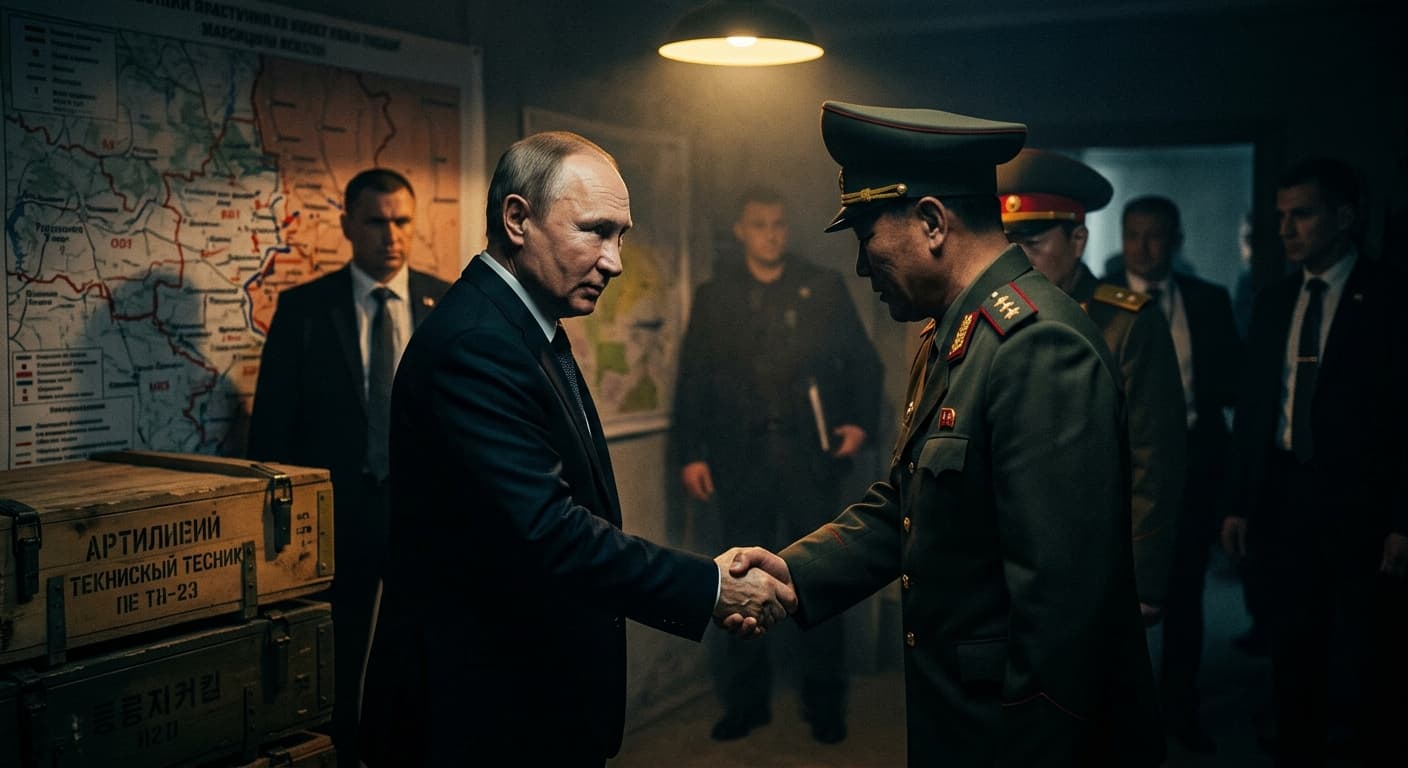
Putin Makes It Explicit: North Korea Is Now a Permanent Pillar of Russia's War Machine
Vladimir Putin's direct thanks for North Korean blood spilled in Kursk — delivered in the Kremlin, to Choe Son Hui, on July 19, 2026 — signals that Moscow views the Pyongyang alliance not as a wartime expedient but as a structural feature of its post-invasion security architecture.
On July 19, 2026, Russian President Vladimir Putin sat across from North Korean Foreign Minister Choe Son Hui in the Kremlin and said something he has never said in quite this way before. He did not offer the usual diplomatic pleasantries about "deepening bilateral ties" or "strategic partnership." Instead, he thanked Kim Jong Un for sending soldiers — specifically, for "the decision to send soldiers of the Korean People's Army to take part in the liberation of the Kursk Region," according to Russia's TASS news agency.
The remark was striking in two respects. First, Putin named the deployment explicitly — Kursk, not "the special military operation" in the abstract. Second, he named it to Choe, the diplomat who has become the public face of Pyongyang's pivot from nuclear hermit to active military ally. The meeting, reported by the Associated Press, had no obvious occasion — no anniversary, no multilateral summit — which is precisely what made it significant. Choe was there to coordinate a visit to Russia by Kim Jong Un, according to
multiple analysts cited by UPI. The choreography matters: the Kremlin is preparing to host Kim on Russian soil, and Putin wanted the public record to show that Moscow remembers who bled for Kursk.
The thesis: Putin's public gratitude is not sentiment. It is a signal — to the Russian military-industrial complex, to Beijing, to Washington, and to Kyiv — that the North Korean alliance has become a permanent, indispensable pillar of Russia's war-fighting capacity, and that Moscow is prepared to pay for it in technology transfers that will reshape security on the Korean Peninsula for a generation.
The Scale of Pyongyang's Commitment
The numbers now available make clear why Putin is grateful. According to South Korea's National Intelligence Service (NIS), North Korea has deployed approximately 15,000 troops to assist Russian forces, with roughly 2,000 killed in combat, UPI reported. A BBC investigation based on satellite imagery and official photos of the Memorial Museum of Combat Feats at the Overseas Military Operations in Pyongyang, unveiled on April 26, 2026, estimated that approximately 2,300 North Korean soldiers have died fighting for Russia, with their names engraved across two memorial walls
BBC News reported.
On the munitions side, the scale is even larger. According to CSIS satellite-imagery analysis, as of early 2026 North Korea had transferred an estimated 15 million-plus artillery shells and deployed 14,000 to 15,000 troops to the front CSIS Beyond Parallel documented. Ukraine's military intelligence chief, Lieutenant General Kyrylo Budanov, has estimated that North Korea is providing roughly half of Russia's artillery shells,
according to the Council on Foreign Relations. The Royal United Services Institute (RUSI) assessed in 2025 that North Korean ammunition may constitute up to 40% of the 14 million rounds Russia has fired since August 2023
RUSI analysis found.
"North Korea is now a more important ally for Russia than Iran or China," said Oleg Ignatov, senior Russia analyst for Crisis Group, in July 2025. "North Korea supplies Russia with ammunition and some types of heavy weapons. As for the North Korean soldiers, Russian sources say they are professional and disciplined."
Al Jazeera reported
The asymmetry in the relationship is stark. A September 2025 study by the Friedrich Naumann Foundation, a German think tank, estimated that North Korea has delivered up to $9.8 billion worth of weapons and fighters to Russia since 2023. In return, Pyongyang's gains may amount to as little as $457 million to $1.19 billion in food, fuel, air defense systems, and possibly some fighter aircraft Al Jazeera reported on the study. On the surface, Kim is getting a raw deal. But the raw deal narrative misses the strategic calculus: Kim is buying technology, battlefield experience, and the irrevocable breakup of the international sanctions regime that constrained his nuclear program for two decades.
What Russia Is Paying: The Technology Transfer
The technology pipeline from Russia to North Korea has moved from speculation to documented fact over the past two years. According to the Congressional Research Service, the Comprehensive Strategic Partnership Treaty signed by Putin and Kim in June 2024 included a mutual military assistance clause — Article 3, which calls for each side to "immediately provide military and other assistance by all of one's means available" in the event either side "is put in a state of war by an armed invasion." But the less-discussed provisions pledged cooperation in "scientific fields, including nuclear energy and space technology."
In practice, this has translated into concrete transfers. According to Foreign Affairs, Russia has provided North Korea with modern air defense systems suitable for guarding against drones, cruise missiles, and precision munitions, as well as advanced electronic jamming gear and operational know-how that could degrade South Korean and U.S. communications. South Korean press reports citing anonymous government officials have indicated that in the first half of 2025, Russia provided North Korea with key parts for a nuclear-powered submarine, possibly including a reactor, turbine, and cooling system.
The missile improvements are measurable. Ukraine's defense intelligence chief Budanov said in August 2025 that North Korean KN-23 ballistic missiles, which initially suffered from poor accuracy — roughly half deviated from their trajectory and exploded in midair upon first shipment — had seen "noticeable improvements" after Russian modernization CFR reported. The commander of U.S. Forces Korea testified in April 2025 that Russia's expertise will "enable advancements of North Korea's weapons of mass destruction program over the next three to five years,"
Foreign Affairs noted.
Perhaps most significantly, Russia used its UN Security Council veto in March 2024 to block the renewal of the mandate of the UN panel of experts that had monitored North Korean sanctions violations — violations that included Russia's own procurement of North Korean weapons CSIS documented. The sanctions regime that had constrained Pyongyang for nearly two decades effectively collapsed because Moscow needed ammunition more than it needed the rules-based order.
The Battlefield Context: Why Kursk Symbolizes Something Permanent
Putin's specific gratitude for Kursk is not accidental. Ukraine's surprise incursion into Russia's Kursk region in August 2024 represented the first occupation of Russian territory by a foreign power since World War II. Russia's subsequent campaign to retake it relied heavily on North Korean troops — a fact made explicit in April 2026 when Russia said it had fully reclaimed Kursk, and Putin publicly thanked "our Korean friends," Al Jazeera reported.
But the war has now turned. According to the Institute for the Study of War, Russia's rate of territorial advance collapsed dramatically in 2026: from 2,190 square kilometers seized in the first six months of 2025 to just 622 square kilometers in the first six months of 2026 — a net gain of only 97 square kilometers when Ukrainian counter-advances are included Al Jazeera reported on ISW data. Russia suffered an estimated 39,490 casualties in June 2026 alone, far outstripping its recruitment capacity of 24,000–30,000 per month. CSIS has estimated total Russian casualties at nearly 1.2 million since February 2022
CSIS analysis found.
This deteriorating position makes North Korean support more critical, not less. As Russian combat performance wanes and casualty rates exceed recruitment capacity, Pyongyang's willingness to supply both ammunition and manpower becomes a structural dependency. The timing of Choe's visit — as Ukraine launched hundreds of drones at Moscow on July 19-20 and Russia unleashed one of its largest ballistic missile barrages at Kyiv — underscores that neither side is close to a breakthrough, Al Jazeera reported on the strikes. Peace talks remain stalled. U.S.-led negotiations, which produced a 28-point draft framework in late 2025, had stalled even before Washington's attention shifted to the war with Iran
CSIS documented the peace plan. In that vacuum, the Russia-North Korea axis hardens.
The China Dimension: Beijing Watches, but Can't Stop It
A less-discussed dimension of Choe's visit is its timing in the broader diplomatic calendar. Her trip to Moscow came just days after Wang Huning, a member of the Chinese Communist Party's Politburo Standing Committee, visited Kim in Pyongyang — and after North Korean Cabinet Premier Pak Thae Song met Xi Jinping in Beijing, NPR reported. Xi Jinping himself visited Pyongyang in June 2026.
The sequencing matters. Kim is signaling to Beijing that his strategic alignment with Moscow does not preclude continued economic reliance on China — but also that Beijing cannot veto his security decisions. "China has been unable to stop North Korea's arms supply and troop deployment to Russia, which suggests that Beijing has lost its control over its neighbor," CSIS assessed. For Beijing, the uncomfortable reality is that its junior partner is now a combat-tested, nuclear-armed military ally of Russia — more useful to Putin in wartime than China is, precisely because North Korea is willing to deploy forces and ammunition that Beijing will not.
The Bottom Line
The balance sheet is now clear: North Korea has committed 15,000 troops, at least 2,300 dead, and up to 15 million artillery shells — roughly half of Russia's total ammunition consumption — in exchange for sanctions relief, modern air defense systems, ballistic missile accuracy improvements, electronic warfare technology, and possibly nuclear-submarine components. This is no longer a cash-for-weapons transaction; it is a fully operational military alliance between two nuclear-armed states, formalized by the June 2024 Comprehensive Strategic Partnership Treaty, paid for in North Korean blood in Kursk, and now publicly acknowledged by Putin at the highest level.
What to watch:
- A Kim Jong Un visit to Moscow. Choe's unannounced trip had no purpose other than to lay diplomatic groundwork. If Kim travels to Russia before the end of 2026, expect a joint statement that moves beyond "strategic partnership" to explicit mutual defense language — and likely a new tranche of technology guarantees.
- The next UN Security Council confrontation. Russia has already killed the sanctions monitoring mechanism. Watch for Moscow to push for formal easing or rescission of remaining UN sanctions on North Korea, particularly if peace negotiations with Ukraine remain stalled and Russia's ammunition dependency deepens.
- South Korea's red line. Seoul has so far declined to provide lethal aid to Ukraine directly. But if confirmed intelligence emerges that Russia has transferred nuclear-submarine reactor technology to North Korea, the political pressure on Seoul to escalate — including direct weapons shipments to Kyiv — will become overwhelming,
CSIS noted.
The bottom line: Putin's public thanks for North Korean soldiers in Kursk is the Kremlin's declaration that the Pyongyang alliance is permanent, not transactional. The next Kim-Putin summit will likely formalize technology transfers that accelerate North Korea's nuclear delivery capabilities — and the sanctions regime that once constrained them is already dead.
Discover more

US Politics
SNAP Food Assistance Faces Legal Challenges
In 2026, SNAP faces stricter eligibility rules and mounting legal challenges, threatening food assistance for the millions of Americans who rely on the program.

US Politics
Next Generation Republicans
A leaked survey shows 39% of Republicans under 30 do not identify as MAGA, revealing a split in the GOP's future leadership.
US Politics
House Ethics Committee Pushes Sexual Miscond.
The House Ethics Committee has shifted responsibility for sexual harassment settlement records to the Office of Congressional Workplace Rights, complicating disclosure efforts.

Economics
Fed's Amex AML order puts correspondent banking on notice
Federal Reserve's Amex AML order requires board-level controls and a 90-day plan; OCC fined the bank $350 million over enterprise-wide deficiencies.