Punjab Defectors vs AAP: Constitutional Clash
Exploring the anti-defection law and its implications
Model Diplomat8 min readAsia
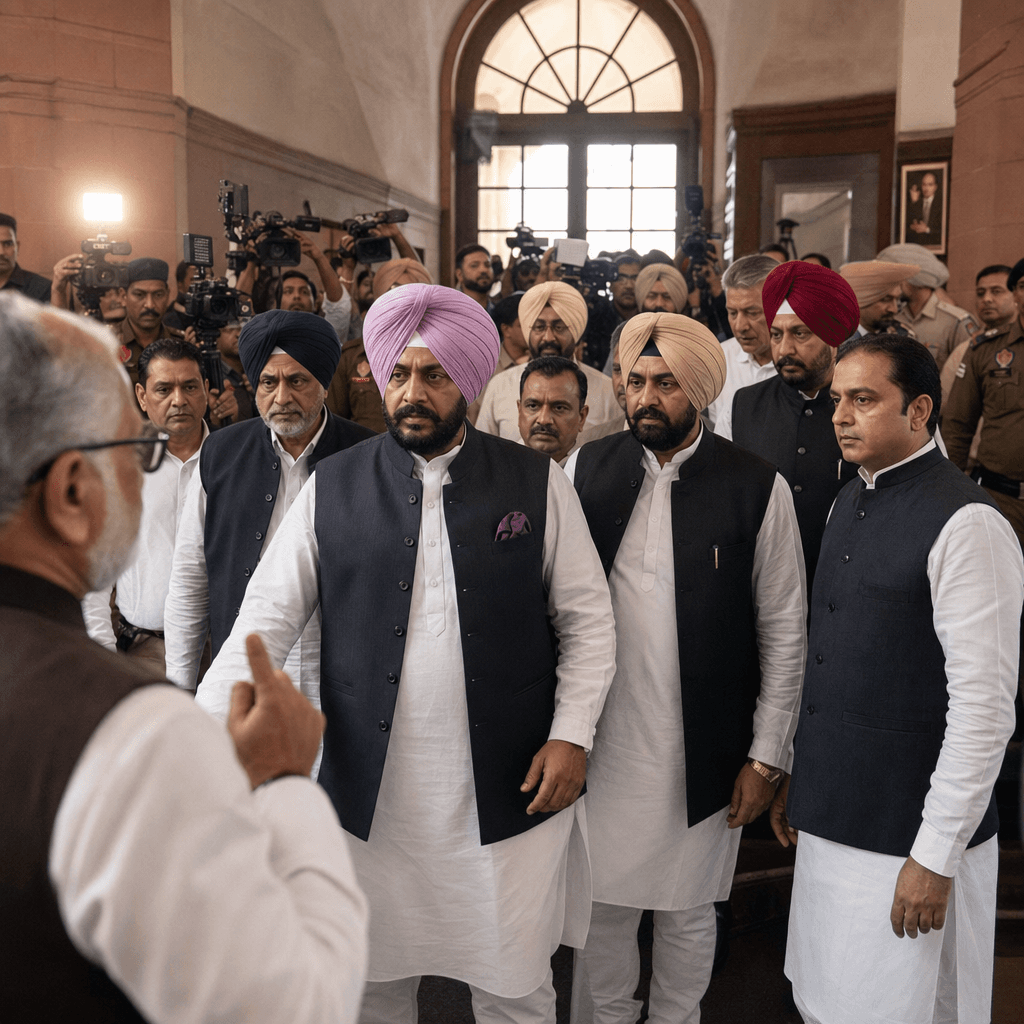
Punjab Defectors vs AAP: Constitutional Clash Explained
Seven AAP MPs used the Tenth Schedule's merger loophole to defect to the BJP. Bhagwant Mann is now demanding Parliament rewrite the anti-defection law.
The seven Aam Aadmi Party Rajya Sabha MPs who "merged" with the Bharatiya Janata Party on April 24, 2026 did something legally elegant and politically explosive: they invoked Paragraph 4 of the Constitution's Tenth Schedule — the two-thirds merger exception — even though the party they were merging from has not merged at all. Vice-President and Rajya Sabha Chairman C P Radhakrishnan formally accepted their move three days later, cutting AAP's Upper House strength from 10 to 3. The real fight is no longer about seven men; it is about whether the 1985 anti-defection law has a hole big enough to drive a governing party through — and whether the Supreme Court, not the Chairman, decides that.
The confrontation reached the President's palace on May 5, 2026, when Punjab Chief Minister Bhagwant Mann, trailed by 90 of his 92 MLAs, and defector-in-chief Raghav Chadha separately petitioned Droupadi Murmu. Mann asked her to back a constitutional amendment introducing right-to-recall; Chadha asked for protection from "state-sponsored vendetta," per The Indian Express. Both understood the stakes. This is the most consequential test of the Tenth Schedule in two decades — and, as Scroll's legal team argued, its outcome will redefine how governing parties in India can be dismembered from above.
The mechanism: a merger that isn't a merger
The Tenth Schedule was inserted by the 52nd Constitutional Amendment in 1985 to end the "Aaya Ram Gaya Ram" era of floor-crossing. It disqualifies any legislator who "voluntarily gives up" party membership — but Paragraph 4 shields two-thirds of a legislature party if they merge into another party, PRS Legislative Research explains. Originally the law also protected a one-third "split"; that carve-out was deleted by the 91st Amendment in 2003 precisely because it had become a vehicle for orchestrated defections.
What survives — the two-thirds merger clause — is now the load-bearing wall of Chadha's defence. Seven of ten AAP Rajya Sabha members clears the numerical bar. But there is a textual problem the rebels cannot argue away. Paragraph 4 requires that the original political party has agreed to merge. The parliamentary compendium published by the Rajya Sabha Secretariat states the merger only takes effect "if not less than two-thirds of the members of the Legislature Party concerned have agreed to such merger" — but it is a merger of the party, not merely a caucus flight.
AAP's national leadership has done no such thing. Its 92-strong Punjab legislature party and its Delhi organisation remain intact. This is the argument Scroll and
The Hindu have laid out at length: the Chairman ruled that a Rajya Sabha two-thirds count is enough because past presiding officers — including Venkaiah Naidu on the TDP defections of 2019 — have treated the legislature-party threshold as sufficient. Constitutional lawyers reading Paragraph 4 disagree.
Who benefits, who loses
Follow the leverage. The BJP does not gain a Punjab government — with two MLAs in the state assembly it holds nothing on the ground. What it gains is arithmetic in the Rajya Sabha, where the NDA has repeatedly struggled to command a majority, and a set of high-recognition Punjabi faces — cricketer Harbhajan Singh, industrialists Rajinder Gupta and Vikramjit Sahni — to deploy in the Sikh-versus-non-Sikh, urban Hindu-versus-rural Sikh split that BBC Hindi's Hemant Atri and other analysts say the BJP is building for the 2027 state poll.
Chadha's calculation is starker. He was AAP's de facto Punjab strategist in 2022, the year the party won 92 of 117 assembly seats, per the BBC. On April 15, 2026 — the day after AAP replaced him as Rajya Sabha deputy leader with Ashok Mittal — the Enforcement Directorate raided Mittal's home. AAP's Sanjay Singh, speaking at a press conference the same afternoon covered by
BBC Hindi, called it "Operation Lotus": first the ED, then the CBI, then the merger. That AAP has a story to tell here — Arvind Kejriwal was jailed in a liquor-policy case eventually dismissed by a Delhi court in early 2026, as the
BBC reported — makes the coercion framing plausible even to voters who dislike Kejriwal.
Bhagwant Mann is the visible loser and the reason the confrontation escalated to the President. He is a chief minister without his own Rajya Sabha bench, facing an Akal Takht rebuke over the April 2026 anti-sacrilege law, a "fabricated" video controversy, and elections due early 2027. The defection cracks his party's national scaffolding at the worst possible moment.
The Chairman's ruling and why it will not settle it
C P Radhakrishnan is not a neutral referee in the technical sense. He was elected Vice-President in September 2025 as the BJP-led alliance's nominee, winning 452 of 754 valid votes after Jagdeep Dhankhar's abrupt resignation. His acceptance of the merger on April 27, 2026 disposes of the parliamentary question. It does not dispose of the constitutional one.
The Supreme Court's 1992 judgment in Kihoto Hollohan v. Zachillhu struck down the Tenth Schedule's original ouster of judicial review, holding that the Presiding Officer's decision is amenable to challenge under Articles 32, 226 and 136. AAP has indicated it will file in the Supreme Court once the Chairman's reasoned order is on the record. The question the bench will have to answer is narrow but foundational: does Paragraph 4 permit a Rajya Sabha faction to "merge" independently of the political party's national leadership? A ruling for AAP would gut the mechanism the BJP has used, in varying forms, in Maharashtra, Goa, Madhya Pradesh, and Andhra Pradesh. A ruling against AAP would effectively concede that two-thirds of a House caucus can walk out of any national party at any time — an outcome the 91st Amendment was designed to prevent.
"Seven MPs broke away at will and said they became a different party. This is unconstitutional. How can they just walk over? The party should either pass a resolution stating that two-thirds of MPs have decided to join another party. What they have done is a mockery." — Bhagwant Mann, after meeting President Droupadi Murmu,
Indian Express, May 5, 2026
The academic literature backs Mann's textual reading. A study in the Indian Journal of Public Administration notes that the Tenth Schedule, as amended in 2003, is meant to protect only "genuine" party mergers, not defection-of-convenience. The NUS Institute of South Asian Studies'
analysis of Congress splinters shows that the one-third split provision was scrapped precisely because it turned into a defection loophole; the two-thirds clause has now taken its place.
The Punjab angle everyone is missing
The received wisdom is that this is a story about Delhi — Kejriwal's national ambitions crumbling. It isn't. It is a story about Punjab, and specifically about a governing party being hollowed out through its Rajya Sabha bench because its Lok Sabha and assembly presence cannot be touched.
Six of the seven defectors held Rajya Sabha seats from Punjab, elected by the same MLAs who now stand behind Mann. That indirection matters. As the parliamentary primer Chapter V on Disqualification makes clear, Rajya Sabha members are elected by state legislators, not directly by citizens — which is why Mann's demand for a right-to-recall amendment is targeted, not symbolic. If Punjab's 92 AAP MLAs cannot revoke a mandate they themselves conferred, the anti-defection law becomes, in his phrasing, "a mockery."
The BJP's short game is to hold the seats until Chadha's cohort's terms expire in 2028. Its longer game — visible in the choice of who defected — is to build a non-Sikh, urban Hindu vote in Punjab that has never existed as a coherent bloc. BBC Punjabi's interviews with local BJP strategists show the party plans to run its 2027 campaign around Hindu voters and Dalit Sikhs while continuing to bleed traditional Akali and Congress voter bases.
What to watch
- The reasoned order. The Chairman's oral acceptance of April 27, 2026 must be converted into a formal, written order. That is the document AAP will attack in the Supreme Court. Expect a filing within weeks of publication.
- The Supreme Court's admission bench. Whether the Court treats this as a routine Article 32 petition or refers it to a Constitution Bench — as Kihoto Hollohan was — will signal how much the judiciary wants to reopen Paragraph 4.
- Punjab's Guru Granth Sahib (Sacrilege) Prevention Bill. The
Akal Takht set a June 15, 2026 deadline for Mann to amend the law. The overlap of two constitutional confrontations — one over religious authority, one over defection — magnifies both.
- AAP's Punjab MLA count. Ninety of 92 MLAs stood with Mann at Rashtrapati Bhavan on May 5, 2026. If that number drops before the 2027 election, the state government itself becomes vulnerable — and the merger clause moves from Rajya Sabha to Vidhan Sabha, where the
- The right-to-recall amendment. Mann's proposal will not pass a BJP-dominated Parliament. But floating it — and getting the President to say she will "speak to experts" — puts the two-thirds merger loophole on the national reform agenda for the first time since 2003.
Diplomat View
The Rajya Sabha Chairman's ruling is a political fact, not a constitutional settlement. On the text of Paragraph 4 and the logic of the 91st Amendment, AAP has the stronger case: a merger requires the original political party, not merely two-thirds of its Rajya Sabha caucus, to agree. If the Supreme Court accepts that reading — and Kihoto Hollohan gives it every doctrinal tool to do so — the seven defectors face disqualification and the BJP loses a template it has used, in varying shades, across half a dozen states since 2019. If the Court defers to the Chairman, India's anti-defection law effectively dies in the Upper House, where every governing party's national scaffolding becomes detachable by a well-timed ED raid. The forecast that would revise this call: a Constitution Bench refusal to hear the challenge on the merits, or Mann losing his MLA count below the two-thirds Punjab threshold — 62 of 92 — before the 2027 election. Either would mean the constitutional clash is already over, and AAP simply hasn't been told.
The Bottom Line
The AAP-BJP fight over Paragraph 4 is not about seven MPs; it is about whether India's 1985 anti-defection law still functions when the party being defected from is intact and the Rajya Sabha Chairman is the ruling coalition's own nominee. If the Supreme Court reads Paragraph 4 strictly, the seven are disqualified and the BJP's post-2019 playbook of caucus-mergers is dead. If it doesn't, every governing party in India — beginning with Bhagwant Mann's — is one ED raid away from losing its Upper House bench.
Discover more
India
BJP Congress Clash Over MP Bill Defeat
The BJP's defeat of the women's quota amendment sparks a political narrative war with Congress, impacting future elections.

Conflict & Security
Drone Warfare Killing Aid Workers at Unprec
Over 1,000 humanitarian workers killed in three years as cheap armed drones collapse legal protections. Gaza, Sudan, Ukraine, and DRC see deliberate targeting of aid convoys and hospitals with zero prosecutions.
Global
World Normalises Taliban as Afghan Women Eras
UN data shows Afghan women erased from public life as Russia recognises the Taliban, EU hosts officials in Brussels, and ICC warrants for gender persecution go unenforced.

Conflict & Security
West Africa Food Crisis: Three Shocks in 2026
Conflict, climate extremes, and the Strait of Hormuz closure drive a severe food crisis in West and Central Africa, with fertilizer prices surging 80% and millions displaced.