Pakistan's Shariat Court Legalizes Child Mar
Court ruling undermines child marriage laws in Pakistan
Model Diplomat8 min readAsia
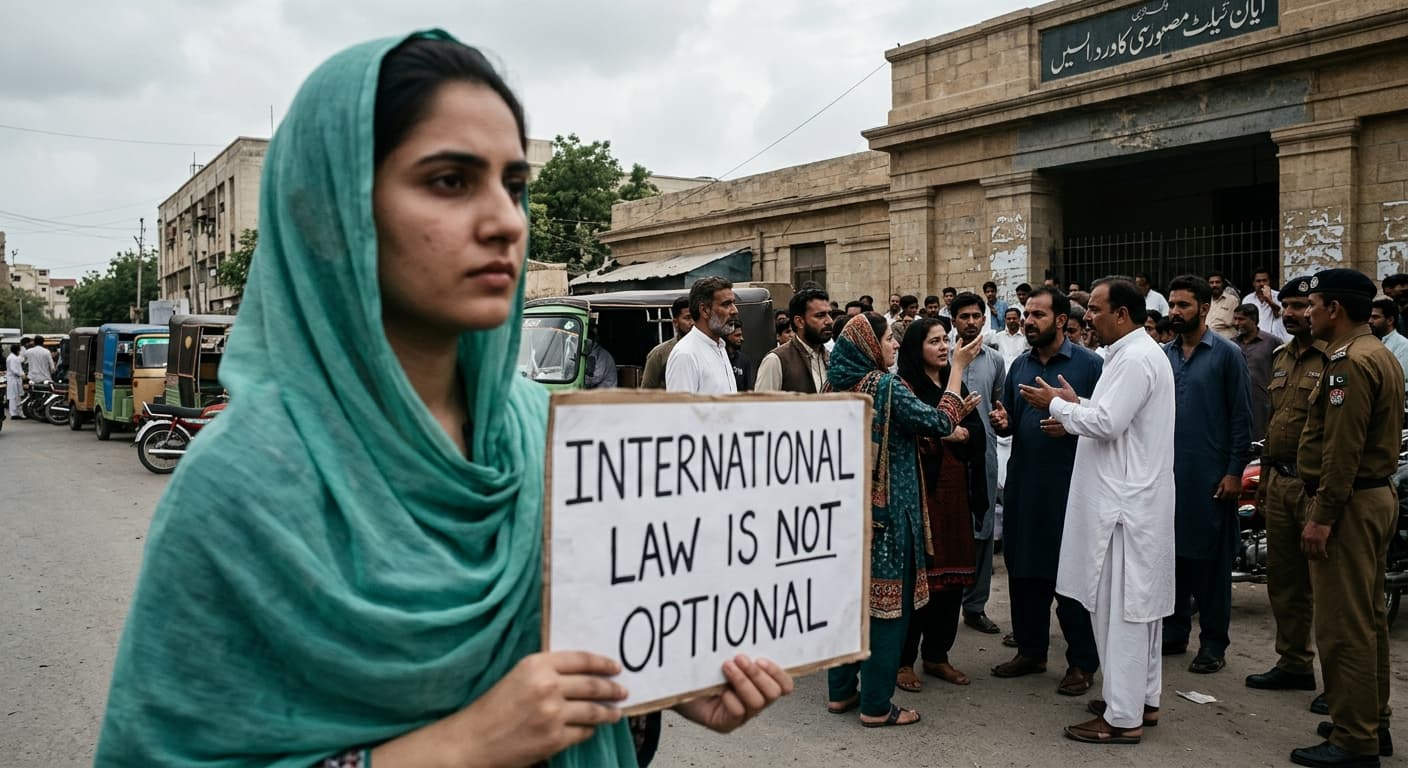
Pakistan's Shariat Court Just Legalized Child Marriage by Judicial Fiat
The Federal Shariat Court's Maria Shahbaz ruling lets a magistrate's statement override a state birth certificate — putting Pakistan's GSP+ trade access and its CRC obligations directly in play.
Pakistan's Federal Shariat Court, in a judgment dated 3 February 2026 whose written grounds were published on 25 March, ruled that a 13-year-old Christian girl named Maria Shahbaz was old enough to convert to Islam, marry a 30-year-old man, and repudiate her parents — because she had reached puberty and said so in court. The decision, in F.C.P.L.A. No. 536 of 2025/2026, does more than sanctify one forced marriage. It converts Pakistan's Child Marriage Restraint Act, its ratifications of the UN Convention on the Rights of the Child and CEDAW, and two 2025–26 provincial statutes setting 18 as the marriage age, into optional guidance a two-judge bench can override with a magistrate's affidavit — a doctrinal move that legal charities Alliance Defending Freedom International (ADF), the Centre for Social Justice, and the Human Rights Commission of Pakistan now argue is incompatible with Pakistan's GSP+ trade preferences with the European Union.
That is the case now heading back into Pakistan's courts, with ADF-supported counsel preparing review proceedings and Maria's father, Shahbaz Masih, seeking to reopen the habeas corpus petition dismissed under Section 491 of the Code of Criminal Procedure.
What the court actually decided
The bench, led by Justice Syed Hasan Azhar Rizvi, accepted that Union Council records and the National Database and Registration Authority (NADRA) both listed Maria's date of birth as 7 October 2012, making her 12 years and nine months old at the time of the nikah — a fact the father's habeas petition, brought after her disappearance, placed at the centre of the case. It then set that evidence aside.
According to the analysis published by Bitter Winter, which reviewed the written judgment, the court prioritised Maria's statement under Section 164 CrPC — recorded while she was in the custody of her alleged abductor — and her physical appearance over the documentary record. The judges further reasoned that while the Child Marriage Restraint Act of 1929 criminalises marriages below the statutory age, it does not render them batil (void) once puberty (bulugh) is reached. Penal consequence, the court held, is severable from civil validity.
That is the load-bearing move. As the Pakistani outlet Imroze Pakistan noted in a legal analysis by Kashif Mirza, the doctrine "conveniently immunises the institution of child marriage from nullification" — the abductor may in theory face prosecution, but the marriage he obtained stands, the conversion he engineered is validated, and the girl's parents lose custody. The
Alliance Defending Freedom International filing supporting Maria's father describes the ruling as inverting the burden of proof in child protection cases: the state issued the birth certificate, and the court now demands the child rebut its own document.
Where the ruling collides with international law
The judgment lands squarely on top of treaty obligations Pakistan itself has accepted. Pakistan ratified the Convention on the Rights of the Child on 12 November 1990, according to the UN Treaty Collection, which defines a child as anyone under 18 and obliges states parties to prevent all forms of exploitation, including forced marriage. It ratified CEDAW in 1996 with a general reservation that its provisions apply "subject to the provisions of the Constitution" — a reservation that Denmark and Austria formally objected to as incompatible with the treaty's object and purpose, according to the
UN's reservations register.
The CEDAW Committee's 2020 concluding observations on Pakistan explicitly urged the state to raise the minimum marriage age for girls to 18 and to "implement measures to eliminate forced marriages." UN human rights experts issued a further statement in April 2026,
carried by UN News, specifically flagging Pakistan's failure to prosecute abductions and forced conversions of minority women — noting that roughly 80% of documented cases in the prior year occurred in Sindh, that girls aged 14 to 18 are the primary targets, and that authorities routinely disregard age documents produced by victims' families. That statement called on Islamabad to criminalise forced conversion as a standalone offence and to set the marriage age at 18 across all provinces and territories.
The Federal Shariat Court's decision engages with none of these instruments. It treats Islamic personal law as the ceiling on statutory reform. That is what makes the Maria Shahbaz ruling something more than a bad habeas decision: it is a doctrinal declaration that Pakistan's legislature and its international treaty commitments cannot raise the effective marriage age above the puberty threshold the court reads into Sharia. The most recent Pakistan submission to the UN Committee on the Rights of the Child said the Ministry of Human Rights was consulting on aligning the marriage age at 18 nationwide — a promise the FSC has now materially undercut.
The number that reframes the case
The court framed the ruling as one girl's testimony. The scale is different. According to the Centre for Social Justice's Human Rights Observer 2025, at least 421 minority women and girls in Pakistan were documented as abducted and forcibly converted between January 2021 and December 2024, with 71% of them minors and nearly half aged 11 to 15. The UK Parliament's All-Party Parliamentary Group for the Pakistani Minorities estimates the true annual figure is closer to 1,000, according to a briefing by the
House of Commons Library, and a
Jubilee Campaign submission to the UN Human Rights Council put the figure at "above 1,000" per year, with victims aged 12 to 25.
Pakistan is also the country with the sixth-highest number of child brides globally, with an estimated 19 million girls married before 18, according to UNICEF's 2025 campaign launch in Islamabad. Nearly half become pregnant before their 18th birthday. Only 13% of married girls finish secondary school, against 44% of unmarried peers. Those are the base rates against which the Maria Shahbaz precedent will now be applied by lower courts across Punjab, Sindh and Khyber Pakhtunkhwa.
The domestic contradiction the court ignored
The most striking feature of the ruling is what it does not mention. Nine days after the 3 February 2026 short order, Punjab's provincial government promulgated the Punjab Child Marriage Restraint Ordinance 2026, setting 18 as the minimum age of marriage for both sexes and making violations a non-bailable offence. Sindh has held the same threshold since the Sindh Child Marriage Restraint Act of 2013. The Islamabad Capital Territory Child Marriage Restraint Act was signed into law by President Asif Ali Zardari in May 2025, criminalising both the nikah of anyone under 18 and its registration, with prison terms of two to three years for adult husbands and up to seven years where "child abuse" is charged, according to BBC Urdu. UNICEF welcomed the ICT law and urged remaining provinces to follow.
The Council of Islamic Ideology promptly declared the ICT law un-Islamic — foreshadowing exactly the reasoning the Federal Shariat Court would deploy months later. The FSC's Maria Shahbaz decision is therefore not an isolated ruling but the judicial arm of a coordinated pushback against the 18-year threshold that Pakistan's federal executive, two provinces and the federal territory have all endorsed since 2013. The court has effectively told Punjab, Sindh and the ICT that their statutes stop at the courtroom door.
Who wins, who loses
The immediate beneficiaries are Pakistan's forced-conversion networks — the loose ecosystem of madrassas, notaries, sympathetic police, and marriage registrars that has processed hundreds of cases documented by the US State Department's International Religious Freedom Report and the
UK Home Office's Country Policy and Information Note on Pakistan, which recorded at least 100 abduction, forced conversion and forced marriage cases involving Christian women between January 2019 and October 2022, mostly in Punjab. The Maria Shahbaz precedent gives that ecosystem a Supreme-Court-adjacent template: obtain a conversion certificate, secure a Section 164 statement, present the girl as physically mature, and the marriage will hold even against contradictory NADRA data.
The clear losers are Pakistan's Christian and Hindu communities — around 1% and 2% of the population respectively — and, more surprisingly, Pakistan's exporters. The EU is Pakistan's second-largest trading partner, accounting for 14.1% of Pakistan's total trade in 2025, with bilateral goods trade worth €12.2 billion, according to the European Commission's trade brief. Pakistan is the largest beneficiary of the EU's GSP+ scheme, with more than 88% of eligible exports entering the EU duty-free in 2024. GSP+ status is conditional on effective implementation of 27 international conventions, including the CRC and CEDAW.
The European Commission's 2024 GSP+ monitoring report already warned that "freedom of religion or belief and rights of persons belonging to minorities continue to be regularly violated" in Pakistan. A European Parliament question filed by MEP Emmanouil Fragkos in
February 2026 formally asked whether the Commission would consider suspending or reviewing Pakistan's GSP+ status. The Maria Shahbaz judgment, arriving in the same reporting cycle, hands Pakistan's critics inside the European Parliament a documented Supreme-Court-tier ruling that fails the CRC test — precisely the kind of primary-source evidence that has moved GSP+ scorecards in the past.
The historical parallel — and why this ruling is different
Pakistani courts have flirted with this reasoning before. In the Huma Younus case (Sindh High Court, 2020), a 14-year-old Christian girl's marriage to her abductor was upheld on puberty grounds. In Farooq Omar Bhoja v. Federation (2021), the FSC acknowledged the state's authority to set a minimum marriage age to prevent social harm. What is new in Maria Shahbaz is the explicit doctrine that the Child Marriage Restraint Act's penal clause does not void the resulting marriage — a legal formula that reconciles the two prior positions in favour of the abductor.
That formula matters because it is portable. The Federal Shariat Court's role in Islamising Pakistani law has, since 1979, been to strike down statutes deemed repugnant to Islamic injunctions and to bless those it deems compliant. By reading the CMRA as compliant but toothless, the court has produced a judgment that is difficult to appeal — the Shariat Appellate Bench of the Supreme Court is the only forum, and its own jurisprudence has repeatedly deferred to FSC readings of bulugh.
What to watch
- The review petition. ADF International and Pakistani human rights lawyers are preparing a review before the same FSC bench, expected to be filed in the coming weeks, with a Shariat Appellate Bench appeal to follow if refused. A hearing date has not yet been announced.
- The European Commission's next GSP+ report. The Commission must present its biennial GSP+ report to the European Parliament and the Council. Pakistan's compliance file now carries a signed FSC ruling directly contradicting the CRC — the strongest documentary basis in years for a formal reassessment.
- The Sindh and Khyber Pakhtunkhwa bills. Both provinces have Child Marriage Restraint Bills under review. The Council of Islamic Ideology's rejection of the ICT law, and the FSC's Maria Shahbaz doctrine, together give provincial legislators political cover to weaken the 18-year threshold before enactment.
The Bottom Line
The Maria Shahbaz ruling is not a domestic family-law case. It is a Pakistani constitutional court telling Pakistan's legislature, its provinces, and its treaty partners that Islamic personal law overrides both the Child Marriage Restraint Act and the UN Convention on the Rights of the Child — and that a magistrate's Section 164 statement can override a state-issued birth certificate. If ADF's review petition fails, the practical minimum marriage age in Pakistan is puberty, and the EU's GSP+ conditionality becomes the last external mechanism with any leverage over the outcome.
Discover more
US Politics
Congress Targets AI Chatbot Access for Terror
The House passed the Generative AI Terrorism Risk Assessment Act, focusing on AI's role in terrorism and potential surveillance implications.

Global Politics
Xi Jinping Calls China-Russia Ties 'Precious'
Xi Jinping's description of China-Russia ties as 'precious' reflects a strategic imbalance, with Beijing dictating terms in the partnership.

US Politics
House Ethics Committee Pushes Sexual Miscond.
The House Ethics Committee has shifted responsibility for sexual harassment settlement records to the Office of Congressional Workplace Rights, complicating disclosure efforts.

Economics
Fed's Amex AML order puts correspondent banking on notice
Federal Reserve's Amex AML order requires board-level controls and a 90-day plan; OCC fined the bank $350 million over enterprise-wide deficiencies.