Pakistan's FCC Bars Land Conversion to Homes
Court rules against repurposing public land for housing.
Model Diplomat7 min readAsia
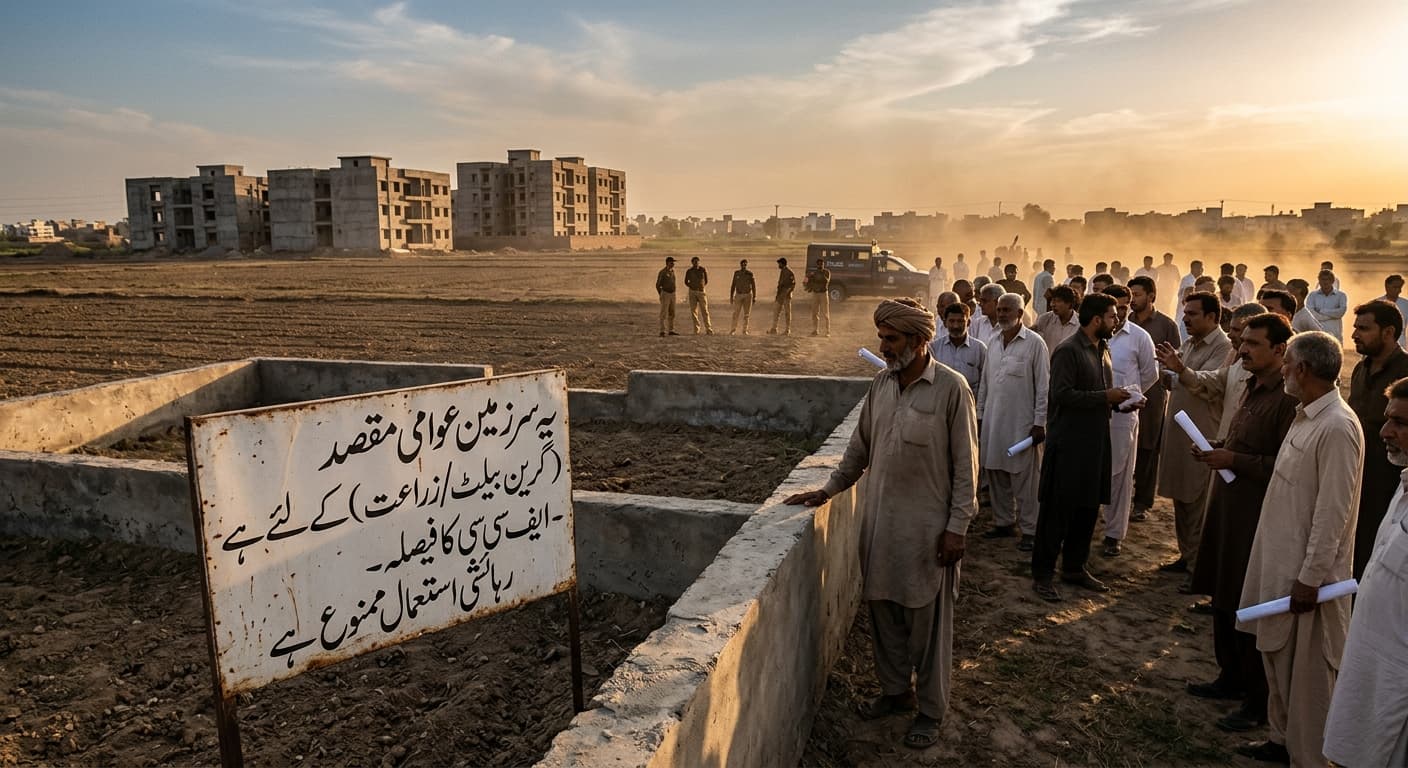
Pakistan's FCC Bars Conversion of Public-Purpose Land to Housing
Pakistan's Federal Constitutional Court on July 9, 2026 ruled that land acquired under eminent domain cannot be flipped into housing or commercial schemes — invoking "indirect expropriation" doctrine drawn from international investment law.
The Federal Constitutional Court (FCC) of Pakistan on July 9, 2026 held that land taken by the state for a specific public purpose cannot be converted into housing or commercial projects by its beneficiary or any later buyer, and cast such conversions as "indirect expropriation" barred by Article 24 of the Constitution. The judgment inverts a doctrine normally deployed by foreign investors against states, and turns it against Pakistan's politically connected developer class — a class that has spent two decades acquiring former industrial and public estates at auction and re-platting them as gated suburbs.
The 17-page decision, authored by Chief Justice Aminuddin Khan in M/s Adil International (Pvt) Ltd v. Government of Khyber Pakhtunkhwa, upholds a Peshawar High Court order and, according to Dawn, was described by a senior lawyer as a ruling with "significant implications" because "a number of lands initially acquired for industrial purposes have been converted into housing schemes in Punjab, Khyber Pakhtunkhwa and Sindh." It is the first substantive property-rights pronouncement from a court that itself was created only eight months ago under the controversial 27th Amendment.
The case: 1,020 kanals, 72 years, one paper mill
The dispute begins with a colonial-era statute still on the books. In 1954 the government of what was then the North-West Frontier Province acquired 1,020 kanals in Mohal Amangarh, Nowshera Khurd, under the Land Acquisition Act, 1894, to build the Adamjee Paper and Board Mills. The acquisition was executed through a Section 41 agreement — the provision by which the state can acquire land on behalf of a company for a public-purpose industrial project.
The mill collapsed commercially. In 2000, Adil International (Pvt) Ltd bought its assets at a court-supervised auction for Rs 220 million, "free from all encumbrances," and eventually secured a No-Objection Certificate to demolish the plant and develop a housing scheme, as reported by The News. Plots were sold; construction began. Then provincial authorities reversed course, restricting the use and transfer of the land and refusing to register sale deeds. The Peshawar High Court dismissed the company's petition on September 11, 2024. Adil International's appeal to the FCC ended, on July 9, 2026, with the appeal thrown out and the state's revocation upheld.
The operative sentence in Chief Justice Aminuddin Khan's judgment, as extracted by The News, reads:
"If the State acquires land for, say, a public hospital and subsequently transfers or leases it to a private developer or for commercial purpose, the constitutional foundation of the original acquisition is destroyed retroactively. This amounts to an indirect expropriation in favour of private interests — a result that Article 24 of the Constitution categorically prohibits."
That framing is the story. "Indirect expropriation" is not a phrase native to Pakistani constitutional law; it is the central term of art of international investment protection.
Borrowing a doctrine — and pointing it the other way
Under customary international law and virtually every bilateral investment treaty, an "indirect expropriation" is a state measure that deprives an investor of the substantial benefits of property without formal title transfer. As the Cambridge International & Comparative Law Quarterly summarises, expropriation is lawful only if it is for a public purpose, non-discriminatory, follows due process, and is compensated, per ICLQ. Pakistan has been on the wrong end of that doctrine before — most brutally in the
Tethyan Copper award, an ICSID ruling of roughly $6 billion enforced in U.S. federal court after the Reko Diq mining concession was blocked.
Aminuddin Khan flips the vector. The FCC uses "indirect expropriation" to describe not what the state does to a private investor, but what the state enables when it lets a private beneficiary strip a public purpose from acquired land. The measure is the same; the direction of protection is reversed. The judgment reads the concept back into Article 24(2) of the Constitution, which prohibits compulsory acquisition of property "save for a public purpose and save by the authority of law" providing compensation — a provision quoted verbatim in a 2024 Human Rights Watch report on Pakistan's colonial-era Land Acquisition Act.
For a comparative analyst, this is the more consequential move than the immediate holding. The FCC is signalling that Article 24 imposes a continuing public-purpose test on acquired land — something closer to Indian post-Kedar Nath Yadav jurisprudence than to the deferential 1894 Act framework. An SSRN monograph on India's parallel statute has argued that "the definition of 'public purpose' is inclusive and not precisely defined... which makes it possible for the government to stretch the public purpose definition to its limit," according to SSRN. Aminuddin Khan's ruling narrows that stretch on the exit side rather than the entry side.
Who wins, who loses
The immediate losers are Pakistan's private developers who bought former industrial land at auction and expected to redevelop it as housing. Pakistan's property market has run on precisely this trick for two decades. The Ravi Riverfront Urban Development Project — a $7 billion scheme launched under Prime Minister Imran Khan in 2020 to seize roughly 43,700 hectares, 85% of it agricultural — has already been through the Lahore High Court and Supreme Court, with Al Jazeera reporting that the LHC declared it illegal in 2022 before the top court partially reinstated it. Bahria Town Karachi's exchange of state land for private tracts near Malir has been under Supreme Court supervision since 2016, per
BBC Urdu. Adil International's plot-holders — small buyers who paid for houses on paper — are collateral losers.
The winners are provincial governments, which now hold a doctrinally-clean weapon to revoke past NOCs, and the FCC itself, which has produced a judgment with populist appeal at a moment when it badly needs it. When the 27th Amendment established the court on November 13, 2025, OHCHR publicly warned that the amendments "seriously undermine judicial independence." Amnesty International's January 2026 report went further, arguing that the FCC "lacks independence, erodes judges' security of tenure and insulates the president and heads of the naval, armed and air forces from accountability," according to
Amnesty. A land-use ruling that hurts private developers and shields "public purpose" is exactly the sort of high-visibility, uncontroversial jurisprudence a legitimacy-hungry court needs.
The international law read-across
There is a second-order effect that has gone unremarked in domestic coverage. If Pakistani courts formally domesticate "indirect expropriation" doctrine as a constitutional test for state action, they hand foreign investors a new argument in future investor-state disputes. In Philip Morris v. Uruguay and its progeny, tribunals have adopted a "police powers" defence that permits bona fide public-welfare regulation without compensation, per the Asian Journal of International Law. The FCC's judgment cuts the other way: it treats an act of non-regulation — allowing conversion — as itself an expropriation. A future BIT claimant against Pakistan can now cite Pakistan's own constitutional court for the proposition that expropriation includes purpose-stripping. Islamabad's Law Ministry will need to think about that before it argues the police-powers defence at ICSID again.
There is also a domestic-institutional wrinkle worth flagging. Economists Sultan Mehmood and Bakhtawar Ali documented in The Economic Journal that Pakistan's government has historically allocated expensive judicial housing "from the government to the judiciary, and reciprocation in the form of pro-government rulings," with an estimated 0.2% of GDP in additional land expropriations enabled in a single year, per The Economic Journal. That literature has framed judicial land allocation as a lever for state expropriation; the FCC ruling narrows the state's ability to re-monetise what it has already expropriated. Whether that narrowing survives contact with actual Bahria Town, DHA, or RUDA litigation is the next test.
What to watch
- Punjab and Sindh provincial responses. Watch for provincial governments moving under Section 41 of the Land Acquisition Act to reclaim or freeze conversions of former industrial estates, particularly in Faisalabad, Kasur, and Karachi's Landhi–Korangi belt.
- The Ravi Urban Development Authority docket. The RUDA challenges pending across Pakistani courts will be the first live test of whether the FCC's reasoning is applied to non-industrial acquisitions where "public purpose" was itself contested from the outset, per
Al Jazeera.
- The next FCC constitutional bench. The court, established under the
27th Amendment on November 13, 2025, still owes Pakistan a signature ruling on a politically sensitive question — army-chief immunity, PTI cases, or provincial autonomy. Adil International is a low-cost credibility deposit; the harder cases are still ahead.
The Bottom Line
The FCC has used a doctrine invented to protect foreign investors — indirect expropriation — to protect the public against private conversion of eminent-domain land, reading a continuing public-purpose obligation into Article 24 of Pakistan's Constitution. In doing so it hands provincial governments a weapon against politically connected developers and hands future BIT claimants an inconvenient precedent citing Pakistan's own top constitutional court. For a court still fighting for legitimacy after the 27th Amendment, it is a cheap, popular win — and a signal that its most consequential rulings are still to come.
Discover more
Global Politics
Xi Jinping Calls China-Russia Ties 'Precious'
Xi Jinping's description of China-Russia ties as 'precious' reflects a strategic imbalance, with Beijing dictating terms in the partnership.

US Politics
US Launches $166B Tariff Refund Portal
The US is launching a $166 billion tariff refund portal to aid importers hit by Trump-era tariffs, with major implications for trade and supply costs.

Global Politics
US Naval Blockade on Iran
The US fully imposed a naval blockade on Iranian ports, escalating tensions even as Trump hinted the conflict may soon end while serious risks of war remain.

Economics
Fed's Amex AML order puts correspondent banking on notice
Federal Reserve's Amex AML order requires board-level controls and a 90-day plan; OCC fined the bank $350 million over enterprise-wide deficiencies.