Pakistan Signs Security Pact With Russia
A strategic shift in counter-terrorism alliances
Model Diplomat8 min readSouth Asia
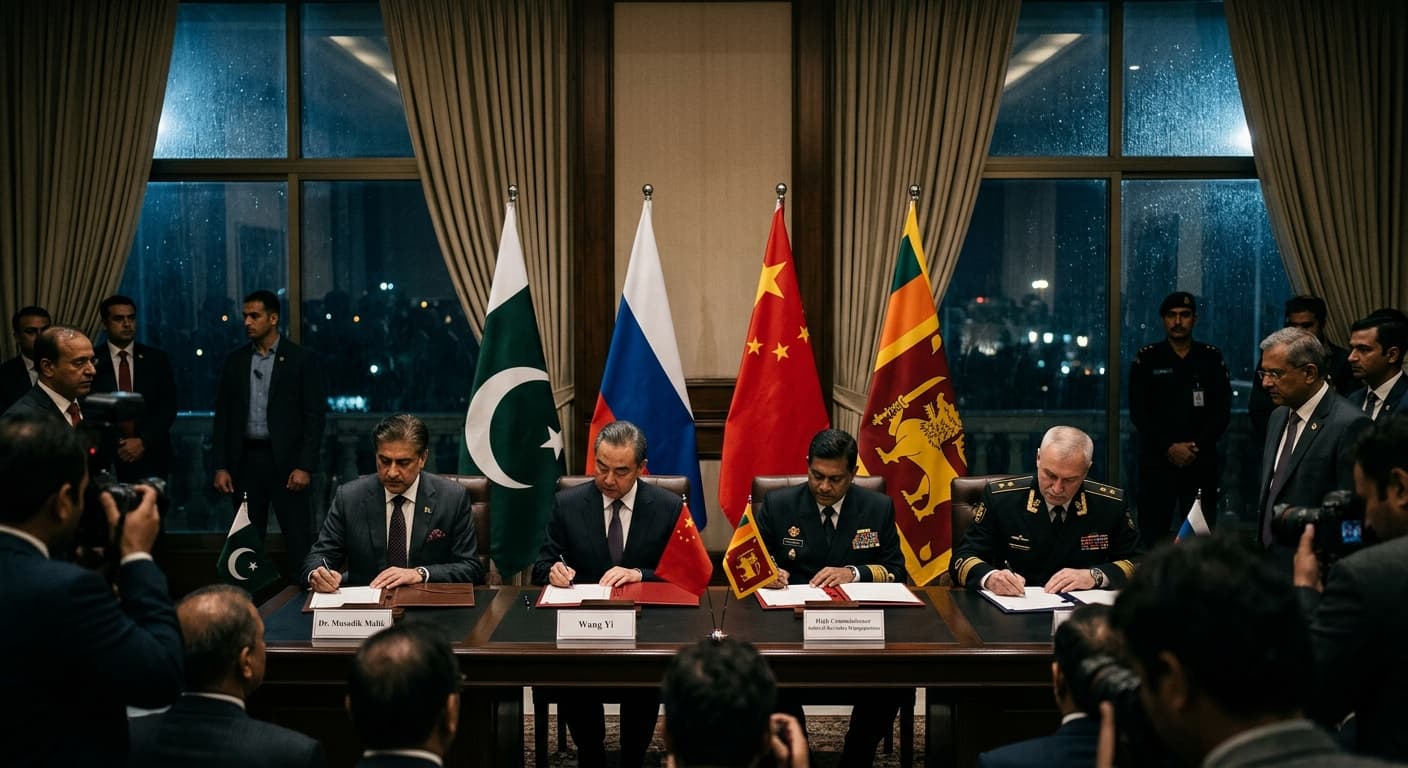
Pakistan Signs Security Pact With Russia at UN, Locks In China and Sri Lanka
Islamabad used the UN Chiefs of Police Summit on July 7–8, 2026 to sign a Russia security MoU and tighten counter-terror ties with Beijing and Colombo — a quiet but consequential alignment shift on Afghanistan.
Pakistan spent 48 hours at United Nations Headquarters this week converting a policing conference into a mini-alliance summit — walking away with a Russia security memorandum, a reaffirmed Chinese strategic partnership, and a Sri Lankan working group. The through-line is Afghanistan: Islamabad has stitched together the three governments most willing to help it choke off the Tehrik-e-Taliban Pakistan (TTP) after the collapse of its own back-channel with Kabul. The real story is not the paperwork; it is that Russia — the first state to formally recognise the Taliban — is now formally aligning its police apparatus with the country bombing Taliban territory. That is the diplomatic development worth watching.
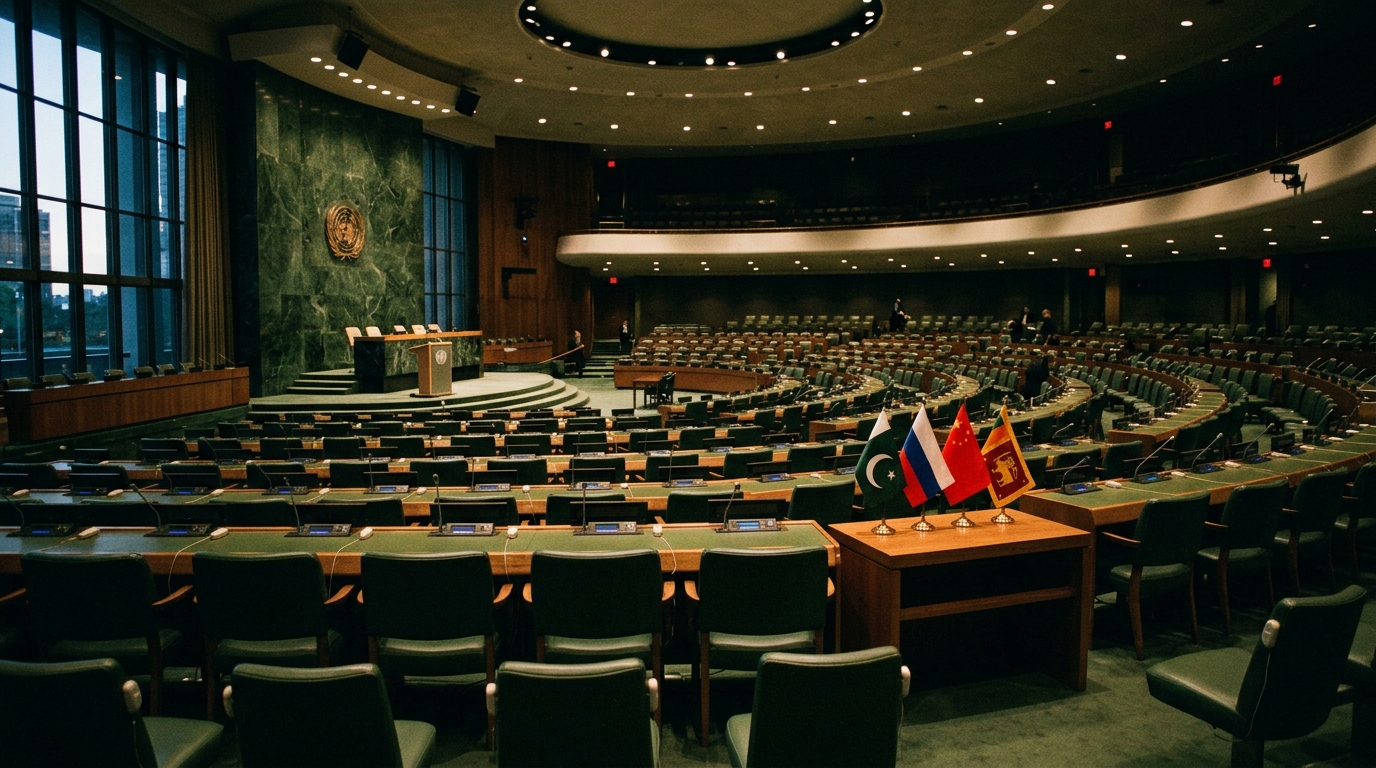
What was actually signed
The venue was the fifth United Nations Chiefs of Police Summit (UNCOPS 2026), convened at UN Headquarters on July 7 and 8, 2026 to "operationalize the United Nations Police Division's role as a system-wide service provider," according to the UN Police Division. Pakistan's Federal Interior Minister Mohsin Naqvi used the sidelines to run three bilaterals in sequence.
With Russian Interior Minister Vladimir Kolokoltsev, the two sides "agreed to finalize a Memorandum of Understanding (MoU) between their Interior Ministries and explored the possibility of conducting joint police exercises," per The Pakistan Daily, which had access to the Pakistani readout. The discussion centred, in Islamabad's framing, on "joint efforts against terrorist networks operating in Afghanistan." Naqvi invited Kolokoltsev to Islamabad; a state visit is now the next milestone.
With Chinese Minister of State for Public Security Ling Zhifeng, Naqvi confirmed the standing-up of a dedicated Special Protection Police Force to guard Chinese nationals in Pakistan and pressed for visa facilitation. The Express Tribune reported the two ministers reaffirmed the "strategic security partnership" and expanded it to counter-terror financing, border management and irregular migration.
With Sri Lankan Interior Minister Ananda Wijepala, Pakistan agreed to a Joint Working Group between the interior ministries and to sign an MoU on "transnational organized crime and money laundering," with immigration authorities instructed to establish direct contact on forged travel documents.
Why Naqvi, and why now
To understand the leverage in this package, follow the casualty curve. Pakistan recorded 1,081 terrorism deaths in 2024, a 45 percent rise on the previous year, with the TTP responsible for more than half, according to the NUS Institute of South Asian Studies. In 2025, combat-related deaths surged another 74 percent to more than 3,400 fatalities — the deadliest year in over a decade — as documented by the
Council on Foreign Relations global conflict tracker.
The October 2025 Pakistani air strikes on Afghanistan, and the March 16, 2026 strike that the UN Assistance Mission in Afghanistan (UNAMA) said killed at least 269 civilians at a Kabul drug rehabilitation hospital, closed off Doha- and Riyadh-mediated diplomacy with the Taliban. Al Jazeera reported that after the June 27, 2026 Karachi paramilitary attack and the June 29 Pakistani strikes into Paktia, Paktika and Kunar, Pakistani officials described their new policy as "controlled escalation." That is the operational context in which Naqvi flew to New York.
Naqvi's brief is the interior — not the foreign ministry — which is the point. The MoUs bind police, immigration, counter-narcotics and financial-intelligence units, not diplomats. That is where TTP financing, Afghan-refugee returns, and cross-border movement are actually managed. It is also where a Russian equivalent — Rosgvardia and the MVD — can be usefully plugged in without triggering the political costs of a defence pact.
The Moscow paradox
Here is what most wire copy missed. Russia formally recognised the Taliban government on July 3, 2025 — the only state so far to do so, as Al Jazeera confirmed. Russia and the Taliban then signed their own bilateral security MoU on May 27, 2026, the contents of which remain undisclosed, according to an
Al Jazeera analysis by former Afghan deputy interior minister Shahmahmood Miakhel.
Six weeks later, the same Russian interior minister sits across from Naqvi in New York and agrees to a joint strategy against "terrorist networks operating in Afghanistan," per the Daily Mail Pakistan readout. This is not a contradiction; it is a hedge. Moscow's calculation, per Miakhel, is narrow: prevent ISKP and Central-Asia-facing jihadist groups from operating out of Afghan territory. It does not require Russia to defend the Taliban's harbouring of the TTP — a group Islamabad, not Moscow, has to fight.
The upshot: Russia is now the only external actor with a formal security instrument with both sides of the Durand Line war. That is unusual leverage. If Moscow chose to use it, it could broker de-escalation on terms neither Doha nor Riyadh managed. Whether it will bother is the open question.
Beijing's non-negotiable: keep Chinese nationals alive
For China, the New York meeting was less about Afghanistan than about attrition inside Pakistan. Al Jazeera reported in May 2026 that Beijing had extracted from Islamabad "targeted steps to boost security and cooperation to ensure the safety of Chinese workers and investments in Pakistan" as a condition of deeper CPEC re-engagement, per its economic desk. The Council on Foreign Relations noted in its
January 2026 Indo-Pacific tracker that Islamabad had already announced "a dedicated protection unit for Chinese nationals in Pakistan's capital."
The Special Protection Police Force confirmed at UN Headquarters is that unit, now formalised. It matters because CPEC — the flagship $65 billion economic corridor — has been visibly stalling under BLA and TTP attacks on Chinese engineers. The Ling–Naqvi meeting is Beijing's way of saying that further tranches of Chinese finance and Belt and Road delivery are contingent on Islamabad putting Chinese-national protection on a statutory footing, with a dedicated force rather than ad-hoc army detachments.
The visa concession is the trade. Pakistan pushed for "improved visa facilitation" and "people-to-people exchanges"; the Chinese side agreed that "visa and immigration-related issues would be reviewed," per Pakistan Economic Net's summary of the ministry readout. That is the exchange rate at this stage of the relationship: dedicated police units for tourist visas.
Sri Lanka: the piece that reveals the strategy
The Sri Lanka bilateral is the tell. Colombo signed a five-year defence cooperation agreement with India on April 5, 2025 during Prime Minister Narendra Modi's visit — a pact in which President Anura Kumara Dissanayake pledged that "Sri Lankan territory will not be allowed to be used by anyone to undermine India's security," according to Al Jazeera. India and the UAE simultaneously agreed to develop an energy hub at the strategically pivotal port of Trincomalee.
That New Delhi–Colombo track has not stopped Sri Lanka's leftist government from taking a Pakistani MoU on transnational crime and forged travel documents. The Wijepala–Naqvi text is narrow — police training, counter-narcotics, migration — and specifically avoids anything that would trigger the Modi red line on Indian security. But it does two things at once: it lets Colombo re-open its traditional Pakistani military-training channel (dormant since the Rajapaksa era) while giving Islamabad a South Asian partner outside Delhi's direct security perimeter. Dissanayake is running the same balancing act he ran in December 2024 (New Delhi) and January 2025 (Beijing).
For Pakistan, the value is symbolic more than operational: an in-region partner willing to sign counter-terror language at the UN, at a moment when SAARC is functionally dead and India has boxed Pakistan out of every other South Asian security forum.
What the SCO cannot deliver
The obvious question is why any of this is necessary given that Pakistan, Russia, China and, since 2023, Iran already sit inside the Shanghai Cooperation Organisation, and Pakistan chairs the SCO Council of Heads of State in 2026, as documented by the Pakistan Institute of International Affairs. The answer is that the SCO does not work for this problem. Carnegie's Temur Umarov argued in a 2024 assessment that the Regional Anti-Terrorist Structure "does little more than help member states organize military exercises," and that when major attacks occur, its response is limited to press-release condolences, per
Carnegie Endowment.
The 22nd SCO Defence Ministers meeting in Qingdao on June 26, 2025 could not even produce a signed joint declaration, after India's Rajnath Singh refused because the text omitted the Pahalgam attack, according to the Observer Research Foundation. India's presence inside the SCO is precisely why Pakistan cannot use the platform to build a counter-TTP coalition. Bilateral MoUs at UN Headquarters are the workaround.
What to watch
- Russia MoU signing date. The New York text was an agreement to finalise, not a signature. Watch for a Kolokoltsev visit to Islamabad in Q3 or Q4 2026, or a signing on the margins of the SCO Heads of State summit Pakistan is chairing.
- First joint Pakistan–Russia police exercise. The location matters: any exercise inside Pakistan's tribal belt would signal Moscow is comfortable with an operational footprint adjacent to Afghan territory. A drill inside Russia would signal it is not.
- UNAMA reporting on Pakistani cross-border strikes. UNAMA's July and October 2026 quarterly protection-of-civilians reports will set the international ceiling on how far Islamabad can push its "controlled escalation" doctrine before Moscow and Beijing have to distance themselves publicly.
- CPEC Phase 2 disbursement. Chinese finance releases tied to the Special Protection Police Force's operational stand-up are the concrete test of whether the Ling–Naqvi meeting delivered.
Diplomat View
The New York package is a small piece of paperwork that reveals a larger geometry: Pakistan has given up on multilateral counter-terror forums it cannot control (SAARC, SCO, the Doha and Riyadh mediation tracks) and is instead building a hub-and-spokes model with itself at the centre, Naqvi's interior ministry as the tool, and UN Headquarters as convenient neutral ground. The forecast: within twelve months, Pakistan signs the Russia MoU, hosts a first joint police exercise, and formalises a Special Protection Police Force deployment tied to CPEC Phase 2 disbursement. The forecast changes if — and only if — Moscow's dual Taliban-and-Pakistan hedge collapses because ISKP hits a Russian target sourced from Afghan soil, or if Beijing decides that no policing arrangement can protect its nationals inside Pakistan and starts pulling engineers. Either would end the current alignment; neither is imminent. For now, the alliance shift the wires missed is real, narrow, and pointed squarely at Kabul.
The Bottom Line
Pakistan used a routine UN policing summit to formalise a counter-TTP coalition with the two great powers that still speak to the Taliban, and to keep a South Asian partner on-side outside India's orbit. The load-bearing signature is Russia's: Moscow is now the only capital with parallel security instruments in Islamabad and Kabul, and that makes it — not Beijing, not Doha, not Riyadh — the actor best placed to shape what "controlled escalation" between Pakistan and Afghanistan actually looks like through the rest of 2026. This is what an alliance shift looks like when it is signed by interior ministers rather than announced by presidents. For Pakistan, it is the most consequential diplomatic move of the summer.
Discover more
Global
Morocco's Gaza Troop Deal: Western Sahara Is
Morocco signs formal agreement to deploy 400 troops to US-led Gaza stabilization force, trading security cooperation for US recognition of Western Sahara sovereignty and Israeli military hardware.
Global
France's Morocco Reset Locks In Decade-Long W
France signs 14 agreements with Morocco, institutionalising Macron's 2024 Western Sahara recognition. The reset locks in a decade-long bet on Rabat over Algeria, with defence, rail, and water deals.
Global
US-Japan-South Korea Trilateral Reactor Pact
The US, Japan, and South Korea sign a trilateral pact on small modular reactor exports, aiming to counter Russian and Chinese influence in the Indo-Pacific.
Global
Russia's African Push: Sahel and Ethiopia
Lavrov's July 2026 Africa tour establishes Russia's influence through Sahel pacts and a nuclear deal with Ethiopia, reshaping regional stability.