Pakistan Court Bars Housing on Public Land
FCC rules against converting public land for housing schemes
Model Diplomat7 min readAsia
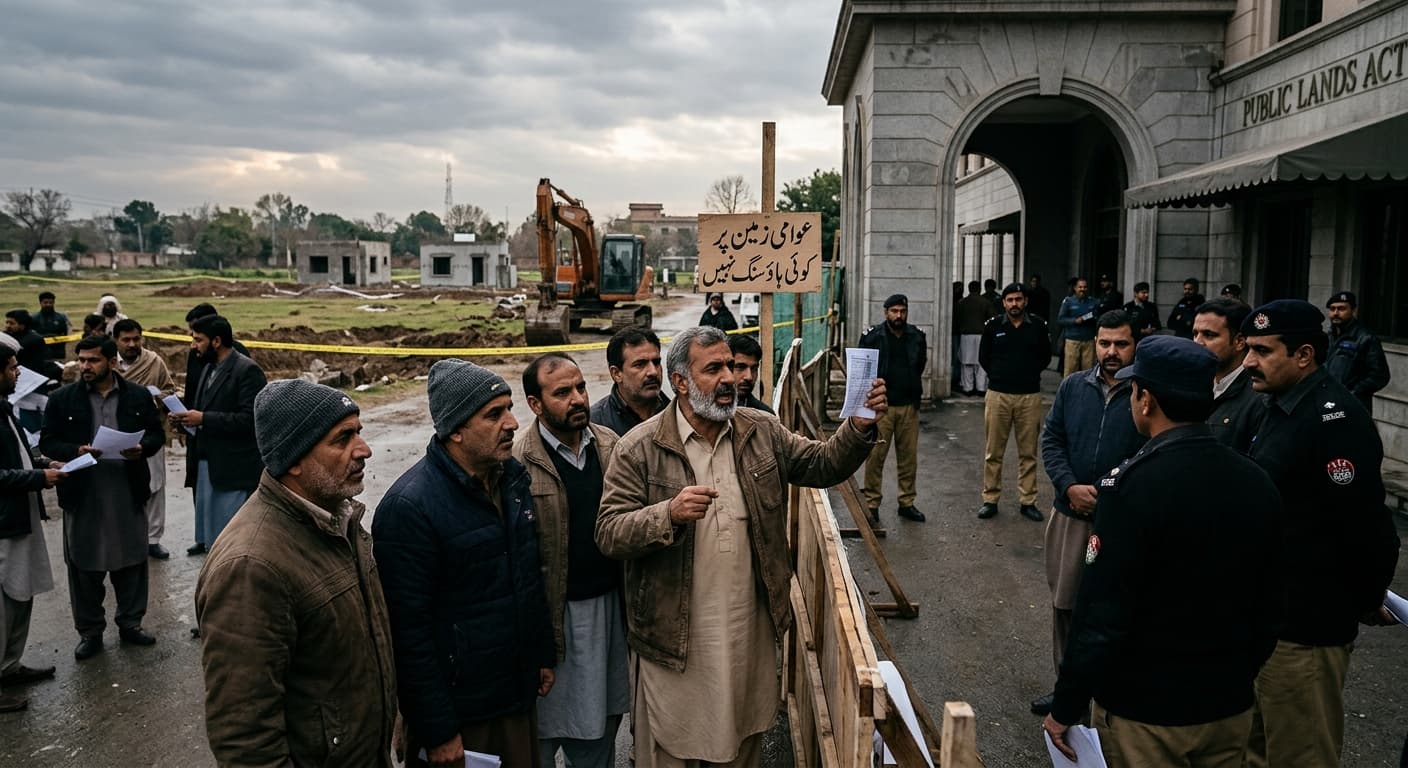
Pakistan's FCC Bars Housing Schemes on Public-Purpose Land
Pakistan's Federal Constitutional Court ruled on July 9, 2026 that land acquired for a public purpose cannot be converted into housing schemes or commercial projects — echoing indirect expropriation doctrine.
Pakistan's newly created Federal Constitutional Court (FCC) on July 9, 2026 ruled that land taken by the state under eminent domain for a specified public purpose cannot later be diverted into housing schemes or commercial projects — a 17-page judgment that borrows directly from the international-law vocabulary of "indirect expropriation" and could unsettle housing developments across Punjab, Khyber Pakhtunkhwa and Sindh built on land originally acquired for industry, hospitals or infrastructure. Chief Justice Aminuddin Khan's ruling is the first substantive constitutional pronouncement from the FCC, a court whose creation last year the International Commission of Jurists warned would weaken the Supreme Court — making the choice of a property-rights case as its opening statement noteworthy in itself.
What the court actually held
The case, M/S Adil International (Pvt) Ltd v. Secretary Industries, KP, ran on facts stretching back seven decades. In 1954, the KP government acquired 1,020 kanals and 19 marlas in Nowshera Khurd under the colonial-era Land Acquisition Act, 1894 for the establishment of Paper and Board Mills. In 2000, Adil International bought the mill's assets through a court-supervised auction for Rs 220 million, dismantled the defunct factory, obtained an NOC and started selling residential plots. When the KP government subsequently blocked the registration of sale deeds, the company litigated — and lost, first at the Peshawar High Court on September 11, 2024, and now at the FCC.
The operative reasoning is unusually blunt for a Pakistani superior-court judgment. According to Dawn, Chief Justice Aminuddin held that acquired land "continues to remain impressed with, and subservient to, the very purpose for which its acquisition was sanctioned," and does not lose that character through subsequent transfer, judicial sale or private purchase. The court told
The News that if the state acquires land for a hospital and later leases it to a private developer, "the constitutional foundation of the original acquisition is destroyed retroactively" — a move that "amounts to an indirect expropriation in favour of private interests" barred by Article 24 of the Constitution.
That framing is the story. Pakistani jurisprudence on land acquisition has traditionally litigated compensation — whether landowners got market value under the LAA — not the constitutional integrity of the "public purpose" itself. The FCC has now moved the fight upstream.
The international-law borrowing
The judgment's language tracks investment-treaty doctrine more closely than domestic precedent. Under the Cambridge International & Comparative Law Quarterly synthesis of investor-state jurisprudence, a lawful expropriation must satisfy four cumulative conditions: public purpose, non-discrimination, due process and compensation. "Indirect expropriation" arises when a state, without formally taking title, so alters the legal character of an asset that its economic value collapses.
Aminuddin's ruling flips that logic inside out. Where investor-state tribunals ask whether state action against a private investor amounts to indirect expropriation, the FCC asks whether state inaction — permitting a private beneficiary to convert acquired land — is itself an indirect expropriation of the original public purpose, transferring the value of eminent-domain power into private hands. That is a novel formulation. It draws on the same doctrinal apparatus tribunals used in cases like Bayindir v. Pakistan, where an ICSID panel found that Pakistan's expulsion of a Turkish contractor from the M-1 motorway project amounted to expropriation under the Turkey–Pakistan BIT. Here, the FCC uses that vocabulary to constrain the state's giveaway of land to private developers, not to compensate an investor for a taking.
Who is exposed
The senior lawyer quoted by Dawn understated the exposure. Across Pakistan's three main provinces, thousands of acres acquired for industrial estates, model towns, cantonments and public utilities have migrated into private hands over the last three decades. A Human Rights Watch report documented that the LAA 1894 permits authorities "to acquire land for vaguely defined 'public purposes'" and has been used to displace low-income residents for both public and private development projects. Oxford researcher Aisha Ahmad's fieldwork for the
Oxford Department of International Development describes the "conversion of arable peri-urban land into real estate" in Lahore as an entire political-economy system, in which "the law is just background noise."
The best-known targets are politically dangerous. Bahria Town's Karachi project — the subject of a 2018 Supreme Court judgment on the transfer of over 12,000 acres of Malir Development Authority land to a private developer, as reported by BBC Urdu — rests on precisely the kind of land-use conversion the FCC has now condemned in principle. So do multiple Defence Housing Authority projects around the Margalla Hills, where the
Islamabad High Court in 2022 declared the army's proprietary claim over 8,068 acres of national-park land unconstitutional. The Ravi Riverfront Urban Development Project near Lahore, launched in 2020 and targeting some 108,000 acres — 85 percent of it agricultural — was declared illegal by the Lahore High Court in 2022 before the Supreme Court partially restored it,
according to Al Jazeera.
None of these projects were named in the Adil International judgment. But the ratio the FCC set — that neither the beneficiary company nor any auction purchaser acquires "an unfettered, absolute or indefeasible right to alter, divert or change the use of the acquired land" — cuts squarely across their legal architecture. The court left an escape hatch: provincial governments retain discretion to authorise a change of use in accordance with the Section 41 agreement executed at the time of acquisition. That discretion is where the next round of litigation will be fought.
Why the FCC picked this case first
The politics of the ruling matter as much as the doctrine. The 27th constitutional amendment passed in November 2025 created the FCC, stripping the Supreme Court — now shorn even of its "of Pakistan" suffix — of most constitutional jurisdiction. Justice Mansoor Ali Shah, then the second-most-senior Supreme Court judge, called the new court a "political device to weaken and control the judiciary."
For a court born under that cloud, Adil International is a low-cost, high-legitimacy debut. The petitioner is a private developer, not a politician; the respondent is a provincial bureaucracy, not the federal government; the underlying land is 72 years old and rural. And the constitutional principle at stake — that eminent domain cannot be recycled into commercial real estate — polls well in a country where an SSRN study by Fatima and colleagues found that 90 percent of 204 private housing societies in Islamabad, covering roughly 1.26 million kanals, are illegal.
Analytically, the ruling gives the FCC a distinctive property-rights identity while sidestepping the political landmines — cantonments, army welfare foundations, DHA schemes — that would have forced it into direct confrontation with the military establishment that the 27th amendment simultaneously empowered by creating the Chief of Defence Forces post.
The international resonance
Beyond Pakistan, the judgment is quietly a contribution to a global common-law conversation. Comparable doctrinal moves have surfaced in India, where the Centre for Policy Research's review of Supreme Court land-acquisition cases from 1950–2016 documented persistent judicial anxiety about "public purpose" being used as cover for private benefit. India's 2013 LARR Act tightened consent and social-impact requirements but did not address post-acquisition diversion of use, the precise gap the FCC has now filled by constitutional interpretation.
The ICSID jurisprudence the FCC borrows from — including CC/Devas v. India and
Quiborax v. Bolivia — treats "public purpose" as a live legality test, not a rubber stamp. By importing that test into domestic constitutional review of eminent domain, the FCC has given
Pakistan a doctrine that could travel: courts in Bangladesh, Sri Lanka and Nigeria, all wrestling with colonial LAA-descended statutes, will find the reasoning quotable.
There is a foreseeable second-order effect. Foreign investors holding Pakistani real-estate assets whose title chains run through repurposed public-purpose land now face heightened title risk. That risk sits awkwardly against Pakistan's BIT obligations, several of which — the Italy–Pakistan BIT among them — protect foreign investors against uncompensated expropriation. A future ICSID claimant who acquires land in reliance on a housing-scheme conversion the FCC subsequently invalidates has a plausible investment-treaty claim against Pakistan — and Pakistan has an equally plausible police-powers defence rooted in Aminuddin's own reasoning.
What to watch
- Pending appeals and review petitions filed by developers whose housing-society approvals rest on former industrial or hospital land — the KP, Punjab and Sindh boards of revenue will now field a wave of writ petitions citing Adil International.
- The next FCC constitutional bench sitting, expected later in July 2026, which will indicate whether the court intends to press the doctrine into military-linked land cases or confine it to purely provincial disputes.
- Provincial legislative responses: Punjab and Sindh have both signalled interest in amending the LAA to formalise change-of-use procedures. Watch whether draft amendments try to codify the Section 41 escape hatch or override the FCC's Article 24 reasoning outright.
The Bottom Line
The FCC has quietly moved Pakistani expropriation law from a compensation-focused regime to a purpose-integrity regime — importing indirect-expropriation doctrine from investor-state arbitration and turning it against the state's own giveaways to private developers. For a new court still fighting for legitimacy, choosing a property-rights case as its first substantive judgment is a strategically neutral debut with far-reaching downstream exposure: every housing scheme in Punjab, Sindh and KP built on former industrial or public-purpose land is now, in principle, litigable. The doctrine will travel — the question is whether the FCC will apply it evenly when the defendant is not a papermill successor, but a cantonment board.
Discover more

US Politics
US Launches $166B Tariff Refund Portal
The US is launching a $166 billion tariff refund portal to aid importers hit by Trump-era tariffs, with major implications for trade and supply costs.

Global Politics
US-Iran Tensions Rise
Tensions escalate in the Strait of Hormuz as Iran and the US clash over maritime control, with a ceasefire hinging on a contested MoU paragraph.

India
Yamini Aiyar on Modi's Federalism Shift
Yamini Aiyar critiques Modi's shift from equity-based to performance-based federalism, highlighting implications for India's political landscape.

Economics
Fed's Amex AML order puts correspondent banking on notice
Federal Reserve's Amex AML order requires board-level controls and a 90-day plan; OCC fined the bank $350 million over enterprise-wide deficiencies.