Owaisi-Rijiju Row Puts Muslim Minority Status on Trial
Rijiju’s “sixth-largest country” line handed Owaisi a clean attack line, but the real fight is over who gets to define a minority.
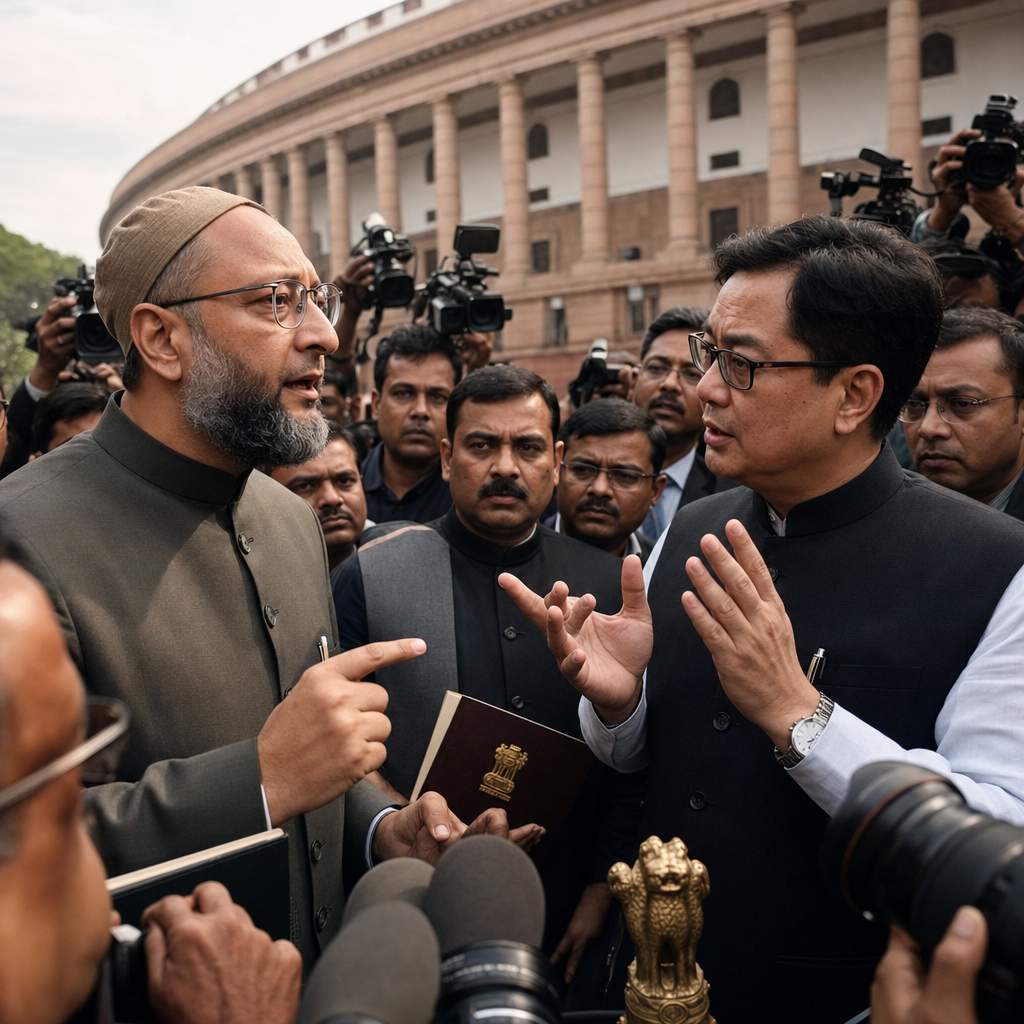
Union Minority Affairs Minister Kiren Rijiju has reopened one of India’s most combustible constitutional fights by comparing India’s Muslim population to the Parsi community and saying that, counted separately, Muslims would form the world’s sixth-largest country, according to  The Indian Express and
  Times Now. Asaduddin Owaisi responded that “79.8% or 14%” is the only math that matters in a Hindu-majority country and accused the minister of “propaganda” to deny Muslims their rights under Article 30, The Indian Express reported.
The leverage is legal, not rhetorical
Rijiju’s statement is not just a political provocation; it is a reminder that the Centre already controls the national list of minority communities under the National Commission for Minorities Act, 1992, and that Muslims, Christians, Sikhs, Buddhists, Parsis and Jains are currently recognised at that level, The Indian Express said. That national notification is what unlocks access to minority welfare schemes, scholarships and Waqf-related protections, which is why Owaisi is treating the minister’s remark as a threat to material rights, not just a semantic slight, The Indian Express reported.
The political benefit is immediate for both men. Rijiju signals to the BJP’s base that the government will not accept identity politics framed around demography alone; Owaisi gets to cast himself as the defender of constitutional guarantees. Neither needs to win the legal argument to win the news cycle. For readers tracking the broader contest over identity and institutions, the  India file is the one to watch.
The real dispute is where minorities are measured
The deeper issue is that Indian law has never cleanly answered whether minority status should be judged nationally, state by state, or even district by district. The Constitution protects minority rights in Articles 29 and 30 but does not define “minority”; the framers left that to the executive, The Indian Express noted. The Supreme Court’s 2002 T.M.A. Pai judgment held that linguistic and religious minorities should be determined at the state level, not nationally, The Indian Express reported.
That matters because a national tally hides local majorities and minorities. A community that is numerically large across India can still be vulnerable in specific states, which is why petitions before the Supreme Court have argued that Muslims are minorities in some places and majorities in others, while Hindus are minorities in several states and Union territories, including Lakshadweep, Mizoram and Jammu & Kashmir, according to  The Hindu and The Hindu. The court has already pressed the Centre to take a clearer position after the government shifted its stance on whether it, or the states, have the power to notify minorities, The Hindu reported.
What to watch next
The next decision point is the Supreme Court. A pending case on state-wise minority recognition is where this dispute could be narrowed, or widened, into a rule on whether minority rights should follow population counts or local context, The Hindu reported. Until then, Rijiju and Owaisi are fighting over arithmetic, but the prize is institutional control: who gets to define vulnerability, and therefore who gets protected by the state.