Oil Prices Surge After US Strikes Iran
Brent crude jumps as ceasefire collapses and sanctions return.
Model Diplomat10 min readMiddle East
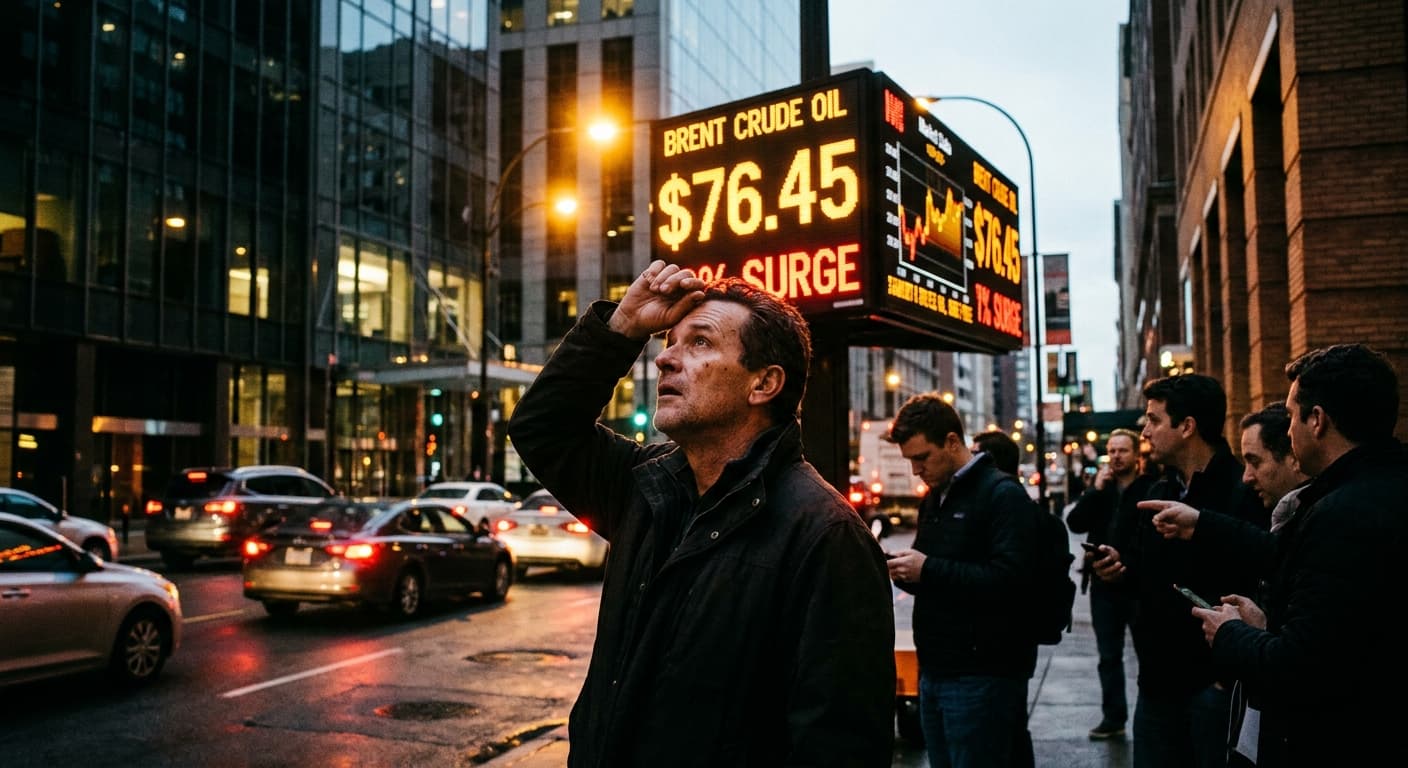
Oil Surges as US Strikes Iran: Brent Back Above $76 as Ceasefire Collapses
Brent jumped 3-6% on July 8, 2026 after US strikes on Iran and revocation of the oil waiver, killing hopes of pre-war pricing and locking in a durable Hormuz risk premium.
The 22-day-old US-Iran ceasefire died in a single trading session. Brent crude for September delivery surged to roughly $76.48 a barrel — and 6.16% higher to $78.73 on the Reuters tape — after US Central Command hit more than 80 Iranian targets and the US Treasury revoked the oil sanctions waiver signed under the June 17 memorandum of understanding, according to Al Jazeera and
the BBC. The move erases the market's assumption that the war's oil premium was transitory — and re-embeds a structural Hormuz risk into every macro forecast for the second half of 2026. The immediate winners are Chinese "teapot" refineries, Russia, and US LNG exporters; the losers are import-dependent Asian economies whose central banks now cannot cut, and a US Federal Reserve that just lost its excuse to ease.
The reprice — and why the shape of it matters
For the six days before Tuesday night, Brent had traded at or below its February 27 pre-war settle of $72.48, per Al Jazeera. That normalisation is now gone. What flipped the tape was not the strikes themselves — markets had priced sporadic tit-for-tat exchanges since Iran and the US traded fire on June 27 — but the sequencing of two US actions inside 12 hours. First, the Treasury's Office of Foreign Assets Control rescinded the general licence that had authorised the sale of Iranian oil until August 21, cutting off new transactions immediately and all wind-down activity after 12:01am EDT on July 17, per OFAC's
Iran sanctions page. Second, CENTCOM struck Iranian coastal radar, air defence, and fast-boat basing at Sirik, Qeshm and Bandar Abbas — the three sites Iran uses to police the strait.
The combination tells the market Washington has abandoned the June 17 architecture, in which sanctions relief was exchanged for Iranian "best efforts" on safe passage through the Strait of Hormuz. Iran's foreign ministry called the revocation a "blatant violation" of the MoU; President Trump said on Tuesday night that dealing with Tehran was a "waste of time," according to Al Jazeera's video record. Iran's Deputy Foreign Minister Kazem Gharibabadi promised "decisive actions." That kind of rhetoric had been sterilised by the MoU. It no longer is.
The chokepoint that will not normalise
The disruption math has not changed since March. Roughly 20 million barrels of oil per day — about 27% of global maritime crude trade and one-fifth of world petroleum liquids consumption — normally transit Hormuz, according to a June 2026 Congressional Research Service report, R45281. What has changed is throughput, and the market's belief about how long the impairment lasts. MarineTraffic data cited by Al Jazeera showed 38 confirmed transits on July 2, versus roughly 130 daily crossings before the war. Saul Kavonic, head of energy research at MST Financial, told Al Jazeera he now expects Hormuz to sit below 50% of pre-war passage "for many months, with periodic flare-ups in hostilities."
The bypass routes cannot absorb the shortfall. Saudi Arabia's East-West Pipeline is running at full 7 mbd capacity to Yanbu; the UAE's Habshan-Fujairah line is at its 1.8 mbd ceiling, Brookings reported in a June assessment. Even with those flows, the International Energy Agency described the disruption at its peak as "the largest supply disruption in the history of the global oil market." For historical scale: the 1973 Arab Oil Embargo removed about 4 mbd, or 7% of global consumption; the effective Hormuz closure earlier this year removed roughly 14 mbd, or 20%, per the
Council on Foreign Relations. This is not 1979 with a bigger number. It is a different order of shock.
OPEC+ tried to lean the other way on Sunday, announcing an 188,000 bpd August production increase from seven members — Saudi Arabia, Russia, Iraq, Kuwait, Kazakhstan, Algeria and Oman — per Al Jazeera. That number is trivial against a shortfall measured in millions of barrels. Total OPEC+ output collapsed to 33.13 mbd in May from 42.77 mbd in February, an unprecedented monthly compression. And crucially, more than 90% of global spare crude production capacity — the IEA counted 5.4 mbd of it in May 2025 — sits inside Middle East countries that must themselves export through Hormuz to reach markets, according to CRS. Spare capacity trapped behind the chokepoint is not spare capacity.
The buffer is thinning fast. The IEA-coordinated release of 400 million barrels — the largest in the agency's history — has been running down since March, and Brookings analysts Kari Heerman and David Wessel estimated in June that IEA Executive Director Fatih Birol's release was adding 2.5–3 mbd but "could be spent by July or August." The US Strategic Petroleum Reserve, drawn from 415 million barrels in February, is nearing its estimated 150-million-barrel structural floor, according to the Government Accountability Office, which flagged the vulnerability in a June 2026 report that warned Congress and the Department of Energy "lack a unified long-term plan" for the reserve. The SPR's paper drawdown capacity is 4.4 mbd; in 2022 it managed 1 mbd in practice, per the
Council on Foreign Relations. The cushion beneath every trader's screen is materially smaller than it looks.
Who gets richer, who gets squeezed
The revocation of the June 21 authorisation does not stop Iranian oil moving. It moves the discount. Before the MoU, Iran was landing roughly 80% of its shipped crude in China, largely through independent "teapot" refineries in Shandong that pay in yuan and barter, according to analytics firm Kpler cited by Al Jazeera. With Treasury reimposing the pre-MoU regime, the teapots regain their arbitrage: discounted Iranian medium-sour barrels that Western refiners cannot legally touch. Al Jazeera's April open-source investigation tracked 185 vessels through Hormuz between March 1 and April 15, of which 61 sat on Western sanctions lists — a
shadow-fleet architecture that survived the US naval blockade using false flags out of Botswana, San Marino, Madagascar and Comoros. That plumbing does not need to be rebuilt. It never went away.
Russia is the second structural beneficiary. Every time Hormuz tightens, the Brent-Urals spread compresses because Asian buyers bid up alternative sour crudes. Its rouble has been "one of the top-performing currencies against the dollar since the outbreak of the Iran war," BBC News reported, propped by high energy revenues and capital controls that force exporters to convert earnings. The third beneficiary is the United States itself — as a net exporter. A June Boston Fed brief by Danilo Leiva-León, Giovanni Olivei and colleagues concluded that the US economy is now "less vulnerable to geopolitical oil price shocks than in the past," with the Dallas Fed calculating that GDP damage from the 2026 shock runs at
one-twentieth of what an equivalent 1980 shock would have inflicted, and one-sixth of the damage to the rest of the world. The shale revolution has finally paid its geopolitical dividend.
The squeeze falls on countries that pay dollars for oil and cannot switch to grey-market barrels. India imports about 90% of its crude, roughly half through Hormuz, per BBC News. The Observer Research Foundation calculates that every $10 rise in Brent widens India's current account deficit by 40–50 basis points; the rupee has fallen from 85.6 to 93.2 per dollar over the past year, forcing the Reserve Bank of India to draw on its $700 billion reserve buffer while the IMF quietly reclassified
India's exchange rate regime from "stabilised" to "crawl-like," according to
ORF. Bernstein's downside scenario has the rupee "beyond 110 to the dollar" if the war extends through 2026, per the
BBC. Indonesia, the Philippines, Thailand and Egypt are absorbing similar terms-of-trade damage. Japan's yen, normally a safe haven, has weakened to a four-decade low of ¥162.8 to the dollar because energy imports dominate its trade balance, the
Atlantic Council notes, despite $73 billion of Bank of Japan intervention and a policy rate now at 1%.
There is a further, quieter loser: the Iranian regime's neighbours. Qatar lost 17% of its LNG capacity during the war, and the Ras Laffan complex could take three to five years to rebuild, according to the Center for American Progress. The UAE quit OPEC on May 1. Brookings expects OPEC to "have a less prominent position in oil markets and oil prices in the future." A generation of Gulf hydrocarbon strategy — anchored in Hormuz as a reliable export corridor — is being unwound in front of the market.
Central banks locked in
The most important second-order effect is monetary. The Federal Reserve held its policy rate at 3.5%–3.75% at its late-June meeting, with Chair Jerome Powell explicitly citing the Iran "oil shock," per BBC News. Fed board members now expect year-end headline inflation at 2.7%, up from a 2.4% December projection. Powell said it was "too soon" to say how the war would shape the trajectory. On July 8, it stopped being too soon.
Federal Reserve Bank of Dallas researchers Lutz Kilian, Michael Plante, Alexander Richter and Xiaoqing Zhou have quantified the trap. Their scenario analysis, published in Dallas Fed Working Paper 2609 and summarised on
CEPR VoxEU, finds that under a "cautiously optimistic" one-quarter Hormuz closure, US Q4/Q4 headline PCE inflation rises by 0.6 percentage points and core by 0.2. If the closure persists three quarters — the trajectory the July 8 collapse now suggests — headline rises 1.1 points, core 0.3, and West Texas Intermediate drifts toward $167 in the tail scenario where infrastructure attacks compound the shortfall to 20% of global supply. That is the number that keeps every FOMC member awake. It is also the number that tells you the September cut priced by fed funds futures is now aggressive.
The IMF has already flagged an "adverse" scenario in which global growth falls to 2.5% and inflation rises to 5.4%, versus a baseline 3.1% and 4.4%, according to BBC News. The European Central Bank, which had been telegraphing a September cut, faces the same dilemma with a euro-area energy import bill that is once again rising. The Reserve Bank of India, per Care Edge Ratings quoted by the BBC, is set for a "wait and watch" hold — a euphemism for policy paralysis when the currency is falling and inflation is rising simultaneously. This is the textbook definition of stagflation risk that Kilian and co-authors warn about, and it is not evenly distributed: energy-importing emerging markets absorb the shock through their exchange rates before it reaches their consumer price indices.
The MoU that was never really signed
The document at the centre of this crisis was always fragile. The 14-point memorandum signed by Trump at Versailles on June 17 committed both sides to "immediate and permanent termination of military operations on all fronts," a $300 billion Iran reconstruction fund with no US contribution requirement, and safe passage for commercial vessels through Hormuz for 60 days, per the BBC's reading of the text. But Iranian negotiator Mohammad Bagher Ghalibaf publicly declared the same day that the "Strait of Hormuz will not return to pre-war conditions" and Iran would "receive a fee for services" from transiting ships. Tony Sycamore of IG Australia told Al Jazeera the MoU's language on strait control was "deliberately vague." Deliberate vagueness works until the first tanker is hit. Three were hit on July 7.
The World Trade Organization is now maintaining a dedicated Hormuz trade tracker; Director-General Ngozi Okonjo-Iweala has warned in the Financial Times that the global response, while more cooperative than in past crises, still risks over-dependence on a small number of suppliers. Since March 2026, WTO monitoring shows global shipping majors have introduced multimodal Gulf services using road and rail land bridges — a permanent rerouting of the world's most important energy corridor that will not reverse when the shooting stops. The Council on Foreign Relations captured the point bluntly: even once Hormuz reopens, "the market will take months to normalize."
Diplomat View
The market's decisive signal on July 8 was not the price move — it was the shape. Brent gave back the entire ceasefire dividend in under 12 hours, but the front-month curve stayed only modestly backwardated. That says traders now believe the risk is durable, not spike-and-fade. The base case: Brent trades $75–$90 through Q4 2026, with periodic $10 spikes on any Hormuz incident; Chinese teapots regain share of Iranian barrels at widening discounts; the Fed skips September and delivers at most one cut in Q4; the rupee, rupiah and peso stay defensive; SPR drawdowns approach the structural floor by year-end. The trade that works is long US and Qatari LNG, long Norway krone and Canadian dollar, short Asian import-dependent currencies against USD. What would change this forecast: a verified Iranian standdown at the strait within 30 days (bullish for EM FX, bearish for oil); a mining incident or an attack on Ras Tanura (WTI to $120+); or a hard Chinese diplomatic move to broker a Version 2.0 of the MoU — Beijing is the only power in the room with leverage over both Tehran and its own refiners, and it has so far declined to use it.
The bottom line: the pre-war oil price is not coming back this year. The June 17 memorandum failed because it left Hormuz sovereignty ambiguous, and the July 8 strikes have taught the market to price that ambiguity permanently. The single most important economic actor in the second half of 2026 is not Powell or OPEC — it is the Chinese teapot refiner in Shandong buying sanctioned Iranian medium-sour at a widening discount and quietly setting the floor under Asian gasoline prices.
What to watch
- July 17, 2026 — Treasury waiver hard cutoff at 12:01am EDT. Any Iranian barrel loading after this date is a sanctions violation, testing whether Beijing pushes back publicly on secondary sanctions exposure for its teapots.
- August 2, 2026 — Next OPEC+ ministerial review. Watch whether Saudi Arabia goes beyond the 188,000 bpd August increase or holds fire pending a US-Iran de-escalation signal.
- August 21, 2026 — Original MoU 60-day negotiation deadline; now moot, but the date Iran will use as a rhetorical marker for US "bad faith."
- September 16–17, 2026 — FOMC meeting. If Brent is above $85, a September cut is off the table; watch the dot plot for the new terminal-rate signal and any language on stagflation risk.
Discover more

US Politics
House Ethics Committee Pushes Sexual Miscond.
The House Ethics Committee has shifted responsibility for sexual harassment settlement records to the Office of Congressional Workplace Rights, complicating disclosure efforts.
India
Romanian Coalition Party Demands PM Resign
Romania's Social Democrats withdrew from coalition, joining far-right AUR to topple PM Bolojan, risking €10 billion in EU funds by August 2026.

US Politics
SNAP Food Assistance Faces Legal Challenges
In 2026, SNAP faces stricter eligibility rules and mounting legal challenges, threatening food assistance for the millions of Americans who rely on the program.

Economics
Fed's Amex AML order puts correspondent banking on notice
Federal Reserve's Amex AML order requires board-level controls and a 90-day plan; OCC fined the bank $350 million over enterprise-wide deficiencies.