OIC Condemns Mali Attacks Amid Security Fail
OIC's response highlights Mali's security crisis.
Model Diplomat9 min readAfrica
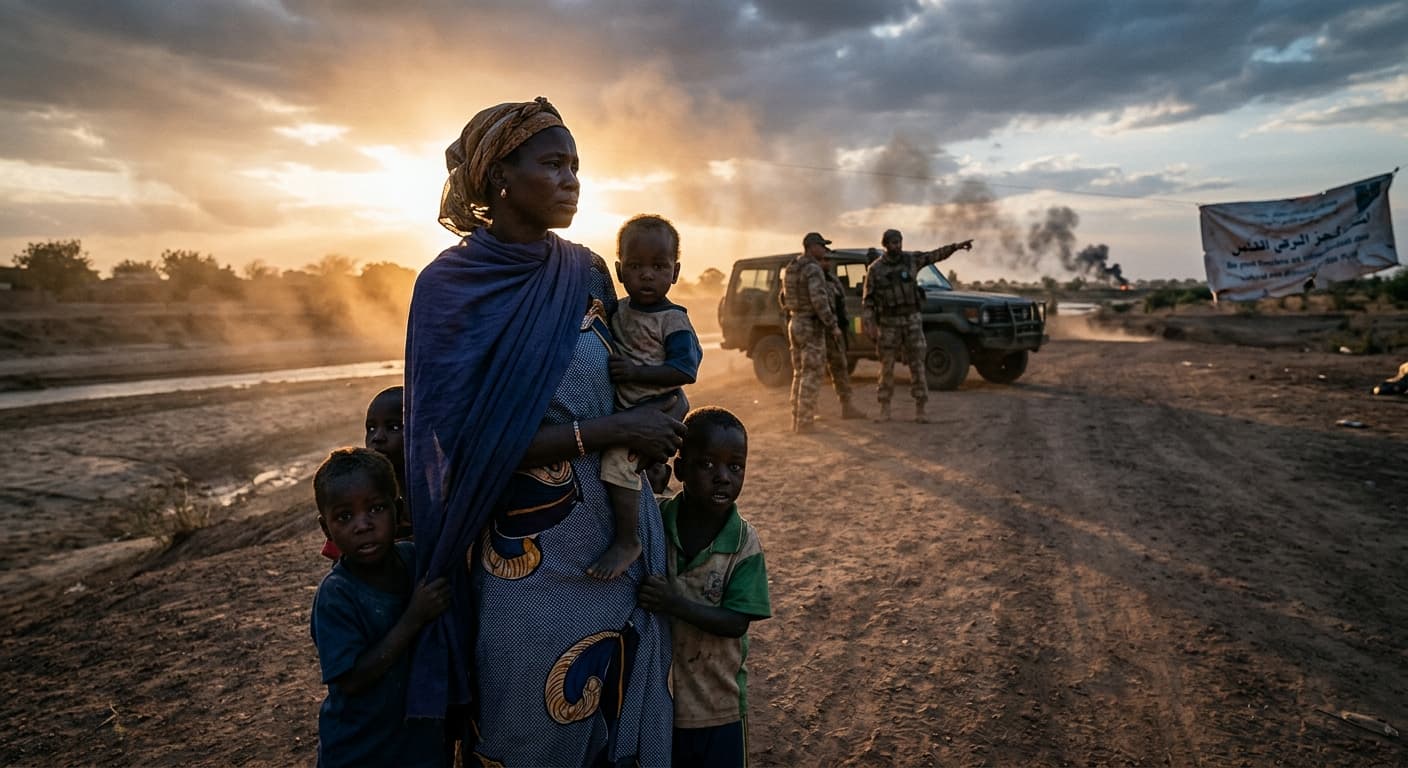
OIC Condemns Mali Attacks as Sahel Security Architecture Collapses
The OIC condemned the July 4 coordinated attacks on Mali — but Bamako's severed ties with the UN, France, ECOWAS and the G5 Sahel have reduced the multilateral response to rhetoric while Russia and JNIM fight for the country.
The Organization of Islamic Cooperation's July 7 statement condemning the coordinated terrorist assaults that hit five Malian towns on July 4, 2026, is significant less for what it says than for what it exposes: after three years of dismantling every regional and Western counter-terrorism instrument built for the Sahel, Mali's junta now depends on Russian mercenaries for firepower and on the Muslim world's press releases for legitimacy. The 57-state OIC's "full solidarity" carries no troops, no funds and no operational reach. That is the point. Jama'at Nusrat al-Islam wal-Muslimin (JNIM) and the Tuareg-led Azawad Liberation Front (FLA) now dictate the tempo of Sahel security — and the international system's response has been reduced to communiqués.
The July 4 attacks: pattern, not aberration
Mali's army confirmed simultaneous assaults on July 4 in Aguelhok, Anefis and Gao in the north, Sevare in the centre, and Kenieroba south of Bamako, according to Al Jazeera. The army said 20 "terrorists" were killed in Sevare and six in Gao, and claimed the situation was "totally under control." JNIM claimed it had taken at least seven positions; the FLA spokesman Mohamed Elmaouloud Ramadane confirmed the group led the assault on Anefis, per
Al Jazeera's follow-up. Anefis and Aguelhok were reportedly the last towns where Mali's army retained a presence in the Kidal region after the April rout.
This was the second nationwide, cross-group offensive in ten weeks. On April 25, the same JNIM-FLA coalition struck Bamako, Kati, Gao, Kidal and Sevare; killed Defence Minister Sadio Camara in a suicide truck bombing at his Kati residence; and — after Russian mercenaries agreed to withdraw — seized Kidal town. The BBC documented that Camara died alongside family members, that a nearby mosque collapsed in the strike, and that junta leader Gen. Assimi Goïta was moved to a safe location after his own home was targeted. Konrad Adenauer Foundation Sahel analyst Ulf Laessing told the BBC it was the "largest co-ordinated jihadist attack on Mali for years" — and that Camara, "the brain behind the deployment of Russian mercenaries in the Sahel," would be difficult to replace as Moscow's interlocutor.
Ten weeks later, the same actors ran the same playbook. The OIC statement of July 7 offered "sincere condolences" and support for "national and regional efforts aimed at combating terrorism and promoting security and stability in the Republic of Mali and the Sahel region." The language mirrors — almost verbatim in structure — the April communiqué in which Secretary-General Hissein Brahim Taha expressed "great concern" over "military operations" targeting Bamako, per
Al Jazeera's live blog. The formula does not change because there is no mechanism behind it.
Why the OIC statement is diplomatically hollow
The condemnation matters because of what it cannot invoke. The OIC has no standing counter-terrorism force. Its member Saudi Arabia leads the parallel Islamic Military Counter Terrorism Coalition (IMCTC), a 41-nation Riyadh-headquartered body that includes Mali, Niger, Burkina Faso and Chad — but which has never conducted a joint operation in the Sahel. The coalition's original 34 signatories, listed by the BBC in 2015, were framed by then-Deputy Crown Prince Mohammed bin Salman around threats in Iraq, Syria, Libya, Egypt and Afghanistan; sub-Saharan operations were never scoped. The
UN Office of Counter-Terrorism's February 2025 cooperation agreement with the IMCTC remains largely notional in operational terms.
Meanwhile the architectures that actually operated in Mali have been systematically expelled. Operation Barkhane departed in 2022. MINUSMA withdrew in 2023. The G5 Sahel dissolved after Mali, Burkina Faso and Niger pulled out. Mali left ECOWAS with its two AES partners in early 2024. UN Secretary-General António Guterres told the Security Council in November 2025 that terrorism in the Sahel accounts for "19 per cent of global terrorist attacks — and over half of global terrorism-related casualties," and that "five of the ten countries most affected by terrorism are in the Sahel," according to his formal remarks. His prescription — "bridging the communication, co-ordination and trust gaps between ECOWAS and the Alliance of Sahel States" — is the vocabulary of an outside observer, not a security provider.
The UK's Charge d'Affaires to the UN at the same November 2025 session flagged Security Council Resolution 2719 as a potential tool for UN support to AU-led operations — a tacit acknowledgement that the previous decade's frameworks are dead and something new must be improvised. On July 5, African Union Commission Chairperson Mahmoud Ali Youssouf issued his own condemnation from Addis Ababa, urging "urgent collective action" in the Sahel, per
Dawan Africa. Like the OIC, the AU has no deployable capability in Mali — it withdrew from operational relevance when the AES rejected external tutelage.
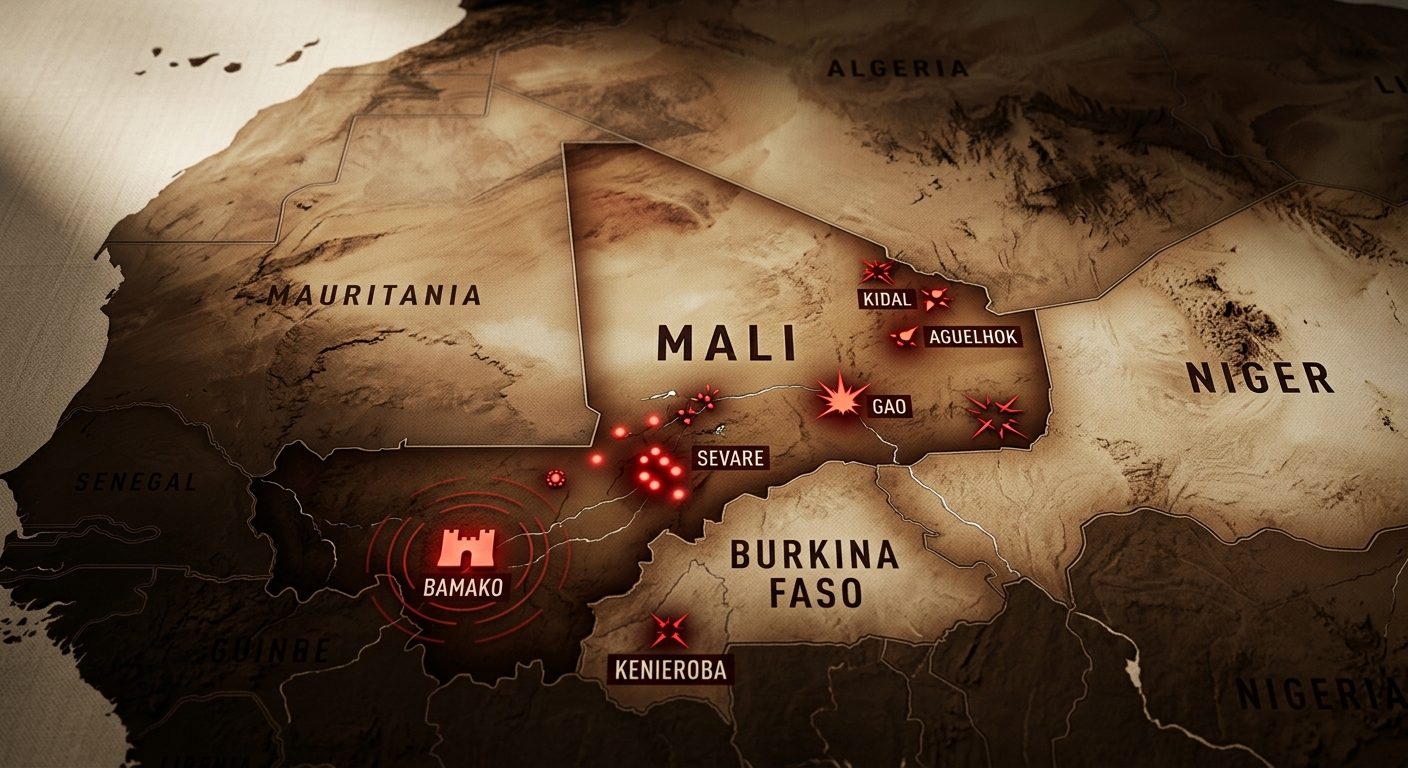
The shadow map: who actually operates in Mali
Three actors carry real weight on the ground, and none of them is the OIC.
JNIM, an al-Qaeda affiliate led by Iyad Ag Ghali, has run a fuel and goods blockade on Bamako since September 2025. The Institute for Security Studies documented that between September and November 2025 the Port of Dakar recorded "a daily blockage of around 120 containers bound for Mali," costing Senegal an estimated 15 billion CFA francs (US$26.54 million) monthly, with "over 2,000 containers" stranded in Dakar by late November and roughly 4,000 empty containers stuck in Bamako by February 2026, per ISS Africa. This is the second-order effect the OIC statement ignores: JNIM has moved from rural insurgency to economic warfare, choking off Mali's top trade partner Senegal, whose 2024 exports to Mali were worth roughly US$1.42 billion. The Hudson Institute compared JNIM's trajectory to Hay'at Tahrir al-Sham's before Damascus fell, warning that "Bamako was on the verge of falling to JNIM in the second half of 2025," per
Hudson.
The Azawad Liberation Front (FLA), formed in 2024 from northern Tuareg factions and led by Alghabass Ag Intalla, controls Kidal and has publicly declared its intent to take Gao and Timbuktu. Its 2025 tactical pact with JNIM — after early-2025 talks in which the FLA committed to Sharia law and JNIM refused to renounce al-Qaeda — is the most dangerous jihadist-separatist convergence in the Sahel since 2012, per a Stimson Center analysis. The 2012 parallel is worth naming precisely: that year, a similar Tuareg-jihadist coalition seized northern Mali before ideological fracture broke it apart. This time, the coalition has held for over a year and executed two nationwide operations.
Russia's Africa Corps — the rebranded Wagner presence — is the junta's last line of defence. Al Jazeera reported on July 7 that the Russian navy was shipping weapons to help Mali "hold off a rebel siege," per Al Jazeera video. A July 2026 analysis from the
Real Instituto Elcano argues Africa Corps is "institutionalising Russia's regime-protection model and sidelining European actors" across the central Sahel — turning Mali, Burkina Faso and Niger into a coherent geopolitical bloc under Moscow's security guarantee.
The AES bet — and its structural limits
In December 2025, at their Bamako summit, Mali, Burkina Faso and Niger inaugurated the Alliance of Sahel States Unified Force (FU-AES), a 5,000-strong joint battalion headquartered in Niamey and commanded by Burkina Faso's Gen. Daouda Traoré, according to BBC Afrique. Burkinabè leader Ibrahim Traoré warned of a "Black Winter" of external pressure and pledged "large-scale" operations against armed groups, per
Al Jazeera. Niger's Gen. Omar Tchiani declared the AES had "put an end to all occupation forces in our countries."
An academic study in the November 2026 issue of Third World Quarterly argues the AES Unified Force marks "one of the most consequential reconfigurations of regional security governance in West Africa since the collapse of the G5 Sahel" — but is "constrained by the same structural forces that undermined earlier initiatives: persistent cross-border insurgent mobility, rising civilian harm, fiscal fragility and growing regional isolation." The Institute for Security Studies notes the G5 Sahel's original €423 million annual budget "far exceeded the contributions of its member states," while the AES has not disclosed its financial parameters at all, per
ISS Africa.
The numbers make the mismatch stark. The Observer Research Foundation, citing ACLED data, reports JNIM was responsible for "approximately 8,800 fatalities across the Sahel" in 2025 and "claimed to have carried out at least 280 attacks in Burkina Faso" in the first half of 2025 alone — double the 2024 pace, per ORF. The West Africa Security Tracker recorded 12,964 conflict-related fatalities across West Africa in the first half of 2025, with Mali alone at 2,157 deaths, per the
CDD West Africa mid-year report. The Atlantic Council's
AfricaSource notes that in Burkina Faso, extremists killed "an estimated 87 percent more civilians" since Traoré's 2022 coup than in the preceding three years — and government-aligned forces killed "up to 132 percent more." The AES's 5,000 soldiers face a regional insurgency operating across a border zone the size of Western Europe.
Who benefits from the OIC's ritual
Three parties gain from OIC condemnations without instruments.
Bamako's junta gets diplomatic cover from a bloc of 57 Muslim-majority states while continuing to expel Western partners. The OIC's April statement referred to "military operations" targeting Bamako — carefully neutral language that let both sides read what they wanted. The July 7 statement went further, using "coordinated terrorist attacks" — a formulation Goïta's government has actively lobbied Muslim capitals to adopt, since Western governments increasingly frame the FLA as a legitimate political actor with historic Tuareg grievances rather than a proscribable terrorist entity.
Saudi Arabia and the Gulf, which chair the IMCTC, retain a low-cost claim to Sahel relevance without deploying capabilities. Their real interest is preventing JNIM from becoming a global al-Qaeda vanguard that could target Riyadh or Abu Dhabi. The Hudson comparison to Somalia, Afghanistan and Syria carries that anxiety.
Russia is the quiet beneficiary of the multilateral vacuum. Every OIC or AU statement that lacks operational follow-through validates Moscow's argument to Bamako, Ouagadougou and Niamey that only Africa Corps delivers.
The losers are named too. Mali's civilians — roughly 4 million displaced across the AES states per UNHCR data cited by Guterres, with 14,800 schools and over 900 health facilities closed across the Sahel. Senegal and Côte d'Ivoire's exporters, strangled by JNIM's blockade of the Dakar-Bamako and Abidjan-Bamako corridors — the latter carrying roughly 1.47 million tonnes of goods by end-2025 per ISS. And increasingly the coastal states of Benin, Togo and Ghana, where the Stimson Center documents JNIM's "southward creep" via cross-border cells embedded in northern border villages.
Diplomat View
The OIC's July 7 condemnation is a symptom, not a policy. It confirms that after Mali expelled France, the UN peacekeepers, ECOWAS and the G5 Sahel, no multilateral body — not the AU, not the OIC, not the UN — retains the leverage to shape events on the ground in Bamako. The vacuum has been filled by Russia's Africa Corps for the junta and by JNIM-FLA coordination for the insurgency. Expect the July 4 pattern to repeat every 8–12 weeks through 2026, with Bamako's perimeter progressively thinning. Our forecast: if the AES Unified Force fails to launch a credible cross-border operation by the December 2026 summit, and if JNIM sustains the blockade through the September-November dry season, the probability that a major Malian city other than Kidal falls to JNIM-FLA control by mid-2027 rises above 40%. The forecast revises down only if Algeria or Morocco brokers a JNIM-FLA split, or if Africa Corps deploys the newly-shipped Russian heavy weapons in an offensive rather than defensive posture. Neither is likely on current trajectory.
What to watch next:
- JNIM's Bamako blockade tempo through the September–November 2026 dry season. A renewed cut on the Kayes-Bamako axis would push the capital toward the collapse scenario Hudson analysts have already modelled.
- The AES Unified Force's first confirmed major operation — deadline: the AES annual summit expected December 2026. Six months after launch, no cross-border deployment has been announced.
- UN Security Council follow-up invoking Resolution 2719. Watch whether a rotating non-permanent African member tables text to authorise AU-led operations. Guterres flagged 2719 explicitly.
- The next JNIM claim of a fatal attack inside Ghana or Côte d'Ivoire — the trigger that would reactivate ECOWAS's dormant 260,000-strong counter-terrorism force plan and its proposed $2.5 billion annual budget announced in August 2025.
The OIC's press releases will continue. So will the attacks.
Discover more

US Politics
US Launches $166B Tariff Refund Portal
The US is launching a $166 billion tariff refund portal to aid importers hit by Trump-era tariffs, with major implications for trade and supply costs.
Global Politics
Xi Jinping Calls China-Russia Ties 'Precious'
Xi Jinping's description of China-Russia ties as 'precious' reflects a strategic imbalance, with Beijing dictating terms in the partnership.

International Relations
U.S.–Iran Peace Deal
A narrow US-Iran deal on nuclear and regional issues could reshape Middle East diplomacy, offering a pragmatic path forward despite grand bargain obstacles.
Conflict & Security
Guatemala: El Niño 2026–27 becomes regional security test
UNICEF: 25.8M children face El Niño risks in Latin America; Guatemala maps 188 municipalities for drought and food insecurity amid regional security test.