North Korea's Warning on Japan's Military
Pyongyang aligns with Beijing on Japan's defense posture
Model Diplomat9 min readAsia
North Korea's Japan Warning Recasts the Indo-Pacific Missile Race
KCNA calls Tokyo's overseas strike posture "reality, not hypothetical" — a July 7 broadside that tracks Japan's Tomahawks, hypersonics and 3,000-km missile plans, and reframes the Korean peninsula as a Taiwan-linked front.
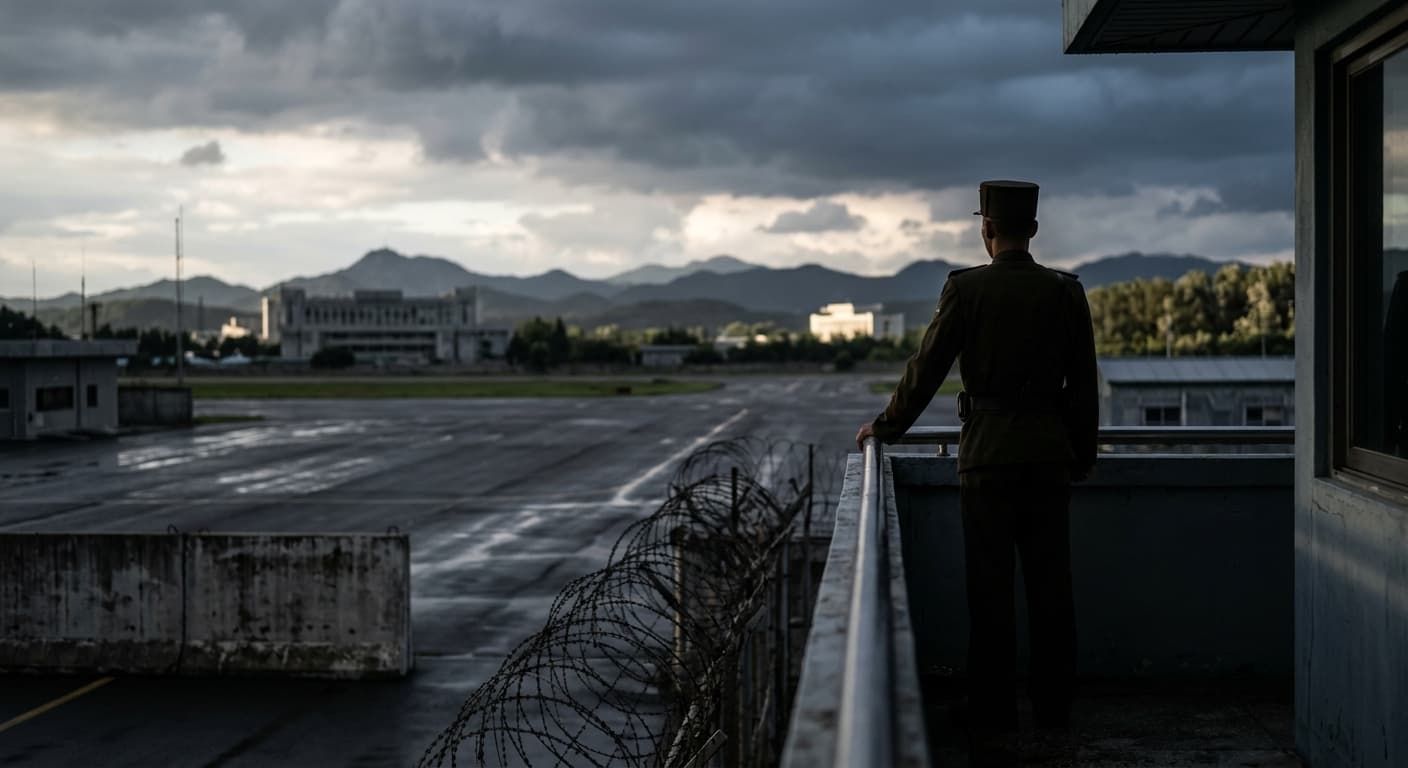
Pyongyang's July 7 commentary is not the ritual denunciation it looks like. It is North Korea publicly aligning its threat model with Beijing's — treating Japan's fast-hardening long-range strike arsenal, not the US alliance in the abstract, as the object of deterrence. The specific weapons KCNA named (Tomahawks, a new 3,000-km ballistic missile, hypersonic glide vehicles, armed unmanned submarines) are the same capabilities that make a Japanese role in a Taiwan contingency operationally credible for the first time since 1945. That is the story: the Korean and Taiwan fronts are being fused into one deterrence problem, and Japan is now the pivot — with second-order consequences for South Korea's nuclear-submarine bet, US alliance management under Donald Trump, and Kim Jong Un's own naval build.
What Pyongyang actually said, and why the specifics matter
The commentary, carried by the Korean Central News Agency on July 7, 2026, accuses Tokyo of abandoning its "exclusively defence-oriented policy" and turning the Self-Defense Forces into a "thoroughly offensive and aggressive force," according to The Straits Times. The piece flagged unmanned submarines carrying torpedoes and naval mines "deployed near the coastlines of neighbouring countries," a new domestic ballistic missile with a range "up to 3,000 km," upgraded anti-ship missiles, hypersonic glide weapons and imported US Tomahawks.
That target list is not rhetorical noise. It maps almost line-for-line onto Japan's official Defense Buildup Program. Japan's Ministry of Defense FY2026 outline allocates ¥177 billion to the ground variant of the Upgraded Type-12 surface-to-ship missile, ¥38.7 billion for the Hyper Velocity Gliding Projectile and ¥30.1 billion for indigenous hypersonic missiles, per the MOD's own budget document. The National Defense Strategy states in plain text that "a key to deterring invasion against Japan is counterstrike capabilities that leverage stand-off defense capability," according to the
MOD strategy paper. The 2025 Defense White Paper's digest confirms Tomahawk acquisition and satellite-constellation targeting are already in the FY2025 budget, per
Japan MOD.
Put bluntly: KCNA is reading Japan's own doctrine back to it. The propaganda value is in the accuracy.
The Takaichi trigger — and why Pyongyang joined Beijing's line now
The proximate cause is not a new Japanese weapon. It is a sentence Prime Minister Sanae Takaichi spoke on November 7, 2025. Asked in the Diet what would qualify as a "survival-threatening situation" under Japan's 2015 security legislation, Takaichi replied that Chinese warships blockading Taiwan "could constitute a survival-threatening situation," according to BBC News. That is the trigger that would legally allow the Self-Defense Forces to fight alongside US forces even before Japan itself is attacked.
Beijing's response was structural, not just rhetorical. CSIS documented a Ministry of Commerce warning on December 4 that Japan "must bear sole responsibility for all consequences," a de facto reinstated seafood ban, tourism curbs, and export restrictions to 40 Japanese entities tied to defense supply chains. By early 2026, Chinese drones were probing Yonaguni airspace within days of Defense Minister Shinjiro Koizumi announcing surface-to-air missiles would deploy 110 km from Taiwan by FY2030, per
Al Jazeera.
North Korea joining that chorus in July matters because Pyongyang almost never subordinates its rhetoric to Beijing's diplomatic calendar. Yet the July 7 commentary echoes the Chinese Ministry of Defense spokesman's June warning that "the grey rhino of a remilitarised Japan is gathering speed," reported by BBC News. The convergence is the signal. It suggests Kim Jong Un now sees value in publicly ratifying the China-led framing of Japan as the destabilising actor, a position that gives cover to his own naval buildup and neutralises the historically awkward optic of North Korean militarism.
The buildup that KCNA is describing accurately
Japan is not marginally more armed than it was three years ago; it is on a different trajectory. Defense spending hit the 2% of GDP target in FY2025 — two years ahead of the schedule Fumio Kishida set in December 2022 — after the Takaichi cabinet approved a record ~¥9.9 trillion budget in December 2025, according to Al Jazeera. CSIS notes Tokyo has signed a "$2.4 billion contract for 400 Tomahawk cruise missiles, including anti-ship variants," per
RAND, with initial deployment on destroyers this year.
The strategic point is what those numbers enable. RAND's Jeffrey Hornung wrote in March 2026 that CSIS's "First Battle of the Next War" wargame consistently found the United States "runs out of long-range anti-ship missiles within the first week" of a Taiwan fight — a shortfall Japan is now positioned to plug. Foreign Affairs described Tokyo's investments in "munitions stocks, expanding uncrewed systems, and loosening constraints on exports and defense industrial cooperation" as amounting to "a point of no return" that even a successor government could not credibly reverse, per Foreign Affairs.
Mitsubishi Heavy Industries is building what Foreign Affairs calls "effectively the country's first ballistic missile" — a hypersonic glide vehicle — while co-developing a sixth-generation stealth fighter with Britain and Italy, according to Foreign Affairs. That is the 3,000-km system KCNA specifically named. Pyongyang is not inventing a threat; it is describing a program on a public budget line.
The angle: Kim's naval build is the mirror image, not the counterweight
The commentary appears at a specific moment in North Korea's own naval push, and that is the non-obvious angle. Kim commissioned the 5,000-tonne destroyer Choe Hyon at Nampho on June 23, 2026, vowing to arm the navy with nuclear weapons and build 10,000-tonne vessels, per Al Jazeera. Two days before the KCNA broadside, on July 5, Kim observed a strategic cruise-missile test from the second destroyer, Kang Kon, and ordered its commissioning within two months, per
The Straits Times. CSIS's Beyond Parallel assessed the Kang Kon as North Korea's "largest warship ever produced," with two additional Choe Hyon-class hulls ordered per year, per
Beyond Parallel.
The July 7 commentary's timing is therefore not a complaint from a bystander. It is a public rationale for a fleet that South Korean and US analysts assess was built with Russian assistance. NPR reported in December 2025 that North Korea unveiled an 8,700-ton nuclear-powered submarine hull and that South Korea, with Trump's October approval, launched a pan-government task force to build its own nuclear subs — a program the Chief of Naval Operations Admiral Daryl Caudle said the US expects to be used against "our pacing threat," China, per NPR.
That is the second-order effect Washington keeps under-pricing: Japan's Tomahawk-and-hypersonics buildup is now the argument North Korea uses to justify a nuclear navy, which is the argument South Korea uses to justify nuclear-fuel supply from the US, which is the argument Beijing uses to justify pushing back on Japan. The loop closes on itself. Analysts at CSIS's Michael Green and Christopher Johnstone note Takaichi's early 2% pledge is likely to intensify pressure from Washington for a further 3.5% target already accepted by Japan's NATO peers and by South Korea, per CSIS.
The historical parallel — and where it breaks
The instinct is to reach for a 1930s analogy. That is the wrong frame. The better parallel is West Germany's 1979 double-track decision to accept Pershing II deployments while pursuing arms control — a moment when a US ally's decision to host offensive strike systems recast the deterrence architecture around it. Japan's counterstrike doctrine differs in one crucial respect: Tokyo owns the weapons and the targeting decision. The Defense Buildup Program states counterstrikes will be conducted "under unified command and control based on joint operations," per the MOD program document — implying, but not committing to, US concurrence.
CSIS's Sheila Smith notes that "as Japan brings long-range missile capabilities online in 2026, the alliance has yet to develop a clear process for coordinating strike operations." That gap is exactly what KCNA and Beijing are trying to exploit. If they can convince third-country audiences that Japan may strike without Washington's sign-off, they weaken the political premise of Japan's counterstrike posture — which is that it is a defensive complement to US power, not a substitute for it.
Who benefits, who loses
The obvious loser is the pacifist reading of Article 9. BBC quoted Koizumi telling the network he personally supports revising the article and that the SDF's ambiguous status must be clarified, per BBC News. Polls after the November Takaichi remarks showed 55–56% of respondents backed her position in Nikkei, Yomiuri and Asahi surveys, per
CFR. The political ceiling for further build-ups has risen.
The less obvious winners are Japanese defense exporters. Koizumi told the BBC that Australia has bought Mogami-class warships, the Philippines is in talks for used destroyers, and Indonesia and New Zealand are engaged — the first meaningful lethal-equipment exports since the 1960s, per BBC News. China's coercive playbook against South Korea in the THAAD dispute and against Australia after 2020 has convinced Tokyo that supply-chain diversification and a domestic defense industrial base are national-security imperatives, not commercial preferences.
The loser Beijing did not intend to create is its own leverage. CSIS notes Japan's rare-earth dependence on China has already fallen from about 90% in 2010 to roughly 60% in 2023, and this crisis will accelerate the trend, per CSIS. The July 6 Chinese submarine-launched ballistic missile test into the South Pacific, condemned by Japan, Australia and New Zealand and reported by
Al Jazeera, pushed additional Pacific states toward the same conclusion.
Diplomat View
The KCNA commentary is best read as a joint diplomatic product with Beijing, not as autonomous propaganda from Pyongyang. Its target audience is not Tokyo — Tokyo is not going to slow down — but Washington, Seoul, and the ASEAN capitals still hedging on the Taiwan question. The line to sell is that Japan is the aggressor, that Japan's counterstrike missiles are indistinguishable from first-strike weapons, and that any US ally hosting them is choosing a side. That framing, if it lands in Manila or Jakarta, could complicate Japan's emerging role as arms supplier to Southeast Asia.
The falsifiable call: if Beijing's next move is to formally restrict rare-earth or gallium exports to Japan (rather than the entity-listing pattern used to date), the pressure campaign has moved from signalling to coercion, and the risk of a genuine economic decoupling within 12 months rises sharply. If instead the Xi-Takaichi channel reopens around a face-saving formula on Taiwan by the end of 2026, this commentary will look, in retrospect, like the high-water mark of the North-Korea-endorsed pressure campaign.
The revision trigger: any concrete Trump-Xi arrangement that trades pressure on Japan for tariff or Taiwan concessions would gut this thesis. Trump made no mention of Taiwan in his November 24, 2025 call with Xi, per NPR — a data point Japanese officials are watching closely.
What to watch next
- End of 2026: Japan's revised National Security Strategy, National Defense Strategy and Defense Buildup Program are due for publication; watch for whether the 2% target formally shifts to 3.5% and whether Yonaguni missile deployment is accelerated.
- August–September 2026: KCNA has flagged commissioning of the Kang Kon destroyer within two months of the July 5 test; a live-fire integration with tactical nuclear-capable cruise missiles would confirm Kim's "nuclear navy" is not rhetoric.
- March 19, 2026 follow-through (already past): Takaichi's Washington visit outcomes on co-production of missiles and munitions stockpiles will drive whether US-Japan strike coordination gets a formal architecture before the next Chinese pressure cycle.
The Bottom Line
North Korea's July 7 commentary is not noise — it is Pyongyang publicly plugging itself into Beijing's pressure campaign against Tokyo, using Japan's own budget documents as the indictment. The real story is the fusion of the Korean and Taiwan fronts into a single deterrence problem in which Japan, not the United States, is now the swing variable. If Tokyo's Tomahawks, hypersonics and unmanned submarines arrive on schedule, the region will have crossed a threshold that no future Japanese government can walk back, and the next crisis will be fought — or averted — around them.
Discover more
US Politics
U.S. House Passes Alert Act for Aviation
The House passed the ALERT Act 396–10, replacing the ROTOR Act after Pentagon intervention, impacting aviation safety regulations.

US Politics
SNAP Food Assistance Faces Legal Challenges
In 2026, SNAP faces stricter eligibility rules and mounting legal challenges, threatening food assistance for the millions of Americans who rely on the program.

India
Women's Reservation Bill 2026: A Political Sh
India's Lok Sabha rejected the Women's Reservation Bill, exposing a political maneuver to redraw electoral maps favoring the north over the south.

Conflict & Security
Drone Warfare Killing Aid Workers at Unprec
Over 1,000 humanitarian workers killed in three years as cheap armed drones collapse legal protections. Gaza, Sudan, Ukraine, and DRC see deliberate targeting of aid convoys and hospitals with zero prosecutions.