North Korea's Russia-Trained Missile Threat
Seoul's defenses challenged by North Korea's new tactics.
Model Diplomat8 min readAsia
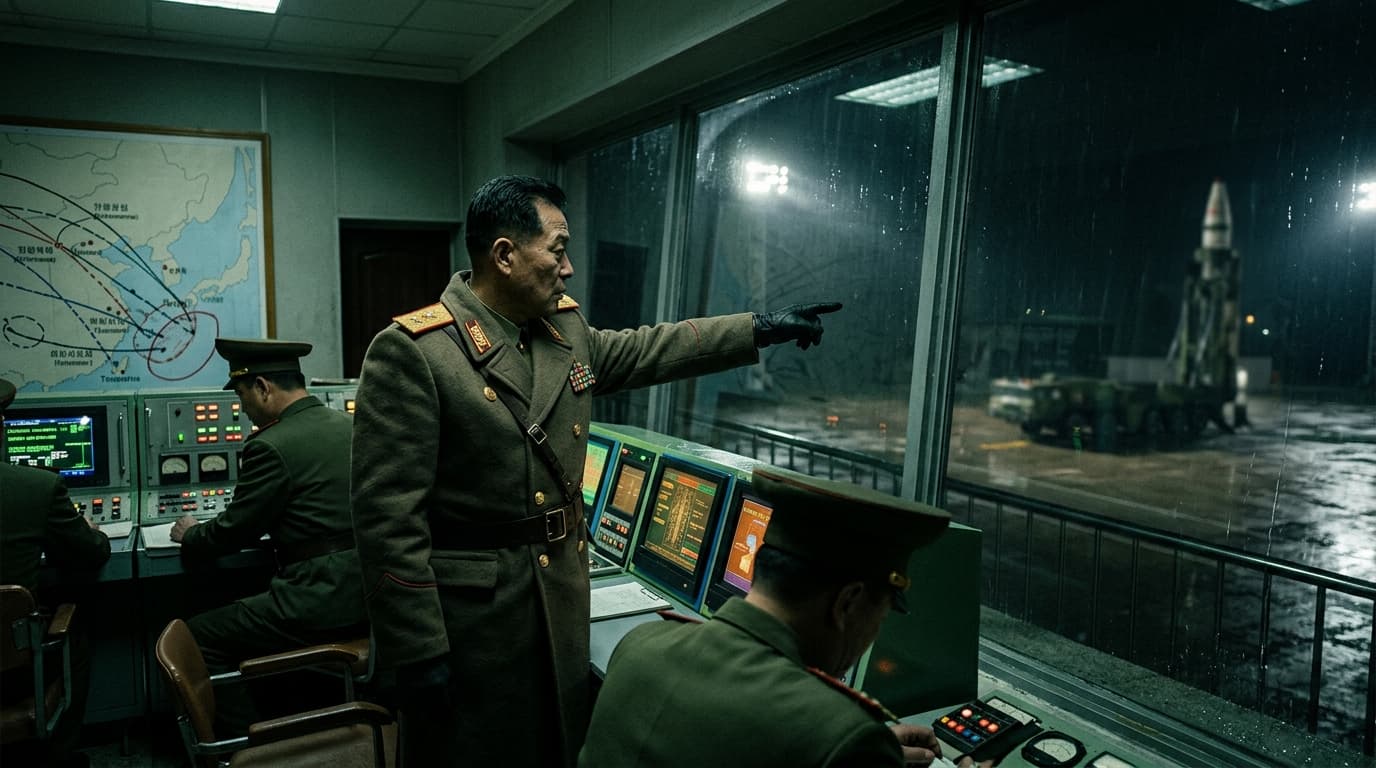
North Korea's Russia-Trained Strike Package Cracks Seoul's Missile Shield
North Korea's June 25 salvo unveiled a Russian-schooled layered strike package built to blind South Korean missile defense — just as US THAAD assets rotate out to the Middle East.
North Korea's June 25, 2026 salvo — a tactical ballistic missile, an upgraded 240mm multiple-launch rocket system and an extended-range 155mm howitzer projectile fired in what Seoul's Joint Chiefs of Staff belatedly disclosed as a single event — was not just another test. It was the first field demonstration of a Russian-schooled "layered strike package" doctrine designed to defeat the Kill Chain and Korea Air and Missile Defense (KAMD) architecture Seoul spent a decade building. The Institute for the Study of War's July 7 Korean Peninsula Update assesses that Pyongyang is deliberately diversifying launch vectors to overwhelm detection — and the timing, coming as US THAAD components rotate out of Seongju for the Middle East, hands Kim Jong Un a coercive threshold he did not previously possess.
What actually happened on June 25
The tests were unusual in two respects. First, they combined three distinct weapon classes in a compressed window — a mix Pyongyang had never previously showcased together. Al Jazeera, citing KCNA and AP wire reports, confirmed the tri-modal salvo included a "special mission" ballistic missile warhead designed to inflict "fatal damage on major targets including airfields, ports and power facilities," alongside the upgraded MLRS and the 60-kilometer-range 155mm gun-howitzer.
Second, South Korea's Joint Chiefs of Staff were late to notify the Ministry of National Defense press corps of the ballistic launch — a detection lag Seoul analysts attributed, as ISW notes, to multiple simultaneous launch vectors overwhelming the standard reporting chain. That is precisely the operational effect the diversified strike package is engineered to produce. Kim inspected the production line for the 155mm self-propelled howitzers in May, according to NPR, and ordered deployment along the southern border within the year, telling KCNA that "such a rapid extension of striking range and remarkable improvement of striking capability will provide a great change and advantage in the land operations of our army." Every element of the June 25 test is deployment-bound, not experimental.
The Ukraine template — and why it matters
The doctrinal fingerprint is Russian. ISW's own analysts explicitly link the June 25 salvo to lessons Pyongyang absorbed from Russia's strike campaigns against Ukrainian cities, which combine Iskander-class ballistics, Kh-101 cruise missiles and Shahed-136 loitering munitions in packages designed to saturate air defenses rather than defeat them individually.
The Royal United Services Institute documented the mechanism in detail. RUSI's analysis of the North Korean modernization program describes a "significantly more dangerous" force that has absorbed Russian tactics on drone-assisted artillery and is building an AI-drone manufacturing base at Panghyon Airbase — with Russia "actively supporting domestic North Korean production of Shahed/Geran-class attack drones" and supplying advanced electronic warfare systems. Kim's 2025 inspection at Panghyon and his personal directive calling AI drone integration a "top-priority task" signal, RUSI notes, that the KPA is now organizing itself around this hybrid strike model.
Ukrainian military intelligence chief Kyrylo Budanov confirmed the drone-transfer arrangement in June 2025 statements cited in the Council on Foreign Relations' updated tracker on North Korean support to Russia, which notes Russia has provided Pyongyang with "air defense equipment, anti-aircraft missiles, and advanced electronic warfare systems" in exchange for 12 million-plus artillery shells and short-range ballistic missiles used against Ukraine. South Korea's Defense Intelligence Agency, per CFR, estimated in July 2025 that North Korean shells now supply roughly half of the artillery Russia expends in Ukraine — a scale of exchange that puts steady technical remuneration inside Pyongyang's grasp.
The Hudson Institute's June 2025 situation report went further, warning that Shahed-class drone inclusion in a North Korean rocket salvo "would significantly complicate South Korea's efforts to defend itself," with the newest Shahed baseline carrying 200-pound warheads — double the original — and Russian production already running 170 per day. Transferring even a fraction of that industrial base to Pyongyang would rewire the peninsula's defensive math.
The load on Seoul's Kill Chain
South Korea's Three-Axis architecture — Kill Chain (preemption), KAMD (interception), Korea Massive Punishment and Retaliation — was calibrated against a threat that fired one system at a time. The Council on Foreign Relations noted in its analysis of the revitalized Three-Axis system that North Korea began launching "multiple missiles from different sites, intending to complicate South Korea's early warning and preemptive strike capability" as early as 2022. The June 25 test operationalizes that concept across weapon classes, not merely launch sites — and CFR's authors already warned Seoul needed "boost or midcourse phase interceptors" to keep pace with advanced systems like the Hwasong-8.
The math is unforgiving. A KAMD interceptor engagement cycle assumes discrimination between ballistic threats prioritized for THAAD/Patriot PAC-3 layers and low-altitude cruise and artillery threats handled by Cheongung and the still-developing Korean Iron Dome (LAMD). A salvo arriving with all three vectors within a single detection window forces defenders to allocate scarce interceptors against ambiguous tracks — the same over-saturation problem Ukrainian air defenses face nightly, where roughly 20% of Shahed drones penetrate even a mature defensive net.
The THAAD problem — and the coincidence that isn't
The June 25 test lands at an inflection point in the alliance's defensive posture. The BBC reported that the United States began relocating components of the THAAD battery at Seongju to the Middle East during the June 2025 US-Israeli war against Iran — a redeployment President Lee Jae-myung publicly acknowledged Seoul had "expressed opposition" to, while conceding "the reality is that we cannot fully push through our position." South Korean media, per the BBC, reported launchers being physically transported out of the Seongju airbase.
That gap in the upper-tier interceptor layer is precisely where a quasi-ballistic KN-23 salvo becomes hardest to defeat. The correlation of Pyongyang's diversification push with Washington's THAAD drawdown is not coincidental — it is the operational logic of the Russia-Iran-North Korea alignment the Heritage Foundation has warned about, in which each partner's opportunistic pressure creates windows for the others. Heritage's Robert Peters flagged specifically the risk that Russia could enable Pyongyang to "launch large quantities of maneuverable cruise missiles to overwhelm U.S. and South Korean missile defenses" — a scenario the June 25 salvo brought a measurable step closer.
South Korea is not standing still. Al Jazeera reported that Defense Minister Ahn Gyu-back announced on June 26 — one day after the North's salvo — a plan to train 500,000 "drone warriors" capable of using drones "like personal firearms," while President Lee unveiled a $650 million push to build five defense-tech firms by 2030. Ahn stated explicitly that Pyongyang was receiving technological assistance from Russia. Yet building a counter-drone force at scale takes years; the strike package exists now.
The naval second front
ISW's July 7 update also confirmed North Korea plans to commission its second Choe Hyon-class destroyer, the Kang Kon, by September 2026 after July 3 tests of its "strategic" cruise missile launch capability. Al Jazeera reported in March that Kim called the sea-to-surface cruise missile a core element of the destroyer's capabilities and declared the arming of the navy with nuclear weapons was "making satisfactory progress."
The naval trajectory is steepening. Kim ordered his navy to build a 10,000-tonne destroyer and develop secret underwater weapons ahead of Xi Jinping's visit, per Al Jazeera — the first time Pyongyang has publicly announced a warship of that class. Hong Min of South Korea's Institute for National Unification told Reuters, per the same report, that the announcement marked a qualitative shift in ambition. A two-coast green-water fleet — even one whose logistics and sensor suite lag its hull count — introduces a maritime cruise missile axis that KAMD was not designed to defeat from the sea.
The primary-document baseline
The UN's own political affairs chief, Under-Secretary-General Rosemary DiCarlo, briefed the Security Council on April 30, 2026 that Pyongyang's Ninth Party Congress had unveiled a 2026-2030 Five-Year Military Development Plan committing to "new secret arsenals and special strategic assets" including "the ICBM complexes of ground and underwater launching." DiCarlo confirmed the DPRK had tested ballistic missiles equipped with "cluster bomb and fragmentation mine warheads" and warned, citing the IAEA Director General, of a "very serious increase" in fissile material production capacity at Yongbyon.
The UN Special Rapporteur's report A/80/149 documents that DPRK troop deployments to Kursk have been remunerated, per external estimates, "in exchange for oil and technology related to North Korea's nuclear and weapons and missile programmes" — with Russia allegedly paying roughly $2,000 per soldier. That payment channel is the mechanism through which Russian technical assistance flows back to Pyongyang.
The sanctions monitoring architecture that would normally constrain this has broken. Russia vetoed renewal of the UN Panel of Experts in March 2024. The successor Multilateral Sanctions Monitoring Team — a coalition of the US, ROK, Japan, UK, France and six other states — published its second report in October 2025 on DPRK cyber and IT-worker sanctions evasion, but has no enforcement mandate. As UIP reported on July 6,
North Korea is exploiting that collapse, along with Xi Jinping's refusal to mention denuclearization at the June PRC-DPRK summit, to "harden its status as a nuclear-armed state."
Key Takeaways
- The June 25 salvo is the first operational demonstration of Pyongyang's Russia-schooled layered strike package doctrine.
- The delayed ROK JCS notification suggests the mixed-vector tactic is already degrading Seoul's launch-detection reporting chain.
- Russian technical assistance — funded by North Korean shell and troop supply to the Ukraine war — is the enabling variable.
- THAAD components rotating from Seongju to the Middle East widens the upper-tier interceptor gap at the worst possible moment.
- The UN sanctions enforcement architecture is functionally dead; Beijing has dropped denuclearization from its stated agenda.
What to watch next
- September 2026: Planned commissioning of the destroyer Kang Kon — watch for a nuclear-capable cruise missile declaration.
- UNGA opening, September 2026: Whether the MSMT publishes a third report naming Russian technology transfers explicitly.
- US-ROK Security Consultative Meeting (fall 2026): Whether Washington backfills the THAAD gap or accepts a permanent drawdown.
Diplomat View
The June 25 test is best read not as an escalation but as a capability crossover. Pyongyang has moved from demonstrating weapons to integrating them into doctrine — and the doctrine is Russian. The decisive actor here is not Kim Jong Un but Vladimir Putin, whose Kursk-front dependence on North Korean shells has made technical remuneration a strategic obligation rather than a favor. That flips the peninsula's threat curve from linear to compounding.
The falsifiable call: if Seoul detects a North Korean long-range one-way attack drone strike test — the missing ingredient in the Ukraine template — before year-end 2026, the peninsula has crossed into a new deterrence regime, one in which Kim can credibly threaten Seoul's infrastructure without resorting to nuclear signaling. What would revise the forecast downward: a genuine Russian technology cutoff (unlikely while the Ukraine war continues), or a THAAD backfill announcement at the fall SCM. Neither is currently on the table. The Korean Peninsula file has quietly become the Indo-Pacific's most under-priced escalation risk.
Discover more

US Politics
SNAP Food Assistance Faces Legal Challenges
In 2026, SNAP faces stricter eligibility rules and mounting legal challenges, threatening food assistance for the millions of Americans who rely on the program.

US Politics
House Ethics Committee Pushes Sexual Miscond.
The House Ethics Committee has shifted responsibility for sexual harassment settlement records to the Office of Congressional Workplace Rights, complicating disclosure efforts.
India
700 Activists Accuse PM Modi of MCC Breach
Over 700 activists allege PM Modi breached election code with a televised address attacking opposition parties just before state elections.

Conflict & Security
Drone Warfare Killing Aid Workers at Unprec
Over 1,000 humanitarian workers killed in three years as cheap armed drones collapse legal protections. Gaza, Sudan, Ukraine, and DRC see deliberate targeting of aid convoys and hospitals with zero prosecutions.