North Kivu Malaria Exclusion Tests Global
MSF warns millions in M23-controlled North Kivu will lose Global Fund malaria support for 2027–2029.
Model Diplomat8 min readAfrica
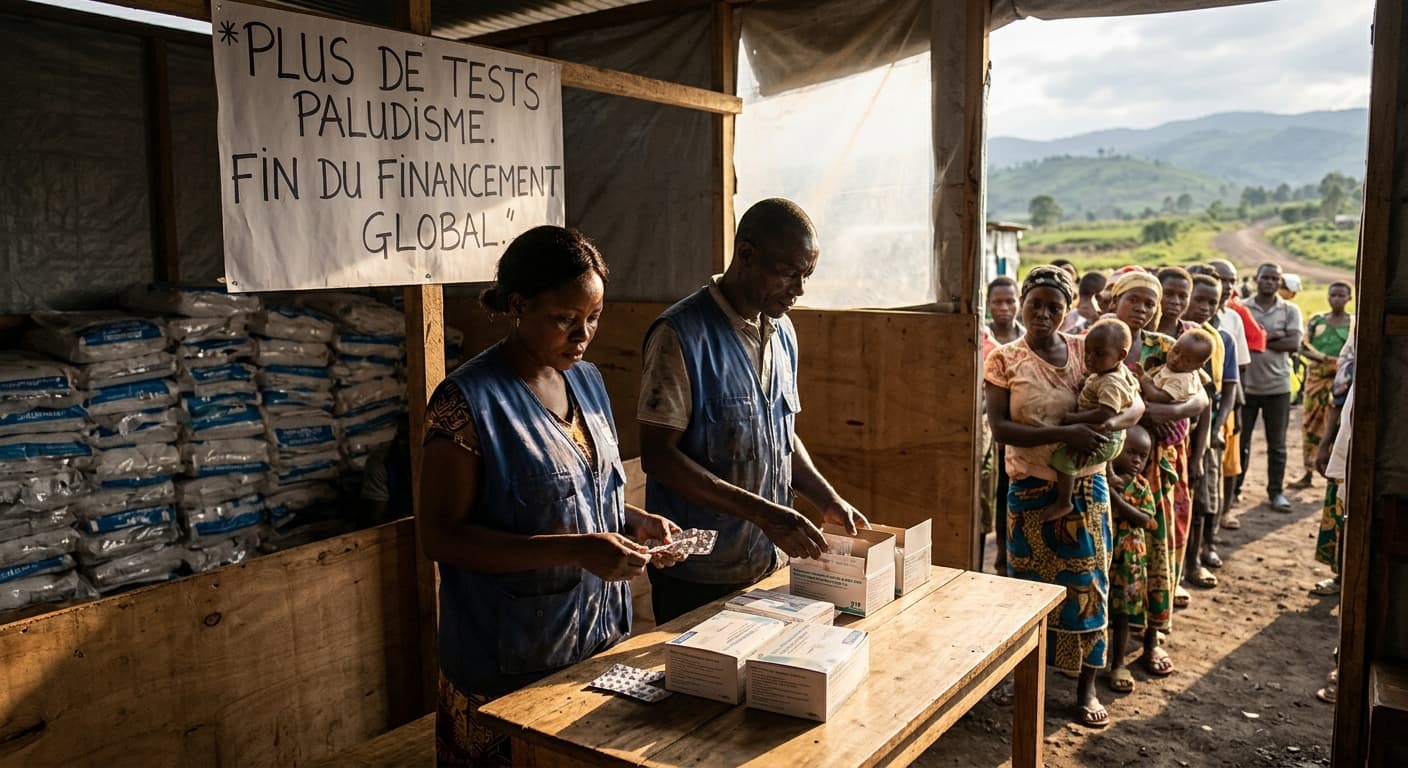
North Kivu's Malaria Exclusion Tests the Global Fund's Conflict Pledge
Médecins Sans Frontières warns that the Global Fund's next malaria funding cycle will skip North Kivu — a province of millions under M23 rebel control — exposing a structural flaw in how multilateral health finance handles territory that governments no longer govern.
On July 16, 2026, Médecins Sans Frontières publicly warned that North Kivu — a province largely controlled by the AFC/M23 armed group since January 2025 — will be excluded from the Global Fund's Grant Cycle 8 malaria funding priorities for 2027–2029, a decision that leaves millions in one of the world's highest-burden malaria zones without international support for a preventable, treatable disease. The exclusion is not a technical oversight but a structural consequence of an allocation architecture that routes through Kinshasa, where the Country Coordinating Mechanism — the national body that submits Global Fund applications — has no operational reach into territory held by a Rwanda-backed insurgency it does not recognize. The result is a population punished for its geography: malaria accounts for 48 to 58 percent of consultations in three MSF-supported health zones alone, yet the province is being dropped from the very funding stream designed for settings exactly like this one.
The funding gap by the numbers
The data MSF has compiled from its own field operations in North Kivu paints a picture of a health system already collapsing before the exclusion takes effect. In 2025, across the three health zones of Bambo, Kibirizi, and Rutshuru — where MSF works alongside Ministry of Health facilities — over 255,000 uncomplicated malaria cases and more than 26,000 severe cases were treated by MSF, the Ministry, and partners combined. Of those, MSF alone treated over 165,560 cases, supplying 53 percent of all treatments for uncomplicated malaria and 35 percent of treatments for severe malaria in these zones. MSF has called this level of substitution "unsustainable in terms of long-term prevention and control."
The deterioration is measurable. No mosquito net distribution has occurred in Global Fund-supported areas of North Kivu since June 2023. Between July and December 2025, no malaria control supplies reached the province at all, due to access constraints. MSF was forced to purchase and supply treatments and screening tests to fill gaps in health centres — a role the Global Fund was designed to play, not an emergency medical NGO already stretched by concurrent outbreaks of Ebola, mpox, measles, and cholera across eastern DRC.
The national and global context compounds the severity. The DRC accounts for 12.6 percent of all estimated malaria cases worldwide and 11.3 percent of malaria deaths, second only to Nigeria, according to the WHO World Malaria Report 2024. The country reported an estimated 33.1 million cases and 67,464 deaths in 2023, and cases rose by approximately 600,000 between 2022 and 2023 alone. North Kivu, with its displaced populations sheltering in forested areas where malaria exposure is high and healthcare access is minimal, sits at the extreme edge of this burden.
Why the exclusion is happening — and who benefits
The Global Fund's allocation process works through a Country Coordinating Mechanism, a national body that conducts "country dialogue," develops funding requests, and submits them for review by the Technical Review Panel. The Global Fund's own guidance states that Full Review Applications reference national strategic plans and are assessed on alignment with country priorities. In the DRC, that mechanism is headquartered in Kinshasa and operates through the Ministry of Health's provincial inspection system — a structure that has functioned, at best, intermittently in North Kivu since M23 captured Goma on January 27, 2025.
The political dynamic is straightforward. Kinshasa does not recognize the M23's parallel administration and has severed banking, administrative, and salary channels to territory under rebel control. Al Jazeera reported that banks in Goma have remained closed for over a year, with Congolese Communications Minister Patrick Muyaya stating that no bank can legally operate in a region controlled by a US-sanctioned armed group. The
UN Security Council documented in late 2025 that AFC/M23 has established its own economic regulatory body, an inspectorate-general of governance, and a parallel justice system with 378 appointed magistrates. The
UN reported in March 2025 that the group had appointed governors and financial officials in both North and South Kivu — a "parallel administration" that Kinshasa has condemned and refuses to engage.
In this environment, the CCM in Kinshasa faces both a practical and a political incentive to deprioritize North Kivu. Practically, it cannot guarantee implementation, procurement delivery, or monitoring in territory it does not control. Politically, including a province run by an insurgency seeking regime change would require acknowledging the de facto authority of a group the government is still fighting. The winners are the provinces Kinshasa still controls, which will absorb North Kivu's share of the allocation. The losers are roughly 4 million people in North Kivu who, according to WHO, were already facing vaccine stockouts and a public health system "on the brink of collapse" before the malaria exclusion was announced.
The policy contradiction
The Global Fund's own Challenging Operating Environments policy explicitly addresses this scenario. The COE policy states that one-third of Global Fund investments target countries or regions experiencing "armed conflicts or civil unrest, natural disasters and climate change-related crises, and/or mass displacement." The policy directs country dialogue to extend beyond traditional stakeholders to include humanitarian organizations and protection cluster actors who can assess risk and plan delivery in inaccessible areas. It offers specific flexibilities: Results-based Contracting with humanitarian organizations to deliver commodities, emergency reprogramming, and context-specific delivery mechanisms for hard-to-reach populations.
None of these flexibilities appear to have been activated for North Kivu's malaria program. The Global Fund's OIG report dated January 2026 reviewed the Fund's work in high-risk, conflict-affected settings and found that "agile, adaptive programming" — including emergency reprogramming, mobile clinics, and partnerships with humanitarian actors — had enabled program continuity in insecure contexts from 2014 to 2023. The report called for better alignment of grant objectives to country context and more strategic use of policy flexibilities. The exclusion of North Kivu from GC8 malaria priorities runs directly counter to both the letter and the spirit of these findings.
An academic analysis of the Global Fund's Technical Review Panel, published in PubMed, found that proposals from fragile states were as likely to be recommended as those from non-fragile states and that resulting grants performed equally well — with one exception: lower performance for HIV/AIDS grants in fragile settings. Malaria grants in fragile states showed no such deficit. The evidence base for excluding a high-burden province on conflict grounds is, at best, thin.
The Ebola collision
The timing of the exclusion is especially dangerous because North Kivu is simultaneously confronting an Ebola outbreak. WHO warned in May 2026 of a "catastrophic collision of disease and conflict" as the outbreak, centered in Ituri, spread to 11 health zones including Butembo and Goma in North Kivu. By July 6, 2026,
Al Jazeera reported that the Ebola death toll had surpassed 500, with North Kivu recording a mortality rate of 57.4 percent — significantly higher than the outbreak average.
MSF's warning highlights a specific clinical danger: the similarity between early malaria and Ebola symptoms complicates diagnosis and delays appropriate treatment. When malaria is untreated or under-treated, patients present with fevers that trigger Ebola suspicion, overwhelming isolation and testing infrastructure. Every additional malaria case in an Ebola-affected zone is a potential false alarm that consumes surveillance resources. Defunding malaria control in North Kivu does not just cost malaria lives — it directly undermines Ebola containment. The WHO's DRC health emergency appeal already documented that the eastern provinces were the most affected by violence and displacement, with over 6.4 million internally displaced people — the second-largest displacement crisis globally after Sudan.
The broader donor retreat
The Global Fund's own replenishment has contracted sharply. Human Rights Watch reported in January 2026 that only $11.85 billion had been pledged for 2026–2028 against an urgently needed $18 billion. The United States reduced its pledge from $6 billion to $4.6 billion; Japan cut its pledge by more than half; Germany by more than a quarter. France and the European Commission made no concrete financial commitments at the November 2025 replenishment summit in Johannesburg. The
WHO and WFP warned in March 2025 that the DRC was among the countries most affected by US aid cuts, with USAID previously funding 70 percent of humanitarian assistance in eastern DRC before the January 2025 suspension.
In this contracting environment, the Global Fund's allocation decisions carry more weight, not less — every province excluded represents a gap no other donor is positioned to fill. Policy Options noted in June 2026 that the DRC's current Ebola crisis is "partly the predictable result of cuts to international aid" and that "health facilities have closed overnight, stocks of essential medicines have run out quickly, and disease surveillance systems have been weakened." The malaria exclusion accelerates this pattern.
What to watch
- July 27, 2026 — GC8 Window 2 funding request deadline. This is the last realistic opportunity for the DRC's CCM to submit a malaria application that includes North Kivu before the Technical Review Panel's August 24–September 5 assessment window. If the exclusion stands through this date, North Kivu will likely go without Global Fund malaria support for the entire 2027–2029 cycle.
- Global Fund Technical Review Panel, August–September 2026 — The TRP can request revisions to funding requests and flag gaps in geographic coverage. Whether it challenges the omission of a high-burden province will test the panel's independent oversight function.
- Ebola containment trajectory in North Kivu, July–August 2026 — The interaction between untreated malaria and Ebola surveillance will worsen if mosquito net distribution, diagnostic supplies, and treatment stocks remain absent. The 57.4 percent Ebola mortality rate in North Kivu, already the highest in the outbreak, is a leading indicator of what happens when multiple disease responses collapse simultaneously.
The Bottom Line
The Global Fund's exclusion of North Kivu from its next malaria funding cycle is a test case for whether multilateral health finance can serve populations in territories their own government no longer controls. The Fund's own Challenging Operating Environments policy — built for exactly this scenario — offers flexibilities that have not been activated. If the exclusion holds, the precedent extends far beyond eastern Congo: any province under armed group control becomes structurally un-fundable through an architecture designed to work through recognized states. The people who lose are the 4 million in North Kivu who will continue to die of a treatable disease because they live on the wrong side of a frontline.
Discover more
Global Politics
Xi Jinping Calls China-Russia Ties 'Precious'
Xi Jinping's description of China-Russia ties as 'precious' reflects a strategic imbalance, with Beijing dictating terms in the partnership.
US Politics
US Military Strikes Drug Traffickers Pacific
A U.S. military strike in the eastern Pacific killed two amid an anti-drug trafficking campaign, raising questions over sovereignty and regional cooperation.
India
Women’s Reservation in India
India's 33% women's reservation law is enacted but won't take effect until after 2029 due to political setbacks and census delays.

Conflict & Security
Drone Warfare Killing Aid Workers at Unprec
Over 1,000 humanitarian workers killed in three years as cheap armed drones collapse legal protections. Gaza, Sudan, Ukraine, and DRC see deliberate targeting of aid convoys and hospitals with zero prosecutions.