Nigeria's Local Arms Strategy Against Jihadis
Tinubu's push for local arms amid Sahel threats
Model Diplomat7 min readAfrica
Nigeria Bets on Local Arms and Tech as Sahel Jihadists Press South
Tinubu pledges Defence Industries Corporation revival and tech-driven security as Sahel jihadists cross Nigeria's borders and the ECOWAS bloc fractures.
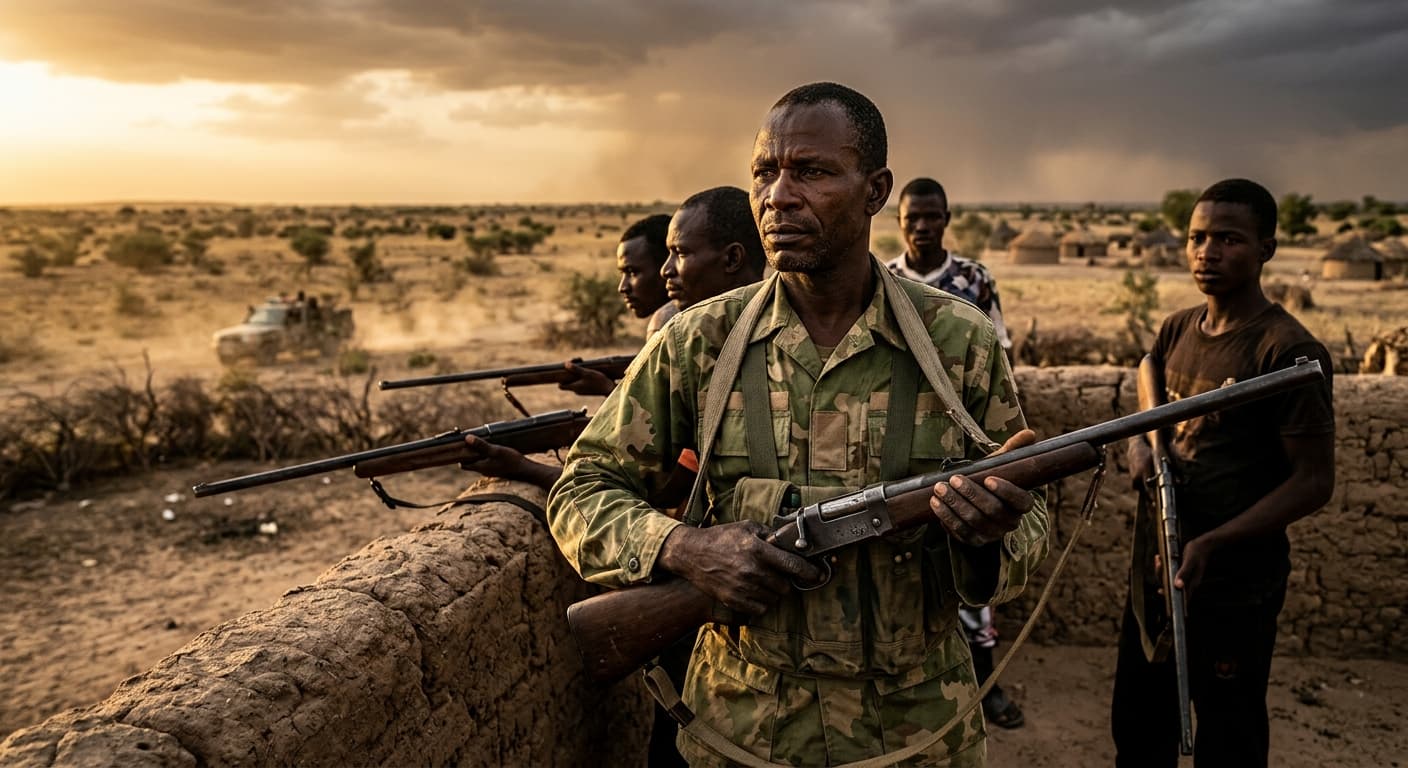
President Bola Tinubu on July 6, 2026 told Nigeria's 16-nation Africa Land Forces gathering in Port Harcourt that Abuja is pouring money into local weapons manufacture and battlefield technology to blunt a jihadist surge spilling out of the Sahel — a pivot that is less an industrial policy than an insurance policy against the collapse of Nigeria's foreign-supply chain. The bet is that a re-tooled Defence Industries Corporation of Nigeria (DICON) and Turkish-Chinese ISR gear can hold the northwest border while the region's security architecture — ECOWAS, French basing, US airpower — is being rewritten around Abuja whether it likes it or not.
The immediate news is thin: Vice President Kashim Shettima read the president's remarks at the grand finale of the 2026 Nigerian Army Day Celebration (NADCEL), where Tinubu promised to "revitalise DICON," deepen the African Land Forces Forum, and modernise the force with intelligence-driven operations, according to Independent Newspaper Nigeria. The context is not thin at all.
The Sahel threat that reframes the speech
Chief of Army Staff Lt-Gen Waidi Shaibu — appointed only in October 2025 in a Tinubu-ordered shake-up of the service chiefs, per BBC Pidgin — used the same podium to warn that "the footprints of foreign jihadists" are already on Nigerian soil, with more than 80% of army personnel now deployed across active theatres. That is not a rhetorical number. It maps onto a documented crisis on the northwestern border.
Lakurawa, a militant group affiliated with jihadist factions in Mali and Niger, killed at least 34 villagers in a single coordinated raid in Kebbi state, according to the BBC. US and Nigerian forces struck Lakurawa camps in Sokoto on Christmas Day 2025 — the first acknowledged US combat action inside Nigeria — followed by the arrival in February 2026 of 200 US personnel providing ISR, targeting and training, as the
Observer Research Foundation documented. In the northeast, ISWAP and Boko Haram are simultaneously resurgent;
Al Jazeera reported that the US-Nigerian killing of ISWAP deputy Abu-Bilal al-Minuki in May 2026 has already triggered a spike in retaliatory raids.
The regional picture behind Shaibu's warning is grim. The South African Institute of International Affairs identifies the Nigeria–Niger–Benin corridor as the new "main frontline and transit route" for Islamic State–Sahel Province fighters — a group that struck Niamey's international airport with drones in January 2026. Attacks in West Africa's coastal states have surged 250% in two years,
UN Deputy Secretary-General Amina Mohammed told African chiefs of defence at the inaugural summit Nigeria hosted in August 2025.
Why the industrial pivot, and why now
Nigeria's dependence on foreign arms is not a rhetorical flourish. SIPRI's Trends in International Arms Transfers, 2025 shows African arms imports fell 41% between 2016–20 and 2021–25 even as the continent's wars intensified — a supply constraint, not a demand collapse. Nigeria has cycled through Russian Mi-35s, Brazilian Super Tucanos, Chinese CH-4 drones and Turkish Bayraktar TB2s precisely because no single supplier is reliable, and because Western human-rights conditionality — a legacy of the 2015 US arms freeze — still shapes what Abuja can and cannot buy.
The DICON pledge is where the Bloomberg-news reader should slow down. The corporation has been "revitalised" by every Nigerian government since Muhammadu Buhari's 2015 order at the National Defence College, as Al Jazeera then reported. The 2019 launch of the DICON-built Ezugwu MRAP was hailed as proof of concept, per
BBC Pidgin. The International Crisis Group's 2016 review of Nigerian military reform concluded that DICON was a "white elephant" and recommended
winding it down in favour of an "investor-friendly environment" for private defence firms.
Tinubu's version differs on that last point. The DICON Act was amended in June 2023 to permit private-sector equity and commercial partnerships — the first legislative attempt to move Nigerian arms production out of a purely military monopoly. That is what makes the July 6 speech more than déjà vu: it is a signal to the Turkish, Emirati, South African and Pakistani firms already prospecting in Kaduna and Abuja that the political top-cover is holding.
The unspoken subtext: ECOWAS is broken, and Abuja knows it
The African Land Forces Forum that Tinubu praised is doing work that ECOWAS can no longer do. In January 2025, Mali, Burkina Faso and Niger — the three coup states — quit ECOWAS to form the Alliance of Sahel States (AES), taking the region's most jihadist-exposed territory out of the bloc's operational reach, Al Jazeera has reported. ECOWAS in February 2026 authorised a 2,000-soldier standby force by year-end. Nigeria historically supplies 75% of ECOWAS mission personnel — and Shaibu is now saying more than 80% of the Nigerian Army is already tied down at home.
That arithmetic doesn't work. If Nigeria cannot spare a brigade for a regional intervention, and if the AES has thrown its lot in with Russia's Africa Corps, then Abuja's realistic options collapse into two: outsource the fight to Washington and Ankara, or build enough capacity at home to prosecute a counter-insurgency alone. The DICON push, the US ISR partnership, and the parallel Africa Chiefs of Defence Staff Summit that Nigeria convened in Abuja in August 2025 are the same policy viewed from three angles.
The US Africa Command commander told the House Armed Services Committee in May 2026 that Washington is now pursuing "innovative security ecosystems" — airborne ISR, sensors, space-based intelligence linked by commercial satellite uplink and AI processing — with Nigeria and the Multi-National Joint Task Force as anchors, according to the prepared testimony on file with Congress. That is what "tech-driven security" translates to in practice: a data pipe from AFRICOM into a Nigerian operations centre, backstopped by local drones and MRAPs stamped "Made in Kaduna."
Who wins, who loses
The winners are legible. Turkey's Baykar, whose Akıncı and TB2 platforms Nigeria has been quietly acquiring, gains a co-production runway through amended DICON rules. The US defence and intelligence apparatus gets its "strategic anchor" in a region where French basing is gone and Russian contractors have filled the vacuum. Tinubu — who faces a 2027 re-election campaign shadowed by mass kidnappings, including school attacks in Borno and Oyo that BBC Pidgin catalogued in his May 29, 2026 anniversary broadcast — gets a security narrative to sell.
The losers are equally concrete. Russia's Rosoboronexport, whose share of African arms sales SIPRI shows has been halved since 2015–19, loses further ground in West Africa's largest defence market. The AES bloc loses the intelligence-sharing that Nigeria still routes through Multi-National Joint Task Force channels but increasingly conditions on political access. And the Nigerian civilian population in the northwest bears the cost of a hybrid strategy that, per Al Jazeera's May 2026
reporting, still leaves villages defended by "poorly armed vigilante groups" while the presidential message emphasises drones and depots.
Diplomat View
Tinubu's local-arms pledge is best read not as industrial policy but as a hedge against strategic abandonment. Nigeria has watched France ejected from Mali, Niger and Burkina Faso; watched Wagner successors fill the vacuum; watched Washington's appetite for African deployments swing with each US election cycle; and watched ECOWAS lose a third of its landmass. The rational response is capability sovereignty — enough domestic production to keep fighting when the next supply valve shuts. Whether DICON, three decades a white elephant, can deliver in the 18 months before the February 2027 vote is the falsifiable question. The forecast changes if: (1) a named private partner — likely Turkish or Emirati — breaks ground on a Kaduna co-production line by Q1 2027; (2) Nigerian forces recover Lakurawa-held ground in Sokoto/Kebbi without US kinetic support; or (3) the ECOWAS standby force deploys with a non-Nigerian lead nation, freeing Abuja's brigades. Absent those three, the "revitalisation" is another photo op.
What to watch
- August 2026: Second African Chiefs of Defence Staff Summit — the test of whether Nigeria's alternative security architecture attracts AES observers.
- End of 2026: ECOWAS deadline to mobilise its 2,000-soldier standby force; watch whether Nigeria commits a battalion or pleads domestic overstretch.
- February 25, 2027: Nigerian presidential election. Sahel-linked mass casualty events in the six weeks prior will decide whether Tinubu's security narrative survives contact with the ballot.
Key Takeaways
- Tinubu, speaking through VP Shettima on July 6, 2026, tied Nigeria's counter-terror strategy to DICON revitalisation and the African Land Forces Forum — with 16 African army chiefs in the room in Port Harcourt.
- Chief of Army Staff Waidi Shaibu confirmed more than 80% of the army is deployed and "foreign jihadist" footprints are inside Nigeria's borders.
- Lakurawa (Mali/Niger-linked), ISWAP and Boko Haram are simultaneously active; the US struck inside Nigeria on Christmas 2025 and now has 200 personnel on the ground.
- ECOWAS is fractured after the AES exit in January 2025; Nigeria's regional lead role is now shouldered by an army already overstretched at home.
- The DICON pledge is the fifth in a decade; the amended 2023 DICON Act allowing private partners is the first structural change that could make it stick.
The bottom line: Nigeria's local-arms and tech push is not about industrial pride — it is Abuja preparing for a Sahel in which no external partner is reliable, ECOWAS cannot deploy, and the next jihadist wave reaches Kebbi before the ballots are counted. If DICON can hand a Nigerian brigade a domestically-made drone and MRAP by early 2027, Tinubu's bet pays. If not, the northwest border becomes the campaign issue that decides his presidency.
Discover more
US Politics
House Ethics Committee Pushes Sexual Miscond.
The House Ethics Committee has shifted responsibility for sexual harassment settlement records to the Office of Congressional Workplace Rights, complicating disclosure efforts.

US Politics
SNAP Food Assistance Faces Legal Challenges
In 2026, SNAP faces stricter eligibility rules and mounting legal challenges, threatening food assistance for the millions of Americans who rely on the program.
US Politics
Congress Targets AI Chatbot Access for Terror
The House passed the Generative AI Terrorism Risk Assessment Act, focusing on AI's role in terrorism and potential surveillance implications.
Conflict & Security
Guatemala: El Niño 2026–27 becomes regional security test
UNICEF: 25.8M children face El Niño risks in Latin America; Guatemala maps 188 municipalities for drought and food insecurity amid regional security test.