New Zealand's Warning on China's Pacific Ambi
NZ's report highlights China's military operations in the Pacific.
Model Diplomat3 min readPacific
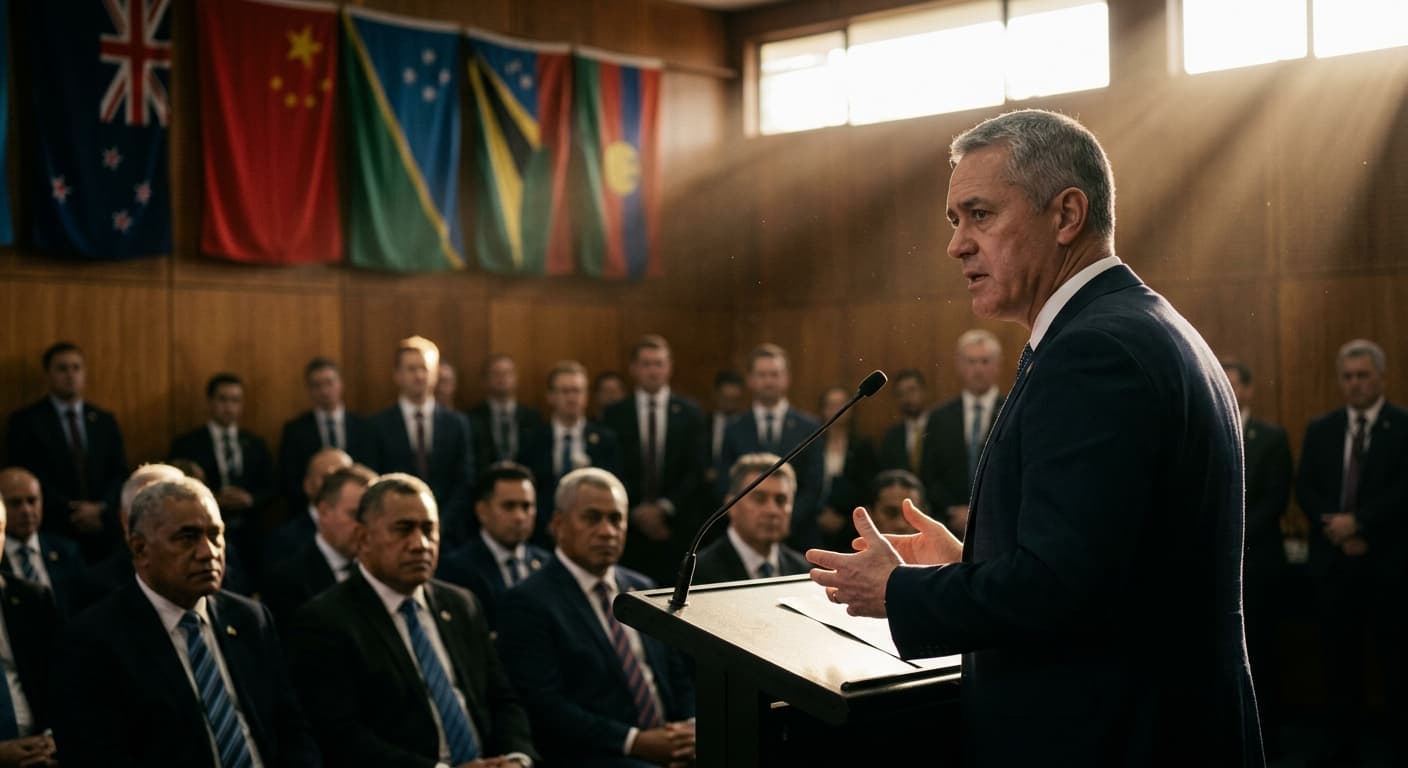
Wellington's Warning: NZ Details China's Pacific Reach
New Zealand's internal report catalogs unprecedented Chinese military operations, signaling a shift from remote advantage to direct strategic exposure
New Zealand is releasing warnings about Chinese military activity across the Pacific based on an internal assessment, marking a significant escalation in official acknowledgment of Beijing's far-seas operations. This comes after months of unprecedented Chinese naval operations—including
the February 2025 Tasman Sea exercises that forced more than 50 commercial flights to divert, the circumnavigation of Australia, and a hydrographic survey vessel operating south of Australia.
The thrust of Wellington's assessment is direct: China has moved from constrained far-seas presence to normalized, high-end military operations in waters adjacent to New Zealand's core interests. The Tasman Sea exercises, conducted with minimal notification, were not incidents—they were demonstrations, deliberately positioned to test both the diplomatic response and the operative readiness of Australia and New Zealand in a region increasingly distant from US focus.
The Pattern: From Anomaly to Routine
What marks the shift is not individual incidents but synchronized messaging through military hardware. In February 2025, a three-ship People's Liberation Army Navy task group—a Type 055 cruiser, frigate, and supply vessel—transited the Tasman Sea and conducted live-fire exercises. Days earlier, and without consultation, the Cook Islands signed a Comprehensive Strategic Partnership with Beijing covering infrastructure, deep-sea mining, and what Wellington feared were security-adjacent arrangements made opaque by design.
The Australian Defence establishment was equally blunt. According to the Office of National Intelligence director general, the exercises were "intended to be provocative" and designed to "establish a sense of normalcy" around Chinese military operations this far from home ports. That framing—making the unprecedented routine—is the strategic target, not a byproduct.
For New Zealand, the jolt was personal. Cook Islands Prime Minister Mark Brown, operating in what he considered an independent prerogative, had simply not consulted Wellington. That opacity, combined with China's operational reach into the Tasman, exposed a hard fact: New Zealand's historic geographic remoteness no longer provides buffer. As Defence Minister Judith Collins stated at the time, "our distance means little to nothing and people need to realize we cannot do anything just by ourselves."
Wellington's Response: Doubling Down on Alignment
The internal report reflects policy already in motion. New Zealand's 2025 Defence Capability Plan (released April 2026) commits to near-doubling defense spending from 1% to 2% of GDP, with explicit focus on China as the primary regional threat. Wellington signed a
Status of Visiting Forces Agreement with the Philippines, easing the way for deeper South China Sea operations. It has deployed vessels through the Taiwan Strait and suspended funding to the Cook Islands until Prime Minister Brown accepted a defense declaration in April 2026 affirming that Wellington is "the partner of choice" on security matters.
This is a breaking of New Zealand's traditional balancing act. For decades, Wellington maintained careful distance from great-power contestation, allowing it to manage relations with both the U.S. and China as its largest trading partner. Now, China's ambassador has warned that closer ties to U.S.-led initiatives like AUKUS would have "inevitable" consequences for the bilateral relationship—a message Beijing underscores through Tasman Sea operations.
What to Watch
The report is a documentation, not a reversal. Wellington will continue the hardware build-out and alliance tightening already announced. The immediate pressure point is whether New Zealand's moves to isolate Chinese influence in the Pacific—through defense agreements and funding conditions on Cook Islands aid—will hold or fragment under economic pressure. China remains New Zealand's largest trading partner, a leverage point Beijing has not yet weaponized directly but holds in reserve. Watch for any reciprocal trade friction or state-directed economic flows redirecting from New Zealand to competing partners. The second decision is the shape of AUKUS participation: joining Pillar 2 (the newer, technology and capability-sharing track) formally would signal full strategic realignment and likely trigger Chinese pressure on trade. That decision sits with Prime Minister Christopher Luxon and will likely track any visible U.S. commitment to Pacific defense.
Discover more
Global Politics
Xi Jinping Calls China-Russia Ties 'Precious'
Xi Jinping's description of China-Russia ties as 'precious' reflects a strategic imbalance, with Beijing dictating terms in the partnership.

International Relations
Pakistan's Key Role in US-Israel-Iran Meddle
Pakistan is seeking to mediate the US-Israel-Iran conflict, balancing high-stakes diplomacy against severe economic pressures and steep regional challenges.
Global Politics
Trump's Conflicting Messages on Iran War
Trump's mixed messages on Iran reflect a strategy of audience management, benefiting Tehran amid a complex geopolitical landscape.

Conflict & Security
Drone Warfare Killing Aid Workers at Unprec
Over 1,000 humanitarian workers killed in three years as cheap armed drones collapse legal protections. Gaza, Sudan, Ukraine, and DRC see deliberate targeting of aid convoys and hospitals with zero prosecutions.