New York's Data Center Freeze Is a Ratepayer
New York halts hyperscale data center construction to protect ratepayers from rising electricity costs.
Model Diplomat9 min readNorth America
New York's Data Center Freeze Is Really a Ratepayer Revolt
New York became the first state to halt new hyperscale data center construction on July 14, 2026. The move targets electricity bills, not AI, and hands utility regulators the decisive choke point in the infrastructure fight.
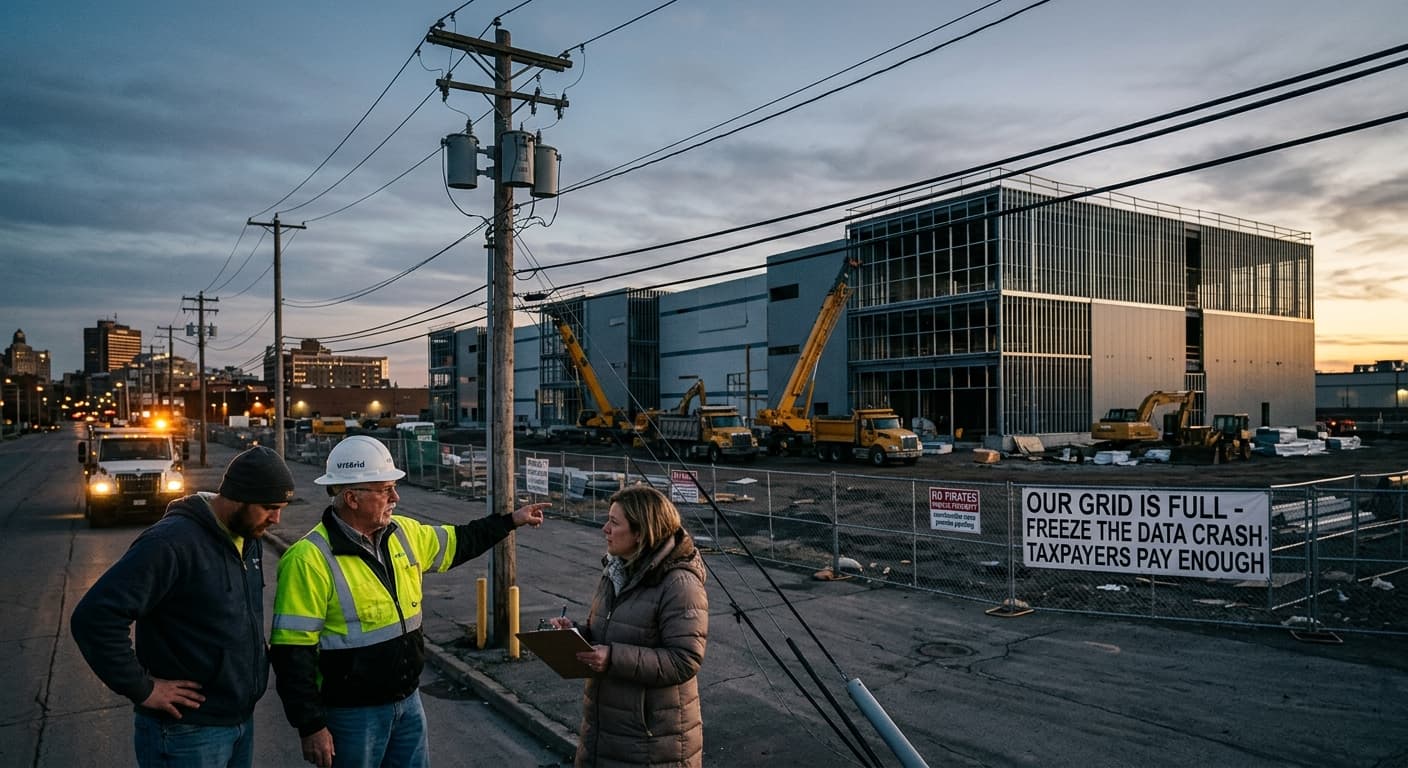
On July 14, 2026, Governor Kathy Hochul signed an executive order freezing new building permits for hyperscale data centers in New York for up to one year, the first statewide construction pause of its kind in the country. The order covers facilities drawing 50 megawatts or more and leaves already-permitted projects untouched. But the freeze is not really about artificial intelligence. Its real target is the electric bill, and the lever is the grid — which makes New York's Department of Public Service, not any AI safety body, the state's most consequential tech regulator. The 133 data centers already operating in the state are unaffected, which means the order protects incumbents while the state builds a framework that will determine who pays for the next wave of infrastructure.
What the Order Actually Does
The executive order pauses issuance of new discretionary environmental permits for any data center project sized at 50 megawatts or more — the threshold defining "hyperscale" facilities used for AI training and inference. Typical hyperscale centers draw 100 to 300 megawatts, enough to power a city of roughly 750,000 people, Al Jazeera reported.
The freeze runs up to one year and comes with three cost-shifting measures. Developers must pay more for power, contribute to grid upgrades through a proposed Grid Acceleration Fund administered by the Department of Public Service, and provide their own generation or invest in clean energy. Hochul is also pursuing legislation to repeal sales tax exemptions for hyperscale facilities, according to Politico, as cited by CNET.
One specific project caught by the pause is a massive planned facility in the town of Alabama in western New York, which drew sustained community opposition, NPR reported. The language is pointed. "As data center development threatens to hike up utility bills, deplete our natural resources, and create uncertainty for New Yorkers, it's my responsibility to take action and lead," Hochul said in a press release.
The framing matters. The order does not condition resumption on AI safety rules. Resumption depends on grid and ratepayer protections. The Department of Public Service (New York's utility regulator) is tasked with building the framework that lifts the freeze. Control of the pause therefore sits with the agency that sets electric rates, not with any body overseeing algorithms. This is the order's most consequential feature, and it is the model most likely to replicate.
The Ratepayer Math That Forced Hochul's Hand
The pressure behind the order is not philosophical. It is a pricing crisis driven by data center load growth across the Eastern Interconnection.
In the PJM grid region, which serves 65 million people across 13 states, power supply costs jumped from $2.2 billion to $14.7 billion in a single year, with data centers accounting for nearly two-thirds of the increase, Brookings reported. Residential electricity rates nationally rose about 32% between July 2020 and July 2025. In Northern Virginia's Loudoun County, the world's largest data center cluster, wholesale electricity costs rose as much as 267% near data center corridors,
Bloomberg found, as reported by the BBC.
Virginia's PJM capacity auction for 2025/2026 saw costs hit $14.7 billion, with prices in some zones rising more than fourteen-fold, according to research from the Belfer Center at Harvard Kennedy School. One estimate from energy economists at the National Bureau of Economic Research puts gross external damages from U.S. data center electricity consumption at roughly $25 billion annually, with Texas and Virginia accounting for 30% of the national total,
an NBER working paper found.
The health literature is starker. A peer-reviewed study estimated that backup diesel generators at Virginia data centers could cause approximately 14,000 asthma symptom cases and 13 to 19 deaths each year, with a total annual public health burden of $220 to $300 million, research published via arXiv found.
New York's grid operator, NYISO, shares the same regional pressures. During the July 2026 heatwave, PJM asked the U.S. Department of Energy to order data centers to switch to backup generators within 15 minutes of an emergency alert, Al Jazeera reported. FERC in June 2026 issued show-cause orders to six grid operators, including PJM and NYISO, directing them to prove their tariffs protect ratepayers from data center-driven cost shifts within 60 days,
the Center for Strategic and International Studies analyzed. Only 20% of FERC's criteria were plausibly met.
"Data center buildout is shifting from an engineering-and-real-estate problem to a political-economy problem: who gets power, who pays for upgrades, and who tolerates the local impacts." — JPMorgan note, June 2026,
cited by AEI
Why Utility Regulators Hold the Choke Point
The second-order effect of New York's order is that it reframes who governs AI infrastructure. The decisive regulator is not a technology oversight body — it is the utility commission that controls interconnection, rate design, and grid upgrades.
This has a historical parallel. In the 1970s, state-level utility regulators effectively slowed the nuclear power industry not by banning reactors but by conditioning permits on ratepayer protections, emergency planning, and waste disposal frameworks. The technical question was always secondary to the financial one. New York's data center moratorium follows the same logic: it does not regulate AI models, it regulates the grid connection that makes AI physically possible. Any state with a public service commission can replicate this approach without passing a single AI-specific law.
Hochul's order also protects the 133 data centers already operating in New York. Existing facilities and already-permitted projects are exempt. This creates a two-tier market: incumbents face no new barriers, while new entrants, and the communities considering them, must wait for a framework the Department of Public Service has up to a year to build. Developers without permits and rural areas like the town of Alabama lose near-term tax revenue. Ratepayers, incumbent operators, and the regulatory agency whose mandate just expanded are the winners.
The progressive flank wants more. The New York City chapter of the Sunrise Movement and allied left-wing organizations posted: "The dream isn't better data centers. The dream is no data centers at all," as Heatmap News noted, cited by AEI. State Senator Kristen Gonzalez, who authored a legislative moratorium bill, stood with Hochul at the Brooklyn signing. A separate legislative bill proposing a tougher moratorium is awaiting the governor's action,
NPR reported.
The industry response was measured. Tech:NYC, which represents Meta and Google among others, said it welcomed what it called the governor's "thoughtful approach" to examining energy demand and community impacts, while warning that a pause would hurt the state's economy by driving needed investment elsewhere, NPR reported.
The Federalist Collision
The New York order lands inside a fragmented regulatory landscape where Washington is moving in the opposite direction — toward faster interconnection, not slower.
Senator Ed Markey released a discussion draft of the Protecting Communities from Data Center Impacts Act on July 13, 2026, a day before Hochul's order, Markey's office announced. It would require federal certificates before permitting and construction. Meanwhile, Senator Bernie Sanders and Representative Alexandria Ocasio-Cortez introduced the AI Data Center Moratorium Act on March 25, 2026, a federal pause conditioned on AI safety laws — including product review, worker protections, and a ban on subsidies,
Congress.gov shows. GovTrack gives it a 2% chance of enactment.
The Trump administration has explicitly pushed in the other direction. A December 2025 executive order directs the FCC to consider a reporting standard "with the goal of preempting state laws," Carnegie analysis noted. The DOE directed FERC to hasten large-load interconnection. In March 2026, seven major hyperscalers — Amazon, Google, Meta, Microsoft, OpenAI, Oracle, and xAI — signed a voluntary "Ratepayer Protection Pledge,"
Brookings documented. Whether voluntary pledges hold without statutory enforcement remains an open question.
The patchwork is real. The National Conference of State Legislatures counts 15 states with moratorium bills filed in 2026; only Maine and New York passed them. Maine's Governor Janet Mills vetoed her state's moratorium in April, citing a carve-out needed for a town that lost a paper mill, NPR reported. Virginia, with the world's largest data center concentration, is moving toward a new energy-use tax rather than a pause. Texas Governor Greg Abbott called for a ban on data centers in rural areas. Roughly 300 data center bills were filed across 30 states in the first six weeks of 2026 alone,
Brookings found.
The local opposition is accelerating faster than state action. At least 48 data center projects representing $156 billion in potential investment were blocked or stalled by local opposition in 2025, Brookings reported. In the first three months of 2026, 75 projects worth $130 billion were blocked or delayed — roughly the same volume as all of 2025 compressed into one quarter,
Brookings analysis found. Utah saw a state senator who supported a Kevin O'Leary-backed data center lose his seat in a June primary. Festus, Missouri, ousted four city council members over support for a $6 billion data center.
The polling explains the speed. A May 2026 Gallup poll found that 71% of Americans oppose data center construction in their local communities — more than oppose new nuclear power plants nearby. A June Reuters/Ipsos poll found only 14% of Americans would be comfortable with a data center near them, as Al Jazeera reported. This cuts across party lines. Republican Josh Hawley and Democrat Elizabeth Warren have both warned about concentrated tech power,
Brookings noted. Hochul, up for re-election in November, leads Republican Bruce Blakeman 52 to 32 in a recent Siena poll — and she took the lead on slowing data centers down.
Winners and Losers
The immediate losers are hyperscale developers without permits and the rural towns that wanted their tax revenue. The town of Alabama, New York, loses a project that might have been one of its largest taxpayers. Colocation firms — which lease server space to remote tenants — face a less direct hit because the 50-megawatt threshold captures mostly hyperscale facilities. But Brookings research found that colocation facilities generate the smallest employment benefits while consuming the largest share of state incentives relative to private investment (62% for colocation versus 2% for hyperscale), meaning any regulatory tightening that captures them disproportionately wastes subsidy dollars.
The immediate winners are New York ratepayers, who avoid bearing the cost of grid upgrades for facilities that benefit out-of-state AI companies. The Department of Public Service gains jurisdictional reach. And incumbent data center operators in New York — those 133 already running — face no new barriers while potential competitors sit on the sidelines.
The longer-term winner is the model itself. If other states adopt utility-regulator-led pauses rather than AI-safety-conditioned ones, the regulatory framework that emerges will be shaped by energy economics, not algorithmic risk. New York already passed the RAISE Act, a frontier AI safety law harmonized with California's SB-53, Carnegie analysis documented. That law governs model deployment. The executive order governs the physical infrastructure. The two operate on different timelines, answer to different agencies, and impose different costs — and the infrastructure lever is the one that bites first.
Diplomat View
New York's moratorium is a ratepayer protection measure disguised as AI governance. The decisive actor is the utility commission, not any technology oversight body, and that is the model most likely to spread, because every state has a public service commission, and most face the same grid cost pressures that forced Hochul's hand. Sanders-AOC's federal bill, conditioned on comprehensive AI safety legislation, has a 2% chance of enactment. A utility-regulator model has a much higher probability of replication because it requires no new legislation, no new agency, and no congressional consensus. It requires only a governor willing to pause permits.
The forecast turns on three things. First, whether the Department of Public Service can produce a framework within the one-year window that satisfies both community advocates and the industry — if it cannot, the legislature's tougher moratorium bill awaits Hochul's signature. Second, whether FERC's show-cause orders produce tariff reforms that meaningfully shift costs to data centers before state-level freezes become the default; the 60-day compliance window expires in August 2026. Third, whether the voluntary Ratepayer Protection Pledge holds without statutory enforcement; Brookings analysts are skeptical, noting that the pledge "needs enforcement".
- August 2026: FERC show-cause compliance deadline for PJM, NYISO, and four other grid operators — the first test of whether federal tariff reform can pre-empt state freezes.
- November 2026: New York gubernatorial election. If Hochul wins, the regulatory framework proceeds on her terms. If the race tightens, the legislature's tougher moratorium bill becomes a campaign vehicle.
- 2027 legislative session: Virginia's data center moratorium bill returns, and the 15-state count of moratorium proposals will expand or contract based on whether New York's framework is seen as a model or a cautionary tale.
If three more states adopt utility-regulator-led pauses by mid-2027, the effective governor of AI infrastructure buildout in the United States will not be Congress or the White House. It will be a patchwork of state public service commissions setting the price of a grid connection.
Discover more

Global Politics
Xi Jinping Calls China-Russia Ties 'Precious'
Xi Jinping's description of China-Russia ties as 'precious' reflects a strategic imbalance, with Beijing dictating terms in the partnership.

India
Yamini Aiyar on Modi's Federalism Shift
Yamini Aiyar critiques Modi's shift from equity-based to performance-based federalism, highlighting implications for India's political landscape.
US Politics
SNAP Food Assistance Faces Legal Challenges
In 2026, SNAP faces stricter eligibility rules and mounting legal challenges, threatening food assistance for the millions of Americans who rely on the program.

Economics
Fed's Amex AML order puts correspondent banking on notice
Federal Reserve's Amex AML order requires board-level controls and a 90-day plan; OCC fined the bank $350 million over enterprise-wide deficiencies.