Netanyahu Gambles ICC Warrant on Prosecutor's
Netanyahu attacks ICC warrant as Khan faces removal vote
Model Diplomat7 min readMiddle East
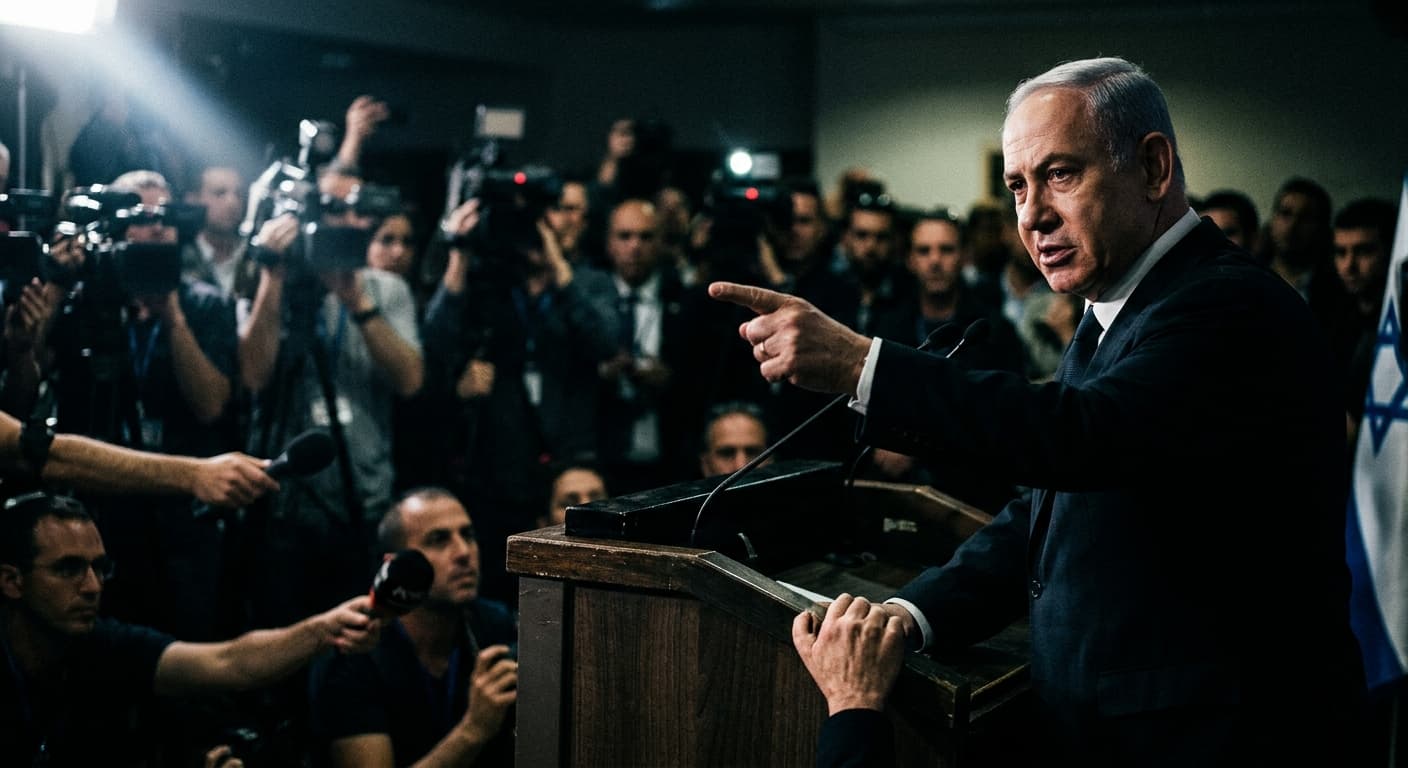
Netanyahu Gambles the ICC Warrant's Future on a Prosecutor's Downfall
New York's mayor threatens arrest ahead of UNGA. Israel's prime minister responds by attacking the man who sought the warrant — four days before ICC member states vote on whether to remove him for good.
On July 20, 2026, Prime Minister Benjamin Netanyahu's office launched a calculated broadside against the International Criminal Court, its former prosecutor, and New York City's mayor — dismissing an arrest warrant as "bogus" and telling Mayor Zohran Mamdani to "focus on fixing the damage his policies have caused New York." The statement landed with four days to spare before the ICC's 125 member states convene on July 24 to vote on permanently removing former prosecutor Karim Khan from office.
The confrontation is not about whether Mamdani can actually arrest Netanyahu — he almost certainly cannot. It is about the legitimacy of the warrant itself, and both sides know it.
The timing is the story. Netanyahu's office is not merely responding to Mamdani's July 18 interview with The New York Times, in which the mayor said his Law Department was in "active conversation" about detaining the prime minister during the September UN General Assembly. The PMO is inserting itself into the final hours of a battle at The Hague over whether the prosecutor who sought the warrants should be removed for sexual misconduct — a fight that could fatally compromise the warrants' credibility regardless of the legal outcome.
"Its bogus arrest warrant against Prime Minister Netanyahu was issued by a disgraced former ICC prosecutor, Karim Khan, a few days before allegations of sexual misconduct against him became public. It was a clear attempt by Khan to divert public attention and seek protection from scrutiny."
The Ynetnews report published the PMO statement in full. The language is surgical: the office does not merely argue the warrant is unjust — it argues the warrant was issued because Khan needed a distraction from the scandal about to consume him. That claim, if it gains traction among ICC member states, could shift the political calculus around the warrants even as the legal validity remains formally unchanged.
The Numbers Behind the Standoff: What Mamdani Cannot Do
Mamdani's threat carries enormous symbolic weight but almost no legal force. Three separate legal barriers stand between the mayor and any arrest.
First, the United States is not a party to the Rome Statute. As codified in 22 U.S. Code § 7421, Congress has declared that "the United States is not a party to the Rome Statute and will not be bound by any of its terms" and that it "will not recognize the jurisdiction of the International Criminal Court over United States nationals."
Second, 22 U.S. Code § 7423 explicitly bars cooperation: "no agency or entity of any State or local government, including any court, may cooperate with the International Criminal Court in response to a request for cooperation submitted by the International Criminal Court." New York City's Law Department is a local government entity. The NYPD is a local government agency. The statute is unambiguous.
Third, the UN Headquarters Agreement and the Convention on Privileges and Immunities of the United Nations grant visiting heads of state and government attending official UN functions diplomatic-level protections while in the headquarters district and transit. The US, as host nation, is obligated to facilitate their presence — not arrest them.
Mamdani himself acknowledged the constraint, telling the New York Times: "Whatever the law allows me to do in New York City, that's what we will do, but we won't be writing our own laws to that end."
Israel's UN ambassador Danny Danon was more direct. On X, he reportedly dismissed the mayor's statements as headline-seeking, writing that "if anyone should be arrested, it is New York's mayor." Danon insisted Netanyahu will address the General Assembly in September.
The Warrant Itself: What the ICC Actually Charged
On November 21, 2024, Pre-Trial Chamber I of the ICC — comprising Judges Nicolas Guillou, Reine Adélaïde Sophie Alapini-Gansou, and Beti Hohler — unanimously issued arrest warrants for Netanyahu and then-Defense Minister Yoav Gallant. The chamber rejected Israel's challenges to jurisdiction and found "reasonable grounds to believe" the two men bear criminal responsibility for:
- War crimes: starvation of civilians as a method of warfare, and intentionally directing attacks against a civilian population
- Crimes against humanity: murder, persecution, and other inhumane acts
The charges cover conduct "from at least 8 October 2023 until at least 20 May 2024." Under the Rome Statute, all 125 ICC member states — including nearly all of Western Europe — are obligated to arrest Netanyahu if he enters their territory.
The warrants have not been tested. No member state has had to decide whether to arrest a sitting Israeli prime minister on its soil. That test almost came in 2025 when several European leaders faced the question of whether Netanyahu could attend diplomatic meetings; each time, the visit was either scaled back or handled through alternative channels. The September 2026 UNGA represents the most public stage yet for that confrontation.
The Khan Implosion: A Prosecutor Undone
The vulnerability Netanyahu is exploiting has been building for over two years — and reached its apex six weeks before the PMO statement.
On June 8, 2026, the Bureau of the ICC's Assembly of States Parties suspended Karim Khan with immediate effect, finding he had engaged in "serious misconduct" and a "serious breach of duty." He became the first ICC prosecutor formally suspended in the court's history. The British Bar Standards Board followed on
June 19, suspending Khan's license to practice law.
The allegations originate from a female aide who worked as Khan's assistant beginning in February 2023. She told investigators that his behavior escalated from boundary violations to unwanted sexual touching during missions across multiple countries. A second woman, who worked as an unpaid intern on Khan's team in 2009, separately alleged he repeatedly tried to touch and kiss her. Khan has consistently denied all allegations.
The procedural history is, however, more complex than the PMO statement suggests — and that complexity is precisely what makes the July 24 vote unpredictable. A UN Office of Internal Oversight Services investigation ran from November 2024 to December 2025, generating more than 5,000 pages of evidence. Yet a three-judge panel appointed by the ASP's Bureau to assess the UN findings
concluded unanimously in March 2026 that "the factual findings by OIOS do not establish misconduct or breach of duty under the relevant framework."
The Bureau disregarded its own judicial panel's conclusion. It found "serious misconduct" anyway and referred the matter to the full Assembly of States Parties. Two former senior ICC judges, writing in Al Jazeera, warned that "dismissing the judicial expert report and substituting the bureau's own judgement would be deleterious to the rule of law, due process, and the integrity of the legal determination."
The vote requires 63 countries to remove Khan. The outcome is uncertain, and the process has already damaged the ICC's institutional credibility regardless of which side prevails.
Who Benefits, Who Loses
Netanyahu is the immediate beneficiary regardless of the July 24 result. The spectacle of the ICC's prosecutor being suspended for sexual misconduct — by a political body that overruled its own judges — provides precisely the argument he needs to delegitimize the warrant. A vote to remove Khan would amplify that argument; a vote to retain him would leave the court with a prosecutor who has been suspended, had his law license revoked in his home jurisdiction, and faces continuing legal challenges.
Mamdani also benefits, though for different reasons. The arrest threat costs nothing — he cannot execute it — but reinforces his positioning as the Democratic Party's most prominent voice on Palestinian rights. He won the mayoralty in June 2025 after a campaign in which opponents, including former Governor Andrew Cuomo, tried and failed to make his positions on Israel a liability. A poll in May 2026 found nearly three-quarters of Democratic voters oppose US aid to Israel, up from 45 percent three years earlier. Mamdani is reading that electorate.
The ICC itself is the clear loser. The Khan affair has pitted the Bureau against its own judicial panel, raised questions about whether political considerations drove the suspension, and handed adversaries of the court — from Washington to Jerusalem — a narrative of institutional rot. The arrest warrants for Netanyahu and Gallant, the court's highest-profile pending cases, now bear the permanent taint of having been issued by a prosecutor subsequently suspended for sexual misconduct by the very body that oversees the court.
The United States government is, for now, a secondary player. President Trump imposed sanctions on the ICC in February 2025 via Executive Order 14,203, designating Khan personally and threatening penalties for anyone providing "services" to the ICC's investigations. Those sanctions remain in place. But the administration has not needed to intervene directly in the Mamdani-Netanyahu standoff — the legal architecture of the American Service-Members' Protection Act and the Headquarters Agreement do the work in advance.
What to Watch
-
July 24, 2026: The ICC Assembly of States Parties votes on Karim Khan's permanent removal. 63 votes are required. If removal passes, Netanyahu will claim vindication. If it fails, the court will be led by a prosecutor under active suspension, with his UK law license revoked, who was cleared by judges but condemned by politicians — a paralysis scenario.
-
September 2026: The UN General Assembly convenes in New York. If Netanyahu attends, the question ceases to be hypothetical. The legal reality — that Mamdani cannot arrest him — will be tested against the political reality that a major American city's mayor has publicly declared a visiting head of government a war criminal who "belongs in The Hague."
-
Any European travel by Netanyahu before UNGA: A member-state arrest would be the first enforcement of an ICC warrant against a sitting Western-aligned leader — a moment with no precedent since the court's founding in 2002.
The Bottom Line
The real fight on July 20, 2026 was never about whether Zohran Mamdani can arrest Benjamin Netanyahu — he cannot, and both men know it. It was about whether the ICC warrant will survive the credibility collapse of the prosecutor who sought it. Netanyahu is betting it will not. The vote is on July 24.
Discover more
US Politics
SNAP Food Assistance Faces Legal Challenges
In 2026, SNAP faces stricter eligibility rules and mounting legal challenges, threatening food assistance for the millions of Americans who rely on the program.
US Politics
Congress Targets AI Chatbot Access for Terror
The House passed the Generative AI Terrorism Risk Assessment Act, focusing on AI's role in terrorism and potential surveillance implications.
India
700 Activists Accuse PM Modi of MCC Breach
Over 700 activists allege PM Modi breached election code with a televised address attacking opposition parties just before state elections.

Economics
Fed's Amex AML order puts correspondent banking on notice
Federal Reserve's Amex AML order requires board-level controls and a 90-day plan; OCC fined the bank $350 million over enterprise-wide deficiencies.