Nepal's 2026 Hunger Season: A Regional Test
Nepal faces a food crunch amid multiple crises.
Model Diplomat8 min readSouth Asia
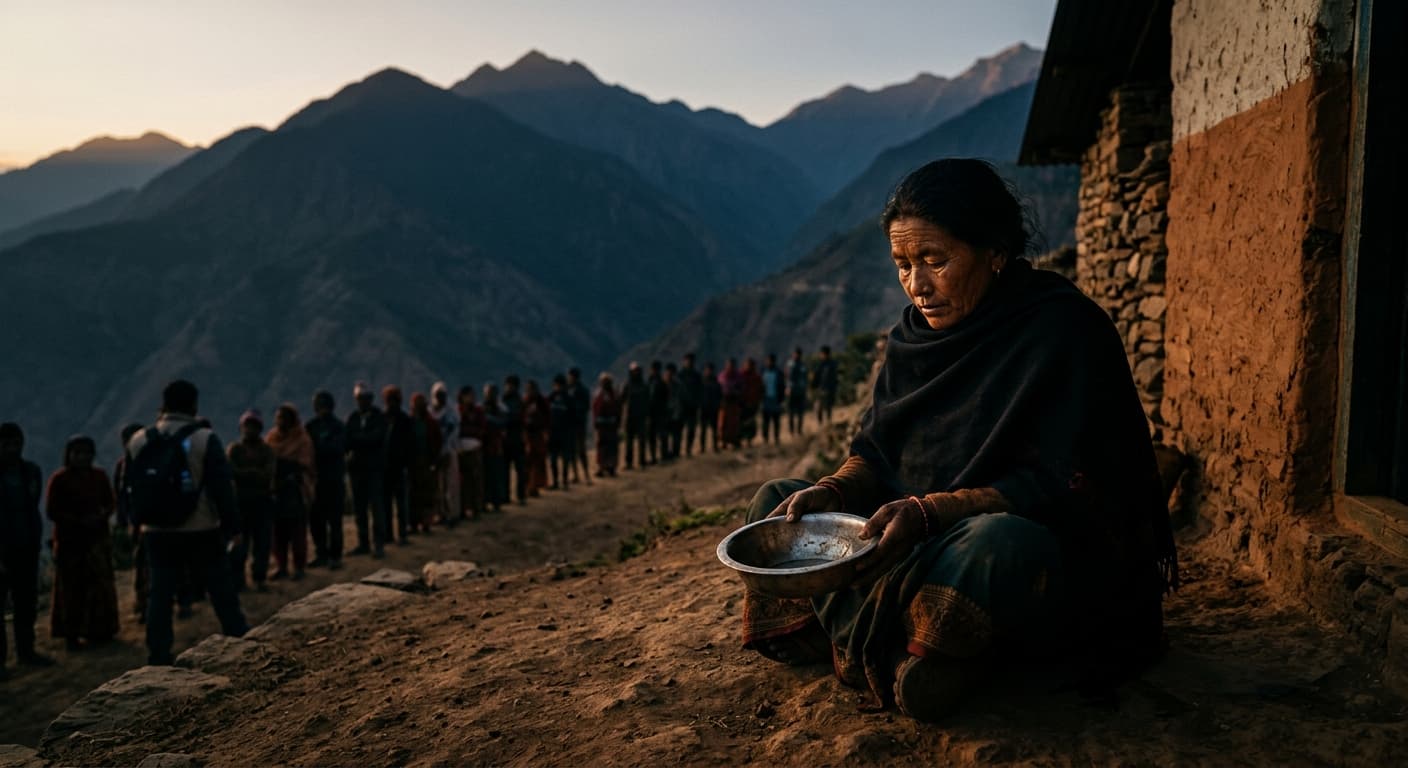
Nepal's 2026 Hunger Season: A Slow-Motion Regional Test
Nepal faces a June 2026–January 2027 food crunch as a weak monsoon, remittance drag from the Middle East war and India's rice dependence converge on the Karki-to-Balen transition.
Nepal's June-to-January food security outlook is not a weather story or an aid story — it is a regional stability test whose outcome will be decided in Doha, New Delhi and Kathmandu, not on Karnali's terraces. A below-average 2026 monsoon has landed on top of a shrunken remittance pipeline from the Middle East war and a post-revolt fiscal squeeze, and the country that ordinarily absorbs South Asia's climate shocks through cash from abroad is running out of that shock absorber precisely as it needs it most. The result will not be famine. It will be something more politically corrosive: a slow, uneven erosion of purchasing power in the districts that have already produced two governments in ten months.
The three shocks are stacking, not sequencing
Nepal's Department of Hydrology and Meteorology projected in May that the 2026 monsoon would deliver below-average rainfall across most of the country, with Madhesh — the Terai province that grows the bulk of Nepal's paddy — already in drought as transplantation began, according to reporting by BBC News Nepali. By mid-July only 37% of the seasonal average had fallen, versus the roughly 50% typical by that date. FEWS NET's June 26, 2026
Nepal Context Report frames the country's peak lean season — June to September — as the moment when household stocks fall, wage labour dries up and markets in the Hills and Mountains become physically harder to reach. This year that lean season opens with less rain in the plains that feed the highlands.
The second shock is macroeconomic. Growth has been revised sharply downward twice. The IMF's Article IV staff report of April 7, 2026 cut FY2025/26 growth to 3.0% from 5.2%, citing the September 2025 unrest, weaker agricultural output and Middle East spillovers. The World Bank's April
Nepal Development Update went lower — 2.3% — and singled out "lower paddy production in Madhesh, reflecting drought conditions and reduced planting" alongside "higher fuel prices and moderating — though still robust — remittance growth" as the twin drags on household welfare. That is the operative sentence for the next seven months. Nepal's food security is not, in the FEWS NET framing, a production story: aggregate cereal supply is met through imports. It is a purchasing-power story. Both variables are moving in the wrong direction at once.
The third shock is political. The interim government of Sushila Karki — installed after Gen Z protests killed 22 people and burned parliament in September 2025 — handed power on March 5, 2026 to Balendra Shah's Rastriya Swatantra Party, which won 124 of 164 counted seats on a change platform, per the Carnegie Endowment. The World Bank estimated the protests and dissolution cost 1.3% of GDP. The new government inherits an economy where non-performing loans have surged to 4.6% and where the fiscal room for a targeted food-price cushion — the exact tool the IMF is urging — is thin.
The remittance choke is the single most important variable
Read the outlook through purchasing power and one number dominates: 77.3% of Nepal's migrant workers are in the Middle East, and Saudi Arabia, Qatar and the UAE alone account for about 37% of remittance inflows, per the World Bank. Remittances run at roughly one-third of GDP and reach more than half of Nepali households, according to the IMF's June 2026 Selected Issues paper. A 2023 IMF quantitative model calibrated to Nepal found that a 25% wage decline in oil-producing destinations would translate into a 10% remittance drop and a 7% rise in the prevalence of undernourishment — a mechanical, well-documented pass-through from Gulf labour markets to Karnali dinner plates.
That mechanism is now live. The World Bank projects Nepal's poverty rate at the $4.2/day line rising to 6.6% in FY26 from a pre-conflict 6.5%, adding 17,267 people below the line — modest in aggregate, but concentrated in "remittance-dependent rural areas" where Nepal has also suspended labour permit issuance. The IMF has warned explicitly that "household purchasing power" faces risks from higher inflation and weaker remittances, and has told Kathmandu to consider cutting food import duties to blunt second-round price effects. That is a primary-source recommendation, not commentary.

India is Nepal's food-security backstop — and its single point of failure
Nepal imported Rs 32.5 billion worth of rice and paddy in the first nine months of FY2025/26 from 16 countries, but "the bulk" from India, according to Department of Customs data reported by Nepal News. World Integrated Trade Solution data confirm the geometry: in 2024 India shipped Nepal $165.7 million of rice against the next-largest supplier, the United States, at $1.4 million — a 99% dependence, effectively. The FAO's
GIEWS Special Report on Nepal forecasts 2024/25 cereal import requirements at 915,000 tonnes, including 509,000 tonnes of rice, all expected to be met through commercial channels.
That is fine — until it is not. The NUS Institute of South Asian Studies documented that India's 2023–24 non-Basmati rice export ban pushed Nepal's rice mill sector "on the brink of collapse" and drove food inflation to 10% by December 2024. India lifted that ban in September 2024, but the FAO's June 29, 2026 GIEWS Update flags that the ongoing El Niño is expected to persist through early 2027, "bringing an increased risk of extreme weather events that could adversely affect agricultural" production across the region. If the same El Niño that is weakening Nepal's monsoon also nudges Delhi back toward domestic-food-security-first policy — a re-run of 2023 — Nepal has no plan B. Al Jazeera reported in September 2025 that cross-border trade at the Indo-Nepal border seized up for weeks in the immediate aftermath of the Kathmandu unrest; the
Al Jazeera dispatch put total FY24-25 bilateral trade at $8.5 billion, of which $7.3 billion flowed India-to-Nepal. Nepal cannot afford friction on that lane in a lean season.
Where the pain will land — and where the aid will not reach fast enough
FEWS NET's context reporting is explicit that Nepal's food insecurity is not evenly distributed. It is concentrated in "poor households in remote Hill and Mountain areas and hazard-prone parts of the Terai." Karnali province — Humla, Jumla, Dolpa, Mugu, Kalikot — carries roughly 80% food-insecure households and a 36% child stunting rate, the country's worst, according to World Bank nutrition mapping. Sudurpashchim's rural poverty rate is 40.2%, twice the national average. These are the districts most dependent on remittances from the Gulf, most exposed to a weak monsoon that thins the Hill maize crop, and least connected to the Terai rice basket by all-weather road.
The World Food Programme's Nepal operation has, since 2021, run Anticipatory Action cash transfers — NPR 15,000 (about $120) per household disbursed ahead of forecast flood events, reaching 15,000 people in the Karnali Basin in one 2022 tranche funded by Germany. That model is elegant for floods. It is less well-suited to a slow drought-plus-remittance squeeze, which is what June 2026–January 2027 will actually be. The instrument that would work — a nationally-financed cash top-up to the elderly and single-woman social grants that already exist — is precisely what the World Bank flagged as "limited social assistance" that may "further constrain support for vulnerable households."
Why this is a regional story, not a humanitarian one
Nepal has been South Asia's quiet good-news case on food security for two decades. The IMF's 2023 country study observed that Nepal, despite low per capita income, outperformed peers on undernutrition — the model attributed most of that to remittances, not to domestic agriculture. Extreme poverty at $3/day fell from 21.5% in 2011 to 3% in 2023, per World Bank data. That achievement was engineered abroad. The 2025–26 stress test asks whether it survives when the two external pillars — Gulf labour markets and Indian rice — wobble simultaneously.
The regional stakes come in three layers. First, migration flows. If the Karki-Shah transition and Middle East disruption combine to close labour-permit issuance while Nepali unemployment stays high — the Carnegie analysis notes Balen Shah's RSP promised 1.2 million jobs it has no near-term way to create — the migration valve slams shut. That pressure lands on India's open border. Second, water diplomacy. The FEWS NET context report reminds that Nepal and India are "hydrologically intertwined" through the Kosi, Gandak and Mahakali; a bad Nepali monsoon means less downstream flow into Bihar and eastern Uttar Pradesh, and any Nepali move to renegotiate water-sharing terms — a live theme in RSP campaign material, per Observer Research Foundation — will hit Delhi in an election-sensitive year. Third, China posture. Beijing sent only $4 million in election aid to the Karki government "with strict conditions," per ORF, versus three tranches from India. A Nepali government under food-price pressure with a mildly anti-Delhi campaign vintage will be tempted to reopen the Chinese-tender questions. Kathmandu's food outlook is therefore a variable in Indo-Chinese competition, not just a humanitarian caseload.
What Balen Shah actually controls
The new government's leverage is narrower than its manifesto. On the supply side, Nepal cannot bring irrigation online in the June-to-January window; roughly one-third of arable land still lacks it, per the Department of Hydrology and Meteorology. On the demand side, the tools are import-duty relief on rice (IMF-endorsed), targeted cash transfers through existing social protection channels (World Bank recommendation), and diplomatic reassurance to Delhi to keep rice moving. On the diplomatic side, the RSP's declared "development diplomacy" line will be tested by whether Shah can secure a bilateral commitment from Narendra Modi's government that India will not repeat the 2023 export ban. That is the single most consequential ask on Kathmandu's docket this year, and it is not on the current bilateral agenda.
What to watch
- Late July–August 2026 monsoon totals. If cumulative rainfall closes above 90% of the long-term average by mid-August, the paddy outlook stabilises and the food-security scenario is manageable. Below 85%, expect Madhesh yield losses at 10–15% and a rice-import surge into Q4 2026.
- FAO GIEWS Nepal update, expected September 2026, with an IPC-style acute food insecurity classification for the September 2026–February 2027 window. That is the document that will determine WFP appeal size.
- India's rice-export posture after its own October 2026 harvest. Any signal — even non-binding — of a renewed export restriction would move Kathmandu retail rice prices within two weeks.
- The Shah government's first federal budget (mid-July 2026, per the Bikram Sambat fiscal calendar). Watch for a food-duty cut and any expansion of the elderly/single-woman cash grant. Absence of either signals fiscal constraint winning over the IMF advice.
- Nepal Rastra Bank inflation print for Ashwin (September–October) 2026. The H1 FY26 low of 1.7% is a base effect; a bounce above the 5% target would confirm the purchasing-power squeeze the World Bank and IMF are modelling.
The Bottom Line
Nepal's 2026-27 hunger season is not being driven by drought or by war in isolation — it is being driven by the simultaneous weakening of the two exogenous shock absorbers, Gulf remittances and Indian rice, that let a country of 30 million with rain-fed agriculture punch above its weight on food security for twenty years. The Balen Shah government's single most important food-security decision this year will not be an agriculture-ministry program; it will be whether it can lock in an Indian commitment not to repeat 2023's rice-export ban. If Delhi holds the line, Nepal muddles through the lean season. If it does not, the next Gen Z protest will not be about social media.
Discover more
US Politics
Virginia's Redistricting Referendum
Virginia's redistricting referendum is drawing a flood of dark money, shaping future elections and the fight for congressional control amid party stakes.
India
700 Activists Accuse PM Modi of MCC Breach
Over 700 activists allege PM Modi breached election code with a televised address attacking opposition parties just before state elections.

US Politics
Virginia GOP Rallies Rural Voters Against Red
Virginia Republicans are mobilizing rural voters against a Democratic-led redistricting referendum, a fight seen as pivotal to control in the 2026 midterms.

Conflict & Security
Drone Warfare Killing Aid Workers at Unprec
Over 1,000 humanitarian workers killed in three years as cheap armed drones collapse legal protections. Gaza, Sudan, Ukraine, and DRC see deliberate targeting of aid convoys and hospitals with zero prosecutions.

