NATO's IP4 Downgrade Masks Deeper Bet
NATO's Indo-Pacific Four partners expand cooperation despite sidelining.
Model Diplomat8 min readGlobal
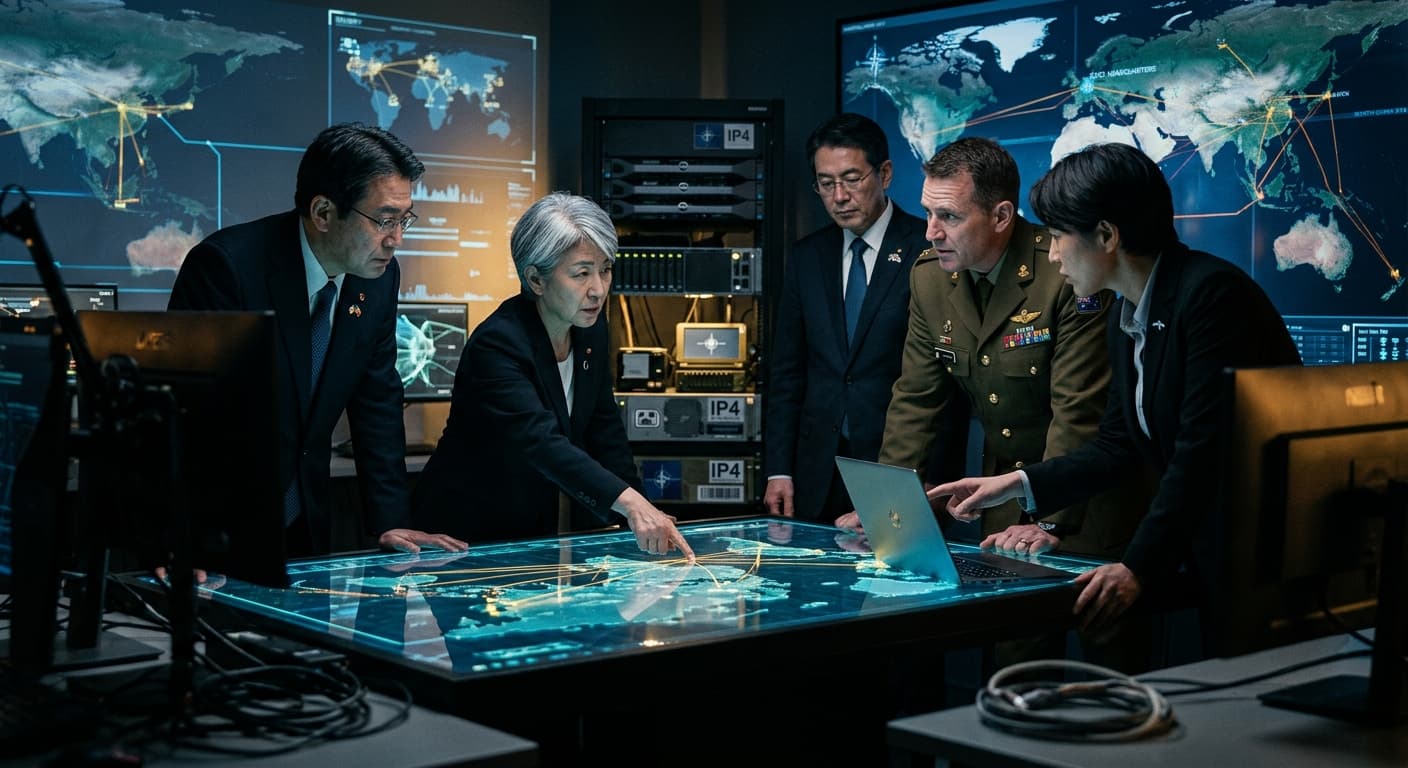
NATO's IP4 downgrade in Ankara masks a deeper Indo-Pacific bet
NATO and its Indo-Pacific Four partners agreed on July 7, 2026 to deepen defense-industrial and cyber cooperation — even as Trump's "NATO 3.0" pushed them off the main stage.
NATO Secretary General Mark Rutte and the leaders of Japan, South Korea, Australia and New Zealand agreed in Ankara on July 7, 2026 to expand cooperation on defense industry, cybersecurity and emerging technologies — a 30-minute sideline meeting that quietly did more strategic work than the main summit. The story is not what was said, but where it was said. With the Trump White House refusing to seat the Indo-Pacific Four (IP4) in the plenary, the alliance's Asia agenda is being pushed out of politics and into the industrial supply chain — and that is the level at which China, North Korea and Russia are already fusing their own coordination. The IP4 lost the photo op; they kept the pipeline.
The meeting itself: a downgrade, dressed up
The format tells the story. According to The Mainichi, Rutte hosted South Korean President Lee Jae Myung, Japanese Foreign Minister Toshimitsu Motegi, Defense Minister Shinjiro Koizumi, Australian Defense Industry Minister Pat Conroy and New Zealand Defense Minister Chris Penk on the sidelines of the Ankara summit — not in the main hall. The four partners agreed to strengthen cooperation on defense-industrial collaboration, cybersecurity and advanced technologies, and repeated the now-standard formula, in Motegi's phrasing, that "the security of the Euro-Atlantic and Indo-Pacific regions is inseparable."
That is a downgrade from 2022–2024. As the Hudson Institute noted before the summit, the absence of IP4 leaders at the 2025 Hague summit and Washington's reluctance to formalize the IP4 role in Ankara "highlights an emerging pattern of selective engagement." The Trump administration's stated preference — what U.S. officials call "NATO 3.0" — is for the alliance to "return to factory settings," curtailing overseas partnerships so Europe carries its own conventional defense while the United States pivots hard to the Pacific. That case was made bluntly in an
ISPI/ORF commentary published the day of the summit.
The concrete trigger for Rutte's push, according to the Mainichi report, was a Chinese submarine-launched ballistic missile test in the days before the summit. Rutte told reporters he had exchanged messages with Koizumi immediately after, calling the test "evidence that we cannot be naive about China."
The Russia–DPRK link Europe cannot ignore
The Ankara statement is analytically driven by one fact European leaders can no longer bracket: North Korean troops and munitions are already in the fight in Ukraine. According to the Carnegie Endowment, Kim Jong Un sent at least 11,000 North Korean soldiers to fight alongside Russian forces from late 2024, on the back of the June 2024 Russia–DPRK mutual-defense treaty. Carnegie also reports that Pyongyang and Moscow are now negotiating a follow-on defense agreement running to 2031.
That is the operational content behind Motegi's diplomatic language. When Japan's foreign minister says the two theaters are inseparable, he is describing a supply chain: Russian oil, cash and drone tech going east to Pyongyang; North Korean 152mm shells, KN-23 missiles and infantry going west to Kursk; Chinese dual-use goods keeping the Russian defense industry running. NATO's March 2026 Tokyo readout had Deputy Secretary General Radmila Shekerinska stating plainly that "China is supporting Russia's defence industrial base directly and indirectly."
The IP4 cooperation architecture is a response in kind. If the authoritarian coalition operates as a single logistical system, the democratic response has to run on the same rails — industrial cooperation, cyber and technology — not communiqués.
The industrial reality: Seoul is already inside NATO's supply chain
Here is where the "downgrade" framing collapses. Whether or not IP4 leaders sit in the plenary, one of them — South Korea — has quietly become one of NATO Europe's most important arms suppliers.
According to RAND, 46% of South Korea's 2024 defense exports went to Poland alone, on the back of Seoul's largest-ever arms deal — a $13.7 billion framework signed in 2022 — followed by a further $6.5 billion K2 tank contract in 2025. The Polish Institute of International Affairs (
PISM) puts the total value of contracts under the 2022 framework at roughly $16.6 billion, covering 180 K2 tanks, 364 K9/K9PL howitzers, 290 K239 Chunmoo rocket launchers and 48 FA-50 aircraft. Norway is in talks for a further $1 billion Chunmoo deal, and Estonia has already signed a €290 million contract, according to the
Carnegie Endowment.
That is what Rutte means by "defense industrial cooperation" with the IP4 — not a future aspiration but a €30-billion-plus fact already rewiring Europe's eastern flank. And it runs both ways. As the Fondation pour la Recherche Stratégique notes, South Korea's arms exports grew eightfold between 2020 and 2025 by systematically adopting NATO standards, even without membership. Hanwha Aerospace opened its first European subsidiary in Poland; Hyundai Rotem is turning Poland into a European K2 production hub.
Japan is on a parallel path. Tokyo's FY2026 defense budget hit a record ¥8.9 trillion ($58 billion), according to the Observer Research Foundation, and Prime Minister Sanae Takaichi has pulled the 2% of GDP target forward to March 2026. In April 2026, Tokyo again revised its defense-transfer rules to permit lethal exports, and — as Koizumi told the
Shangri-La Dialogue on May 31, 2026 — Japan now supplies frigate technology to Australia, patrol vessels to the Philippines, and is negotiating destroyer cooperation with Indonesia. That is the same industrial function Poland performs for Korea, run from Tokyo.
Cyber: the flagship that already exists
The cyber leg of the Ankara agreement is less a new commitment than a continuation of a track already running. In Prague on March 16, 2026, NATO Allies and the four IP4 partners held the Cyber Champions Summit and agreed, per NATO's own readout, to "further develop cyber defence cooperation, including through enhanced expert level exchange at the political, military and technical levels" — one of the alliance's Flagship Projects with the IP4.
The threat picture justifies the pace. The Center for a New American Security documents that Japan's 2022 National Security Strategy made cybersecurity a national-security pillar for the first time; Seoul rewrote its cyber strategy around a "Defend Forward" posture; and Taiwan built out a National Institute of Cybersecurity. In February 2025, according to
ISPI, North Korea-linked hackers pulled off the largest crypto heist in history — $1.5 billion from the ByBit exchange — funding a regime the UN can no longer sanction effectively because Russia and China veto the mechanisms.
Cyber is where NATO's Indo-Pacific engagement can go furthest with the least political cost: no bases, no ships in the South China Sea, no French or German veto on a Tokyo liaison office. It is also where the official NATO–IP4 statement of June 25, 2025 already committed the five parties to "explore collaboration on projects to deliver capabilities together with interested NATO Allies and partners, including in the space and maritime domains, and in the area of munitions."
Who benefits, who loses
Beneficiaries first. Poland is the biggest winner — its K2 factories become the export platform for a NATO-standard tank line that Norway, Romania and the Baltic states are already buying. Hyundai Rotem and Hanwha get scale their domestic market cannot provide. Japan's shipbuilders and MHI get an opening in Australia's frigate program and a growing Southeast Asian customer base. Rutte gets a Pacific card to play against a Trump administration that increasingly treats NATO as a European-only alliance.
Losers are harder to name but real. France, which blocked the proposed NATO liaison office in Tokyo in 2023, watches European defense-industrial spending flow to Korean and eventually Japanese platforms rather than French ones. German arms manufacturers, historically the incumbents in Poland and the Baltics, are being displaced on price and delivery time — the Stiftung Wissenschaft und Politik notes Berlin now treats Seoul as a "NATO-equivalent" partner precisely because it cannot beat Korean firms on speed. And Beijing loses the ability to treat NATO as a Europe-only problem: a Chinese SLBM test now generates a phone call between the NATO Secretary General and Japan's defense minister within hours.
What China and North Korea actually see
Beijing's calculation: NATO cannot deploy to the South China Sea, but it can starve the Russian defense industrial base, tighten export controls on the semiconductors that go into PLA missiles, and — through Korean and Japanese firms — turn Poland and Romania into forward magazines that free U.S. munitions for a Taiwan contingency. The International Centre for Defence and Security argues this is the structurally correct response: "when the same principle is defied in the South China Sea, the citizens of Tallinn, Warsaw, and Ottawa are also taking note."
Pyongyang's calculation is more immediate. Kim Jong Un's leverage over Moscow depends on North Korea being uniquely useful — the sole supplier of infantry and shells to Russia. Every additional shell coming off a Hanwha line in Poland, or a Japanese munitions plant under the revised export rules, is a shell Russia does not need from Kim. That erodes the price Kim can charge in submarine, satellite and warhead miniaturization technology, which is precisely what the Russia–DPRK 2031 agreement is designed to lock in.
Lee Jae Myung's positioning in Ankara — his first NATO appearance as president — is telling. According to the Herald Business briefing, Lee cast Korean Peninsula conflict risk as the foundation of the ROK defense industry's global relevance. That is not the old progressive posture of engagement with Pyongyang; it is a pragmatic bid to make South Korea indispensable to Europe's rearmament, and thereby to Washington.
Forward look
- September 2026 — Japan's revised National Security Strategy is due, per Koizumi's Shangri-La remarks. Watch for whether Tokyo names Taiwan explicitly and codifies AUKUS Pillar II participation.
- Q4 2026 — Norway's expected $1 billion Chunmoo decision; a signature would confirm Poland as the European production hub for Korean rocket artillery.
- Late 2026 — The Trump administration's next posture review of USFK and USFJ. If Washington pushes further toward "NATO 3.0," expect Rutte to accelerate IP4 industrial deals to compensate for the political retreat.
Diplomat View
The IP4's demotion in Ankara is a feature, not a bug — the political ceiling on NATO's Asia role is what liberates the industrial floor. Our call: the NATO–IP4 relationship will deepen fastest precisely where it is least visible — defense production, cyber, and standards — while the summit-level architecture stagnates or shrinks. The forecast changes if any one of three things happens: (1) France or Germany moves to block Korean or Japanese firms from EU defense funds under the European Defence Industrial Strategy, killing the Polish model at source; (2) a Trump–Kim nuclear-freeze deal reduces Seoul's threat perception enough that Lee de-prioritizes NATO industrial ties in favor of a China rapprochement; or (3) Beijing forces a Taiwan crisis before 2027, at which point the industrial track becomes irrelevant and the question becomes whether Europe's newly stockpiled munitions flow east or stay home. Absent those triggers, expect the Ankara pattern to repeat: quieter meetings, bigger contracts.
Related: Global Politics.
Discover more

US Politics
SNAP Food Assistance Faces Legal Challenges
In 2026, SNAP faces stricter eligibility rules and mounting legal challenges, threatening food assistance for the millions of Americans who rely on the program.

India
Delhi CM Rekha Gupta Blasts Opposition's Delm
Delhi CM Rekha Gupta's remarks on women's quota defeat reveal BJP's strategy for the 2029 Lok Sabha elections, focusing on delimitation.
India
Congress Accuses Modi of Stalling Women's Law
Congress accuses Modi of stalling women's reservation law by linking it to delimitation, revealing a deeper electoral strategy.

Conflict & Security
Drone Warfare Killing Aid Workers at Unprec
Over 1,000 humanitarian workers killed in three years as cheap armed drones collapse legal protections. Gaza, Sudan, Ukraine, and DRC see deliberate targeting of aid convoys and hospitals with zero prosecutions.