NATO's Economic-Security Pivot in Ankara
NATO leaders focus on critical minerals at summit.
Model Diplomat7 min readEurope
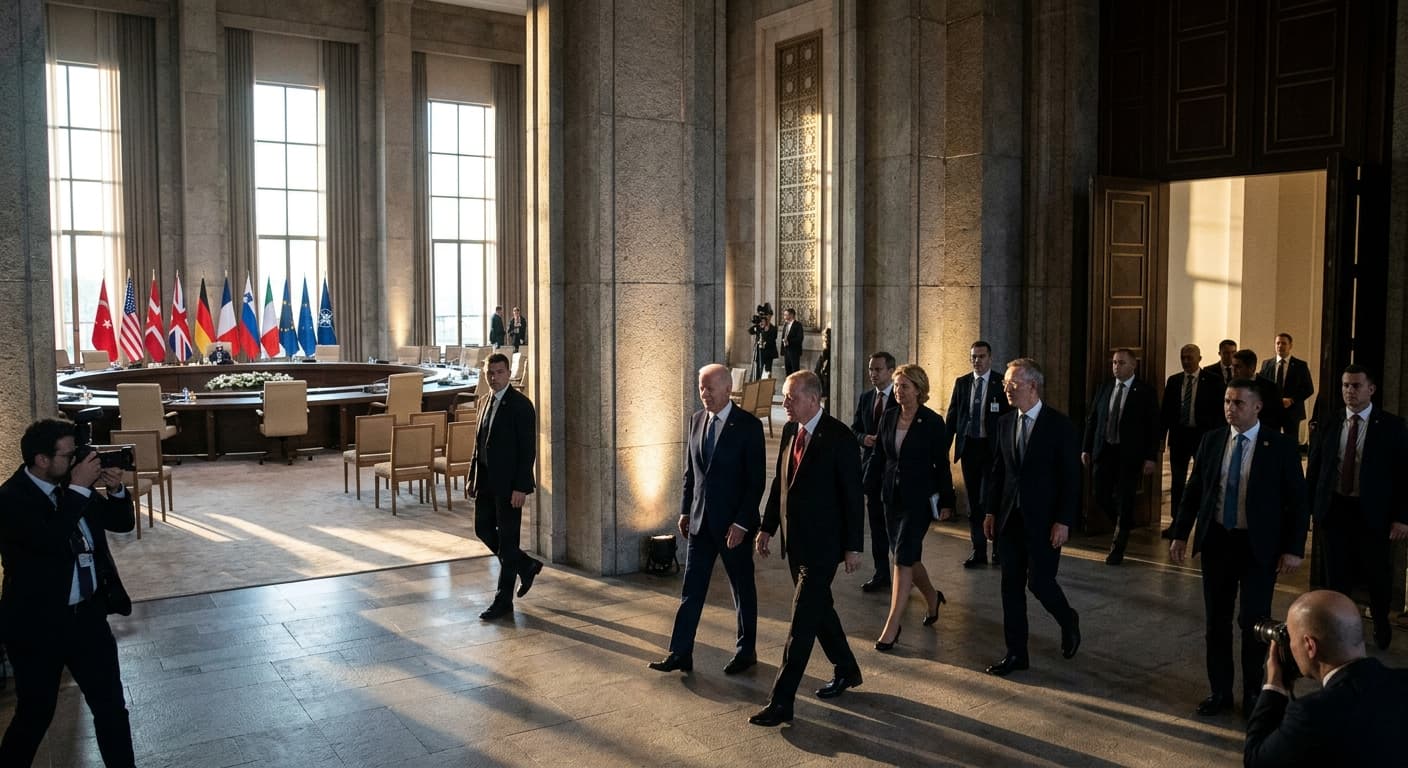
Ankara summit: NATO's economic-security pivot on critical minerals
NATO leaders meet in Ankara on July 7–8, 2026 under pressure to make critical minerals and supply-chain security a formal alliance pillar, after China's rare-earth squeeze exposed the defence industrial base.
When NATO's 32 heads of state convene at the Beştepe Presidential Compound on July 7, 2026, the alliance's most consequential decision may not concern tanks or troop numbers, but a schedule slot at 11:07 that morning inside the parallel Industry Forum, titled simply "Defence Critical Raw Materials." That agenda line is the leading edge of a strategic pivot: NATO is being pushed, for the first time in its 77-year history, to treat economic security — and specifically the minerals feeding its ammunition lines and radars — as a core deterrence variable on par with troops and 5% defence budgets. The push comes not from Brussels but from Beijing, whose October 2025 rare-earth licensing regime has turned mineral flows into a live coercion tool against every ally in the room.
The demand landing in Ankara
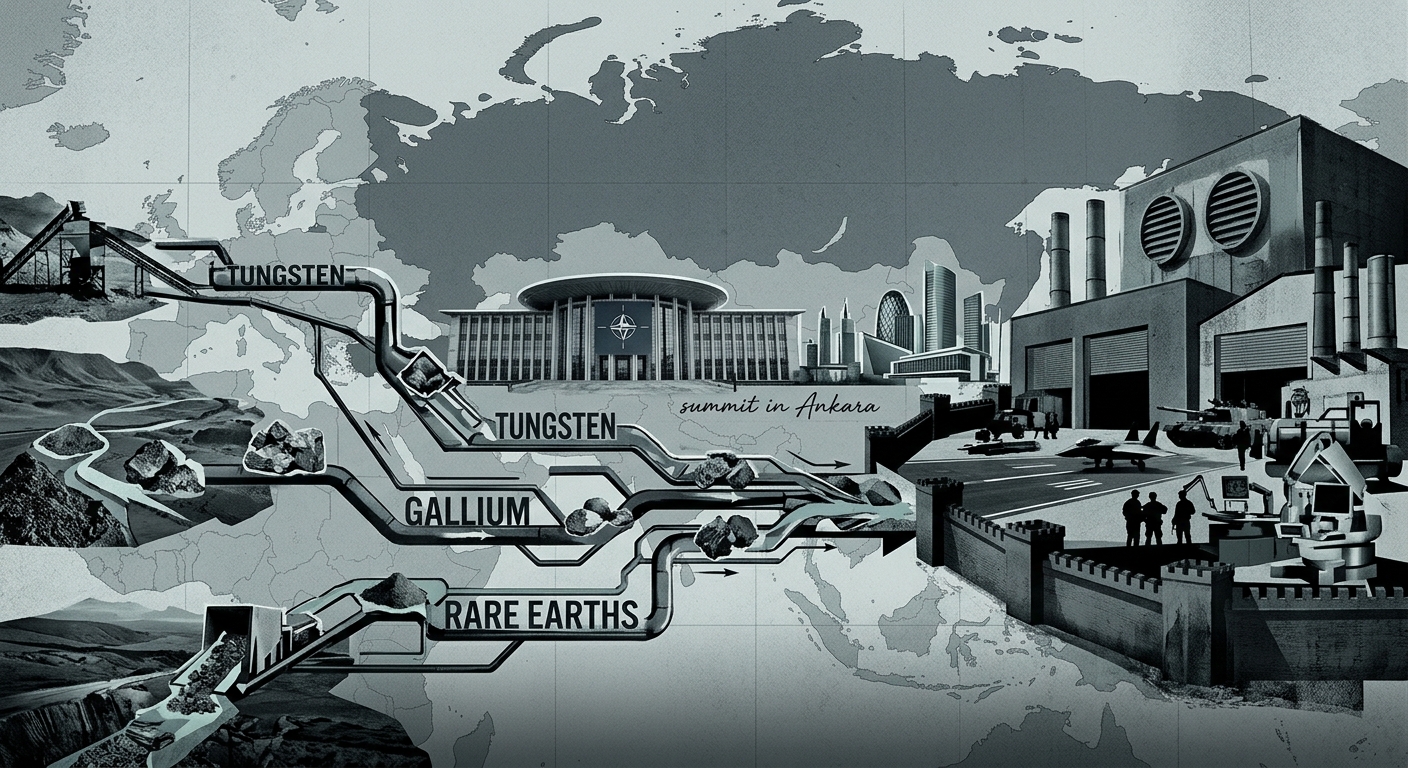
The most direct call comes from the Gulf press. The UAE Journal argues NATO should map defence supply chains across allies, establish a joint strategic reserve of minerals such as gallium and tungsten, and elevate "NATO economic security" as a core pillar — no new treaty required. The framing is echoed by
Khaleejion 24, which characterises the emerging battlefield as one of "critical minerals, maritime insurance and export controls."
That analysis is not fringe. According to the Congressional Research Service's Ankara Summit briefing, Secretary General Mark Rutte's official priorities remain defence investment, industrial production and Ukraine. But the CRS notes NATO has quietly built the scaffolding for a broader economic-security role through the Defense Production Action Plan and the NATO Industrial Capacity Expansion Pledge. The
European Parliamentary Research Service briefing confirms leaders are considering a revision of NATO's 2013 Framework for Industry Engagement — the vehicle most likely to codify a minerals mandate without a treaty change.
The primary document to watch is NATO's own December 11, 2024 release of 12 defence-critical raw materials: aluminium, beryllium, cobalt, gallium, germanium, graphite, lithium, manganese, platinum, rare earths, titanium and tungsten. It is the first time the alliance has publicly named the metals its deterrence depends on. According to the Danish Institute for International Studies,
China dominates the extraction or processing of ten of the twelve.
Why the pivot became unavoidable
The trigger is dated and specific. On October 9, 2025, China's Ministry of Commerce issued Announcement No. 61, imposing what the Centre for Strategic and International Studies called its "strictest rare earth and permanent magnet export controls to date." From December 1, 2025, any foreign firm affiliated with a foreign military — explicitly including U.S. forces — is largely denied export licences; requests for military use are automatically rejected. Foreign-made magnets containing as little as 0.1% Chinese-origin rare earths fall under Beijing's licensing net.
Poland's OSW Centre for Eastern Studies characterises the October wave as a direct strike on European defence industrial plans and a "final opportunity" for Beijing to slow U.S. arms production before a January 1, 2027 congressional ban on Chinese rare-earth content in American weapons systems takes effect. Beijing suspended the second wave until November 10, 2026 in the run-up to the Xi–Trump APEC meeting, but the
European Parliamentary Research Service records that first-wave controls from April 2025 remain in force — and European Central Bank data cited in the same brief show over 80% of large European firms sit within three intermediaries of a Chinese rare-earth producer, with negligible stockpiles.
Tungsten tells the same story. According to the Australian Institute of International Affairs, Beijing added tungsten to its export-licence list in February 2025 and cut mining quotas a further 6.5% in April; European ammonium paratungstate prices jumped roughly 30% by June. Tungsten sits inside every armour-piercing round Europe now ships to Ukraine.
What Rutte's team can actually deliver in Ankara
The Ankara declaration will not create an "economic NATO." A 2024 CSIS analysis by Emily Benson and colleagues judged the proposition a "political oxymoron or inevitability", noting that extending Article 5 to economic coercion would fracture allied consensus. What is achievable is more prosaic — and, for the defence industrial base, more useful.
Three deliverables are in play, according to the NATO Summit Defence Industry Forum programme. First, a "mass signing ceremony" at 12:19 on July 7 will formalise multinational projects; last year's Hague forum produced a defence-critical raw materials supply-chain project referenced in Rutte's
June 24, 2025 keynote ("another project to secure the supply chain of defence critical raw materials"). Ankara is expected to expand it.
Second, allies will fight over what counts under the 1.5% of GDP resilience track agreed at The Hague. The Atlantic Council argues the summit's most consequential technical deliverable would be transparent rules on which spending qualifies — critical-minerals stockpiles, port hardening, undersea-cable protection. If minerals reserves count toward the 1.5%, member treasuries have a fiscal reason to build them.
Third, the summit will endorse a "NATO 3.0" division of labour in which Europe assumes more of the conventional burden. That framing, as Rutte laid out in his June 25, 2026 Atlantic Council conversation, assumes European industry can actually deliver. It cannot, if a single Chinese licensing officer in Guangzhou can stop a howitzer line in Elling.
Who wins, who loses
The immediate winner from a NATO minerals mandate is not European. It is American. The Trump administration launched Project Vault in February 2026 — a $10 billion EXIM-backed public-private stockpile covering all 60 minerals on the U.S. Geological Survey list, with participation from General Motors, Stellantis, Boeing, GE Vernova and commodities trading houses Hartree, Mercuria and Traxys.
Benchmark Mineral Intelligence estimates a 60-day U.S. buffer of key battery minerals alone would cost $991 million at 2026 prices. Any NATO reserve architecture that emerges from Ankara will plug into Project Vault's rails, extending American economic-security infrastructure across the alliance. CSIS analysts note Chairman Jovanovic has already held early conversations with G7 finance ministers.
The second winner is Turkey. Hosting the Defence Industry Forum lets Ankara position its expanding defence-industrial complex — ASELSAN, Baykar, Roketsan — as a non-EU industrial hub NATO cannot afford to exclude. The Atlantic Council brief explicitly urges an EU–NATO mechanism modelled on the Prioritized Ukraine Requirements List to route allied financing to Turkish producers.
The loser is the EU's autonomy narrative. Brussels' €150 billion SAFE loan facility and the Critical Raw Materials Act were designed to build a European midstream. But according to the International Institute for Strategic Studies, a Spanish tungsten project projecting first production in 2027 aims to meet only up to 20% of EU demand. Every month the EU cannot deliver refined tonnes, the case for a U.S.-led allied stockpile hardens. Carnegie's earlier warning that
U.S. and NATO militaries face serious mineral shortage risks — from export controls, war-driven demand, and disrupted sea lanes — now reads as prescient.
The second-order loser is the climate agenda. NATO's twelve defence-critical materials overlap heavily with the energy transition minerals list — cobalt, lithium, graphite, rare earths, manganese. According to Brookings, energy transition minerals are the same building blocks as electric vehicles, wind turbines and grid transmission. If NATO stockpiles bid against civilian buyers for tight offtake, EV cost curves and renewable deployment timelines slip. The Ifri paper on
financial tools for CRM resilience proposes joint European purchasing entities to pool niche-metal demand — but concedes such stocks "cannot be fully ESG compliant" and must be located inside Europe. The climate-defence tradeoff is no longer theoretical.
Diplomat View
The Ankara summit will not declare a new NATO pillar on economic security — the treaty politics do not permit it, and Rutte will not spend political capital on a declaratory fight when concrete deliverables are in reach. But the summit communiqué will name defence-critical raw materials explicitly, endorse an expanded multinational CRM supply-chain project, and count national minerals reserves toward the 1.5% resilience budget. That is the operative pivot. NATO becomes, in practice, an economic-security alliance while insisting rhetorically that it is not. The forecast revises if two conditions hit: if Beijing extends the November 10, 2026 suspension into a de facto retreat from extraterritorial licensing — reducing pressure — or if any allied capital vetoes the 1.5% categorisation to protect its Chinese trade exposure. Watch Berlin and Rome. Neither has fully broken with the pre-2024 economic playbook, and both host major automakers whose supply chains depend on the same Chinese midstream NATO now wants to route around.
What to watch next
- July 7, 2026, 11:07 Ankara time. The NSDIF26 "Defence Critical Raw Materials" segment; the "Big Reveal" at 10:00 and the mass signing at 12:19 will indicate how many allies commit new mineral projects.
- July 8, 2026. Ankara summit communiqué language on economic security and the 1.5% resilience-spending definition.
- November 10, 2026. Expiry of China's suspension of its second-wave rare-earth export controls; decision point for Beijing on whether to reimpose extraterritorial licensing.
- January 1, 2027. U.S. congressional ban on Chinese rare-earth content in American weapons systems takes effect, forcing NATO co-production programmes into fully allied supply chains.
The Bottom Line
NATO's Ankara summit is not really about the 5% spending target — it is about whether an alliance built for tanks can defend a war economy running on twelve metals that China largely controls. The mineral clause in the July 8 communiqué, and whether stockpiles count against the 1.5% resilience budget, will tell you whether NATO has quietly become an economic-security bloc without ever saying so. If it has, the winners are Washington and Ankara; the losers are Brussels' industrial autonomy narrative and the pace of Europe's energy transition.
Discover more
India
Congress Accuses Modi of Stalling Women's Law
Congress accuses Modi of stalling women's reservation law by linking it to delimitation, revealing a deeper electoral strategy.

India
Delhi CM Rekha Gupta Blasts Opposition's Delm
Delhi CM Rekha Gupta's remarks on women's quota defeat reveal BJP's strategy for the 2029 Lok Sabha elections, focusing on delimitation.
India
700 Activists Accuse PM Modi of MCC Breach
Over 700 activists allege PM Modi breached election code with a televised address attacking opposition parties just before state elections.

Conflict & Security
Drone Warfare Killing Aid Workers at Unprec
Over 1,000 humanitarian workers killed in three years as cheap armed drones collapse legal protections. Gaza, Sudan, Ukraine, and DRC see deliberate targeting of aid convoys and hospitals with zero prosecutions.