NATO's Ankara Summit on Critical Minerals
Economic security becomes a NATO priority at Ankara summit.
Model Diplomat8 min readEurope
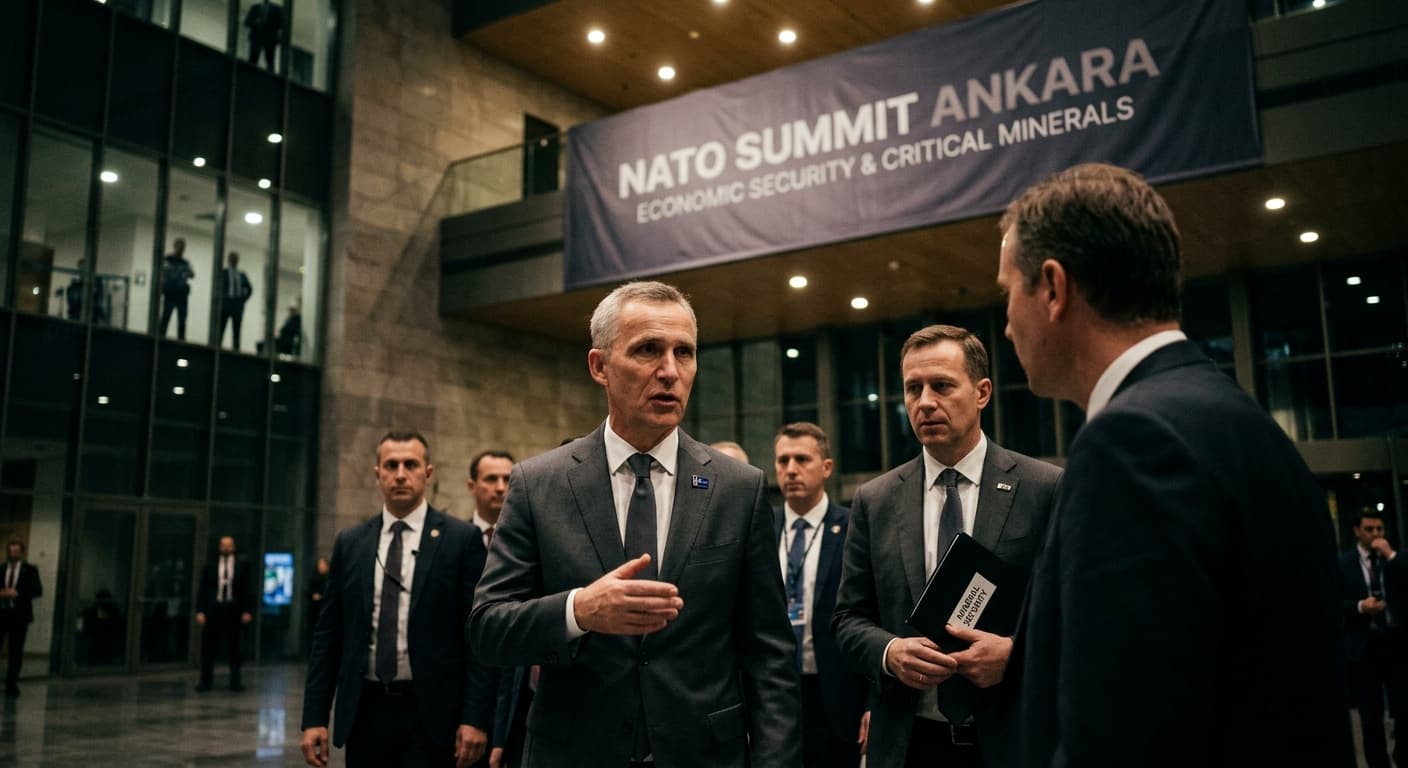
NATO's Ankara Summit Pivots to Critical Minerals and Economic Security
NATO's July 7–8 Ankara summit elevates critical-minerals security and supply-chain resilience into a core pillar — a response to Beijing's rare-earth chokehold on allied rearmament.
A 12-minute slot at the Ankara summit's Defence Industry Forum is titled simply "Defence Critical Raw Materials." That is not a footnote. It is the moment NATO formally converts economic security from a policy debate into an alliance workstream — because eight months of Chinese rare-earth export controls have shown that a Ministry of Commerce licence in Beijing can now stall a Meteor missile line in Bordeaux, a Patriot interceptor in Bavaria, and an F-35 magnet in Fort Worth simultaneously. The 32 allies gathering at the Beştepe Presidential Compound will not sign a new treaty — they will do something quieter and more consequential: fund and operationalise a minerals-and-supply-chain regime that treats economic coercion as a deterrence problem, not a trade problem.
That pivot is the story of this summit. Everything else — the 5% of GDP pledge, the Ukraine package, the Trump-era burden-sharing quarrel — will be read through it.
Why economic security landed on the Ankara agenda
The proximate cause is Beijing. On April 4, 2025, in retaliation for Donald Trump's "Liberation Day" tariffs, China's Ministry of Commerce imposed licensing on seven heavy rare-earth elements and permanent magnets — samarium, gadolinium, terbium, dysprosium, lutetium, scandium and yttrium — the exact set used in F-35 magnets, missile guidance and radar. A Center for Strategic and International Studies analysis found that 15 of the 16 US firms placed on China's export-control list that day were defence and aerospace companies. On October 9, 2025, Beijing escalated again, adding five more rare-earth metals and, for the first time, asserting extraterritorial reach: any magnet with 0.1% Chinese-sourced rare-earth content, or made using Chinese process technology, would require a Chinese export licence. As a
European Parliamentary Research Service briefing records, licences would "as a rule" not be granted where the end-user was a defence firm. The second wave was suspended on November 7, 2025 until November 10, 2026 — a truce, not a settlement.
The scale of exposure is the number that changed the politics. The International Monetary Fund's April 2026 World Economic Outlook commodity feature documents that China accounts for 97% of global heavy rare-earth oxide separation and 90% of permanent-magnet production. The European Central Bank, cited in the same EPRS brief, found that over 80% of large European firms are within three intermediaries of a Chinese rare-earth producer, and — critically — most had not stockpiled. The Merics think tank concluded flatly that Europe's re-armament plans, including the €800 billion ReArm Europe/Readiness 2030 envelope, are
in danger unless minerals policy is embedded in defence procurement.
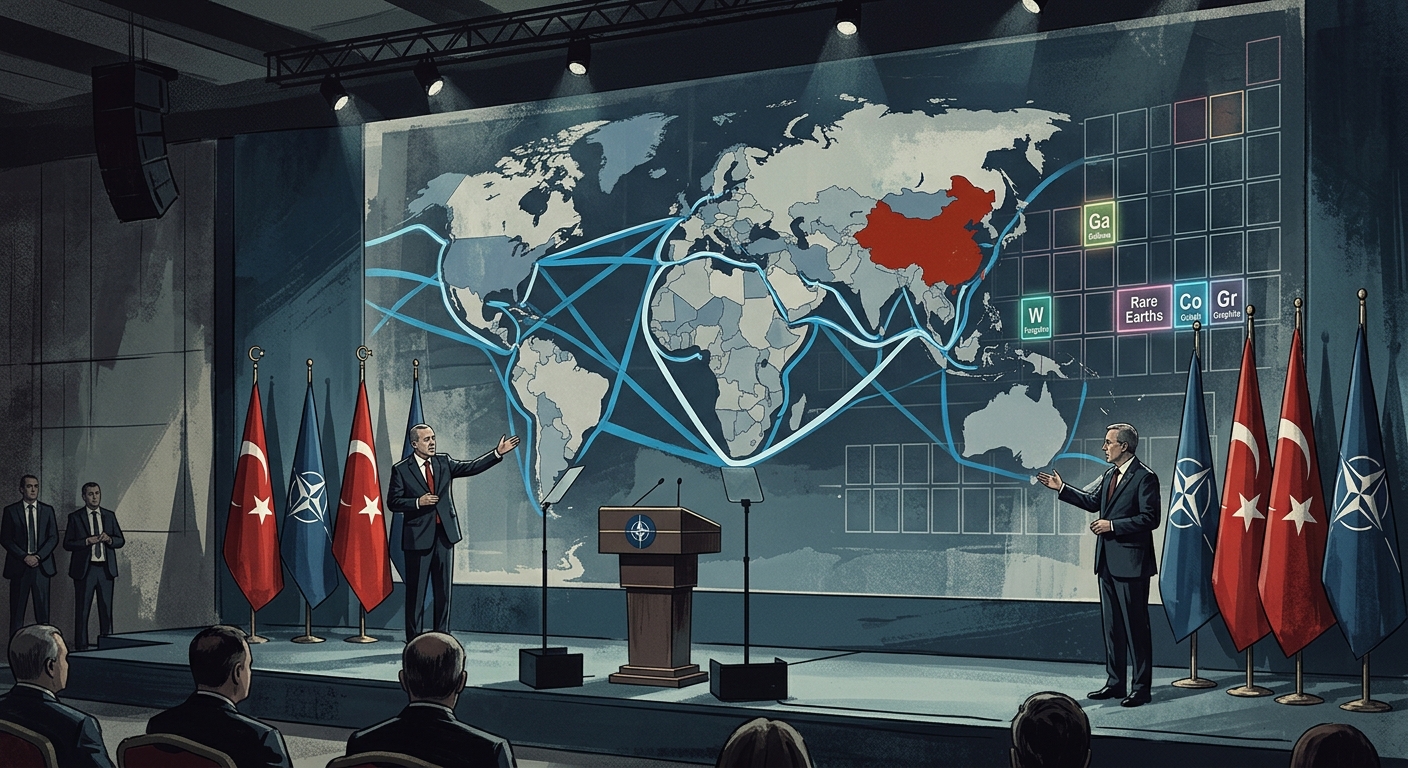
That is what NATO has moved to do. The alliance's Defence-Critical Supply Chain Security Roadmap, endorsed by defence ministers in June 2024, laid the plumbing: identify strategic materials, stockpile, substitute, share assessments, build a NATO community of interest. On December 11, 2024, NATO published its first-ever list of
12 defence-critical raw materials — aluminium, beryllium, cobalt, gallium, germanium, graphite, lithium, manganese, platinum, rare earths, titanium, tungsten. And on February 13, 2025, the
Updated Defence Production Action Plan instructed allies to "explore the establishment of multinational stockpiling initiatives for specific critical raw materials" and consider "national plans for onshoring/friend shoring."
Ankara is where those instruments are supposed to graduate from paper to portfolio.
What Ankara is actually deciding
The Ankara agenda is publicly modest. Secretary General Mark Rutte's three declared priorities — investment, industrial production, Ukraine — sound familiar. The Congressional Research Service report NATO: Issues for the July 2026 Ankara Summit, issued in advance of the summit, notes Rutte expects allies to unveil "tens of billions of dollars of new [defence] contracts" and formalise their glide-paths toward the 5% GDP defence target adopted in The Hague in 2025 (3.5% core, 1.5% defence-related).
Read the fine print, however, and the industrial and economic-security lines are where the real work is happening. At the 2025 NSDIF in The Hague, 12 allies signed a High Visibility Project on "the joint acquisition, storage, transportation and management of stockpiles of defence critical raw materials, including through recycling existing products," per an IISS assessment. Ankara is expected to add signatories, funding lines and — several officials briefed to Reuters and the Financial Times, per European Parliament research — a joint qualification fund allowing allied defence ministries to share the cost and results of certifying substitute materials, an idea championed by the
Atlantic Council Global Energy Center.
That is where the alliance's economic-security debate has actually been going, and it is more radical than the language suggests. As a Center for Strategic and International Studies commentary on NATO and economic security argued, the alliance was never designed as an economic body — Article 2 of the Washington Treaty exists but has rarely done real work — yet supply-chain resilience "is not something NATO can ignore." Ankara begins the process of institutionalising it without opening the treaty text: through Article 3-adjacent resilience commitments, capability targets, and the NATO defence-planning process itself.
The emerging allied consensus, per UAE Journal reporting: move toward NATO economic security as a core pillar alongside military readiness without requiring a new treaty, map supply chains for single points of failure, and build joint reserves of gallium and tungsten.
The climate-energy angle NATO is not talking about
The under-discussed dimension is that this pivot is a climate-energy story as much as a defence one. NATO's twelve materials are almost identical to the inputs the International Energy Agency identifies as bottlenecks for the energy transition. Every dysprosium magnet argued over in Ankara is also a wind-turbine magnet; every ton of lithium reserved for guided munitions is a ton not going into a European gigafactory.
A June 2025 Atlantic Council report on China's strategy for rare-earths dominance makes the interlock explicit: Chinese control over these inputs "poses serious energy security and national security risks" simultaneously, because the same magnets underpin fighter jets, EV motors and offshore wind. The Council on Foreign Relations' 2026 task-force report
Leapfrogging China's Critical Minerals Dominance argues bluntly that expanding traditional mining, even at Trump-administration speed, "takes years, often decades, and is insufficient" to close the gap on its own.
That means the Ankara mineral push is competing directly with civilian decarbonisation for the same finite supply, an issue climate ministries have not yet caught up to. A 2026 IRIS Paris study on defence supply-chain monitoring counted "more than 10 critical raw materials" affected by geopolitically motivated export restrictions as of 2025, most imposed by Beijing, and warned that defence and civilian sectors would now be locked in a bidding war for the same secured supply. Britain's chemistry sector, Airbus's supplier tail of 18,000 firms, and Germany's chipmakers are all pulling on the same rope as air-defence integrators.
The politically inconvenient corollary: friend-shoring at NATO scale requires new mines and new refineries, most of them in jurisdictions with tougher environmental rules than China's. The IISS's March 2025 study Critical Raw Materials and European Defence warned that reshoring "may lead to some difficult choices, including over environmental, social and governance rules." Ankara will not resolve that trade-off. It will, in effect, quietly rank defence higher.
Who wins, who loses
The clear beneficiaries are threefold. First, Turkey: hosting a summit that elevates industrial cooperation puts ASELSAN, Baykar and Roketsan into NATO's inner supply-chain conversation just as European buyers look for non-EU friend-shoring options. NATO's own readout of Rutte's April 22, 2026 visit to Ankara praised Turkey's "defence industrial revolution." The Atlantic Council brief
From burden sharing to strategic delivery argues that keeping Turkey out of the industrial inner circle "undermines transatlantic solidarity" — and this summit is the vehicle to bring it in.
Second, US critical-minerals policy vehicles. The Congressional Research Service brief on rare earths records that on February 2, 2026 the White House announced Project Vault, a $12 billion US Strategic Critical Minerals Reserve, and confirms MP Materials' $500 million Department of Defense equity deal plus a $110/kg neodymium-praseodymium price floor. Every allied stockpile agreed in Ankara that offtakes from US or allied producers hardens that industrial policy.
Third, mid-sized "friend-shoring" jurisdictions — Australia, Canada, Saudi Arabia, Malaysia — that can offer processing capacity NATO members will now pay a security premium for. CSIS notes Malaysia became the first country outside China to produce dysprosium oxide in 2025.
The losers are also clear. European primes — MBDA, Airbus, Leonardo — face the tightest bind: heavily magnet-dependent products, thin stocks, and, per Merics, EU imports of 98% of the magnets they need from China. And Beijing itself has ceded strategic surprise; the extraterritorial October 2025 move, in the assessment of Poland's Centre for Eastern Studies, was "unprecedented" and forced Western capitals into precisely the coordinated response Beijing had spent years trying to prevent.
Diplomat View
Ankara will not produce a treaty declaring "economic security" a fourth NATO pillar. It will produce something more durable: a set of technical instruments — joint stockpiles, shared qualification of substitute materials, an expanded NATO High Visibility Project on raw materials, and language embedding minerals resilience in the defence-planning process — that operationalise the concept without a ratification fight. The forecast: within two years, NATO capability targets will include supply-chain sourcing tests, and allied defence contracts will begin to carry "no-Chinese-content" clauses that mirror the US Department of Defense's January 1, 2027 sourcing cliff. This is a real, and irreversible, geoeconomic hardening of the alliance.
What would change that call: a durable US–China rare-earth truce beyond the November 10, 2026 suspension deadline; a Trump-administration decision to prioritise a bilateral minerals deal with Beijing over allied coordination (a real risk given US ambivalence on burden-sharing); or European fragmentation over the environmental costs of onshoring processing. Watch the wording of the Ankara communiqué closely: any explicit mention of "economic coercion," "critical raw materials" or "collective resilience" tied to the defence-planning process is the tell.
What to watch
- July 8, 2026 — Ankara summit communiqué language on supply chains and economic coercion; number of new signatories to the June 2025 High Visibility Project on joint mineral stockpiling.
- November 10, 2026 — expiry of China's suspension of its October 2025 extraterritorial rare-earth export controls; any renewal or extension will re-open the crisis.
- January 1, 2027 — US Department of Defense deadline barring Chinese, Russian, Iranian and North Korean rare earths and magnets from defence supply chains; a stress test of whether NATO allies quietly align, or diverge.
The Bottom Line
The Ankara summit is where NATO stopped debating whether it should do economic security and started doing it — not by amending the Washington Treaty, but by embedding critical-minerals resilience into the same defence-planning machinery that governs tank fleets and air-defence targets. The winners are Turkey, US minerals policy, and friend-shoring jurisdictions from Australia to Malaysia. The loser, on current trajectory, is Beijing's ability to use a Ministry of Commerce licence as a coercion lever — and, unless European industrial policy accelerates, the civilian energy transition that competes for the same materials.
Discover more

US Politics
House Ethics Committee Pushes Sexual Miscond.
The House Ethics Committee has shifted responsibility for sexual harassment settlement records to the Office of Congressional Workplace Rights, complicating disclosure efforts.
India
Congress Accuses Modi of Stalling Women's Law
Congress accuses Modi of stalling women's reservation law by linking it to delimitation, revealing a deeper electoral strategy.
India
700 Activists Accuse PM Modi of MCC Breach
Over 700 activists allege PM Modi breached election code with a televised address attacking opposition parties just before state elections.

Conflict & Security
Drone Warfare Killing Aid Workers at Unprec
Over 1,000 humanitarian workers killed in three years as cheap armed drones collapse legal protections. Gaza, Sudan, Ukraine, and DRC see deliberate targeting of aid convoys and hospitals with zero prosecutions.