NATO's €70bn Ukraine Pledge Reshapes Power
NATO pledges €70bn military aid to Ukraine, shifting power dynamics.
Model Diplomat8 min readEurope

NATO's €70bn Ukraine Pledge Reshapes Eastern Europe's Power Map
NATO Allies pledged €70bn in military aid to Ukraine for 2026 and $50bn in new arms contracts at the Ankara Summit, cementing Europe as the war's primary financier and Russia's principal deterrent.
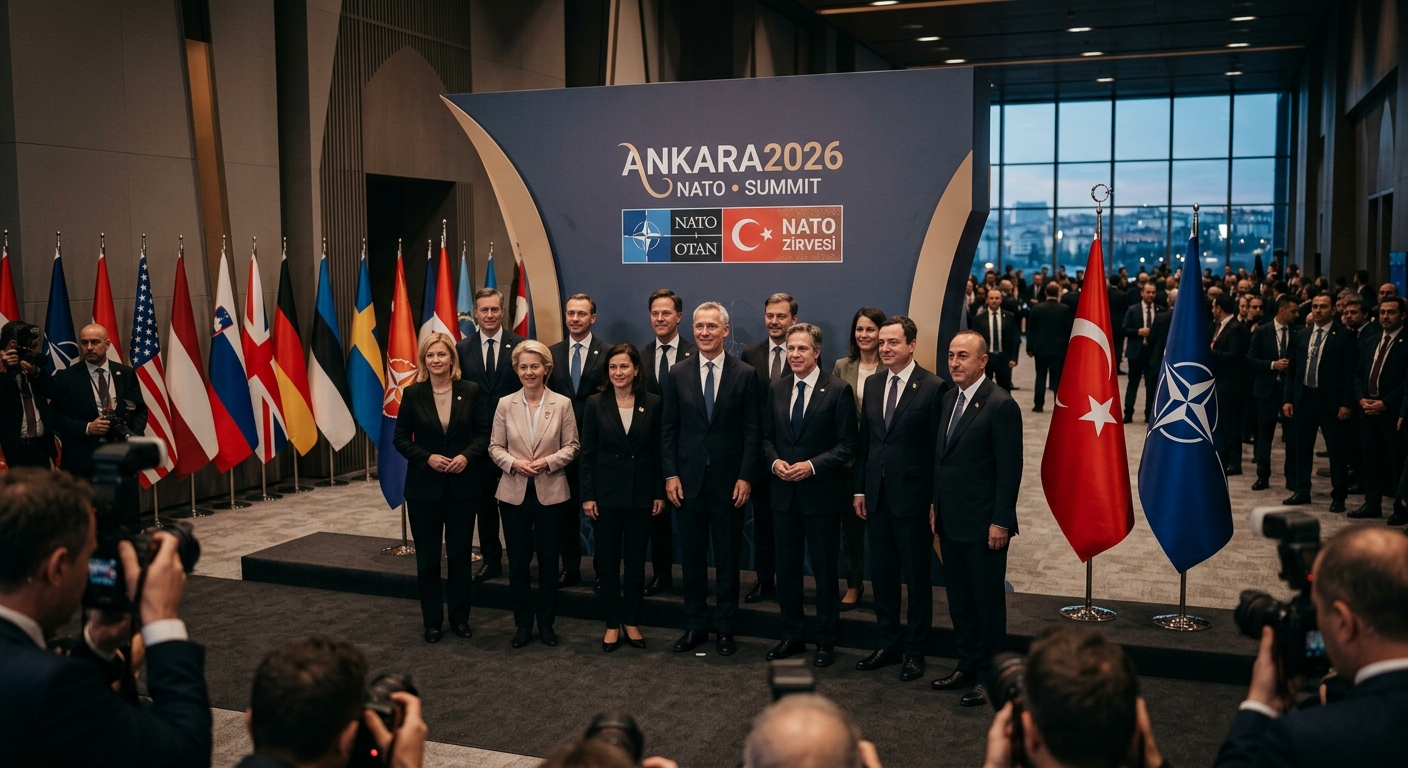
At the Ankara Summit on July 8, 2026, NATO leaders pledged €70 billion in military equipment, assistance, and training for Ukraine in 2026 — matched by an equivalent commitment for 2027 — and announced more than $50 billion in new defence procurements. The declaration's single most consequential line is not the number; it is the sentence stating that European Allies and Canada "now finance the vast majority of security assistance to Ukraine." Ankara formalises what the battlefield already showed: Washington is out of the direct-aid business, and Europe now owns the Eastern European deterrence order — whether Ukraine wins, loses, or freezes in place.
That handover — not the headline figure — is what reshapes the balance of power between Berlin, Warsaw, Kyiv, and Moscow for the next decade.
What Ankara actually signed
The Ankara Summit Declaration is unusually short and unusually specific. It reaffirms Article 5, commits Allies to the 5%-of-GDP pledge agreed in The Hague in 2025, and confirms that European Allies and Canada raised core defence investment by more than $139 billion in 2025 alone. On Ukraine, the language hardens: Allies "stand united" in support of Kyiv's "freedom, sovereignty, and territorial integrity," and pledge €70 billion for 2026 with sovereign commitments to sustain "at least equivalent levels in 2027." The document explicitly welcomes the European Union's multi-year Ukraine Support Loan as the financial rail.
Secretary General Mark Rutte, in his post-summit press conference, described this as "delivery" rather than planning, framing the Hague pledge as an execution problem NATO is now solving. In his
doorstep remarks that morning, Rutte quantified the shift: "258 billion extra spent dollars in 2025 and 2026 by Canadian and European Allies. It's staggering. You are reaching the max you can spend more in terms of absorption capacity."
The primary source language on burden-sharing is worth quoting directly:
"European Allies and Canada now finance the vast majority of security assistance to Ukraine through bilateral and multilateral means. Allies underscore that this support must be equitable, predictable, and sustainable in the long-term."
— Ankara Summit Declaration, July 8, 2026
The strategic handover, quantified
The Kiel Institute's Ukraine Support Tracker shows the crossover was already visible in the data before the summit. Kiel reports that European military aid in 2025 rose 67% above the 2022–2024 average, and financial and humanitarian support by 59%, even as the United States allocated no new aid packages after Donald Trump's return to office. According to the
Council on Foreign Relations, European contributions have now collectively surpassed the roughly $131 billion the United States committed since 2022. An EU loan of about $106 billion agreed in late 2025 is now flowing into Kyiv's budget.
Ankara turned that trend into doctrine. The €70 billion figure is roughly double the pace of European-led military aid in 2024, and it is the first time NATO as an institution has attached itself to a specific annual bilateral-aid target. The Atlantic Council notes that 26 countries have now contributed more than $4 billion through the Prioritised Ukraine Requirements List (PURL) — the mechanism Rutte engineered in July 2025 to keep US Patriots and interceptors flowing to Ukraine while Washington collects the cheque rather than writing it.
That mechanism is the strategic pivot dressed as procurement. As the BBC reported when the deal was struck in 2025, Trump made the arrangement explicit: "It's totally logical that European members of NATO pay for it." Ankara has now scaled the model. Ukrainian President Volodymyr Zelensky told Rutte in Ankara that PURL alone requires roughly $15 billion in European contributions this year — a number that will only rise as the European air-defence industry cannot yet substitute for US Patriots at scale.
Who gains leverage — and who loses it
The winners of Ankara are not the ones on the podium. The center of gravity in European security has moved north and east, from Berlin-Paris to a Warsaw-Copenhagen-Helsinki-Stockholm axis that now writes checks disproportionate to its GDP and, therefore, sets the political price.
Kiel's data shows Northern Europe provided roughly a third of Europe's military aid to Ukraine in 2025 despite accounting for only 8% of donor GDP. Estonia and Denmark each spend around 2.3% of GDP on bilateral aid. Western Europe contributes roughly in line with its economic size, while Southern Europe (19% of donor GDP) provides only 3% of aid. The Ukraine Institute of Sweden's mapping confirms the pattern: France, Italy, and Spain remain laggards, while the Nordics, Baltics, and Poland set the pace and the doctrine.
The corollary is that France and Italy — Ankara's most visible holdouts on PURL — are watching their strategic weight in Ukraine policy shrink in real time. The Atlantic Council names France, Italy, Turkey, Czechia, Hungary, and Slovakia as the six NATO members that have not contributed to PURL. Paris and Rome contribute substantially through other channels, but the Ankara model makes PURL the coordinating instrument. Countries outside it are excluded from the operational conversation on air defence — the single most contested capability of this war.
The other structural winner is US defence industry. The $50 billion procurement announcement includes joint buys of Saab GlobalEye AEW&C aircraft, Northrop Grumman Triton uncrewed surveillance systems, and the 10th Airbus A330 MRTT tanker, as NATO detailed at the Defence Industry Forum. Rutte also unveiled "NATO Drone Edge" and a "Front Door for Industry" platform, aimed at scaling counter-drone production and giving industry a public demand signal. In substance, European capitals are guaranteeing multi-year purchases from US and European primes; the Pentagon retains the industrial base without carrying the political cost of Congressional appropriations.
What Moscow reads in the declaration
The strategic question in Moscow is not the €70 billion — it is the 2027 commitment. According to SIPRI's fifth-year budget analysis, Russia's federal military spending reached 16 trillion roubles in 2025 (about 7.5% of GDP), and the 2026 draft budget quietly reduces planned military expenditure to 14.9 trillion roubles, or 6.3% of GDP. The Kremlin has begun tightening arms procurement to manage a 2.6%-of-GDP fiscal deficit. SIPRI's global
data release puts Russian outlays at $190 billion in 2025 against $864 billion for Europe — a 4-to-1 gap that widens further in 2026.
That is the number that matters. A Europe committing €70 billion for two consecutive years, funding a $258 billion two-year defence-spending surge, and locking in industrial procurement contracts on a five-year horizon is a Europe that has resolved — at least on paper — the "will they, won't they" question that shaped every Kremlin scenario since 2022. It also raises the political cost for Vladimir Putin of a negotiated freeze. As BBC security correspondent Frank Gardner wrote from Ankara, 'once [the war] happens, Russia will launch a rapid rearmament programme and be in a position to threaten NATO territory within four years' — the working assumption inside the summit hall.
The battlefield offers Moscow no offsetting leverage. Poland's Centre for Eastern Studies reported that May 2026 saw Russia's smallest monthly territorial gains in three years — DeepState estimated just 14 km² net advance. Kostiantynivka is falling but slowly; Kramatorsk is under drone terror at 12 km range, per OSW's
June 30 assessment. Hudson Institute's
July 2 briefing flagged the Russian crossing of the Vovcha River at Dachne as the most dangerous development — a potential domino into Dnipropetrovsk Oblast. But even Hudson's assessment acknowledges Ukraine's deep-strike campaign is now reaching 800 miles into Russian territory, hitting the Kupol air-defence plant in Izhevsk on July 1.
Ukraine's own defence spending, at $84.1 billion in 2025 — 40% of GDP, per SIPRI — is the highest sustained wartime burden of any state in the tracker's history. Ankara's €70 billion effectively underwrites another year of that burden.
The tensions the declaration papered over
The summit was not the triumph the communiqué suggests. The Economist called it "bipolar." Trump arrived threatening to withdraw US troops from Europe unless Denmark handed him Greenland, and left praising "tremendous love" in the room. He publicly called Spain "a terrible partner" and criticised the United Kingdom, per
Al Jazeera's live coverage, even after London permitted US strikes on Iranian missile sites from RAF bases during Operation Epic Fury earlier in 2026.
Only five NATO members are projected to meet the 3.5%-of-GDP core defence target in 2026, according to updated NATO data reported by Al Jazeera before the summit. Britain's Defence Investment Plan is billions of pounds short of the trajectory set out in its 2025 Strategic Defence Review. The declaration's insistence that Allies are "delivering on The Hague defence commitment" is aspirational for at least two-thirds of the alliance.
Zelensky put the operational gap on the record in his remarks alongside Rutte on July 7: PAC-2 and PAC-3 interceptor missiles for Patriot batteries. "This is the most important thing," he told Rutte. Europe cannot yet manufacture the interceptors; the joint European-Ukrainian Patriot replacement will not deliver before 2027; the Franco-Italian SAMP/T lacks capacity. That is the operational choke point the €70 billion has to buy through.
What to watch
- Ukraine Support Loan disbursement schedule — the EU's ~$106 billion multi-year facility, referenced in the declaration, is the funding rail for the €70 billion pledge. First tranches are expected through Q3 2026. Delays would gut the commitment.
- PURL contributions from France, Italy, Czechia, Turkey, Hungary, Slovakia — the six non-contributors named by the Atlantic Council. Any of them joining between now and NATO Defence Ministers in October 2026 would signal genuine burden equalisation. Continued absence signals the €70 billion is Nordic-Baltic-German money with a NATO label.
- Russia's 2026 budget amendment — SIPRI expects the 14.9 trillion rouble figure will be revised upward mid-year, as it was twice in 2025. Higher oil prices from the Iran war give the Kremlin fiscal room. Watch the September Duma revision.
- Kostiantynivka and the Vovcha-Dnipropetrovsk axis — the two live operational stress tests. A Russian collapse of Kostiantynivka or a breakout at Dachne before autumn would recast the pledge as insufficient rather than decisive.
The Bottom Line
The Ankara Summit did not merely fund another year of the war — it ratified a strategic handover in which Europe now owns the Ukraine deterrence portfolio and US industry supplies it on contract. The €70 billion pledge is the price Europe is paying to keep Washington's weapons flowing and Moscow's advance grinding to a halt. The $50 billion in procurements is the receipt. If the commitment holds through 2027, the balance of power in Eastern Europe will pivot away from a US-guaranteed order toward a Nordic-Baltic-Polish-led one — with Kyiv, not Berlin or Paris, at its operational centre.
Discover more

US Politics
SNAP Food Assistance Faces Legal Challenges
In 2026, SNAP faces stricter eligibility rules and mounting legal challenges, threatening food assistance for the millions of Americans who rely on the program.
India
Congress Accuses Modi of Stalling Women's Law
Congress accuses Modi of stalling women's reservation law by linking it to delimitation, revealing a deeper electoral strategy.
US Politics
Congress Targets AI Chatbot Access for Terror
The House passed the Generative AI Terrorism Risk Assessment Act, focusing on AI's role in terrorism and potential surveillance implications.

Conflict & Security
Drone Warfare Killing Aid Workers at Unprec
Over 1,000 humanitarian workers killed in three years as cheap armed drones collapse legal protections. Gaza, Sudan, Ukraine, and DRC see deliberate targeting of aid convoys and hospitals with zero prosecutions.