Narges Mohammadi's Health Crisis in Iran
Iran's regime faces backlash over dissident treatment.
Model Diplomat3 min readMiddle East

Narges Mohammadi's Health Crisis Exposes Iran's Calculated Cruelty
Iran's Nobel laureate is out of prison on heavy bail after a May 2026 cardiac crisis — but her survival now depends on a regime executing dissidents at record rates.
Narges Mohammadi has been home in Tehran since May 18, 2026, discharged from Pars Hospital after two episodes of unconsciousness and what her foundation called a "severe cardiac crisis" that struck her in Zanjan Prison on May 1. She is 54, weighs roughly 20 kilograms less than she did in December 2025, and now shows signs of variant angina, her Oslo-based brother Hamidreza told the BBC. Her release is not clemency; it is a hedge. Iran's judiciary suspended her sentence on heavy bail rather than let a Nobel Peace laureate die in custody during a year in which Iranian courts are executing at the fastest clip in nearly four decades — a calculus that keeps her alive, silent-adjacent, and revocable.
That is the load-bearing fact of this story. Everything else — the war, the sanctions talks, the rising execution count — sits on top of it.
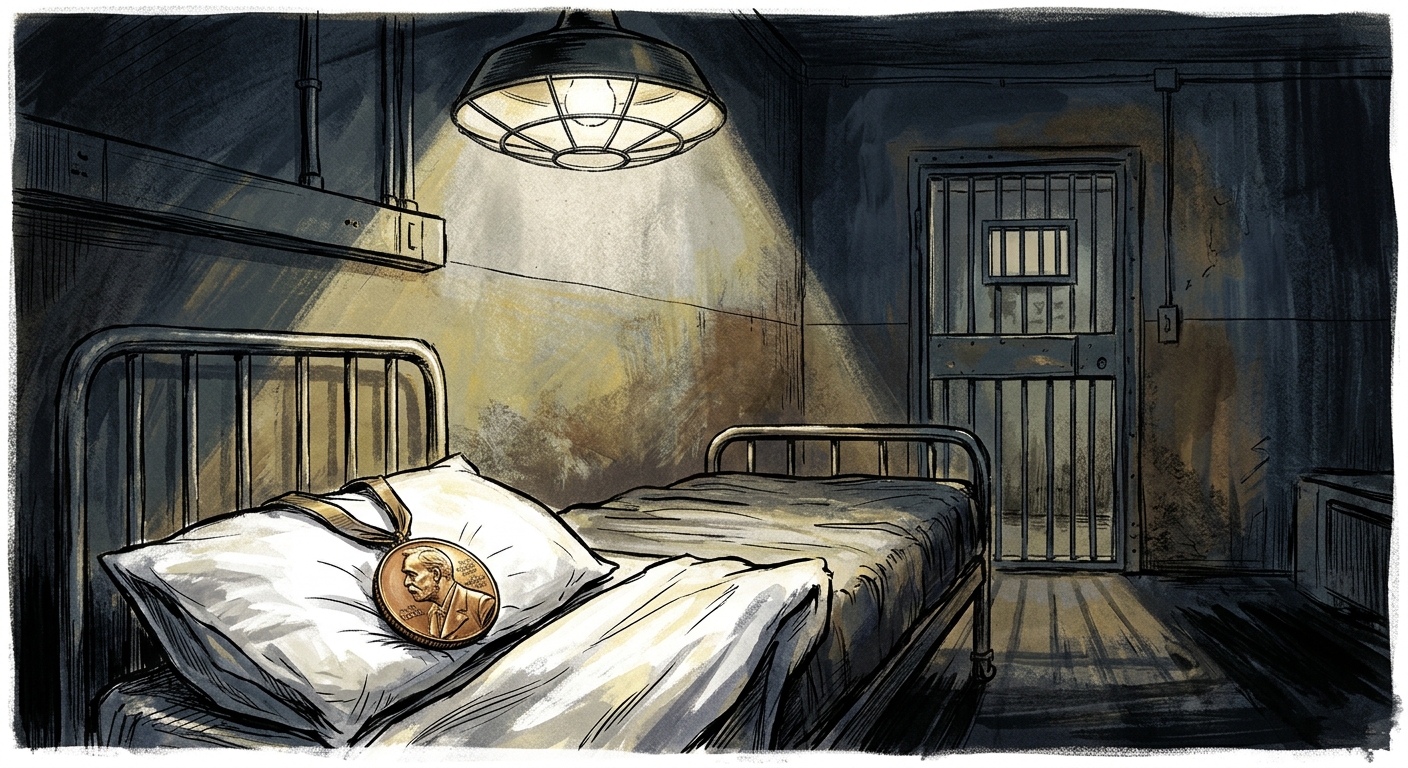
What actually happened, in order
Mohammadi was rearrested on December 12, 2025, in Mashhad, at a memorial for the human rights lawyer Khosrow Alikordi. Her family says she was beaten by roughly 15 plainclothes agents; her lawyer Mostafa Nili later told the BBC she had been kicked in the head, side and neck. She was on a medical furlough from a prior 13-year, 9-month sentence when she was seized. On February 8, 2026, Branch 1 of the Mashhad Revolutionary Court added seven and a half more years for "gathering and collusion" and "propaganda activities," plus two years' internal exile to Khusf and a two-year travel ban, Al Jazeera reported. The Narges Foundation says her accumulated sentence now runs to 44 years.
She was transferred without notice to Zanjan Prison, 265 kilometres north-west of the capital, cutting her off from her Tehran medical team. On March 24, 2026, cellmates found her unconscious "with her eyes rolled back" for over an hour; officials refused to move her to a hospital despite a documented history of pulmonary embolism, cardiac stenting and severe blood-pressure fluctuations, the BBC reported citing the Free Narges Coalition. On May 1, she fainted twice more and was rushed to the Zanjan cardiac ward — but blocked from transfer to Tehran for ten days,
NPR reported, while her blood pressure swung between extremes and she required oxygen to breathe.
Only after the Legal Medicine Organization — Iran's own government-appointed medical examiners — formally ruled that her multiple illnesses required treatment outside prison did the judiciary yield. Her lawyer Nili announced the sentence suspension on May 10; she was moved by ambulance to Pars Hospital in Tehran, NPR confirmed. She was discharged home on May 17 with daily outpatient physiotherapy and cardiac follow-up,
Al Jazeera reported. The suspension is open-ended and revocable at any time. As of July 6, 2026, her legal status remains a "sentence suspension on heavy bail" — bail, not liberty.
Why the regime blinked
Iran did not release Mohammadi because the international outcry moved anyone in Tehran. It released her because the alternative — a Nobel laureate dying in a provincial cardiac ward — carried a specific set of costs the judiciary was unwilling to pay in the summer of 2026.
Consider the backdrop. The 12-day Israel–Iran war of June 2025 was followed, on February 28, 2026, by a fresh round of unlawful US and Israeli strikes on Iran, UN experts said in a joint statement. Since then, the Islamic Republic's judiciary has been executing prisoners on politically motivated charges at a pace not seen since the 1988 mass killings. Amnesty International documented at least 36 arbitrary executions of dissidents in the two months after the strikes began, with at least 78 more under sentence of death,
in its April 2026 update. The UN confirmed more than 4,000 arrests on national security charges in the same window,
Al Jazeera reported. Iran Human Rights recorded 1,639 executions in 2025 — a 68% jump over 2024 and the highest annual total since 1989,
the BBC reported.
Discover more

Global Politics
US Seizes Iranian Ship, Tensions Surge
The US seizure of the Iranian ship Touska highlights a shift in control over the Strait of Hormuz, favoring Iran's strategic position.
India
UN Expert Albanese: India Violates Law
UN Rapporteur Francesca Albanese accuses India of breaching international law, spotlighting human rights concerns in Kashmir and prompting diplomatic pushback.

Conflict & Security
Drone Warfare Killing Aid Workers at Unprec
Over 1,000 humanitarian workers killed in three years as cheap armed drones collapse legal protections. Gaza, Sudan, Ukraine, and DRC see deliberate targeting of aid convoys and hospitals with zero prosecutions.

Global
World Normalises Taliban as Afghan Women Eras
UN data shows Afghan women erased from public life as Russia recognises the Taliban, EU hosts officials in Brussels, and ICC warrants for gender persecution go unenforced.