Naira Weakens to N1,400/$ Amid FX Reform
Nigeria's currency faces pressure as reforms are tested.
Model Diplomat8 min readAfrica
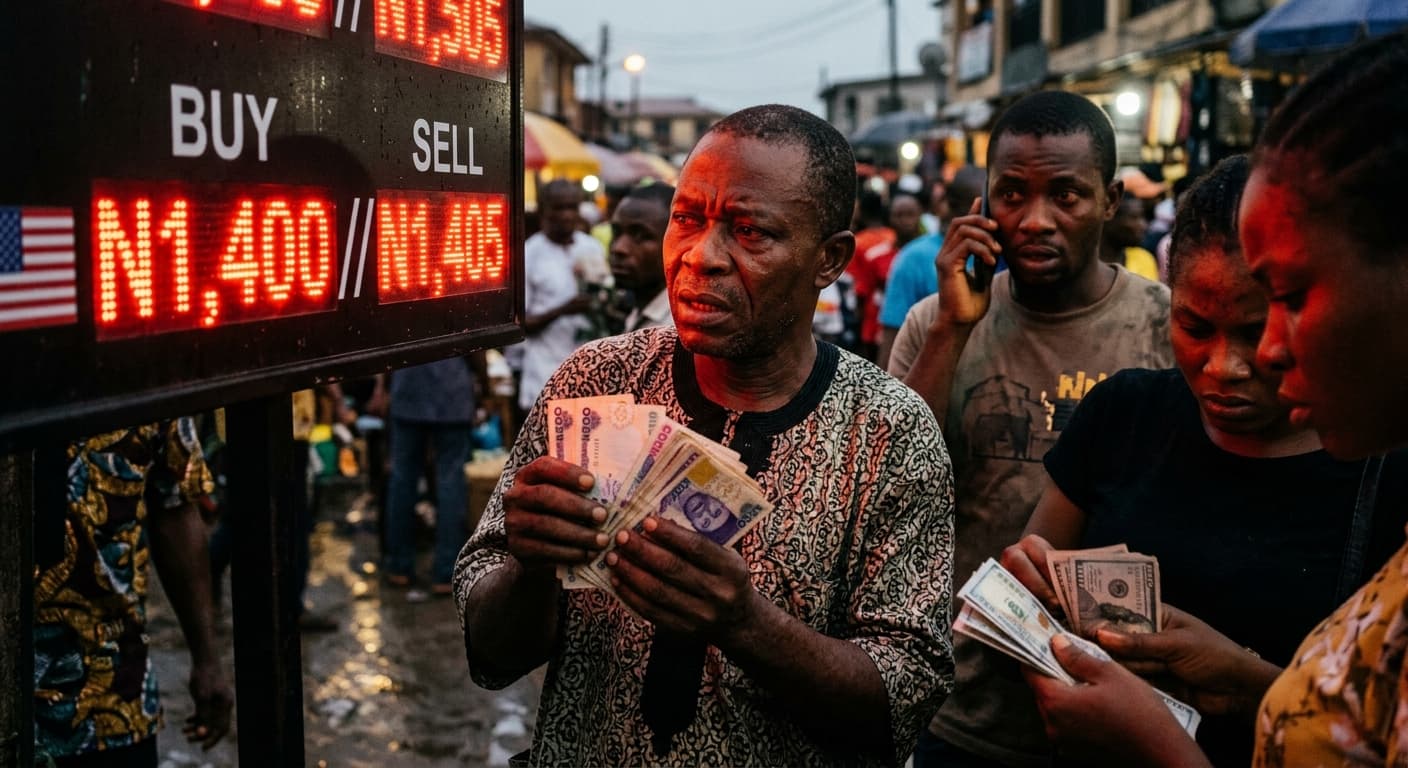
Naira Slides to N1,400/$ as Nigeria's FX Reform Hits Its First Real Test
Nigeria's naira weakened to N1,400/$ in the parallel market on July 7, 2026 as the official rate slipped to N1,371/$ — reopening a spread the CBN spent two years closing.
The naira's slide to N1,400 to the dollar in Lagos parallel trade — with street quotes as wide as N1,410 — is not a repeat of the 2024 crisis. It is a stress test of the flexible exchange-rate regime that has anchored Nigeria's macroeconomic reform since 2023, and the first serious signal that Governor Olayemi Cardoso's central bank has run out of easy wins. The gap between the parallel and official rates, which had all but disappeared, has snapped back to N29–N40 — not because reserves are collapsing, but because the CBN chose to cut rates in February, oil revenue is softening, and summer dollar demand is arriving on schedule. The next Monetary Policy Committee meeting will decide whether the widening is a wobble or the start of a reversal.
What actually moved, and how much
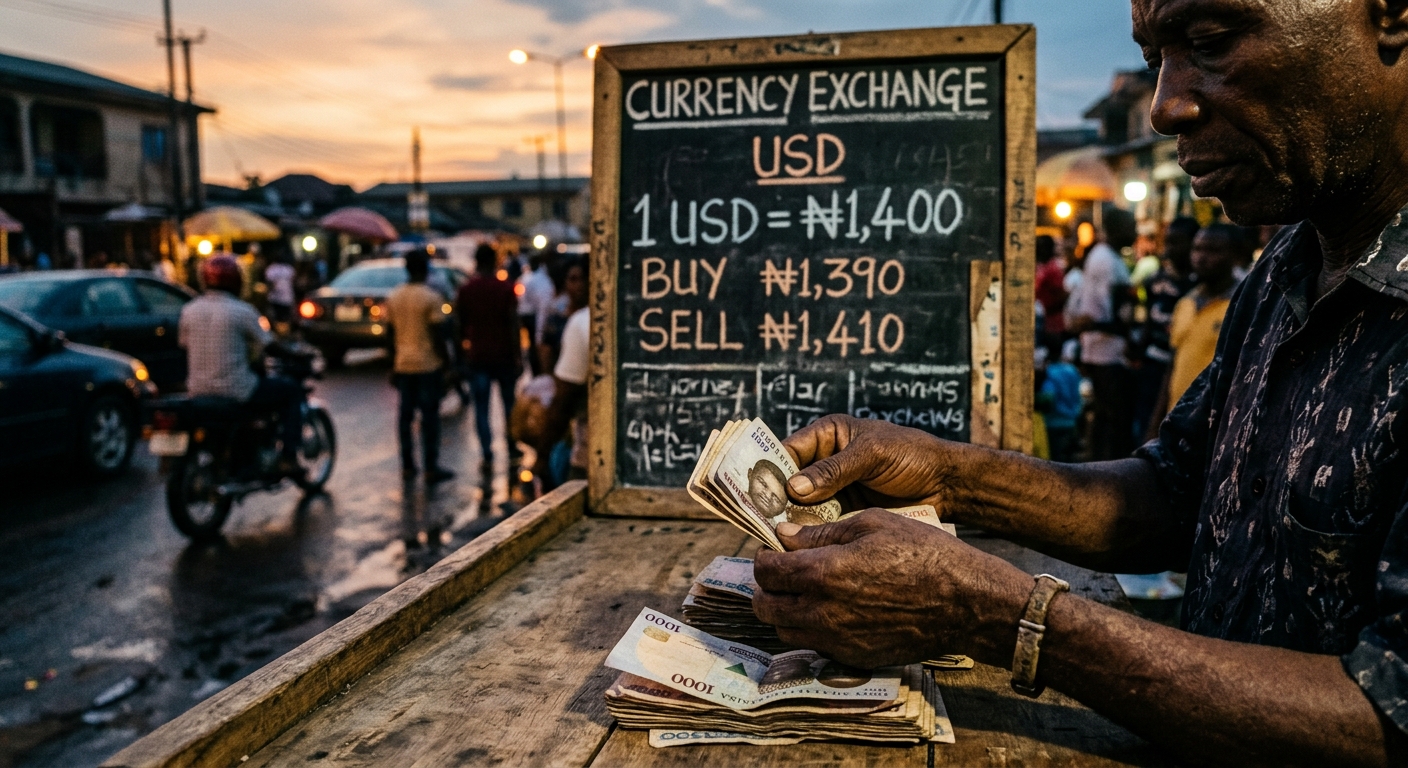
The mechanics are narrow but revealing. In the parallel market the naira traded at N1,400 per dollar on Monday against N1,395 at the previous close, AsheNews reported, while the CBN's Nigerian Foreign Exchange Market (NFEM) indicative rate drifted to N1,371 from N1,370. Interbank turnover on the NFEM dropped 23% in a single session to $54.2 million, from $70.4 million — a thin market amplifying small moves.
Street quotes were softer still. BusinessDay reported the black-market rate at N1,410/$ on the same day, down N13 week-on-week from N1,397. Currency traders told the paper the pressure came from end-users "sourcing foreign exchange ahead of the summer holiday season" — the familiar June–August personal-travel-allowance bulge that has moved the parallel rate every year since Nigeria dismantled BDC dollar sales in the mid-2010s.
The context that matters, though, is the divergence itself. For most of 2025 the parallel and official rates traded within a rounding error of each other. The World Bank's 2024 country note observed that "the official exchange rate and the parallel market have converged, eliminating the parallel premium," calling this the flagship deliverable of the Tinubu-Cardoso reforms. That convergence is now breaking, and it is breaking in a benign macro environment — which is what makes it worth watching.
The counterintuitive part: reserves are fine
The reflex read on a widening spread is a reserve crunch. That is not this story.
Nigeria's gross external reserves reached $51.45 billion on June 30, 2026, an increase of $14.24 billion — or 38.3% — over the same date in 2025, BusinessDay reported citing CBN data. That is a decade-plus high. The IMF's June 9, 2026 Executive Board conclusion of the Article IV consultation noted gross international reserves had climbed to $46 billion by end-2025 from $40 billion at end-2024, with net reserves jumping to $35 billion from $23 billion.
The Fund projects gross reserves at $58.1 billion by end-2026, or 9.7 months of prospective imports.
So the pressure is not a stock problem. It is a flow problem — and a monetary-policy problem.
Quest Merchant Bank's June analysis, cited by BusinessDay, pegged total FX inflows at about $2.8 billion in June 2026, down 26% month-on-month and 11% year-on-year. Exporter proceeds collapsed 39% to $867.9 million from $1.4 billion in May, driven by Bonny Light crude averaging $87.7 per barrel in June against $112.6 in May — the fading of the Middle East premium that Dangote Refinery had blamed for domestic fuel-price pressure earlier in the quarter, per
BBC News Pidgin. Offshore inflows softened 13% to $1.5 billion, with foreign portfolio investors — the marginal price-setter — cutting participation 16% to $1.4 billion.
That last number is the one Cardoso's team should be staring at. The IMF's May 2026 staff report is explicit that "the CBN should reduce its reliance on expensive portfolio inflows that pose a rollover risk," and recommended gradually reducing OMO-related foreign portfolio investment. Cardoso's stability since late 2024 has been financed, in part, by high-yielding naira OMO bills that attract exactly the sort of flighty capital
the IMF's April 2026 Global Financial Stability Report singles out as most likely to reverse in a risk-off episode. As the Financial Times observed in its April 2026 sweep of frontier local-currency debt, "frontier local currency still gives you carry" — but only until it doesn't,
according to the FT.
The February rate cut is the load-bearing decision
The proximate policy trigger is not disputed. The CBN cut the monetary policy rate by 50 basis points to 26.5% in February 2026, lowered the Cash Reserve Requirement by 5 percentage points to 45%, and adjusted the interest-rate corridor. The IMF's Article IV staff report summarised the sequence and warned Abuja to stop there: "keeping the MPR unchanged for now and carefully monitoring inflation, exchange market, and fiscal developments is appropriate," the Fund wrote.
That warning was issued because inflation had already turned. After more than a year of declines, headline CPI ticked up to 15.4% year-on-year in March 2026 as the global fuel and food shock from the Middle East war fed through. The World Bank's country page notes inflation eased from 33.2% in 2024 to 23.0% in 2025 — the biggest disinflation win of the reform program — but also that an additional seven million Nigerians fell into poverty in 2025,
pushing the poverty rate to 63%. A renewed naira slide would erase part of that gain by importing food and fuel inflation directly.
Chatham House's Andrew Kenningham captured the political dilemma in March 2025: a stronger naira would tame inflation, but the temptation to let it appreciate "should be avoided at all costs," because the devaluation is what has held the fiscal deficit together, Kenningham wrote. Nigeria's fiscal deficit fell from 6.4% of GDP in early 2023 to 4.4% in early 2024 in large part because dollar-denominated oil royalties and customs receipts translated into more naira. The CBN cannot burn reserves defending an over-valued rate without gutting the budget. But it also cannot let the parallel spread reopen far enough to reignite the arbitrage racket the reforms were designed to kill.
Who wins, who loses
The immediate winner is the Federal Government's balance sheet. Every naira of depreciation flatters oil-linked revenues in local-currency terms — the Chatham House point that a misaligned exchange rate cost the budget more than fuel subsidies did. With Brent above the 2026 budget's $64.85 benchmark, per
BBC News Pidgin, Abuja gets a double boost: dollar oil revenues at higher prices, translated at a weaker naira.
The second winner is the foreign portfolio investor who is already in. FT's April 2026 dispatch on frontier-market carry trades named Nigeria alongside Egypt, Pakistan and Kenya as beneficiaries of yield-hungry inflows, the FT reported. A 26.5% policy rate against a naira depreciating at a controlled pace is still a real-dollar-positive trade — until the depreciation accelerates. That is the roll-over risk the IMF flagged.
The losers are more numerous and more Nigerian. The 63% of Nigerians below the national poverty line who spend up to 70% of income on food are, per the World Bank, the population most exposed to renewed exchange-rate pass-through. Dangote Refinery — which has already had to raise depot pump prices because "the conflict don drive global crude and freight prices sharply higher,"
BBC News Pidgin reported — will see its naira revenue insufficient to buy new cargoes if the parallel rate keeps drifting. Importers, foreign airlines waiting to repatriate ticket revenue, and multinationals with trapped naira balances are back to watching the spread, a decade-old Nigerian ritual
documented by the FT at every previous inflection.
The historical parallel — and why this time is genuinely different
Nigerian FX crises follow a script. The parallel rate widens, EFCC raids Bureau de Change hubs from Abuja to Port Harcourt (as BBC News Pidgin catalogued in 2024), the CBN issues circulars, and the currency eventually finds a new floor after a discrete devaluation. In February 2024 the naira touched almost N2,000/$ on the black market before Cardoso's regime restored order through a combination of BDC dollar sales at N1,251, backlog clearing worth
$7 billion in cumulative payments, and an 875-basis-point cumulative hike documented in
the IMF's 2025 Article IV.
Two things make July 2026 different. First, the CBN has genuine ammunition — reserves above $51 billion, not the roughly $33 billion Cardoso inherited. Second, the reform framework itself is now on the line. The IMF explicitly told Nigeria's Executive Board on June 1 that "the flexible exchange rate regime is serving Nigeria well," and urged Abuja to phase out "remaining exchange restrictions, capital flow management measures, and remaining multiple currency practices," the Fund said in its June 9 statement. Every day the parallel spread widens, the temptation to reach for the old toolkit — BDC clampdowns, admin measures, quiet peg management — grows.
The domestic signal that the CBN understands the risk is that it plans a record N2 trillion in treasury bill issuance in July to soak up naira liquidity, AsheNews noted in a companion piece. That is the orthodox move: tighten liquidity to make the naira scarce, defend the rate through interest-rate differentials rather than reserves. Whether it works depends on whether portfolio investors read it as commitment or as panic.
Diplomat View
The naira slipping to N1,400 is not a crisis — it is the price of a decision. Cardoso cut rates in February on a disinflation trajectory that has since been broken by imported fuel-price shock, and he now faces a choice between reversing that cut (which the IMF would applaud and markets would reward with stronger portfolio inflows) and holding (which protects the domestic disinflation narrative but risks the parallel spread widening toward the crisis threshold of 5–10%). Our call: the CBN holds at 26.5% at its July MPC meeting but announces expanded OMO issuance and steps up NFEM interventions — enough to signal defence without conceding the rate cut was a mistake. That forecast breaks if June CPI comes in above 16% year-on-year, or if reserves post a monthly drawdown above $1 billion; either would force a hike. The reform regime survives 2026 only if the parallel spread stays inside N50/$. Above that, the political economy of "just clamp down on the BDCs" becomes irresistible — and that is the road back to 2023.
What to watch
- CBN Monetary Policy Committee meeting, July 2026 — the decision on whether to reverse the February 50 bp cut. Watch the accompanying communiqué for language on portfolio flows.
- June 2026 CPI print, July release — a number above 16% y/y kills the "disinflation intact" defence of the February cut.
- July NFEM turnover and CBN intervention data — a sustained rise in daily CBN FX sales above $50 million signals a soft peg has been reintroduced under a floating label.
The Bottom Line
The naira's slide to N1,400/$ is the first crack in a two-year reform edifice built on convergence — and the crack opened not because Nigeria ran out of dollars, but because Cardoso cut rates before disinflation was locked in and oil revenue softened at exactly the wrong moment. If the parallel spread stays inside N50, the flexible-rate regime survives its first real stress test; if it widens through the summer travel season, the political pressure to reach for the old administrative toolkit will overwhelm the reform. July's MPC decision is the tell.
Discover more
India
Rajnath Singh's Durga Squad for 2026 Polls
Rajnath Singh's Durga Squad promised women's safety in Bengal but has since disappeared from the agenda, revealing BJP's true priorities.
US Politics
SNAP Food Assistance Faces Legal Challenges
In 2026, SNAP faces stricter eligibility rules and mounting legal challenges, threatening food assistance for the millions of Americans who rely on the program.
India
Women’s Reservation Bill 2026
The Constitution (131st Amendment) Bill, 2026 was defeated in Lok Sabha, revealing deeper political conflicts over women's reservation and delimitation.

Economics
Fed's Amex AML order puts correspondent banking on notice
Federal Reserve's Amex AML order requires board-level controls and a 90-day plan; OCC fined the bank $350 million over enterprise-wide deficiencies.