Myanmar Scam Operations Persist Despite Raids
Over 5,300 victims remain trapped in fraud schemes.
Model Diplomat3 min readSoutheast Asia
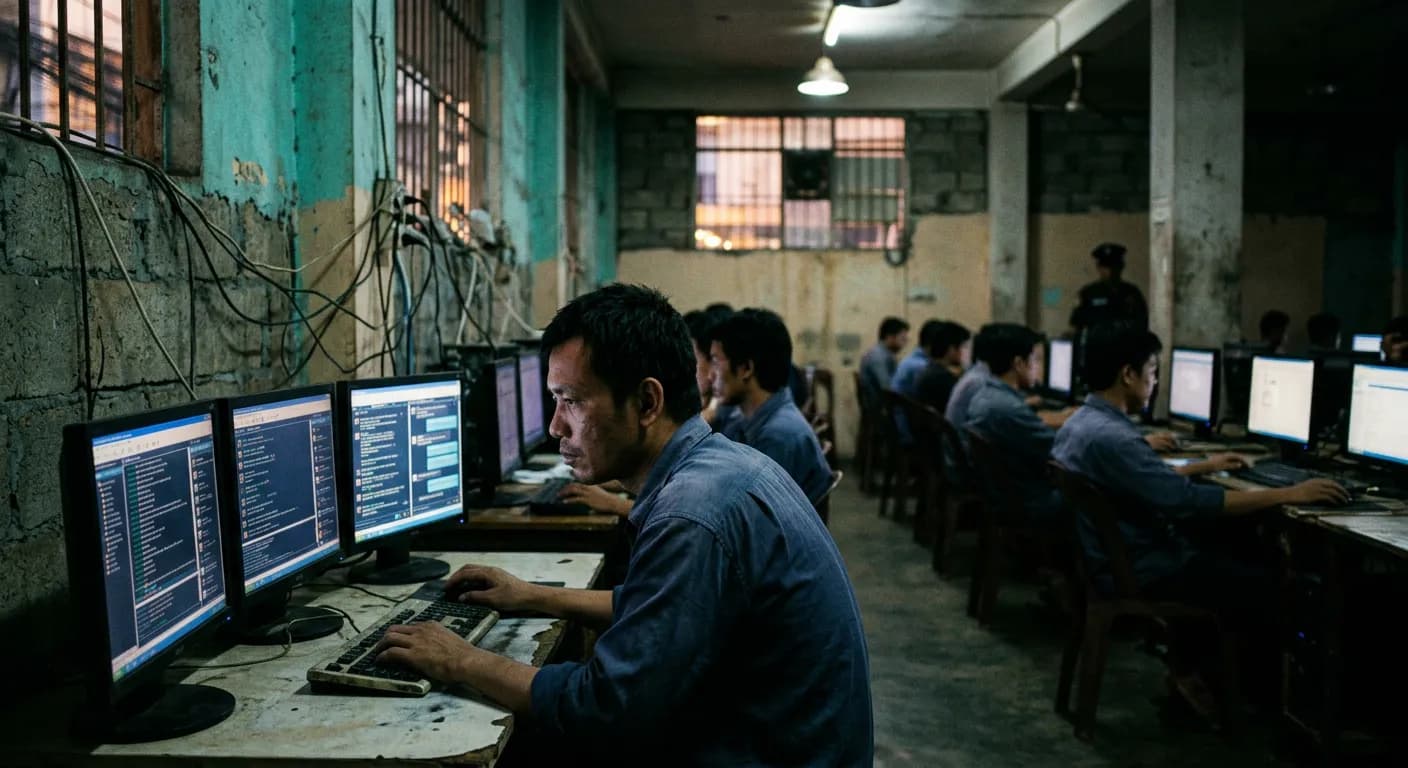
Myanmar Scam Compounds Multiply Despite Raids—Militia Still Calls the Shots
Over 5,300 people remain trapped in Myanmar's forced fraud operations as regional crackdowns fail to dismantle the system; militia control over border areas shields operators.
More than 5,300 people remain trapped in online scam centres near Myanmar's Thai border, according to a letter the Civil Society Network for Human Trafficking Victim Assistance sent to Thai police on June 22, nearly 16 months after a major regional raid freed thousands. The victims—mostly foreign nationals held at four locations controlled by the Myanmar Democratic Karen Buddhist Army (DKBA) militia—span at least 20 countries, with approximately 1,600 Chinese nationals representing the largest single cohort,
Al Jazeera reported.
The pattern exposes a fundamental enforcement failure. Thailand led a multinational crackdown in early 2025 that extracted roughly 5,000 people from sprawling hubs in Myawaddy, but The Straits Times reports that "large-scale illegal operations have continued." The compounds operate a simple playbook: publicize a raid, temporarily disperse, reconstitute elsewhere. Myanmar Witness, a monitoring group tracking satellite imagery since the 2021 coup, documented that
when authorities raided the KK Park compound on October 23, 2025, compound leadership had received advance warning and relocated workers just three kilometers away. By February 2026, a nearby facility, Qingsong Park, had expanded rapidly with visible Starlink equipment, while KK Park's supposedly cleared infrastructure remained largely intact.
The DKBA's tolerance—and likely profit participation—anchors the problem. Myanmar's junta nominally controls the country, but this militia dominates Kayin State's border security and has systematically enabled scam operations in exchange for a cut. Neither DKBA officials nor Myanmar's military-backed government responded to inquiries about their role. A UN estimate from February 2026 places at least 300,000 forced workers across the region; inside compounds, victims face 18-hour shifts, confiscated passports, electric shocks, beatings, and starvation wages for missed fraud quotas, with documented cases including a 14-year-old boy. Roughly half of Myanmar's 137 suspected scam sites show indicators of torture or trafficking.
The junta's legislative response on June 3—proposing death penalties for forcing victims into compounds and life sentences for operators—signals performance, not intent. That same militia still controls the territory where the victims are held, and Thailand's electricity blockade since February has merely pushed operations toward Cambodia rather than dismantling them fundamentally. A February 2026 UN report documented "torture and other ill-treatment, sexual abuse and exploitation, forced abortions, food deprivation, solitary confinement" among grave abuses at active compounds, yet crackdowns have only shuffled the operations, not closed them.
Why This Persists: Economics and Immunity
The scam economy generates billions annually. Transnational criminal networks—mostly China-based, according to the US Institute of Peace—profit from victimizing Americans and Europeans while exploiting Southeast Asia's economically vulnerable. The syndicates recruit via social media with promises of legitimate tech or customer-service roles, then transport victims across borders into debt bondage. So long as the DKBA and allied militia collect a share, they have little incentive to cooperate with external raids or Myanmar's own junta.
What to Watch
Thailand's June 23 letter is a diplomatic pressure move with limited teeth if Myanmar's junta won't enforce within militia-held territory. Watch whether the two US congressional bills introduced to address the crisis—H.R. 5490 and S. 2950, which would impose sanctions on compounds and the regime that enables them—gain traction by autumn 2026. Any escalation will likely require either direct US-Thai-Myanmar negotiations (unlikely without regime change) or a unilateral Thai decision to cut more power and financial flows, risking Myanmar's retaliation. For the 5,300 currently held, rescue probability remains minimal absent a shift in who controls the border or who profits from scam operations.
Discover more

India
UN Expert Albanese: India Violates Law
UN Rapporteur Francesca Albanese accuses India of breaching international law, spotlighting human rights concerns in Kashmir and prompting diplomatic pushback.

Global Politics
US Seizes Iranian Ship, Tensions Surge
The US seizure of the Iranian ship Touska highlights a shift in control over the Strait of Hormuz, favoring Iran's strategic position.

India
India-South Korea $50B Trade Expansion Plan
India and South Korea target $50 billion in bilateral trade by 2030, focusing on industrial cooperation and strategic alignment amid US pressures.

Conflict & Security
Drone Warfare Killing Aid Workers at Unprec
Over 1,000 humanitarian workers killed in three years as cheap armed drones collapse legal protections. Gaza, Sudan, Ukraine, and DRC see deliberate targeting of aid convoys and hospitals with zero prosecutions.