Mozambique Faces Food Crisis Amid Conflict
Conflict and climate challenges threaten food security in Mozambique.
Model Diplomat8 min readSouthern Africa
Mozambique Food Outlook: Conflict, Floods and El Niño Squeeze Access
FEWS NET projects 1.5–1.99 million Mozambicans will need food assistance by January 2027 as conflict, flood recovery and a hardening El Niño converge on the lean season.
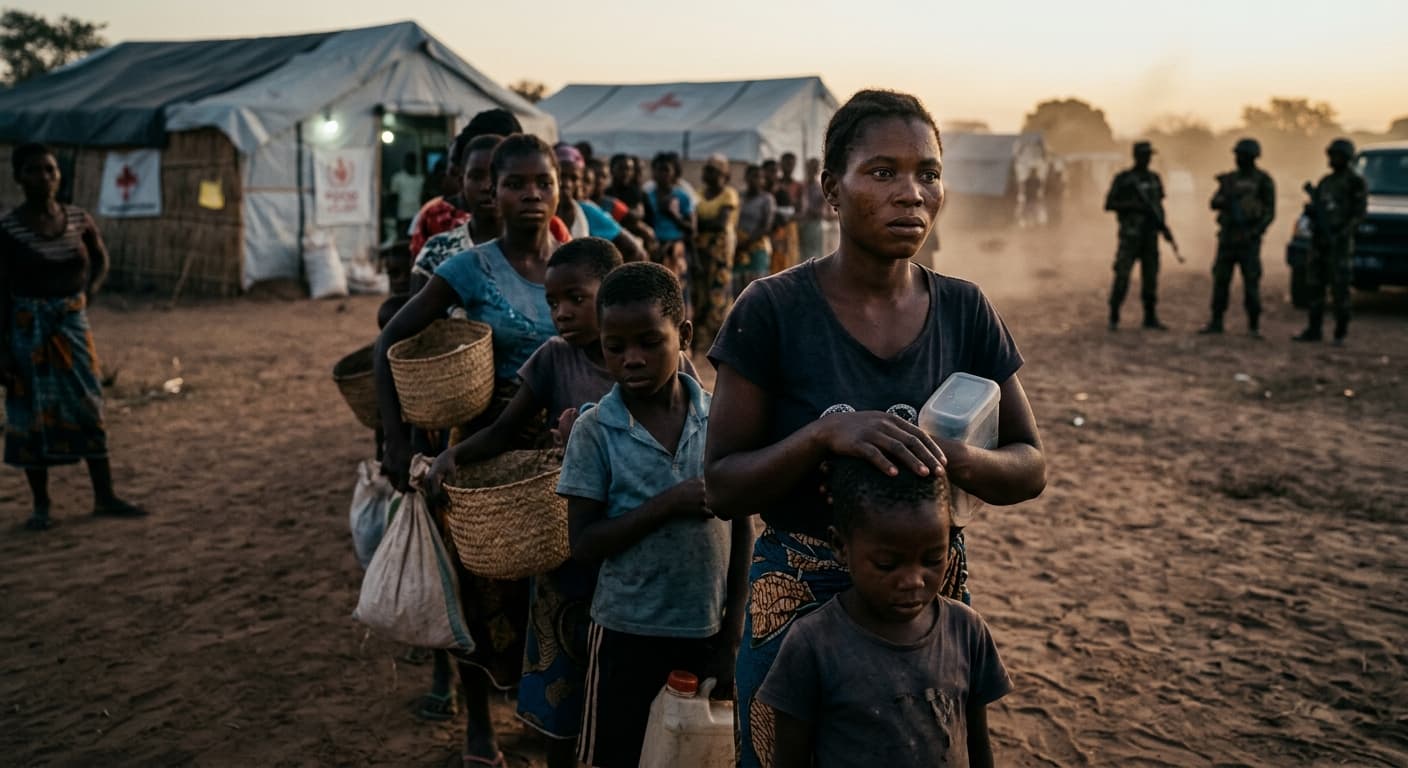
Between December 2026 and January 2027, FEWS NET estimates that 1.5 to 1.99 million people in Mozambique will require emergency food assistance — a caseload the agency now attributes, in a single line, to "conflict, slow recovery from floods, and dry conditions." The June 26, 2026 Food Security Outlook is the first cycle in which all three drivers are locked in for the full projection window, and it lands as the World Food Programme's northern operation is being cut back for lack of money. The result is a food-security map that has bifurcated: Cabo Delgado and northern Nampula stay in Crisis (IPC Phase 3) on conflict, held there indefinitely; the south and centre briefly improve, then slide back on El Niño — with the peak of need arriving in the same months donor pipelines are thinnest. The decisive variable for the next eight months is not rainfall or the harvest. It is whether Rwanda's troops stay in Cabo Delgado, and whether the EU and WFP write cheques large enough to keep the assistance-dependent "Stressed!" districts from tipping into Crisis.
A two-front crisis, mapped on one country
The outlook draws a hard line between north and south. In Cabo Delgado and northern Nampula, Crisis (IPC Phase 3) outcomes will persist "through at least January 2027" due to non-state armed group activity, displacement and disrupted livelihoods, according to FEWS NET. Areas receiving assistance are held at Stressed! (IPC Phase 2!) — the exclamation mark denoting a classification that only holds because of aid. Withdraw the ration, and the phase moves up.
The southern and central provinces run on a different clock. FEWS NET expects an improvement from Crisis to Stressed (IPC Phase 2) starting in July, as households access second-season vegetables, post-flood seed assistance and residual moisture. By October, though, stocks decline and market dependence rises "amid high food prices and weak purchasing power," with some districts reverting to Crisis before January 2027. That reversal is the story: the recovery is real, but it does not survive the lean season.
The macro backdrop confirms the strain. The World Bank's Mozambique Macro-Poverty Outlook projects headline inflation rising to 7.5 percent in 2026 from 4.4 percent in 2025, "driven by higher food prices following flood-related supply disruptions." Growth is forecast at just 0.9 percent — well below population growth — and poverty at the $3-a-day line remains at 82 percent. The Bank of Mozambique cut its policy rate to 9.25 percent in January 2026, but the same report notes private-sector credit is stuck at 16 percent of GDP, "crowded out from domestic government borrowing." Fiscal space to absorb another shock is close to zero.
The flood shock has not cleared
The January 2026 floods — described by the World Bank as "comparable to the 2000 floods" — punched a hole in the 2026 harvest that the June outlook is still trying to measure. A February WHO Public Health Situation Analysis for southeast Africa recorded, as of January 26, 2026, more than 325,000 livestock deaths and 285,000 hectares of damaged agricultural land in Mozambique, with nearly 47,300 farmers affected. The European Commission's humanitarian arm puts the human toll higher, saying floods in December 2025 and January 2026
affected roughly 800,000 people and displaced more than 390,000. The floods came on top of Tropical Cyclones Chido (December 2024) and Dikeledi (January 2025), which had already hammered the same northern provinces — Chido affected at least 329,510 people and killed 73 in Cabo Delgado and Nampula, according to the UN's
CERF allocation record.
The regional context sharpens the anomaly. The European Commission's Joint Research Centre found on June 8, 2026 that Southern Africa's overall 2025/26 cereal output is above average — South African maize up 10 percent versus the five-year average, a record Zambian harvest — but adverse weather is expected to reduce yields in parts of Angola, Mozambique, and southern Madagascar. Mozambique is the deficit outlier in a surplus region. That is a familiar bind: World Bank market analysis of Mozambique's maize sector has long documented that the country's
northern surplus zone rarely supplies southern deficit markets, because the 1,500-kilometre transport corridor loses out to South African rail imports arriving in Maputo. In practice, that means a South African bumper crop does more for Maputo's shelves than the surplus in Nampula.
El Niño arrives on top of it
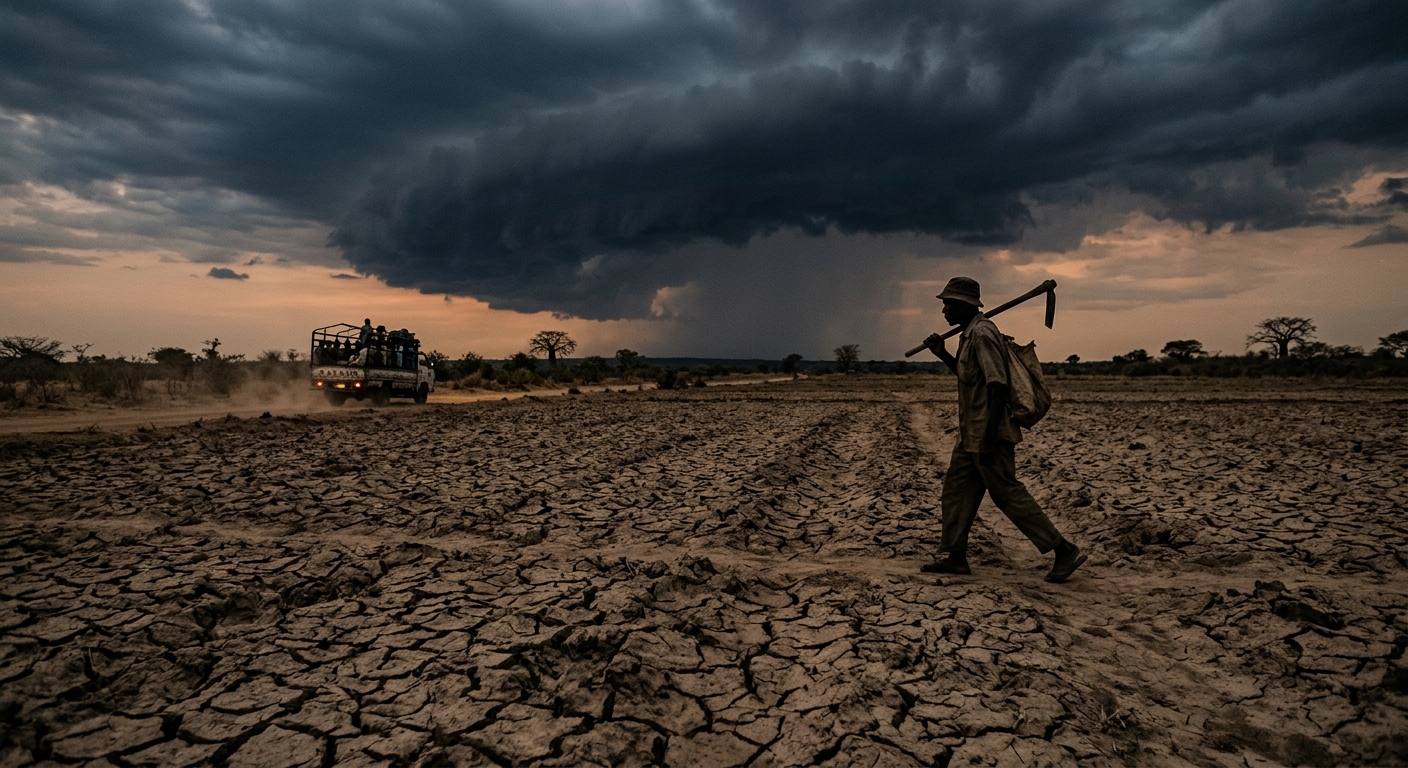
FEWS NET's most important new assumption is climatic. The June outlook states that an El Niño event "is now ongoing and is likely to persist through at least January 2027, with possible strong events." A below-average start to the 2026/27 rainy season is the modal forecast, with above-average temperatures in southern and central Mozambique and below-average labour opportunities for poor households. The Joint Research Centre's May assessment already flagged that "widespread ASAP forecast warnings on crops" were being triggered for the second half of the year by upcoming El Niño conditions.
That matters because the last strong El Niño — the 2023/24 event — is what pushed Mozambique into the crisis it is only now exiting. The WHO analysis noted that in 2024/25, "Malawi, Mozambique, Zambia, and Zimbabwe were most affected, with temperatures 5 degrees above average leading to anticipated below average cereal harvests and widespread crop failures." Before the January 2026 floods, about 2.67 million Mozambicans were already projected to face acute food insecurity (IPC Phase 3+) between October 2025 and March 2026, including 170,183 in IPC Phase 4 (Emergency), per the same WHO document. Layering a new El Niño onto communities that have not restocked seeds, livestock or savings from the previous one is the mechanism behind the October reversion to Crisis. The parallel worth naming: this is the third consecutive lean season in which the same southern provinces have entered the dry months with depleted household stocks. That kind of stacked shock — drought, cyclone, flood, drought — is what the IPC framework struggles to price, because coping capacity is being drawn down faster than any single-season assessment captures.
Cabo Delgado: the assistance-dependent Phase 2!
The northern crisis is structurally different, and structurally more fragile. The Institute for Security Studies reports that since October 2017 the Islamic State-linked insurgency has caused more than 6,200 deaths and displaced over 1.1 million people, roughly half Cabo Delgado's population, and now touches 16 of the province's 17 districts. Human Rights Watch documented that between November 10 and 23, 2025 alone, IOM registered
about 108,000 people, including 70,000 children, forced to flee attacks in Nampula's Memba district for already overcrowded areas in Erati.
The IPC's own malnutrition analysis picks up the second-order effect. The EU Knowledge for Policy portal notes that acute malnutrition is now driven partly by "increased pressure on resources… due to an influx of internally displaced persons from Memba District to Erati District as a result of insecurity," with Erati projected to move from Phase 1 to Phase 2 and Doa District already in IPC AMN Phase 3 (Serious). Around 72,000 children aged 6–59 months are expected to be acutely malnourished between November 2025 and October 2026.
Two moving pieces determine whether the northern Phase 2! becomes a Phase 3. The first is Rwanda's roughly 5,000 troops. The Institute for Security Studies reported that on March 14, 2026 Kigali threatened to withdraw if EU funding — about $46 million since 2022, covering roughly 17 percent of costs — is not extended past May. President Kagame framed it as a "practical issue," not a threat. The second is the WFP pipeline. In January 2026, WFP Country Director Claire Conan told the UN that funding shortfalls had already
forced a 60 percent cut in northern caseload versus 2024, with a further 40 percent reduction planned in March and a "complete halt in assistance expected by May" absent new money. The EU's March 16, 2026 announcement of
€20 million for Mozambique — out of a €36 million Southern Africa package — bought time. It did not close the gap.
Who benefits, who loses
Name the actors. The clearest winner from the current configuration is TotalEnergies, which on January 29, 2026 agreed with Maputo to restart the $20 billion Afungi LNG project suspended since 2021 — a decision the Manohar Parrikar Institute for Defence Studies and Analyses attributes directly to Rwandan-underwritten security in Palma. ExxonMobil sits behind that, on the Rovuma project. Both need the Phase 2! zone around the gas fields, not the countryside, to hold. The losers are concentrated and identifiable: the displaced households in Erati, Chiure and Memba districts whose ration lines shrink as insurgent attacks push new arrivals into camps that WFP is already funded to serve at 40 percent of 2024 levels. Mozambique's own government also loses fiscal room: the World Bank projects the fiscal deficit widening to 5.2 percent of GDP in 2026 and public debt to 94.6 percent, leaving Maputo dependent on the same donors it is negotiating with over Rwanda.
The Southern African bumper harvest is a mixed benefit. It caps regional maize prices — and therefore Maputo shelf prices via South African rail — but it does not reach the rural north, where household food insecurity is a function of own production and displacement, not import parity. That is why the European Civil Protection and Humanitarian Aid Operations puts national IPC 3+ at 3.25 million — nearly double FEWS NET's December-January projection — reflecting the same underlying gap between people who benefit from cheaper Maputo maize meal and people who cannot reach a functioning market at any price.
What to watch
- Rwandan Defence Force posture in Cabo Delgado. The March 14 EU-funding threshold has slipped; the next test is whether Rwanda draws down troops during the July–September fighting season. A visible drawdown would reopen the corridor between insurgent bases in the Catupa forest and populated coastal districts, which the
International Crisis Group has already flagged after June maritime attacks on fishing vessels off Macomia.
- WFP northern caseload as of September 2026. Conan's January warning gave a May cut-off; the next FEWS NET Key Message Update (July) and the October Food Security Outlook will show whether the "Stressed!" zones have re-classified upward.
- Rainy-season onset in southern Mozambique, October–November 2026. A confirmed late start under El Niño triggers FEWS NET's reversion-to-Crisis scenario for southern districts. Watch the Copernicus C3S monthly forecast and the JRC's end-of-October ASAP bulletin.
- The next Cabo Delgado IPC AMN update. With 108,000 people newly displaced into Erati since November 2025, the projection that put Erati in Phase 2 from May 2026 may already be conservative.
The Bottom Line
Mozambique's food-security outlook through January 2027 is not a rainfall story — it is a bandwidth story. The country is running three concurrent emergencies with the fiscal space of one, and the arithmetic only balances while Rwanda holds the north and the EU and WFP keep the "Stressed!" districts on rations. Pull either lever, and FEWS NET's 1.5–1.99 million figure becomes a floor, not a ceiling.
Discover more
US Politics
Washington's Scrutiny of Iran War Prediction
The Iran war prediction market scandal exposes political ties and regulatory challenges in Washington, as insider trading concerns rise.

International Relations
U.S.–Iran Peace Deal
A narrow US-Iran deal on nuclear and regional issues could reshape Middle East diplomacy, offering a pragmatic path forward despite grand bargain obstacles.
US Politics
US Military Strikes Drug Traffickers Pacific
A U.S. military strike in the eastern Pacific killed two amid an anti-drug trafficking campaign, raising questions over sovereignty and regional cooperation.

Economics
Fed's Amex AML order puts correspondent banking on notice
Federal Reserve's Amex AML order requires board-level controls and a 90-day plan; OCC fined the bank $350 million over enterprise-wide deficiencies.