Morocco's Gaza Troop Bet: Western Sahara
Morocco sends 400 troops to Gaza force, aiming for US backing on Western Sahara.
Model Diplomat4 min readNorth Africa
Morocco's 400-Troop Gaza Bet: Down Payment on Western Sahara, Not Palestinian Peace
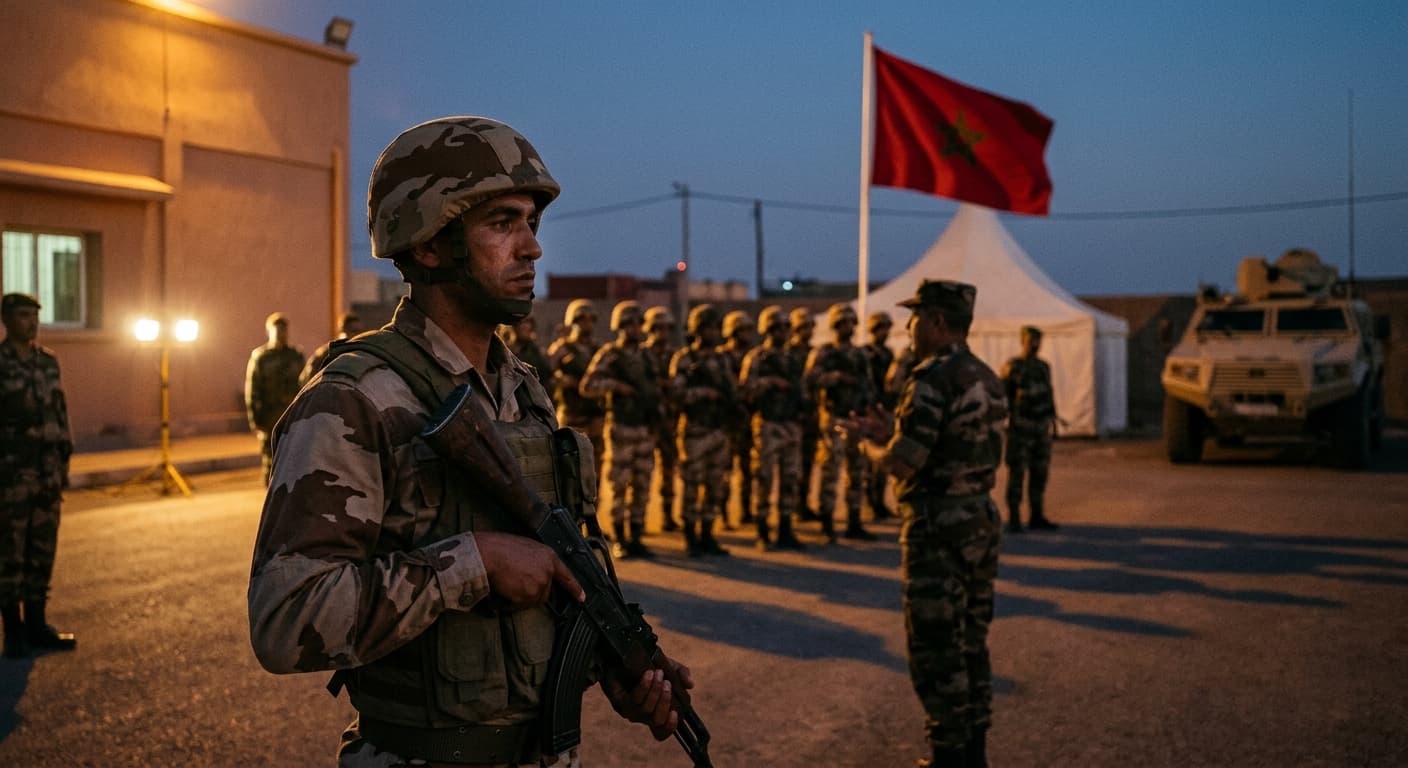
Morocco signed on July 16, 2026, to send 400 troops, gendarmerie, and a field hospital to the US-led Gaza stabilization force — a contribution sized for diplomatic leverage with Washington, not battlefield impact.
Morocco committed 400 troops, Royal Gendarmerie, and police personnel to the US-led International Stabilization Force (ISF) in Gaza on July 16, 2026, in a signing ceremony that says far more about Rabat's calculation with Washington than about the arithmetic of Middle East peacekeeping. The agreement, signed in Rabat by Foreign Minister Nasser Bourita, Minister-Delegate for National Defense Abdelltif Loudyi, and Board of Peace envoy Nickolay Mladenov, makes Morocco one of only five countries to convert diplomatic endorsement into actual troop commitments for a mission that has approached roughly 70 governments and received commitments from almost none of them. The contribution is a strategic down payment: Morocco is buying continued US backing for its sovereignty over Western Sahara, and outflanking Algeria as Washington's indispensable North African security partner — Gaza is the venue, not the prize.
The agreement: gendarmerie over infantry
The text of Morocco's commitment, as reported by Moroccan state agency MAP and confirmed by Anadolu Agency, is deliberately scoped away from combat. Senior Royal Armed Forces officers will serve in the ISF's joint military command, helping monitor the ceasefire, secure humanitarian corridors, protect aid distribution sites, and assist with border security. The mission will also deploy Royal Gendarmerie and DGSN (General Directorate of National Security) personnel, plus a military field hospital. Morocco's defense administration framed the agreement as reflecting "shared determination to contribute, through concrete humanitarian and security actions, to the establishment of a climate of peace and security in the region," according to
The Media Line.
The composition matters. Morocco is not sending infantry battalions. It is sending the capabilities — policing, gendarmerie, field medicine — that the ISF most desperately needs and that most other contributors have been unwilling to provide. The force's mandate, authorized under UN Security Council Resolution 2803 (2025), includes "supporting police training and enabling NCAG police deployment, deconfliction, and protecting civilians including humanitarian operations." The resolution authorizes the ISF to "use all necessary measures" to carry out its mandate, with a sunset clause of December 31, 2027. A pre-deployment site survey by troop contributors was completed in late April 2026, the same UN document notes.
"On 19 February 2026, the Declaration of Founding Contributors to the International Stabilization Force was signed by five Member States — the Republic of Albania, the Republic of Indonesia, the Republic of Kazakhstan, the Republic of Kosovo and the Kingdom of Morocco — expressing their intention to contribute troops to the ISF." — UN Security Council document S/2026/418
The Board of Peace, the transitional administration overseeing the ISF, was formally launched at a signing ceremony in Davos on January 22, 2026, with 28 heads of state as members, including Morocco, the United States, Israel, Egypt, Jordan, Saudi Arabia, and Indonesia. The ISF operates under the unified command of the United States through Major General Jasper Jeffers, with an Indonesian deputy commander, per Al Jazeera.
The real prize: Western Sahara
Morocco's foreign policy operates on a single axis: sovereignty over Western Sahara. Every major diplomatic move Rabat has made in the past six years — the Abraham Accords normalization with Israel in December 2020, the deepening security partnership with Washington, the courtship of France and Spain — feeds that goal. The Gaza deployment is no exception.
The chain of transactions is direct. In December 2020, President Trump recognized Moroccan sovereignty over Western Sahara in exchange for Morocco normalizing relations with Israel, as the Congressional Research Service documented. On April 8, 2025, Secretary of State Marco Rubio reaffirmed that recognition, calling Morocco's autonomy plan "the only feasible solution," according to the
Policy Center for the New South. On October 31, 2025, the UN Security Council adopted Resolution 2797, which described "genuine autonomy under Moroccan sovereignty" as potentially "the most feasible solution" — language that effectively narrowed the diplomatic options available to the Polisario Front, as the
LSE Africa blog noted. The vote was 11-0-3, with China, Russia, and Pakistan abstaining; Algeria, a non-permanent Council member, did not participate.
The Carnegie Endowment's Intissar Fakir observed that while the Biden administration chose not to actively implement Trump's 2020 proclamation, it also did not reverse it — and the recognition paved the way for France's July 2024 endorsement and Spain's subsequent alignment. Morocco's strategy has been to make its sovereignty claim irreversible through accumulating bilateral recognitions, and the Gaza troop pledge is a down payment on keeping Washington locked in.
Discover more
Global Politics
US-Iran Tensions Rise
Tensions escalate in the Strait of Hormuz as Iran and the US clash over maritime control, with a ceasefire hinging on a contested MoU paragraph.

International Relations
U.S.–Iran Peace Deal
A narrow US-Iran deal on nuclear and regional issues could reshape Middle East diplomacy, offering a pragmatic path forward despite grand bargain obstacles.

Global Politics
US Proposes Pakistan for Iran Talks Amid Ties
The US-Iran negotiations are now mediated by Pakistan, highlighting Islamabad's strategic role and the implications for regional diplomacy.

Economics
Fed's Amex AML order puts correspondent banking on notice
Federal Reserve's Amex AML order requires board-level controls and a 90-day plan; OCC fined the bank $350 million over enterprise-wide deficiencies.