Modi's BJP Victory in Assam
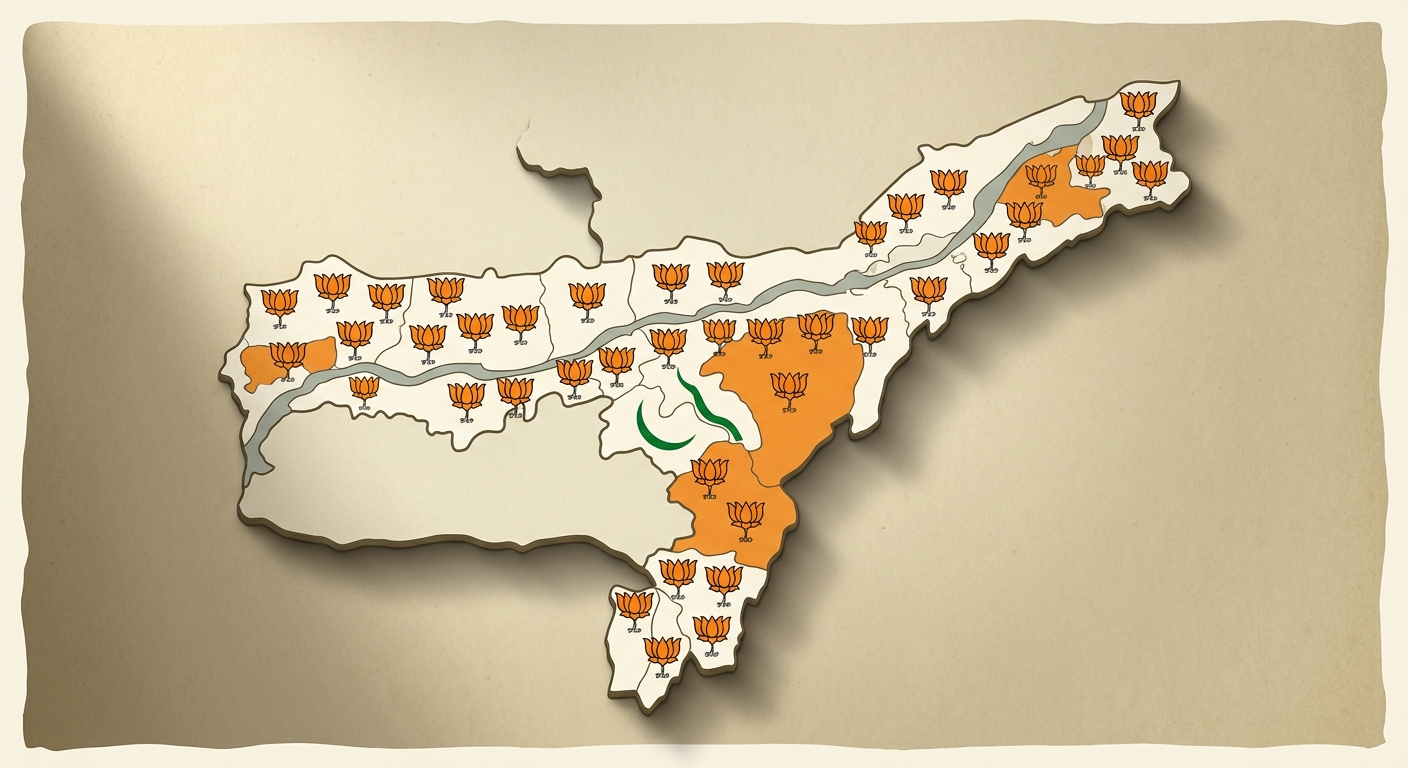
BJP's 81 seats in Assam showcase electoral strategy.
Model Diplomat7 min readAsia

Modi's BJP Wins Assam Solo — The "Assam Model" Goes National
How the BJP turned a 38% vote share into 81 seats: delimitation, cash transfers to 4 million women, and a Congress bench that is now 18-of-19 Muslim.
Narendra Modi's Bharatiya Janata Party won 81 of Assam's 126 assembly seats on May 4, 2026 — its first solo majority in the northeastern state and, on a 38% vote share, the clearest demonstration yet that a redrawn electoral map plus a targeted welfare state can convert a plurality of votes into a supermajority of seats. The result is not simply a "hat-trick." It is a template — the "Assam model" — that Chief Minister Himanta Biswa Sarma pioneered, that Amit Shah has just replicated in West Bengal, and that a proposed 2026 national delimitation could scale to the Lok Sabha before the 2029 general election.
That is the story worth telling. Everything else — Congress's worst-ever tally, the AIUDF's near-annihilation, Gaurav Gogoi's defeat in Jorhat — flows from it.
The numbers behind the "landslide"
The BJP alone crossed the 64-seat majority mark for the first time in state history, with allies Asom Gana Parishad and the Bodo-focused UPPL adding another 21 seats for an NDA total of 102, The Times of India reported. Congress fell from 29 seats to 19; the AIUDF, the Bengali-Muslim vehicle led by Badruddin Ajmal, was reduced to two, according to
Business Standard.
The vote share tells a subtler story. According to the BBC, the BJP's Assam vote share has climbed from under 12% a decade ago to 38%. That is a meaningful expansion — but it is not a two-thirds mandate. The two-thirds sits in the seat column, not the vote column. Understanding why requires looking at what the Election Commission did in 2023.
The delimitation nobody outside Assam noticed
In November 2022, the Ministry of Law and Justice asked the Election Commission of India to redraw Assam's assembly and parliamentary boundaries under Section 8A of the Representation of the People Act, 1950 — an order the ECI made public in a Press Information Bureau release that specified the use of 2001 census figures. The final notification came in August 2023.
Six constituencies were merged. Fifteen were redrawn. The Observer Research Foundation's technical review found that of 126 assembly seats, 27 ended up more than 10% above the ideal population and 32 more than 10% below — with high-density districts systematically under-allocated and low-density (predominantly Hindu and tribal) districts over-allocated. Gauripur, in the Muslim-dense lower Brahmaputra belt, ended up 45% above the ideal population; Amri, a hill constituency, 50% below.
The political effect was arithmetic. The Singapore-based NUS Institute of South Asian Studies estimated that constituencies where Muslim voters play a decisive role fell from roughly 35 to about 23. Al Jazeera's
pre-election investigation put the drop from 35 to around 20. Either way, the state's Muslim third of the electorate — the largest Muslim share of any Indian state, per the 2011 census — was compressed into fewer decisive seats before a single ballot was cast.
The BJP fielded zero Muslim candidates in 2026. In 2021 it fielded nine. The result is a Congress caucus of 19 MLAs, of whom 18 are Muslim, according to Al Jazeera's post-election analysis. Assam's opposition bench is now, effectively, a religious-minority bench — a structural outcome, not a rhetorical one.
The other half of the model: cash on the eve of the poll
Delimitation redraws the map. Welfare buys the map. On March 10, 2026 — five days before the election was formally announced — the Sarma government credited ₹9,000 (roughly $107) to the bank accounts of nearly 4 million women under the Orunodoi cash-transfer scheme, framed as a "Bihu gift" tied to Assam's spring harvest festival. Al Jazeera reported that the government had withheld the routine monthly ₹1,250 stipend for the preceding two months, then bundled arrears, advance and a ₹4,000 top-up into a single pre-poll transfer.
Joydeep Baruah, an economist at Krishna Kanta Handiqui State Open University, told Al Jazeera the transfer amounted to 10–15% of monthly household income for beneficiaries in a stagnant rural wage economy — enough, on his estimate, to swing at least 10–15% of the four million women recipients into the BJP column. Pre-poll survey firm Vote Vibe found 38% of female respondents saying the schemes had strengthened the BJP's base.
The Observer Research Foundation's comparative brief on the 2026 election cycle placed Assam alongside West Bengal and Puducherry as states now running structural unconditional cash transfers to women — a form of "welfare-linked mobilisation" that has become the BJP's default counterweight to identity backlash.
The Sarma factor — and what he intends to do next
The 2026 campaign was the first in which Himanta Biswa Sarma, rather than Modi, was the projected face of the BJP in Assam. Sarma retained his Jalukbari seat, which he has held since 2001, and was sworn in for a second term on May 10, per the BBC. Gaurav Gogoi, the Congress's national deputy leader in the Lok Sabha and son of the late former chief minister Tarun Gogoi, lost Jorhat by nearly 20,000 votes.
Sarma's next legislative package is already public. His manifesto commits the state government to:
- A Uniform Civil Code overriding religion-based personal laws on marriage, divorce and inheritance;
- A statute against alleged forced religious conversion, and one against so-called "love jihad";
- An intensified continuation of eviction drives targeting Bengali-origin Muslim settlements.
Between May 2021 and early 2026, an investigation by The New Humanitarian — cited by Al Jazeera — recorded more than 22,000 structures demolished and 20,380 families evicted in Assam, overwhelmingly Bengali-origin Muslim. On January 19, 2025, the
UN Committee on the Elimination of Racial Discrimination formally communicated concerns to India's permanent representative in Geneva that Bengali-speaking Muslims in Assam faced racial discrimination, forced evictions, hate speech and excessive use of force — the first UN treaty-body intervention on the issue.
Delhi has rejected the CERD characterisation. Sarma has said in the assembly that his government will "not take sides" and "will not let miya rule all of Assam."
Why this matters beyond Assam
Two second-order effects deserve a policymaker's attention.
First, West Bengal. The BJP took West Bengal for the first time on the same counting day, winning 207 of 294 seats and ejecting Mamata Banerjee's Trinamool Congress after 15 years, Al Jazeera reported. Banerjee lost her own Bhabanipur seat to state BJP chief Suvendu Adhikari. Assam and Bengal share a 263-kilometre border and a common demographic anxiety: waves of Bengali-Muslim migration from what is now Bangladesh. The playbook Sarma refined — target the "miya" voter, redraw where possible, transfer cash to women, promise a Uniform Civil Code — is exactly what the BJP campaigned on in Bengal. The Assam result is the proof-of-concept; the Bengal result is the scale test.
Second, the national delimitation fight. During a special session of parliament in April 2026, the Modi government introduced the Constitution (One Hundred and Thirty-First Amendment) Bill, the Delimitation Bill, and the Union Territories Laws (Amendment) Bill — a package that would expand the Lok Sabha from 543 seats to 850 and, opposition parties argue, redraw constituency boundaries nationwide. The Carnegie Endowment's May 2026 analysis notes that the bills stalled short of the two-thirds threshold and cannot advance until the current census concludes. Rahul Gandhi told parliament the plan was an attempt to "seize power through delimitation and gerrymandering," per Al Jazeera. Gaurav Gogoi — days before losing Jorhat — called it delimitation "through the backdoor."
Assam is the working proof that a delimitation exercise, followed by an election, can convert a 38% vote share into 64% of seats. If the same conversion factor were applied nationally in 2029 on an 850-seat house, the BJP's current majority becomes structurally durable rather than electorally contingent. That is the prize the opposition is fighting over — and the prize the government is arguing does not exist.
What to watch next
- Uniform Civil Code bill in the Assam assembly. Sarma has committed to introducing it in the first legislative session. Any draft will be litigated to the Supreme Court within weeks and will function as a national template if it survives.
- Census completion and delimitation report. The current census, launched in April 2026, is expected to take a year to enumerate and longer to publish. The Delimitation Bill cannot be tabled again until it does. Watch for a government push to accelerate publication ahead of 2027 state polls.
- Supreme Court challenges to the 2023 Assam delimitation. Petitions filed by Congress and the AIUDF remain pending. A ruling that upholds the ECI's methodology will effectively bless the model for national use.
- The Sarma succession question. Sarma is now the BJP's most successful non-Hindi-belt chief minister and, at 57, the leading contender for a future central role. His movement to Delhi would signal that the "Assam model" is being institutionalised, not localised.
Diplomat View
The Assam result is not a mandate story. It is a redistricting story dressed in a landslide. The BJP's first-ever solo majority in the state arrived one election after a delimitation exercise that shrank Muslim-decisive constituencies by roughly a third, and one campaign after a cash-transfer scheme that put ₹9,000 into 4 million women's accounts weeks before the vote. That is not an incidental combination; it is a working machine. The specific, falsifiable call: if the government secures a two-thirds vote to pass the Delimitation Bill after the current census reports — most likely in 2027 or early 2028 — the 2029 general election will be fought on a map that structurally converts the BJP's current 37–38% national vote share into a durable Lok Sabha supermajority, on the Assam ratio. What would revise this forecast: a Supreme Court ruling striking down the 2023 Assam order as unconstitutional gerrymandering; a coalition partner (Nitish Kumar's JD(U) or Chandrababu Naidu's TDP) defecting on the constitutional amendment; or census delays that push delimitation past 2029. Absent those, Assam in May 2026 is where the next decade of Indian electoral geography was drafted.
India has changed the machine, not just the driver.
Discover more
India
BJP's Misunderstanding of Women's Quota Needs
The BJP's linking of the Women Reservation Bill to delimitation risks delaying women's empowerment in India, misreading the aspirations of female voters.
India
Modi's Women’s Convention in Varanasi
Modi's Varanasi rally frames women's reservation as a national mission, targeting the 2027 Uttar Pradesh elections with a strategic narrative.

Conflict & Security
Drone Warfare Killing Aid Workers at Unprec
Over 1,000 humanitarian workers killed in three years as cheap armed drones collapse legal protections. Gaza, Sudan, Ukraine, and DRC see deliberate targeting of aid convoys and hospitals with zero prosecutions.

Global
World Normalises Taliban as Afghan Women Eras
UN data shows Afghan women erased from public life as Russia recognises the Taliban, EU hosts officials in Brussels, and ICC warrants for gender persecution go unenforced.